An AI printer OEM project is a connected-product sourcing program, not a conventional mini-printer order with a new logo. A U.S. education or gift-channel buyer must qualify the print hardware, AI workflow, content rules, privacy design, cloud-service ownership, packaging, compliance documents, and after-sales handoff before approving production. The practical sequence is to define the channel proposition, issue a version-specific RFQ, test the real sample flow, close documentation gaps, and only then negotiate a pilot or production order. This guide gives sourcing and product teams a stage-gate process for doing that work without treating configurable AI features as finished specifications.
What Buyers Should Know
- An AI printer quotation must separate standard hardware, enabled sample functions, custom development, and recurring cloud costs.
- The domestic importer or brand needs its own compliance plan; a supplier’s document list is evidence to review, not automatic U.S. market clearance.
- Sample approval should test the complete user journey, including weak Wi-Fi, rejected prompts, failed generation, paper changes, and account recovery.
- Content governance and privacy responsibilities belong in the commercial scope, not in a conversation postponed until after tooling or packaging.
- A pilot order is useful only when it has written acceptance criteria and a defined path to production.
Where This Product Fits
| Entity | Role in the sourcing decision |
|---|---|
| Brand | Yosiya, AI hardware products and solutions supplier |
| Reference platform | K1 Pro AI Printer |
| Buyer | U.S. importer, education or gift-channel brand, OEM/ODM project manager |
| Product category | Kids AI learning printer with physical thermal output |
| Commercial path | Sample review, private-label definition, pilot discussion, mass-production handoff |
| Main decision | Whether one supplier setup can support hardware, AI scope, content, documentation, and ongoing service |
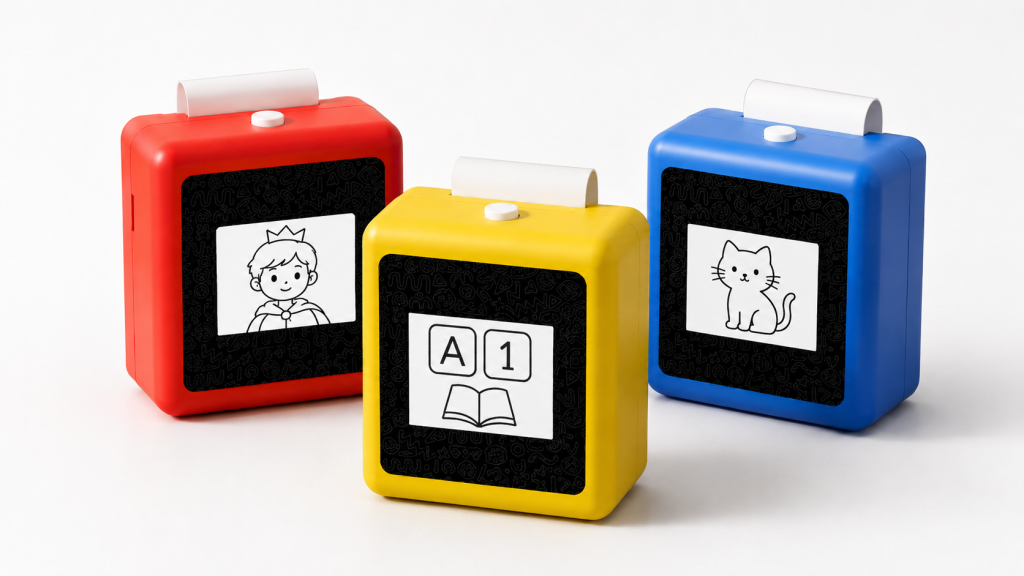
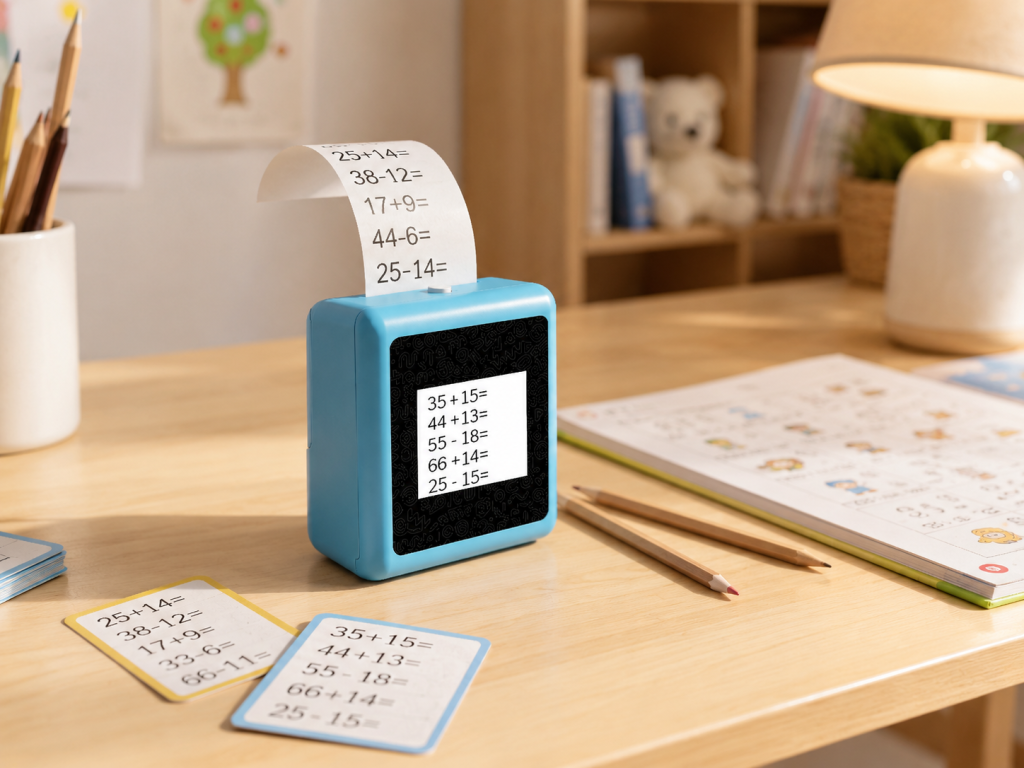
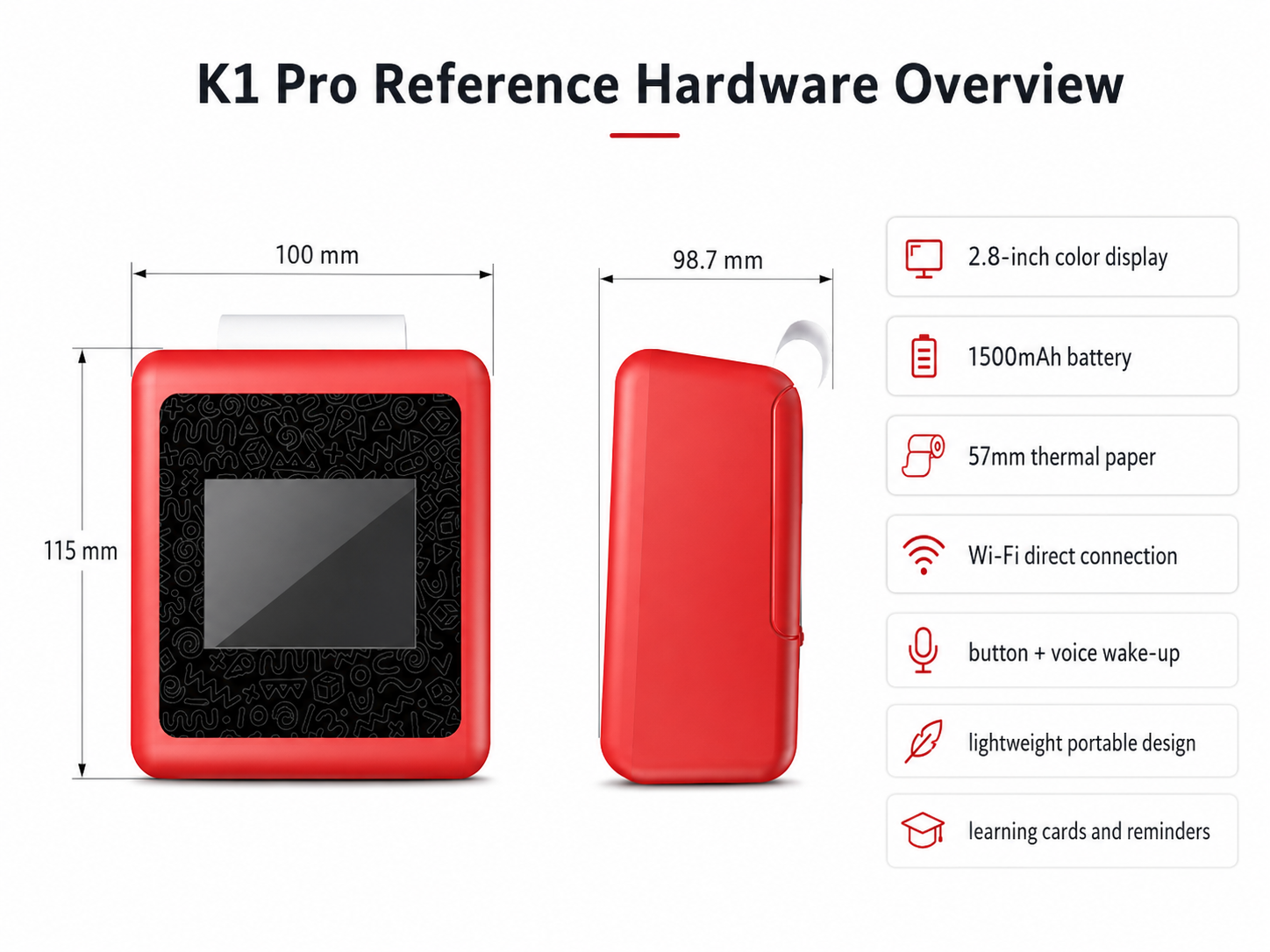
K1 Pro is presented as an OEM/ODM reference platform rather than a single fixed consumer configuration. The official product information describes 57mm thermal printing, Bluetooth plus web direct connection, private-label discussion, and configurable AI features. Voice dialogue, voice-to-image, language support, content templates, and cloud behavior must be confirmed for the quoted version.
Start With a One-Page Product Mandate
Many OEM conversations become expensive because the buyer starts by asking for a price instead of defining the product. “Kids AI printer” is not a complete RFQ. The supplier still does not know who will buy it, what the demonstration must show, how the AI service will operate, or which team will support it after launch.
Before contacting manufacturers, write a one-page mandate containing:
- Channel: education distributor, specialty gift, family technology, marketplace, or another defined route.
- User: intended age range, adult role, setup owner, and language.
- Three hero activities: for example, story cards, vocabulary prompts, and routine reminders.
- Permitted claim: an observable product function, not an unverified learning outcome.
- Target retail logic: product, accessories, initial paper, refill strategy, and any service cost.
- Launch market: country, state considerations, sales channel, and responsible importer.
- Success test: what a buyer, sales representative, or parent must be able to complete in two minutes.
This document prevents feature drift. If a new idea does not strengthen the three hero activities or the channel proposition, it belongs in a later version.
Procurement should freeze the product promise before it freezes the color, carton, or unit price.
Build an RFQ That Exposes the Real Scope
A useful RFQ separates five workstreams. Asking only for a specification sheet hides the boundaries between them.
| RFQ workstream | Questions that require a written answer | Expected evidence |
|---|---|---|
| Reference hardware | Which components, screen, audio, battery, print head, and connection method are in this version? | Dated specification, photos, sample label, bill-of-material revision |
| AI and software | Which functions work now, which require development, and which provider runs each service? | Live demonstration, architecture note, version list, API or service responsibility |
| Content | Who creates templates, moderates prompts, reviews outputs, and approves age positioning? | Example content pack, rejection cases, approval workflow |
| Commercial customization | What can change without new tooling or software work? | Logo, color, packaging, manual, accessories, language, and cost matrix |
| Production and support | How are changes controlled and failures handled after shipment? | Quality plan, firmware policy, escalation contacts, spare or return process |
Request pricing in matching layers:
- Standard reference sample
- Private-label hardware and packaging
- Optional software or AI configuration
- One-time development charges
- Recurring hosting, API, content, or account costs
- Testing, documentation, and market-labeling work
- Pilot and production quantities
- Paper and accessory pricing
This makes two quotations comparable. A low hardware price can conceal an incomplete app, an unpriced cloud dependency, or a support obligation that falls back on the brand.
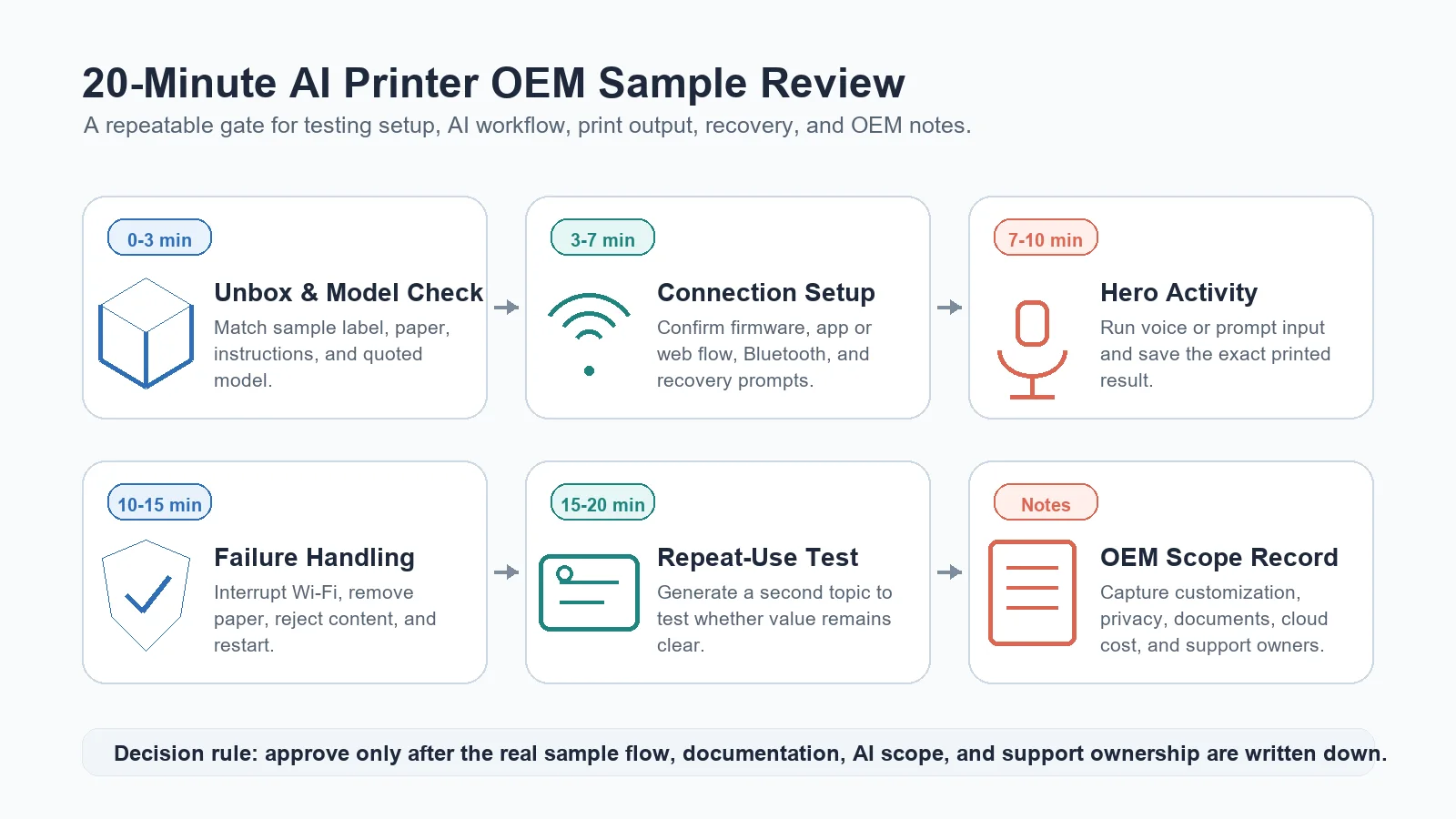
Use the 20-Minute Sample Gate
The first sample review should be short, repeatable, and slightly unforgiving. Do not begin with a polished supplier demonstration. Give the unit to someone who did not join the sourcing calls and observe where the workflow breaks.
Minutes 0–5: setup
Open the package, identify the instructions, power the unit, load paper, and connect it. Record every point where the reviewer needs supplier help. Gift and education channels have little patience for an unspoken setup ritual.
Minutes 5–10: hero activity
Run the main use case using the proposed customer flow. Measure how many choices, confirmations, and retries are needed before a useful print appears. Save the exact prompt and resulting output for later version comparison.
Minutes 10–15: failure handling
Interrupt Wi-Fi, use an unclear voice request, remove paper, reject an output, and restart the device. The purpose is not to punish the sample. It is to discover who owns recovery messages, content errors, and customer support.
Minutes 15–20: repeat use
Generate a second activity on a different topic. Then ask whether the experience still feels useful without a sales representative explaining it. Repeat-use value comes from the activity system, not from the surprise of the first print.
Freeze the AI Service Before Packaging
Packaging cannot be accurate until the buyer knows what the AI service actually does. The version record should identify:
- Input methods and wake behavior
- Supported languages for the production version
- Model or service provider responsibilities
- Data transmitted from device, app, or web flow
- Account requirements and parental controls
- Prompt rules and output moderation
- Adult review or confirmation steps
- Expected response when content is rejected
- Connectivity requirements and degraded behavior
- Update policy and recurring operating cost
- Service termination and customer-data handling
The NIST AI Risk Management Framework gives organizations a structured way to govern, map, measure, and manage AI risk. Its generative-AI profile also highlights third-party and value-chain risk. For an OEM buyer, that translates into a basic rule: the AI provider, device supplier, app developer, importer, and brand cannot remain unnamed boxes in the product architecture.
For child-facing services, review the FTC COPPA FAQ with qualified U.S. counsel. It explains the framework around online collection of personal information from children under 13. The correct conclusion is not that a feature list proves compliance; it is that data flow, notices, consent, retention, and third-party roles must be evaluated in the final service design.
Treat Content as a Production Component
A printed AI output is customer-facing content. It needs requirements and acceptance criteria just like the enclosure or print mechanism.
Create a small test library before pilot approval:
- 20 expected prompts across the three hero activities
- 10 unclear or incomplete prompts
- 10 requests that should be refused or redirected
- Names, accents, background noise, and age-appropriate language cases
- Prints that test text length, line wrapping, image density, and legibility
- Adult-review cases where content should not print immediately
Record the output, response time, moderation result, and reviewer decision. This does not prove universal safety or quality. It creates a versioned baseline that the buyer can rerun after a model, prompt, template, or backend change.
UNICEF’s guidance on AI and children is useful for framing child rights, privacy, fairness, transparency, and accountability. Those principles become commercially practical when they are converted into test cases and assigned owners.
Decide What “Private Label” Actually Includes
Private label can mean a logo on an existing box, or it can become a multi-team development project. Use a customization ladder so that sales and engineering discuss the same scope.
| Level | Typical changes | Main risk |
|---|---|---|
| Brand layer | Logo, colors, box, manual, quick-start guide | Claims or instructions do not match the sample |
| Channel bundle | Paper, accessories, content cards, gift presentation | Refill and accessory economics remain unclear |
| Content layer | Templates, prompt direction, age and topic packs | Content approval and update ownership are missing |
| Experience layer | Language, voice flow, app/web journey, account setup | Timeline and cloud cost are underestimated |
| Product layer | Hardware or industrial-design changes | Testing, documentation, tooling, and change control expand |
The K1 Pro reference information states that logo, exterior color, retail packaging, manuals, accessories, prompt direction, content templates, language requirements, and selected AI scope can be discussed. Standard private-label MOQ starts from 1,000 units; sample, validation, or pilot quantities may be discussed case by case.
Do not request every available change. Select the smallest configuration that produces a defensible channel difference.
Make the U.S. Documentation Review Importer-Led
The supplier can provide reports and product records, but the U.S. importer or responsible business needs to determine which rules apply to the finished product and issue or maintain the required documentation.
The U.S. Consumer Product Safety Commission’s CPC guidance explains that covered children’s products require a Children’s Product Certificate based on applicable third-party testing. It also notes that the domestic manufacturer or importer is responsible for the certificate. Requirements depend on the product, intended age, materials, functions, and applicable rules.
For the quoted K1 Pro platform, Yosiya may provide FCC, CE, ROHS, CPC, and quality-report materials for review. Buyers should request the underlying documents, match model and component details, check dates and laboratories, and identify what remains applicable after customization. A color, material, component, charger, label, or intended-use change can affect the review.
The documentation folder should include, as applicable:
- Final model and product identification
- Intended-age and classification rationale
- Applicable test reports and certificate data
- Component and material records
- Product and packaging labels
- Tracking information
- Manual and warning copy
- Battery, charging, radio, and shipping documents
- Factory and test-location details
- Change-control and retest triggers
This section is procurement guidance, not legal advice. Engage qualified compliance professionals for the final U.S. product.
Set Pilot Acceptance Criteria
A pilot is not simply a smaller purchase order. It should answer unresolved questions before the brand commits to scale.
Define pass/fail criteria for:
- Setup completion without supplier intervention
- Print quality across agreed paper
- Hero-activity completion time
- AI response and rejection behavior
- Content test-library results
- Connection loss and recovery
- Packaging accuracy
- Documentation completeness
- Cloud cost and service monitoring
- Customer-support handoff
Name the approver for each criterion. Product may approve the activity flow, legal may review privacy, sourcing may approve cost and capacity, quality may approve physical tests, and channel teams may approve packaging. “The sample looks good” is not a production gate.
Red Flags in an AI Printer OEM Quote
Pause the project when:
- Every listed AI feature is described as standard but cannot be demonstrated.
- The supplier cannot identify the app, backend, model, or service owner.
- Recurring AI costs are absent from the commercial proposal.
- Compliance is expressed only as certification logos.
- Test reports cannot be matched to the quoted model or configuration.
- Content moderation is described as somebody else’s responsibility.
- Packaging claims are stronger than the demonstrated functions.
- Firmware, cloud, return, and customer-support ownership is undefined.
- A production deposit is requested before the version and acceptance criteria are frozen.
One red flag may be fixable. Several together usually mean the buyer is pricing an idea rather than a controlled product.
FAQ
What is included in an AI printer OEM project?
It can include reference hardware, logo and color changes, packaging, accessories, manuals, printable content direction, language setup, selected AI functions, app or web workflow, cloud services, documentation, and production support. The exact boundary needs a written version-specific scope.
How is AI printer OEM different from thermal printer OEM?
A thermal printer project mainly focuses on physical printing, connectivity, packaging, quality, and supply. An AI printer adds generated content, data flow, moderation, cloud cost, account design, updates, and ongoing service ownership.
Can a kids AI printer be private labeled?
Yes. K1 Pro is presented as a private-label and OEM/ODM reference platform. Buyers can discuss branding and selected product, content, packaging, and experience changes, subject to feasibility, quantity, timeline, and development scope.
What should buyers request before ordering samples?
Request a dated specification, enabled-function list, demonstration of the actual sample workflow, price layers, customization matrix, paper details, available reports, service architecture, and a clear statement of what still requires development.
Are supplier certificates enough for U.S. sales?
No blanket assumption is safe. The responsible U.S. business must determine applicable requirements for the finished configuration and review the supporting reports and certificate information. Customization may change what must be tested or documented.
How should buyers evaluate AI content safety?
Define content boundaries, create expected and refused prompt tests, document adult-review steps, identify every service provider, and rerun the test library after material AI or backend changes. This supports review but does not guarantee every output.
What is a useful pilot order?
It is a limited order tied to written acceptance criteria for hardware, user flow, AI behavior, packaging, documents, cloud operations, and support. Its purpose is to close evidence gaps before scale.
Move From Quote Collection to Controlled Sourcing
The strongest AI printer OEM project is not the one with the longest feature list. It is the one in which the buyer can trace every customer promise to a demonstrated function, every digital service to an owner, every document to the quoted configuration, and every production decision to an acceptance criterion.
Use K1 Pro as reference hardware, but build the commercial decision around your channel mandate and evidence. To request the current specification, sample scope, customization options, and OEM discussion path for a U.S. education or gift-channel project, contact Yosiya.