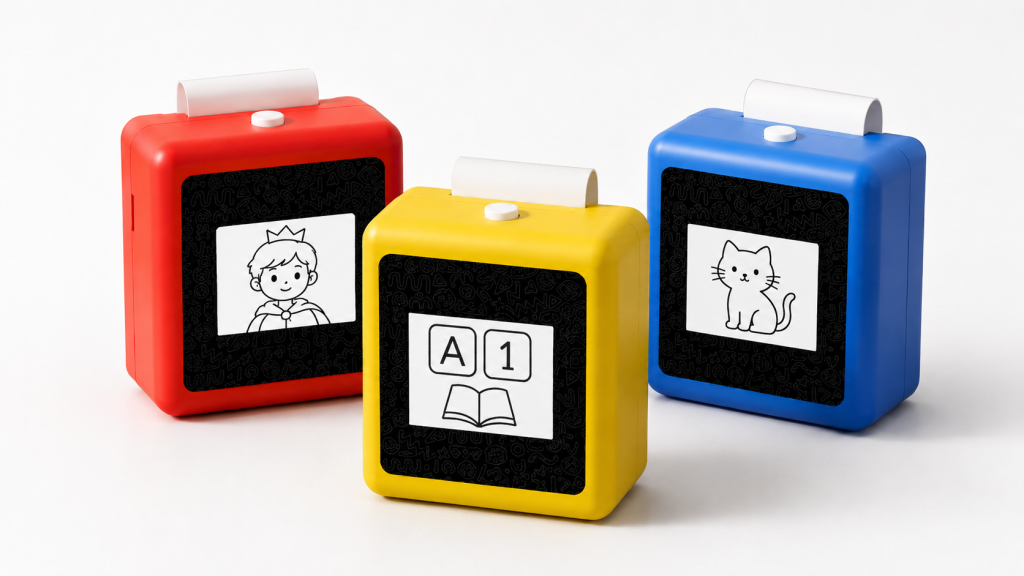
A printable AI learning device supplier should help education distributors, after-school program suppliers, and private-label brands turn AI interaction into a repeatable paper-based learning routine. The useful product story is not “AI added to a printer.” It is a compact device that can support short story prompts, practice cards, family reminders, creative tasks, and other small outputs that a child or adult can use away from the screen. Buyers should judge the supplier by the complete learning loop: hardware reliability, enabled AI functions, content boundaries, privacy responsibilities, paper supply, packaging, and after-sales ownership.
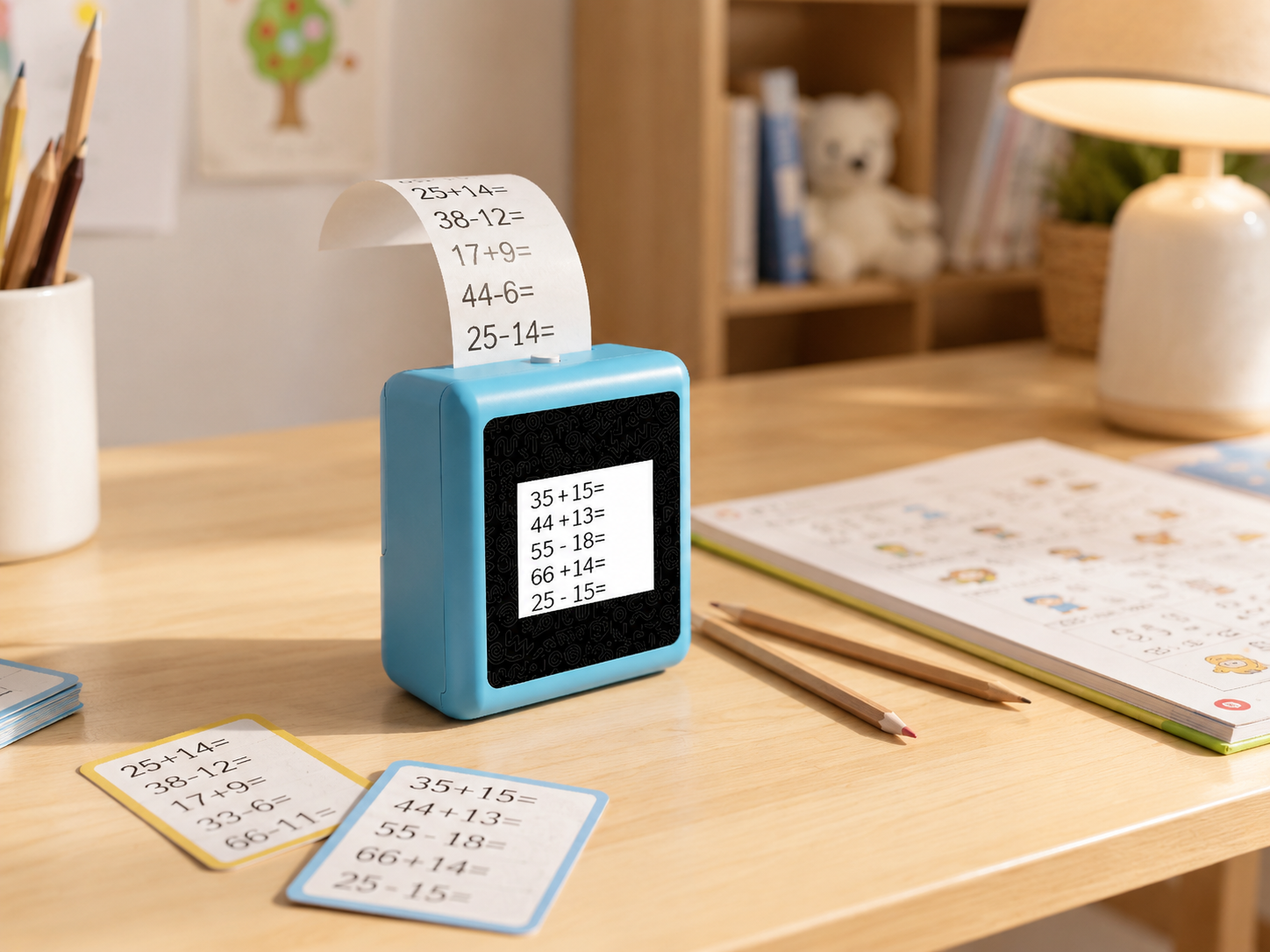
The Buying Question: Can AI Learning Become a Tangible Product?
Education distributors and family-learning brands are not only asking whether AI learning is popular. They are asking whether an AI learning device supplier can turn that demand into a physical product that is easy to demonstrate, package, support, and sell. A print-first device answers that question by making the learning result visible.
The device should not be presented as an app with a printer attached. The stronger position is a learning loop: speak or select a task, generate a short activity, print it, and practice away from the main screen. That loop gives buyers a clearer way to compare suppliers than a feature list full of AI labels.
The clearest product position is print-first and screen-light, not screen-free. Setup, review, or cloud service may still involve a screen, but the output should become a paper card, prompt, reminder, or creative task.
What Buyers Should Know
- An AI learning device supplier should be evaluated by the learning routine it can demonstrate, not by the number of AI labels on a specification sheet.
- Print-first positioning helps AI learning become a tangible product for education and family-learning channels.
- The strongest workflow is speak or select, generate, print, and practice with a short paper output.
- Buyers should test story cards, flashcards, reminders, creative prompts, content review, privacy flow, paper supply, and support ownership.
- Printed story cards, flashcards, and reminder cards are the physical learning results that help the product differ from app-only AI learning.
- K1 Pro can be discussed as a reference platform, but exact AI functions depend on the confirmed project version.
Where This Product Fits
| Entity | Description |
|---|---|
| Brand | Yosiya, an AI hardware products and solutions supplier |
| Reference product | K1 Pro AI Printer |
| Category | Printable AI learning device for kids education channels |
| Target buyers | Education distributors, after-school suppliers, family-learning brands, and OEM/ODM product teams |
| Typical outputs | Story prompts, flashcards, routine notes, reminders, labels, and creative activity cards |
| Buyer stage | Supplier shortlist, sample review, private-label planning, and pilot evaluation |
Why App-Only AI Learning Is Hard to Merchandise
App-only AI learning can be useful, but it is not always easy for B2B channels to sell as a hardware SKU. Distributors need a product that can sit on a shelf, be shown in a short demo, and create a result that parents or educators immediately understand.
Fixed-content education toys have the opposite problem: they are easy to package, but they may lose repeat value once the child has used the same cards or activities. A print-first AI learning device sits between those two models. It gives the channel a physical product while allowing the activity content to change by topic, routine, or learning moment.
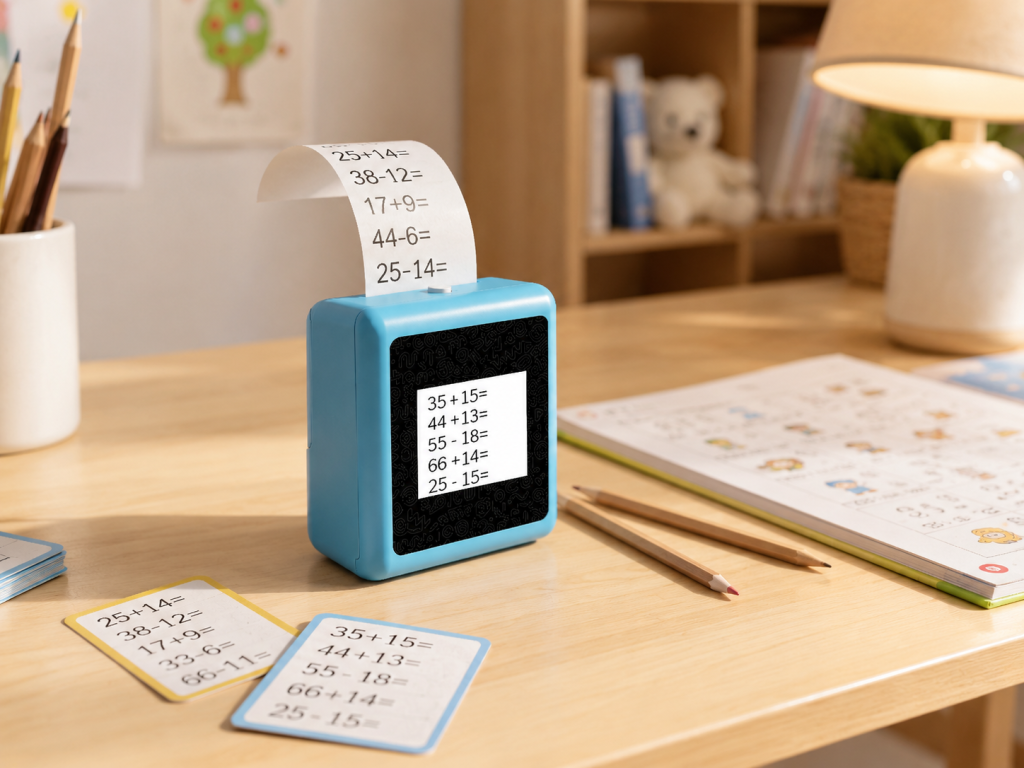
For supplier evaluation, that means the buyer should ask for real output examples, not only an app screen or a feature list. Story cards, flashcards, reminders, and creative prompts should be short enough for 57mm thermal printing and specific enough to feel useful.
Speak, Generate, Print, Practice
A strong AI learning device brief begins with one user, one moment of use, and one paper artifact. For example, an after-school supplier may want a five-minute vocabulary card. A family-learning brand may want a bedtime story prompt. A distributor may want a simple demo that shows voice input, AI-assisted content, adult review, and a printed card.
This keeps the supplier discussion practical. If the activity cannot be explained in one sentence or demonstrated in two minutes, adding more AI features will usually make the product harder to sell. The supplier should show how the current sample behaves, what still requires development, and what should not be promised on packaging.
The useful workflow is simple:
| Step | Buyer check | Example output |
|---|---|---|
| Speak or select | Can a child or adult start without complex prompt writing? | “Make a five-word spelling review” |
| Generate | Are prompt rules, age position, and refusal behavior clear? | A short practice task or story starter |
| Is the card readable and suitable for 57mm paper? | Flashcard, routine note, reminder, or creative card | |
| Practice | Does the printed result support a real learning action? | Read aloud, answer, color, sort, or repeat |
Supplier Evaluation Scorecard
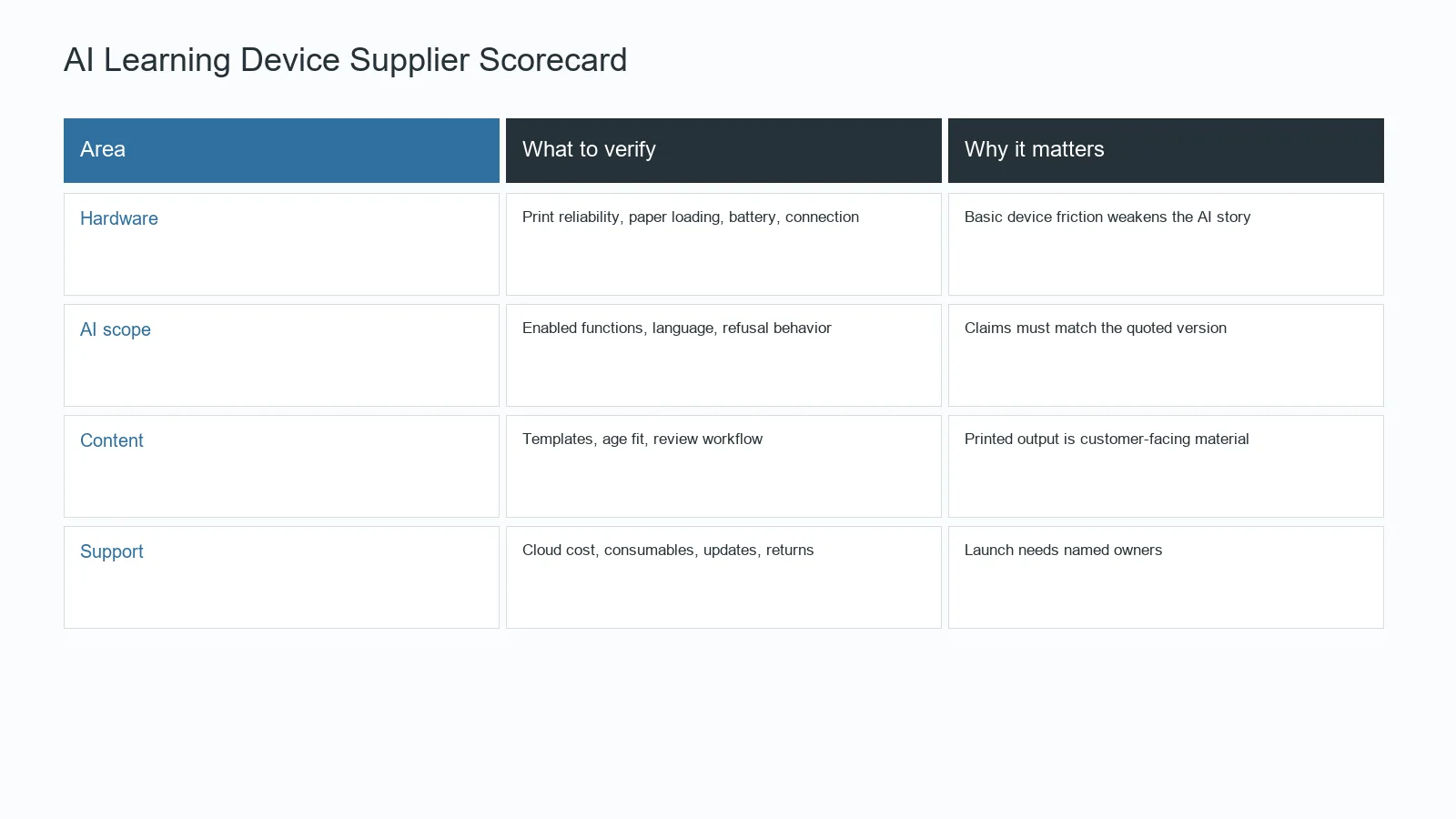
Use a scorecard that separates the device, the AI layer, and the channel promise.
| Evaluation area | What to confirm | Why it matters |
|---|---|---|
| Hardware | Print quality, paper loading, battery, buttons, screen, and connection flow | A weak basic printer will damage the AI story |
| AI scope | Enabled functions, languages, voice behavior, image or text generation, and refusal handling | Buyers need version-specific claims |
| Content | Template quality, age positioning, review process, and update ownership | Printed output becomes customer-facing material |
| Privacy | Data flow, account design, parental notice, cloud providers, and retention | Child-facing connected products need extra review |
| OEM/ODM | Logo, color, packaging, accessories, manuals, and content direction | Private-label scope affects cost and timeline |
| Support | Consumables, firmware updates, cloud cost, returns, and after-sales response | The launch plan must survive after the demo |
Three Scenarios Worth Prototyping
After-School Five-Minute Review
The device can print a short question set, vocabulary card, or recap prompt for a quick practice moment. The supplier should demonstrate the full path from input to printed card, including unclear input and failed connectivity. The buyer should check whether a staff member can run the activity without engineering support.
Parent-Prepared Topic Cards
For family-learning brands, the product can turn a parent-selected topic into a small card that starts reading, drawing, speaking, or review. The important question is not whether AI can generate content once. The question is whether parents can understand, approve, and reuse the activity safely.
Creative Prompt Packs
Gift and education channels often need repeat use beyond the first demo. Creative prompt packs can support drawing challenges, story starters, scavenger clues, and reward cards. Buyers should confirm who writes the prompt rules, who reviews the output, and how updates are handled after launch.
How to Evaluate an AI Learning Device Supplier
The supplier review should connect the learning promise to operational evidence. Buyers need clear supplier evaluation standards before they compare quotes. They should request a current sample, a version-specific function list, sample printed outputs, app or web flow notes, paper and consumables information, and a clear map of who owns AI service, templates, cloud costs, privacy review, and after-sales questions.
The buyer should also test whether the product can be explained without overclaiming. “AI voice interaction helps children or parents start a printable activity” is safer than promising automatic learning improvement. “Cloud-generated content can support refreshed tasks” is safer than claiming unlimited safe content.
Keep Capability Claims Version-Specific
Hardware, AI, and content mature at different speeds. The physical printer may be stable while voice behavior, template design, moderation, model provider, or cloud service remains configurable. Procurement should keep three columns in the project record: demonstrated now, included after confirmed setup, and outside the current scope.
This also protects channel copy. A roadmap item should not become a retail-box promise. If a supplier says a function is possible, buyers should ask whether it works in the current sample, whether it requires custom development, and whether it changes cost, timeline, data flow, or documentation.
The U.S. Department of Education AI report is useful for framing human-centered AI questions in education. The UNESCO guidance on generative AI in education, FTC COPPA FAQ, and AAP Family Media Plan can also help buyers form privacy, child-use, and family-context review questions. These sources do not certify K1 Pro or any final product configuration.
K1 Pro Fit for a Supplier Shortlist
K1 Pro can be discussed as a compact reference platform with 57mm thermal printing, Bluetooth plus web direct connection, and OEM/ODM discussion options. Yosiya describes configurable AI voice interaction, voice-to-image direction, printable templates, and private-label support. Availability depends on the quoted version, so the sample should come with a clear enabled-function list.
Brand teams can discuss logo, colors, retail packaging, manuals, accessories, printable-learning content direction, language requirements, selected AI features, and support boundaries. Standard private-label MOQ starts from 1,000 units, while samples, validation quantities, or pilots can be discussed case by case.
Questions for a Structured Supplier Interview
- Which learning routines can the current sample demonstrate today?
- What AI learning device can distributors sell as a physical SKU?
- Which AI learning hardware is suitable for kids, and what evidence supports that positioning?
- Which functions are configurable, optional, or still under development?
- Who owns prompt rules, templates, content review, and cloud service?
- What data is collected during voice, app, web, or AI interaction?
- What documents match the exact model and customized version?
- What recurring cost appears after the device ships?
- Which claims should stay off packaging until the final version is confirmed?
Limits That Should Stay Visible
A printable AI learning device should not be described as screen-free if setup or use includes a screen, app, web flow, or cloud service. “Print-first” and “screen-light follow-up” are more precise. The device should not promise learning outcomes, universal content safety, or automatic legal compliance.
The thermal format is also a boundary. It works for concise cards, prompts, notes, labels, and activities; it is not intended to replace Letter-size worksheets, detailed books, or permanent archival prints.
FAQ
What is a printable AI learning device?
It is a compact connected device that uses AI-assisted interaction or templates to create short printable learning or family activity outputs, such as story prompts, flashcards, reminders, and creative cards.
Which AI learning hardware is suitable for kids?
Suitable kids AI learning hardware should have a simple input method, short outputs, adult-visible review points, realistic age positioning, and safe claim language. A print-first device can be suitable when it turns AI interaction into concrete cards, prompts, reminders, or creative tasks.
How should buyers evaluate an AI learning device supplier?
Buyers should test the full learning loop: input, AI behavior, content review, print quality, privacy flow, packaging claim, consumables, and after-sales ownership.
Is K1 Pro a finished consumer configuration?
K1 Pro should be treated as a reference platform for OEM/ODM evaluation. Exact AI functions, languages, content rules, and connection behavior should be confirmed for the quoted project version.
Can this product support private-label projects?
Yes. Branding, colors, packaging, manuals, accessories, content direction, languages, and selected AI functions can be discussed subject to feasibility, quantity, timeline, and scope.
What should not be overstated?
Avoid claims such as assured learning improvement, fully screen-free use, automatic child safety, or blanket market compliance unless the final configuration and evidence support them.
Request Product Details and Sample Outputs
For education distributors, after-school suppliers, and brands comparing tangible AI learning devices, the next step is to choose one priority routine and test the current sample against it. To review K1 Pro hardware, current AI scope, printable sample outputs, OEM/ODM options, and sample availability, contact Yosiya.