Furby knew your name in 1998. Or at least, it seemed to. Press its tummy in the right sequence and it would “learn” a word. Cover its eyes and it would say “me scared.” The toy felt alive — and that was the point. But Furby was not smart in any meaningful sense, and it was certainly not AI. It was a clever arrangement of sensors, pre-recorded audio, and timing that created the illusion of responsiveness.
In 2026, the word “AI” appears on toy packaging with the same frequency that “interactive” did in 2005. A singing cactus that repeats what you say is not AI. A robot that holds a multi-turn conversation with a five-year-old is. This article explains where the line is — and gives you a simple test to tell the difference before you buy.
What “Smart Toy” Actually Means
The term “smart toy” entered the toy industry lexicon in the late 1990s to describe anything with a microprocessor. By that definition, a Tamagotchi was a smart toy. A LeapFrog LeapPad was a smart toy. Even a singing birthday card with a chip inside qualified.
The working definition used by researchers and industry analysts today is more precise: a smart toy contains sensors, a microprocessor, and pre-programmed responses. It can detect input — a button press, a touch sensor, a specific spoken phrase — and trigger a corresponding output. But the mapping between input and output is fixed at the factory. The toy cannot generate anything the engineers did not put there.
Key characteristics of a smart toy:
- Responds to specific triggers (buttons, touch, motion, basic voice detection)
- Uses pre-recorded or pre-programmed content
- Cannot adapt to a child’s age, language level, or interests over time
- Cannot sustain a conversation — each interaction starts from zero
- Cannot create new content — every response exists in its memory before the child ever touches it
Examples: Furby (2012 and 2023 editions), VTech Touch & Learn Desk, LeapFrog 100 Words Book, Cozmo robot, any toy that repeats what you say in a funny voice.
These are not bad toys. A two-year-old pressing buttons on a VTech desk and hearing animal sounds is developing cause-and-effect understanding. The limitation is not quality — it is ceiling. A smart toy is as good on the hundredth use as the first. It never grows. The child does.
What “AI Toy” Means
An AI toy processes language, images, or behavior patterns in real time and generates responses that were not pre-written. The distinction is not about having a chip — it is about generating output dynamically rather than retrieving it from storage.
Three capabilities distinguish an AI toy from a smart toy in practice:
1. Natural language understanding, not keyword detection. A smart toy might recognize the word “dog” and play a barking sound. An AI toy understands “tell me a story about a dog who is afraid of vacuums” and generates a novel response. The difference is between a lookup table and language comprehension.
2. Context across turns. If a child asks “why is the sky blue” and the toy answers, a smart toy starts from zero on the next question — it has no memory of the previous exchange. An AI toy can follow up: “and why is it different at sunset?” and the AI knows what “it” refers to. This multi-turn coherence is what makes a conversation feel real to a child.
3. Dynamic content generation. An AI toy can create something new in response to a child’s input — an image, a story, a learning card, a creative prompt. A smart toy can only retrieve what was stored during manufacturing.
The Capability Spectrum
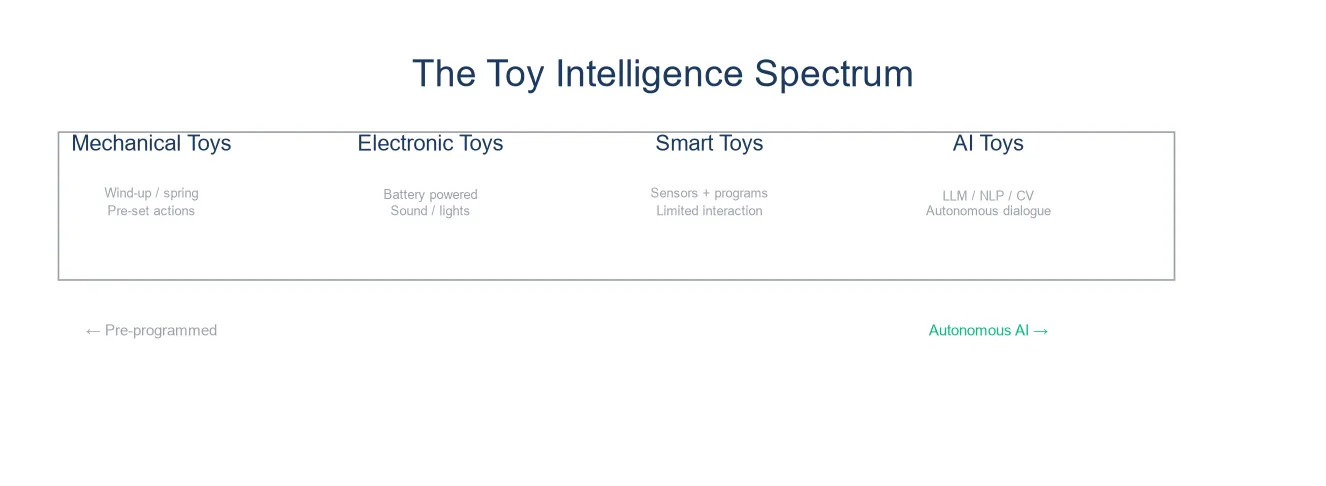
Toys do not fall neatly into two buckets. There is a spectrum from purely mechanical to fully conversational AI, and many products occupy the middle zone.
| Level | What it does | Examples |
|---|---|---|
| Mechanical | Push button → one action | Jack-in-the-box, pop-up toys |
| Electronic | Button → pre-recorded phrase | VTech alphabet desk, talking dolls |
| Smart | Sensors + processor + fixed responses | Furby, Cozmo, LeapFrog LeapPad |
| Voice-triggered | Voice command → pre-designed output | Stickerbox (command → sticker sheet) |
| AI generation | Voice prompt → generated image | BDI X16 (prompt → AI image) |
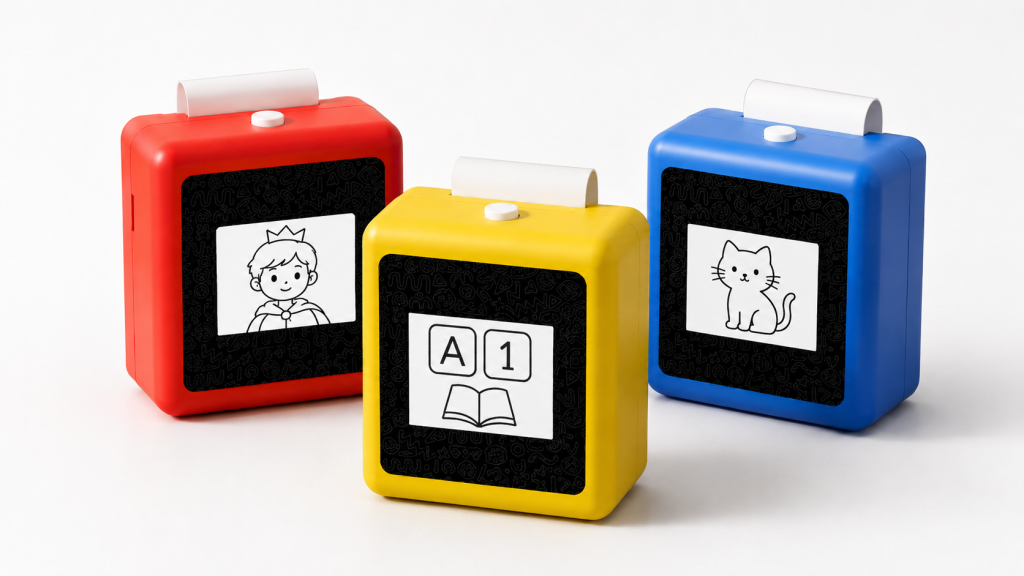
| AI conversational | Multi-turn dialogue + adaptive responses | Miko Mini (dialogue), K1 AI Printer (dialogue + print) |
The middle rows are where confusion lives. Stickerbox uses AI to match a spoken description to a sticker design, but the designs are pre-made — the AI is doing retrieval, not generation. BDI X16 generates novel images but does not hold conversations. Miko Mini holds conversations but produces no physical output. The K1 AI Printer holds conversations and produces physical output — the only device on this spectrum that spans both.
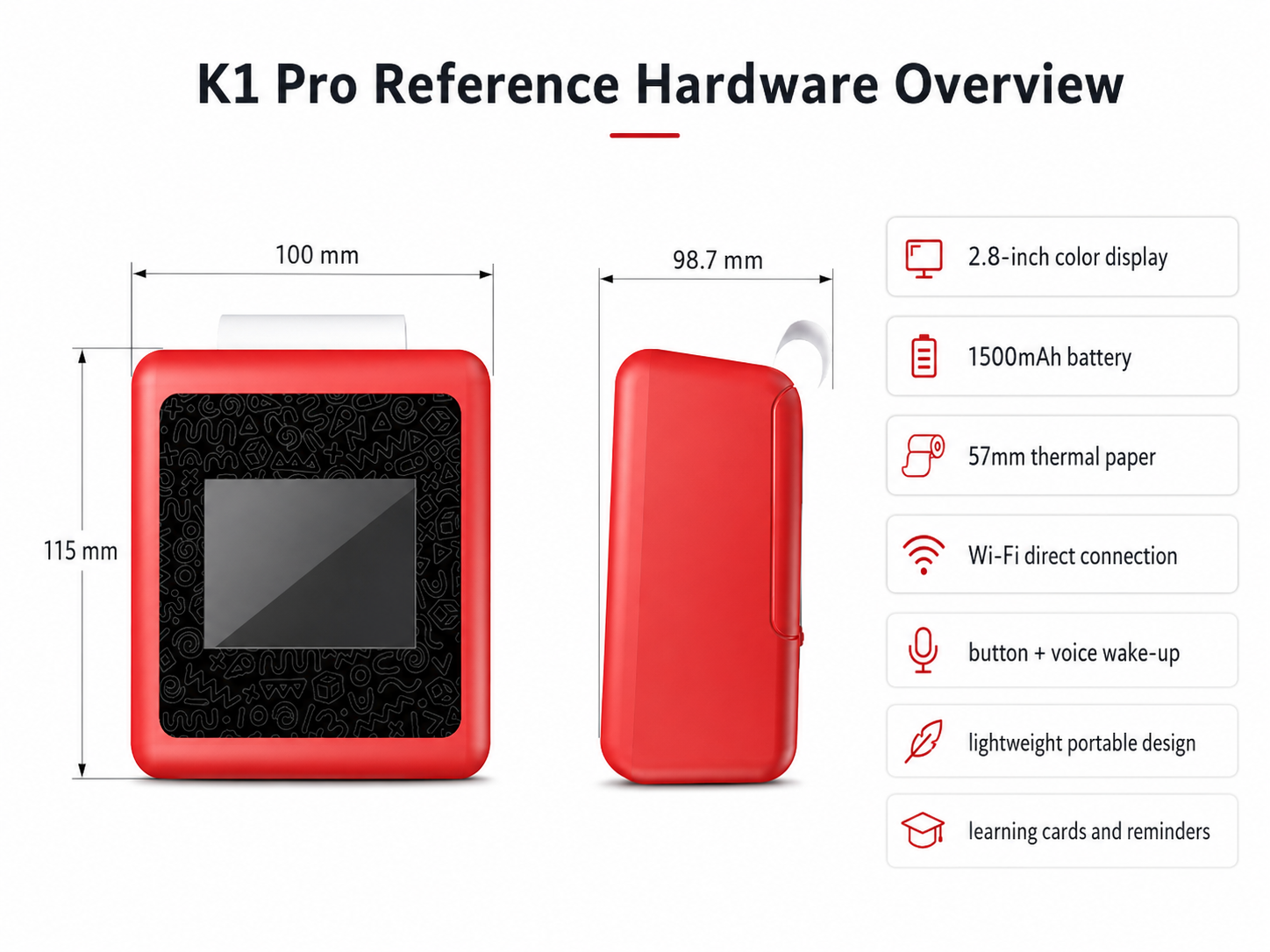
None of these positions are objectively better. A parent who wants their child to hear rich language through conversation might choose Miko Mini. A parent who wants fast, fun image output might choose BDI X16. A parent who wants conversation plus physical creation might choose the K1. The point of the spectrum is not to rank — it is to clarify what “AI” delivers at each level so parents can match the capability to what their child actually needs.
The AI-Washing Problem
AI-washing is to 2026 what “smart” was to 2016: a label applied so broadly it has lost meaning. The practical consequence is that a parent standing in a toy aisle or scrolling Amazon cannot trust the word on the box.
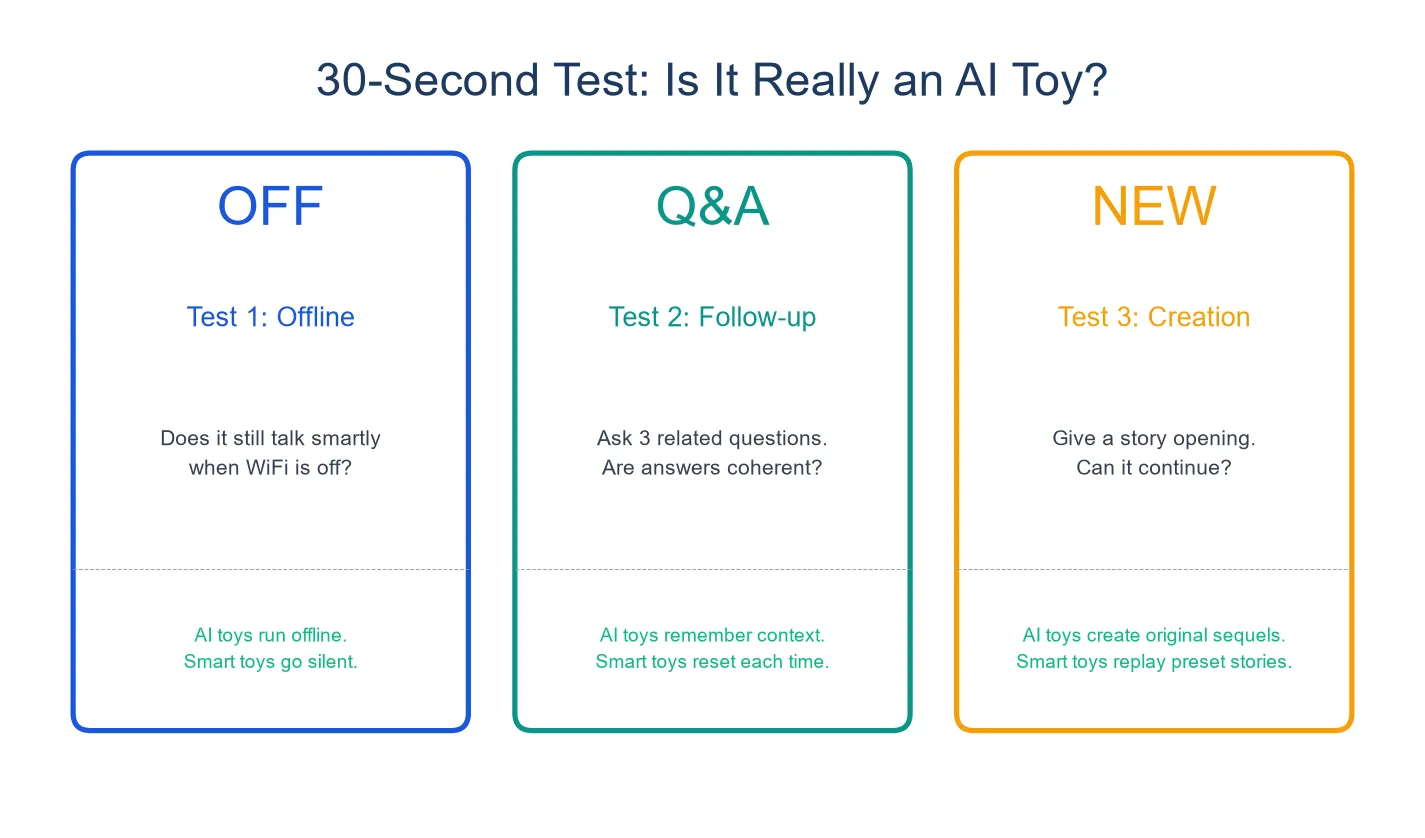
Here is how to spot it in 30 seconds:
The repeat test. Ask the toy the same question twice, five seconds apart. If the response is identical — same words, same tone, same pacing — the content is pre-recorded. An AI toy might give a similar answer but will not give an identical one, because it is generating responses, not playing files.
The context test. Ask a follow-up question that depends on the previous answer. “What is the biggest planet?” Jupiter. “Why is it called that?” If the toy says “I don’t understand” or repeats the Jupiter answer, it has no context awareness. A conversation-capable AI toy will explain the Roman god connection.
The creation test. Ask the toy to make something specific. “Tell me a story about a penguin who wants to learn ballet.” A pre-programmed toy either ignores the specificity (“here is a story about a penguin”) or cannot respond. An AI toy generates a penguin-ballet story that has never existed before.
Red flags in product descriptions:
- “AI-powered” without specifying what the AI does
- “Smart learning” without describing adaptive behavior
- “Responds to voice” (this just means a microphone, not language understanding)
- “Educational” without a curriculum or content scope description
- A companion app that does the AI work while the toy is just a Bluetooth speaker
Why the Distinction Matters for Your Wallet
A smart toy’s useful life is bounded by its fixed content. A VTech desk teaches the alphabet — and once a child knows the alphabet, the toy’s educational value drops to zero. A Furby is entertaining for the novelty period and then becomes a shelf decoration. These are not defects; they are inherent to the product category.
An AI toy that generates responses dynamically has a longer useful window because its content is not fixed. A child at age five asks the K1 for simple animal drawings and sight-word cards. At age seven, the same child asks it for science explanations and creative writing prompts. The hardware did not change. The child did — and the AI adapted.
This does not mean AI toys are always the better purchase. A $20 LeapFrog book is the right tool for a two-year-old learning first words. A $129+ AI toy for that same two-year-old is money spent on capabilities they are not ready to use. The value of AI in a toy scales with the child’s language development — it is lowest before age three, rises sharply between four and seven, and plateaus (or declines, if the content cap is reached) after age eight to ten.
FAQ
1. Is my child’s talking toy “AI”?
Probably not — unless it generates novel responses rather than playing pre-recorded ones. Try the repeat test described above. If the response is word-for-word identical every time, it is not AI.
2. Are AI toys more expensive than smart toys?
Generally yes, because the cost includes ongoing cloud AI processing, not just the hardware. But compare two-year total cost, not sticker price. A smart toy that is outgrown in three months costs more per useful hour than an AI toy that stays engaging for two years.
3. Do all AI toys need Wi-Fi?
Most do, because the AI processing happens on cloud servers, not inside the toy. A device that claims to run AI entirely offline should be treated with skepticism — on-device AI for children’s toys remains limited in 2026.
4. Can a smart toy become an AI toy with a software update?
No. The hardware architecture is different. A smart toy’s processor and memory are designed for playback, not real-time language processing and generation.
5. Is a toy with a companion app automatically AI?
No — and this is one of the most common AI-washing tactics. A toy that connects to an app that plays videos or tracks progress is not AI. The AI label requires the toy itself to generate adaptive, context-aware responses, not just stream content from a server.
The 30-Second Test
Before buying any toy marketed as “AI,” ask these three questions of the product — either by reading the description carefully or by asking the manufacturer:
- Does the toy generate responses in real time, or play pre-recorded ones?
- Can the toy follow a multi-turn conversation where the second question depends on the first answer?
- Can the toy create something new (a story, an image, a learning activity) in response to a specific request?
If the answer to all three is no, the toy is smart — not AI. That does not make it a bad purchase. It makes it a different category of purchase, and knowing the difference is worth the thirty seconds it takes to check.
Explore the K1 AI Printer — conversational AI with physical output