
Before approving AI device customization, confirm the reference version, requested changes, acceptance criteria, commercial assumptions, and the responsibilities that continue after delivery. A request for quotation should describe the same product across hardware, firmware, the app, and any AI service. Otherwise, two apparently comparable offers may cover different configurations or leave important work unpriced. For sourcing managers, a useful confirmation checklist turns each promise into a named deliverable, owner, and approval record. The aim is to resolve the items that could change what the buyer receives, how the device is evaluated, or who must act when the delivered system needs support.
Build one record that follows the quotation
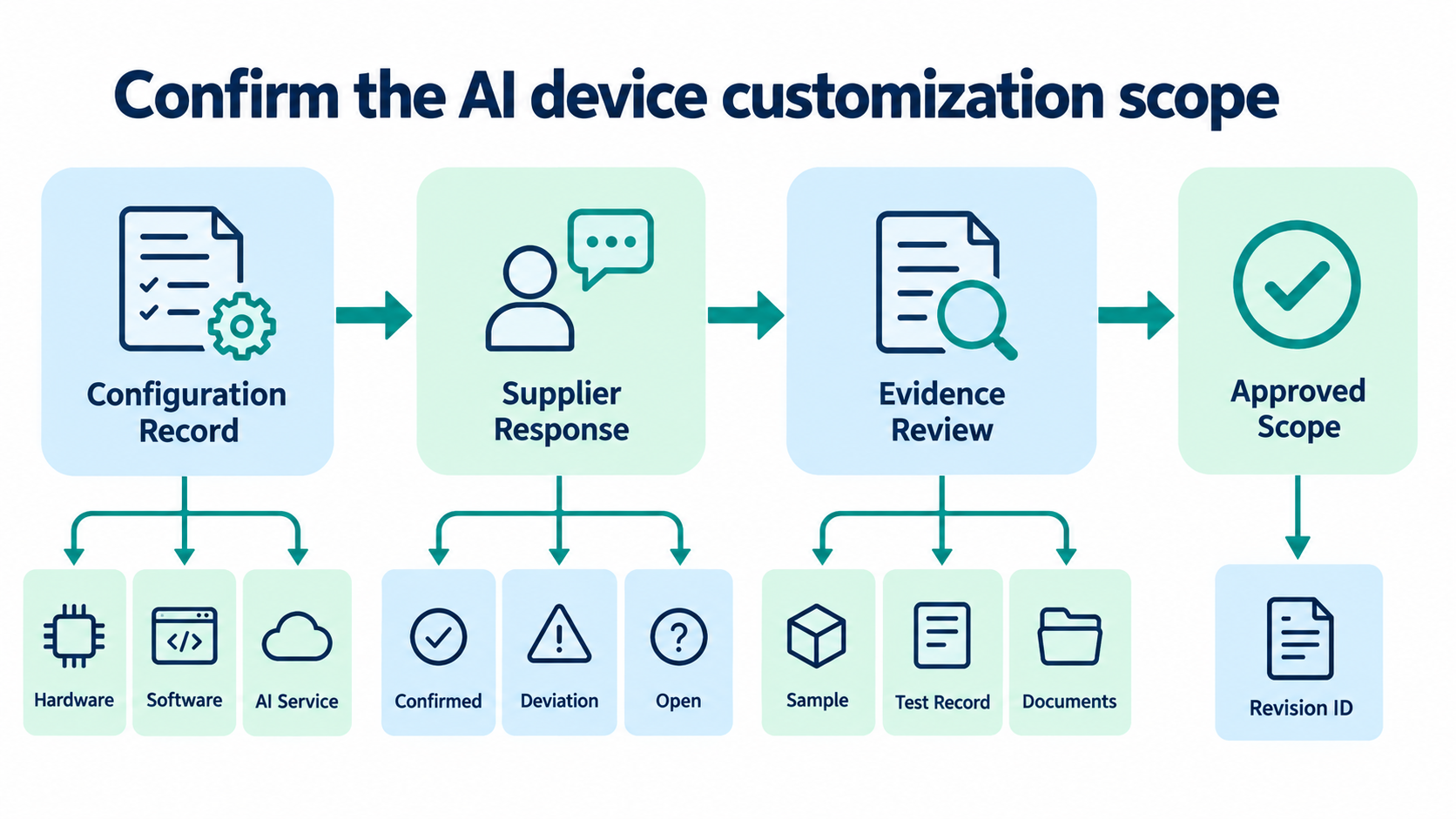
Start with a configuration sheet carrying a project identifier, revision, date, and owner. Attach or link the relevant drawings, software descriptions, artwork, and acceptance plan. Keep the supplier’s response against that same revision so a price cannot silently refer to a different requirement set.
The record should distinguish confirmed items, supplier deviations, open questions, and optional work. These statuses matter more than filling every cell with “yes.” An unresolved interface should remain visible until someone owns the investigation and its effect on the proposal is understood.
For AI hardware sourcing, a concise confirmation record can follow this structure:
| Area | Buyer input | Supplier response needed | Approval evidence |
|---|---|---|---|
| Reference configuration | Device identifier and intended baseline | Exact board, enclosure, and software versions | Version list tied to the reviewed sample |
| Requested changes | Required modifications with priorities | Included, excluded, conditional, or investigation needed | Agreed scope with listed deviations |
| Device behavior | Main task and failure expectations | Supported workflow and limitations | Accepted behavior description |
| AI processing | Input, output, processing location, service expectations | Proposed integration and dependencies | Data-flow and interface record |
| Acceptance | Test conditions and decision criteria | Test method, responsibility, and exceptions | Signed evaluation plan and results |
| Deliverables | Files, samples, tooling, and documentation required | Format, access, ownership, and handoff terms | Deliverable schedule |
| Commercial basis | Quantity assumptions and destination | Itemized charges and quotation conditions | Written quotation matched to scope |
| Ongoing support | Intended deployment and support expectations | Update, incident, repair, and end-of-service responsibilities | Support agreement or agreed scope |
Use the table as a working procurement aid, not a universal certification checklist. Product category, target market, and integration model determine the additional records needed. An engineering review should identify those additions while the configuration is still open.
Identify what the sample represents
Request a sample identifier and configuration record before evaluating the device. Note any temporary parts, manual operations, demonstration accounts, development firmware, or unimplemented features. These limitations define which observations can support a purchasing decision.
If a sample uses a shared test account, for example, successful operation says little about the proposed customer registration and account-recovery experience. Ask for that workflow to be demonstrated separately. If an accessory is a temporary substitute, record which mechanical and electrical checks remain open for the final version.
Also establish what happens to the approved sample. The team may retain it as a reference, but approval should connect to controlled documents and software identifiers. A physical unit without a record of what it contains can become an unreliable comparison after revisions accumulate.
Translate the feature list into acceptance criteria
“Stable connection,” “clear recording,” and “accurate AI output” are starting concerns, not complete acceptance criteria. Ask the technical owner to specify the conditions, inputs, measurements, and decision rule for each important requirement. Purchasing should ensure these criteria appear in the agreement without inventing technical thresholds.
For a hypothetical connected inspection device, an acceptance plan might separate sensor capture, data transfer, AI result generation, and the user-visible error response. The example is illustrative; it does not describe a Yosiya product. Each step needs an observable result so a failure can be assigned to the right part of the system.
Confirm at least these testing details:
- Which production configuration the evaluation represents.
- Who supplies representative inputs and verifies the expected result.
- What environmental, connection, and usage conditions apply.
- Which results are retained and who reviews exceptions.
- What must be corrected or explicitly accepted before the next approval.
ISO’s quality assurance overview distinguishes preventive process controls from checks on delivered outputs. For the buyer, that supports asking about both the production process and the inspection evidence. A final sample inspection does not describe every control used to maintain consistency.
Confirm the AI service as carefully as the device
An AI device customization quote may include hardware while leaving the service commercial model unresolved. Specify whether the proposal includes an app, backend integration, processing usage, account administration, or only an interface for the buyer’s software team. Name the party responsible for each dependency.
Ask where input data goes, which party operates each service, how access is granted, and what happens when a subscription or account ends. The product description should state which functions remain available in those conditions. Avoid accepting “cloud included” without a defined period, usage basis, and scope.
For software transparency, request a component inventory appropriate to the project. SPDX provides a standard way to communicate software bill of materials information, including provenance, licensing, and security-related details. A component inventory can support review, but the project agreement must separately define the rights and access the buyer receives.
Keep source-code delivery, build instructions, binaries, credentials, and cloud accounts as separate deliverable items. Receiving an application file is not the same as receiving the ability to build or maintain it. Clarify the access required for the brand’s actual support responsibilities before approving the software scope.
Assign support work to a named party
For connected devices, ask who receives vulnerability reports, who investigates them, and who communicates actions to customers. Confirm update responsibilities, the intended support period, and the information available when support ends. These are procurement questions even when technical teams handle the implementation.
NISTIR 8259B describes nontechnical support capabilities for IoT cybersecurity, including documentation, receiving information, disseminating information, and education. It is a useful reference for organizing support questions, not proof that a proposed device or supplier meets a particular security requirement.
Record responsibilities in operational terms. “Supplier support available” should become an identified contact, the information needed to open a case, and the agreed path for investigation. If the brand operates the app while another provider controls firmware, specify how those parties exchange diagnostic information and approve a remedy.
Match conformity evidence to the proposed product
Ask the supplier to identify the documentation relevant to the selected configuration and target markets, and to explain anything still pending. The record should show the product identifier, scope, issuing party, and relationship to the device being purchased. Have the responsible specialists review whether modifications require additional assessment.
ISO/CASCO distinguishes supplier declarations from customer and independent third-party attestations. Its guide to attestations of conformity also describes supporting evidence such as test and inspection records. Use those distinctions when evaluating the type of evidence offered; different documents answer different questions.
For procurement, the practical rule is to request an evidence list rather than accept a logo sheet. Mark each required item as available, pending, or outside the supplier’s scope, with an owner and next action. Do not assume that a document for another model establishes the status of the customized version.
Make the quotation’s assumptions visible
Separate one-time development charges, tooling or fixtures, sample costs, unit pricing, software or service charges, and logistics assumptions where relevant. Ask which items are optional and which are necessary to deliver the agreed configuration. A complete cost comparison depends on the scope of both the initial purchase and continued operation.
For each quoted schedule, identify the event that starts the period and the approvals or materials it depends on. For example, a schedule may depend on artwork approval or completion of a technical review. State the actual conditions in the quotation; no single timing rule fits all customization projects.
Before commercial approval, review these open-item questions:
- Does every price refer to the same dated configuration?
- Are the quantity assumptions and price validity stated?
- Are unpriced engineering investigations identified?
- Does the proposal define how scope changes affect cost and timing?
- Are delivery, acceptance, payment, and defect-handling terms recorded?
This review should produce a short exception list. Resolve exceptions that change the purchase decision before approval, and assign owners to the remaining actions. A long email history is difficult to use as a configuration record when the project moves between sourcing and engineering.
Prepare the handoff before issuing the order
Check that the agreed documents reach the people who will use them. Engineering needs technical versions and acceptance criteria. Operations needs identification, packaging, and inspection information. Support needs the approved user behavior and escalation path. Purchasing needs the commercial record and its dependencies.
Yosiya’s company information describes OEM/ODM and prototyping services. When discussing a customization project, ask which requested documents and deliverables form part of the proposed engagement. Broad service descriptions should lead to an explicit scope for your specific device.
FAQ
Can an RFQ be sent while some technical items are still open?
Yes, if each open item is identified and the response states its assumptions. Ask for conditional pricing or a separate investigation proposal where needed. Do not treat a preliminary estimate as approval of requirements the supplier has not yet reviewed.
How should suppliers record exceptions to the request?
Use a deviation column beside each requirement. Ask the supplier to describe the alternative, its effect on user behavior, and any additional work. This makes exceptions comparable across offers and prevents a general compliance statement from hiding a meaningful difference.
What if the AI service provider is not yet selected?
Keep the service integration as an open dependency. Define the required interface and evaluation questions, then identify who will select the provider. The quotation should say which integration work is included and what may change after selection.
Which document should control if a proposal and an email disagree?
Agree on a document hierarchy and revision process in the project terms. Carry accepted email changes into the controlled scope and quotation instead of leaving them scattered. Ask the appropriate contract owner to resolve any conflict before the relevant commitment is made.
Who should approve the completed checklist?
Use one coordinating owner with named reviewers for technical, commercial, support, and market-specific items. The sourcing manager can track completion, but specialist reviewers should approve the requirements and evidence within their responsibility. Record approval against the same project revision.
Align the checklist with your proposed configuration
Share the reference device, change list, intended users, markets, and unresolved requirements. Review your customization checklist with Yosiya to align configuration, deliverables, acceptance, and responsibilities before agreeing to AI device customization.


