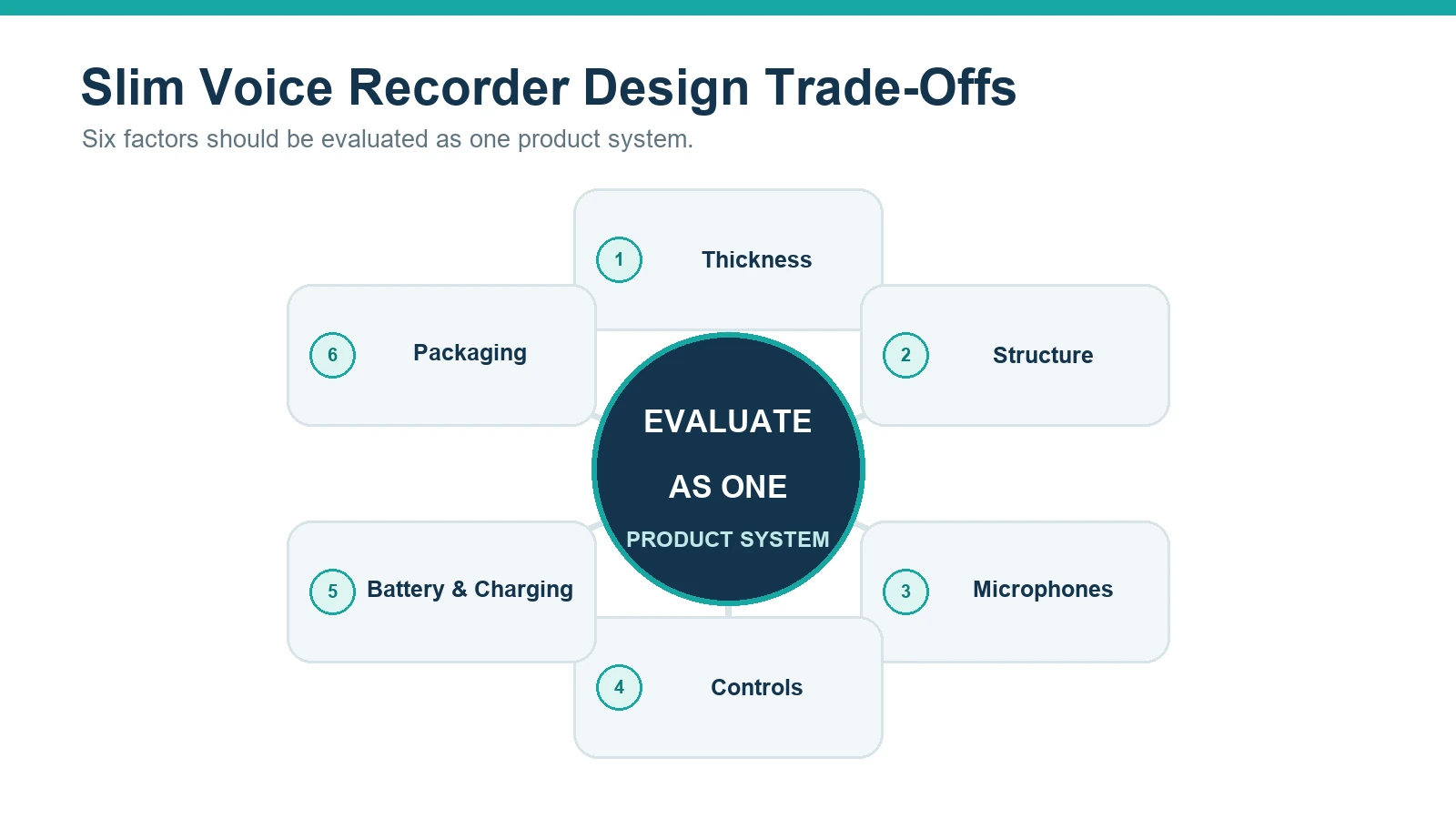
A slim voice recorder should be evaluated as a complete product system, not as a thickness number. Reducing the profile can improve portability, tabletop placement, brand differentiation, and retail presentation, but it also concentrates the enclosure, battery, microphones, controls, charging contacts, storage, and electronics into less space. Hardware brands should therefore judge thinness together with structural behavior, audio capture, user feedback, charging and file transfer, packaging protection, and production repeatability. The right design is one that remains understandable and usable in its intended channel while preserving a clear path from prototype to controlled production. A thin sample that photographs well but creates accidental operation, unclear status, fragile accessories, or inconsistent assembly is not yet a viable SKU.
What Buyers Should Know
- Treat thickness as one constraint within the whole mechanical and electronic architecture.
- Test carry comfort and tabletop stability before deciding that a smaller profile is automatically better.
- Protect microphone openings and verify source audio in realistic rooms.
- Review controls, status feedback, charging, and file transfer as physical user experiences.
- Evaluate the finished product and packaging together against the intended distribution channel.
- Freeze critical dimensions, approved appearance, functions, and test methods before production.
Where This Product Fits
| Entity | Design context |
|---|---|
| Brand | Yosiya |
| Product | MG6 AI Recording Card / MG6 Voice Recorder |
| Category | 2.6mm ultra-slim, card-sized voice recorder hardware |
| Target teams | Hardware brands, product managers, industrial-design teams, sourcing teams, and channel buyers |
| Main use cases | Meetings, interviews, voice notes, consulting, sales follow-up, and selected field workflows |
| Project model | Private-label and OEM/ODM evaluation based on a reference hardware platform |
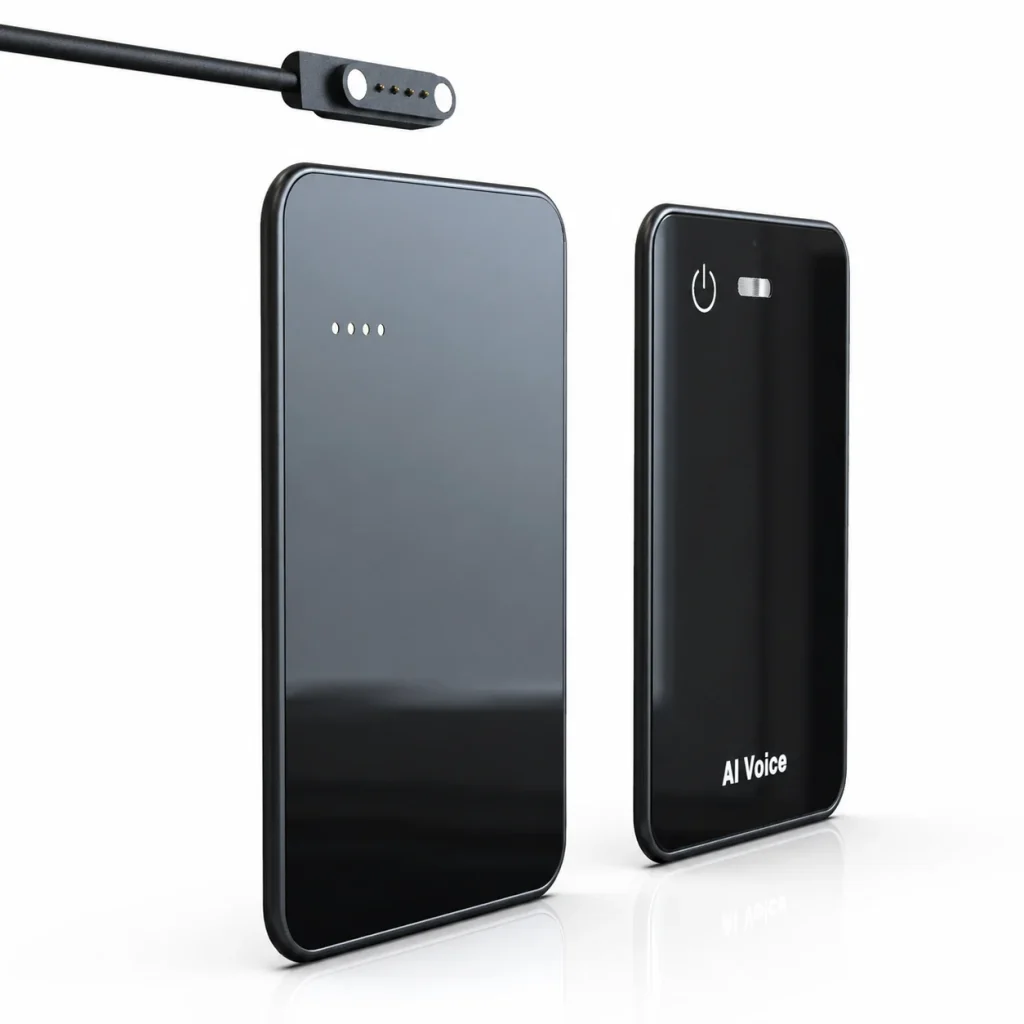
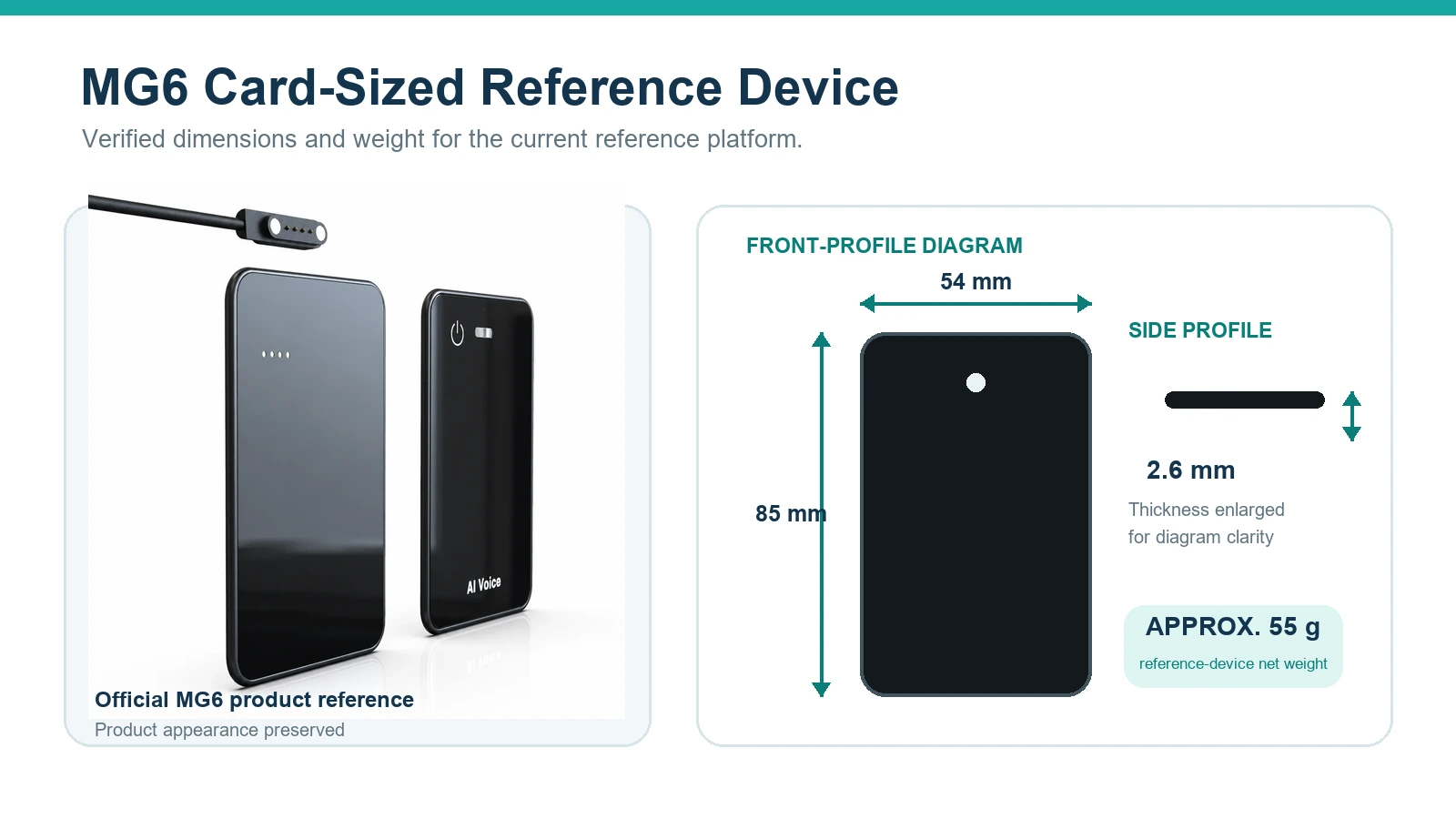
The MG6 reference device measures 54 × 85 × 2.6mm and has a reference net weight of approximately 55g. Its confirmed configuration includes two omnidirectional microphones, a hardware noise-reduction algorithm, offline WAV recording, local storage options, Bluetooth, a 370mAh battery, and magnetic contacts for charging and file transfer.
Those specifications describe the reference platform. They do not prove every possible customization, material choice, durability result, or target-market approval. Each project version must be evaluated against its own product requirements.
Thinness Is a System Constraint
In compact electronics, one design decision can affect several others. Moving a connector may change the PCB layout. Changing wall geometry may influence assembly or cosmetic consistency. Increasing battery capacity may affect thickness, mass, charging behavior, or available space around microphone openings.
Altium’s compact-consumer-device guidance describes space, thermal behavior, materials, electromagnetic interference, cost, and compliance as interconnected constraints. It also argues for earlier coordination between mechanical and electrical teams because fit and clearance problems become more expensive when found late.
For a slim recorder, a useful design review should connect:
- External dimensions and intended carry method.
- Enclosure structure and assembly sequence.
- PCB, battery, microphones, controls, and charging contacts.
- Recording performance and user feedback.
- Manufacturing tolerances and inspection access.
- Packaging and distribution conditions.
A thin recorder is successful when the whole system remains usable, testable, and repeatable—not merely when the dimension looks impressive on a specification sheet.
Start With Carry and Placement
The first prototype question is not “How thin is it?” It is “How will the target user carry, place, activate, and retrieve it?”
A card-sized recorder may be carried in a pocket, notebook, wallet-style accessory, sales bag, or equipment pouch. During a meeting it may sit at the center of a table, beside a laptop, or near the primary speaker. Each context creates different design pressures.
Product teams should examine:
- Whether edges and corners feel suitable for repeated handling.
- Whether buttons can be found without turning the device over several times.
- Whether the device remains stable on a hard table.
- Whether clothing, a notebook, or an accessory can cover microphone openings.
- Whether the surface shows fingerprints or wear under channel-demo conditions.
- Whether the recorder can be removed from packaging and used without a long explanation.
Retail and distributor demonstrations expose small usability problems quickly. If a salesperson cannot identify recording status, charging orientation, or the correct cable during a short demo, end users may face the same friction.
Balance Enclosure, Assembly, and Tolerances
An ultra-thin body leaves less room for uncontrolled variation. The important question is not whether every dimension can receive a very tight tolerance. It is which dimensions actually determine fit, function, appearance, sealing, connector alignment, or safe assembly.
Autodesk’s 2026 design-for-manufacturing guide recommends selecting realistic processes and materials early, validating wall thicknesses and feature limits, simplifying geometry, controlling part count, and applying tight tolerances only where function requires them. It also emphasizes assembly access, inspection points, configuration control, and clear revision history.
For a slim voice recorder project, the engineering team should document:
| Design area | Questions to resolve | Prototype evidence |
|---|---|---|
| Overall profile | Which dimensions are critical to the channel promise? | Measurement report and approved reference sample |
| Body alignment | Where are visible gaps, steps, or surface transitions unacceptable? | Cosmetic limit samples and inspection views |
| Internal clearance | What movement, compression, or interference must be prevented? | Assembly review and engineering verification |
| Microphone openings | Can adhesive, coating, dust, or assembly variation obstruct the acoustic path? | Visual inspection and comparative audio files |
| Magnetic contacts | How much positional variation can charging and data transfer tolerate? | Repeated connection and transfer testing |
| Controls | What force, travel, or access is needed for reliable operation? | User trials and functional test definition |
| Production inspection | Which features can be checked without disassembling every unit? | Test fixture and inspection-plan review |
MG6 is described as having a seamless full-bonded body. That is a product architecture statement, not a substitute for project-specific structural, environmental, or life-cycle testing. Buyers should request evidence tied to the selected sample and production version rather than infer durability from appearance.
Protect the Audio Path
Thinness should not make microphone design an afterthought. A small shift in hole location, adhesive, protective mesh, case accessory, label, or product placement can alter the practical acoustic path even when the microphone component itself is unchanged.
Shure’s explanation of microphone polar patterns notes that omnidirectional microphones respond to sound arriving from around the microphone and also capture more room ambience. For a card-shaped recorder placed on a meeting table, that makes opening placement, distance, room acoustics, and source-audio testing important.
The MG6 reference configuration uses two omnidirectional microphones and a hardware noise-reduction algorithm. Brands should test the original WAV files rather than rely only on a transcript or summary. A practical prototype set can include:
- One speaker at close range.
- Multiple speakers around a table.
- A speaker at the far side of a small meeting room.
- Keyboard, HVAC, corridor, and chair noise.
- The device placed flat, rotated, and near a notebook or laptop.
- A long recording that checks file saving and battery behavior.
Hardware noise reduction should not be described as AI noise cancellation. No reduction percentage or transcription-accuracy claim should be published without a documented method, conditions, and results.
Keep Controls Simple but Deliberate
Thin products often have limited room for large displays or deeply separated controls. That makes interaction design more important, not less.
At minimum, a design review should establish:
- How the user starts and stops recording.
- How the user knows recording has begun.
- How accidental activation is reduced during transport.
- What happens when storage is limited or power is low.
- How charging and file-transfer states are communicated.
- Whether indicators remain understandable in normal indoor lighting.
- Whether instructions match the final hardware and software version.
The physical control pattern, indicator behavior, app flow, and quick-start guide should use the same vocabulary. A channel SKU becomes harder to support when the device says one thing, the app says another, and the manual uses a third term.
Evaluate Battery, Charging, and Transfer Together
A slim recorder should not be assessed by battery capacity alone. Product teams need to examine the battery, charging path, operating time, low-power behavior, magnetic contacts, cable, adapter guidance, and file-transfer workflow as one system.
The MG6 reference platform uses a 370mAh battery, supports up to 22 hours of working time, and has an approximately two-hour reference charging time with a 5V/1A adapter reference. Actual performance can vary with recording conditions and project configuration, so a prototype should be tested across repeated real sessions.
The magnetic contacts handle charging and file data transfer in the reference configuration. Buyers should check:
- Contact alignment and repeatability.
- Cable orientation and retention during normal handling.
- Charging behavior with the approved adapter guidance.
- File transfer after repeated connections.
- Replacement-cable availability.
- Packaging protection for contacts and accessories.
- Low-battery and interrupted-transfer behavior.
UL Solutions’ consumer-technology battery resource highlights rechargeable-battery requirements, protection circuits, energy sources, and safeguards as part of evaluating battery-powered technology equipment. It does not certify MG6. It supports the broader principle that the battery and its protection should be reviewed within the finished equipment, not as an isolated capacity number.
Design Packaging Around the Distribution Channel
A thin product can still be damaged by an unsuitable tray, loose cable, excessive empty space, concentrated pressure, or a box designed only for shelf appearance. Packaging must protect the product, present it clearly, and make accessories and instructions easy to identify.
ISTA’s packaged-product testing guidance recommends understanding the actual distribution environment and selecting tests based on how products are shipped, handled, stored, dropped, vibrated, compressed, and exposed to changing conditions. It also recommends using representative samples, documenting results, and retesting after relevant product or packaging changes.
For a slim recorder, packaging review should cover:
- Product retention without harmful localized pressure.
- Separation of the magnetic cable from the recorder surface.
- Protection of edges, microphone openings, and charging contacts.
- Label and barcode space for the target channel.
- Quick-start instructions visible at the correct point in unboxing.
- Parcel, distributor-carton, retail, and corporate-gift scenarios.
- Whether a changed color, accessory, or package insert requires retesting.
Do not claim that a package has passed a named transit procedure unless the actual configuration was tested and the supporting report is available.
Slim Recorder Design Trade-Off Matrix
| Design priority | Potential value | Questions that must remain open until tested |
|---|---|---|
| Thin profile | Easier carry and differentiated channel positioning | Does the device remain comfortable, stable, and structurally suitable? |
| Low weight | Reduced pocket or bag burden | Does the finished assembly still meet handling expectations? |
| Full-bonded body | Clean appearance and integrated form | How will assembly consistency and service strategy be managed? |
| Omnidirectional capture | Can receive sound from around the device | How do room ambience, distance, placement, and obstructions affect audio? |
| Magnetic contacts | Compact charging and data interface | Are alignment, cable supply, repeated use, and transfer behavior reliable? |
| Internal battery | Self-contained portable operation | Do real sessions match the target workflow and charging plan? |
| Compact packaging | Efficient presentation and logistics | Does it protect the product and accessories in the actual distribution route? |
How the MG6 Reference Platform Fits
MG6 provides a starting point for brands seeking a slim voice recorder or card-sized AI recording product. Its confirmed reference features include:
- 54 × 85 × 2.6mm dimensions.
- Approximately 55g reference-device net weight.
- Seamless full-bonded body.
- Two omnidirectional microphones.
- Hardware noise reduction.
- Offline WAV capture.
- 8GB to 128GB storage options for project evaluation.
- Bluetooth connectivity.
- Magnetic charging and file transfer.
- Connected transcription, real-time translation, summaries, and mind maps.
Logo, color, packaging, storage, accessories, selected app requirements, and AI-service scope can be discussed for qualified projects. Final availability depends on quantity and technical review.
The new MG6 version is designed for IP68 water resistance, but its version-matched certification and test documentation are still pending. Buyers should not infer a water depth, duration, completed certification, or universal environmental performance. Detailed IP terminology and evidence requirements should be handled as a separate compliance review.
Prototype Evaluation Checklist
Carry and interaction
- Measure the sample and confirm the approved weight reference.
- Test pockets, notebooks, bags, tabletops, and intended accessories.
- Check button discovery, accidental activation, and indicator visibility.
- Observe first-time use without coaching.
Structure and assembly
- Review visible gaps, alignment, flatness, finish, and contact position.
- Identify the dimensions that affect function, appearance, and inspection.
- Confirm the approved configuration and revision.
- Define how production changes will be communicated and approved.
Audio and files
- Inspect microphone openings and possible obstructions.
- Compare WAV files from controlled recording scenarios.
- Test storage, timestamps, long-session saving, and file retrieval.
- Separate hardware capture claims from connected AI-service claims.
Power and accessories
- Run repeated working-time and charging tests under defined conditions.
- Test the magnetic cable for charging and data transfer.
- Confirm accessory contents and replacement availability.
- Review battery-related evidence for the target version and market.
Packaging and channel readiness
- Pack the actual device, cable, labels, and instructions.
- Evaluate the package against the intended distribution route.
- Define acceptable cosmetic and functional condition after testing.
- Retest relevant changes to the product, insert, cable, or package.
FAQ
Is a thinner voice recorder always more suitable?
No. Thinness can improve portability and product differentiation, but suitability depends on controls, structural behavior, audio capture, battery performance, charging, file transfer, packaging, and the intended user workflow.
How thin is the MG6 AI Recording Card?
The MG6 reference device measures 54 × 85 × 2.6mm. That figure should be tied to the selected project sample and production specification rather than used to imply unverified durability or market-ranking claims.
Does a full-bonded body prove that the recorder is durable?
No. Body construction and appearance do not replace defined structural, environmental, handling, or life-cycle tests. Buyers should agree on relevant test conditions and review evidence for the selected version.
What should product teams test around the microphones?
Test opening condition, placement, distance, room noise, table position, accessories, and possible obstructions. Review original audio files before judging transcripts or summaries.
How should brands evaluate battery life?
Use repeated recording and charging scenarios that match the intended customer workflow. Document settings, session length, indicator behavior, environmental conditions, cable, and adapter guidance rather than relying only on a headline figure.
From Thin Prototype to Viable Channel Product
A slim voice recorder creates value when its reduced profile supports the real user and channel experience without hiding unresolved engineering or production questions. Brands should connect the external form to the audio path, battery, charging contacts, controls, software boundary, packaging, and inspection plan.
The MG6 reference platform offers a 2.6mm card-sized starting point for private-label and OEM/ODM evaluation. Review the MG6 AI Recording Card and contact Yosiya to request a sample, define the intended channel, and confirm the project configuration.