Sourcing a small audio recorder for a brand or channel program requires more than comparing dimensions and quoted prices. Buyers need to define the intended user, test source audio in realistic settings, review battery and storage workflows, and document exactly what the approved sample represents. Packaging, accessories, software scope, compliance evidence, and shipment preparation also affect whether a promising sample becomes a reliable SKU. For a card-sized recorder, compactness is valuable only when the controls, microphones, file transfer, charging method, and after-sales documents still fit the target channel. The practical goal is therefore not to find the smallest device in isolation, but to select a recorder platform that can be evaluated, branded, produced, inspected, and supported with clear acceptance criteria.
What Buyers Should Know
- Define the recording use case before requesting samples.
- Compare physical size together with microphone placement, controls, battery behavior, storage, and file retrieval.
- Test original audio files rather than judging only an AI-generated transcript.
- Record every approved hardware, packaging, accessory, app, and service detail in the project specification.
- Confirm that compliance and transportation documents match the selected production version.
- Treat MOQ and lead time as configuration-dependent project terms, not universal promises.
Where This Product Fits
| Entity | B2B role |
|---|---|
| Brand | Yosiya |
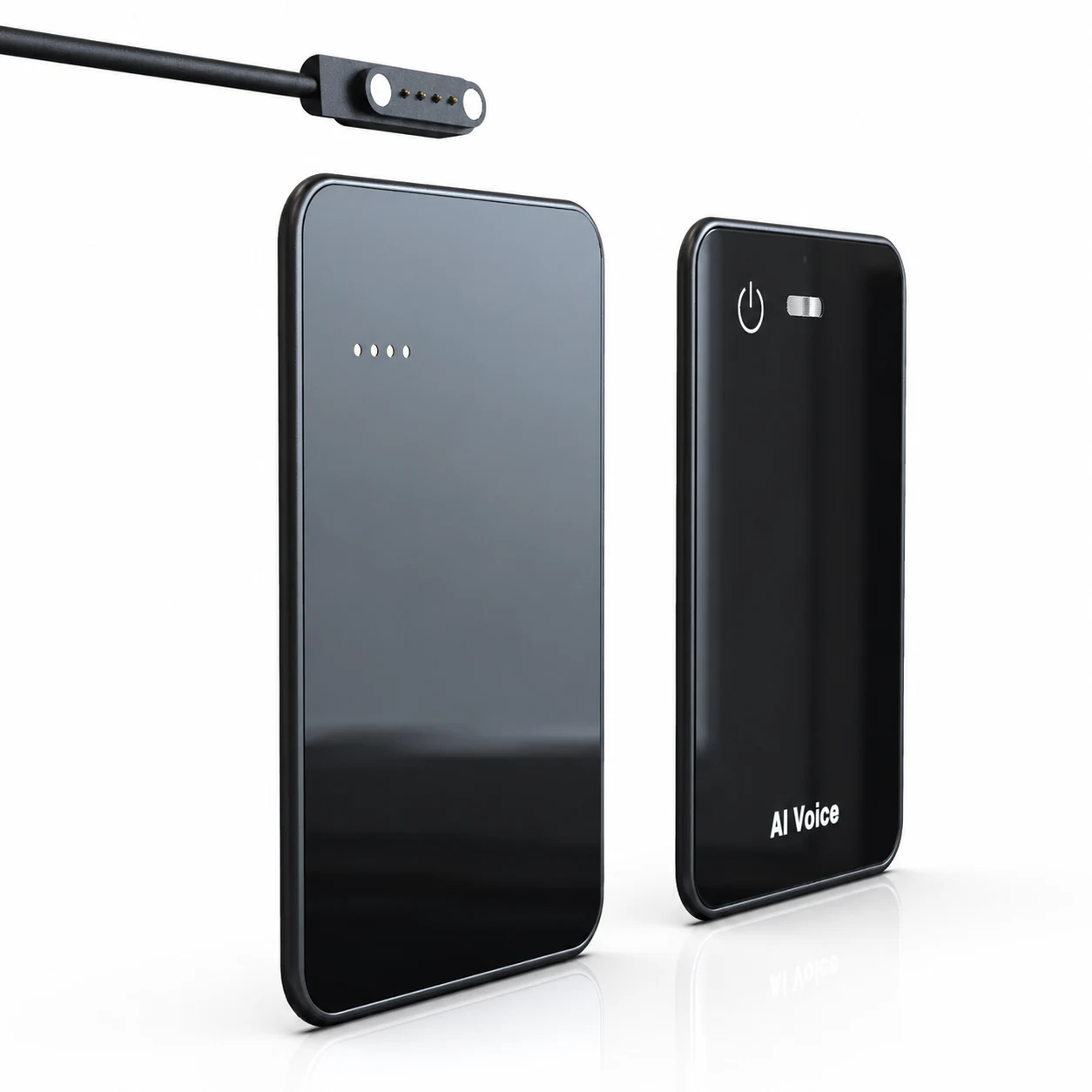
| Product | MG6 AI Recording Card / MG6 Voice Recorder |
| Category | Card-sized small audio recorder with offline capture and connected AI services |
| Suitable buyers | Consumer-electronics brands, product teams, sourcing managers, distributors, corporate-gift channels, and private-label partners |
| Primary use cases | Meetings, interviews, voice notes, sales follow-up, research, consulting, and selected field workflows |
| Commercial model | Sample evaluation, private label, and OEM/ODM project discussion |
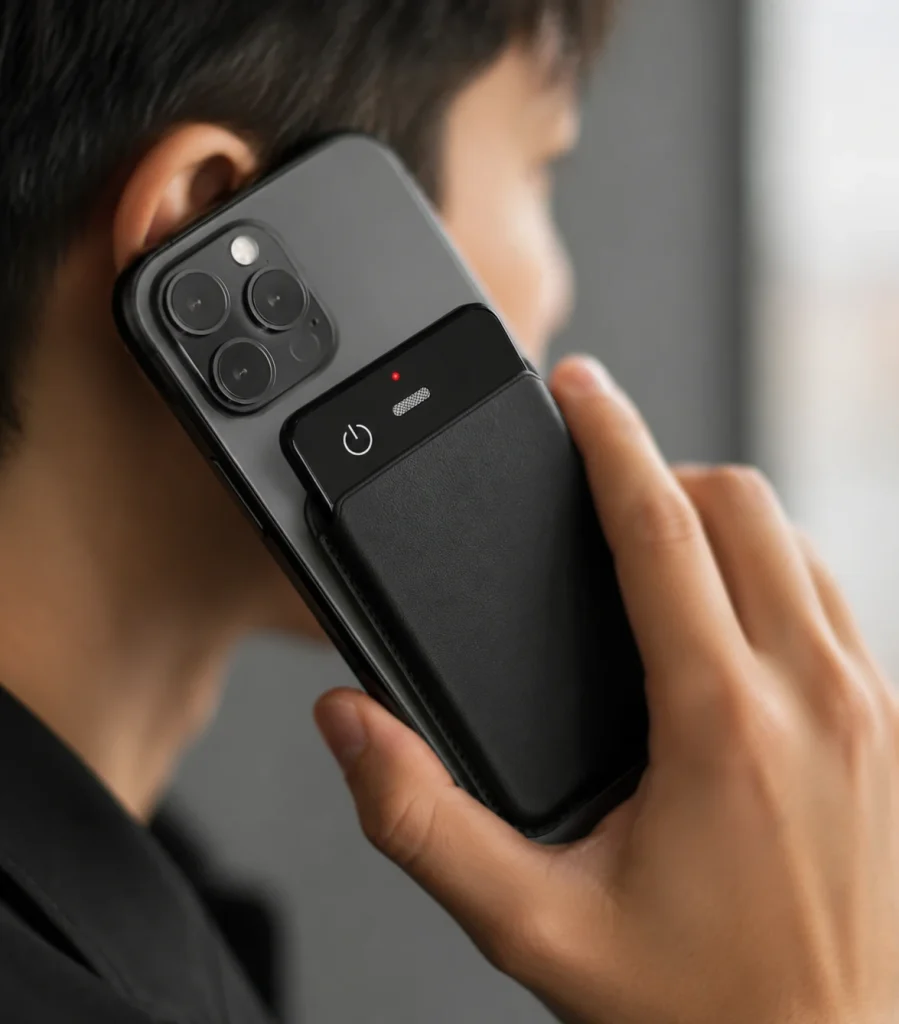
The MG6 reference platform combines a 54 × 85 × 2.6mm card-sized profile with two omnidirectional microphones, a hardware noise-reduction algorithm, offline WAV recording, local storage options, and connected services for transcription, translation, summaries, and mind maps. Those layers should be reviewed separately. A buyer should not assume that approving the enclosure automatically approves the app, AI service plan, language coverage, or data workflow.
Define the Target SKU and Channel
A useful sourcing brief begins with the customer and sales environment. A recorder intended for executive meeting notes has different priorities from one sold through a corporate-gift channel or supplied to a field-service team.
Before contacting suppliers, write down:
- The main recording scenarios and typical session length.
- The number of speakers, room size, and expected noise conditions.
- Whether recording must continue without a phone or network.
- How users will retrieve, name, store, and delete files.
- Which app or connected AI functions are required.
- The target country, channel, retail price position, and launch timing.
- Required logo, color, packaging, language, manual, and accessory options.
This prevents a common sourcing problem: a sample looks attractive in a short demonstration, but the team has not agreed on what the finished SKU must accomplish. A low unit price is not helpful if the file-transfer workflow, packaging contents, or AI-service scope remains unclear.
Compare Specifications That Affect the Workflow
Size and weight matter, but they should be evaluated alongside the complete recording path.
| Evaluation area | Questions for the supplier | What the buyer should verify |
|---|---|---|
| Form factor | What are the finished dimensions and reference weight? | Measure the sample and test pocket, wallet, notebook, and tabletop use |
| Microphones | How many microphones are used, and where are they located? | Record speakers from different positions and distances |
| Noise processing | Is processing performed in hardware, software, or a connected service? | Compare original files under controlled noise conditions |
| Recording format | Which formats and recording settings are supported? | Inspect actual files and confirm compatibility with the intended workflow |
| Storage | Which capacities are standard or optional? | Confirm the selected production SKU and usable file-management process |
| Battery | What test conditions support the working-time claim? | Run repeated session tests with the intended settings |
| Charging and transfer | Which cable, contacts, app, or computer connection is required? | Test charging, file transfer, replacement accessories, and user instructions |
| Connected services | Which transcription, translation, summary, or organizational functions are included? | Confirm language coverage, usage allowance, account flow, and service terms |
The MG6 reference device is specified at approximately 55g and offers 8GB to 128GB storage options for project evaluation. It has a 370mAh battery, up to 22 hours of working time, magnetic charging and file data transfer, and an approximately two-hour reference charge time. Final storage configuration and real-world battery performance should still be confirmed for the selected project version and use conditions.
Test Source Audio Before Evaluating AI Output
An AI summary can look convincing even when the original audio contains missed words, clipped speech, or overlapping speakers. Buyers should therefore listen to the WAV files before reviewing transcripts and summaries.
AWS’s speech-to-text overview explains that clear, intelligible recordings with limited background noise help speech-recognition systems process audio more accurately. That guidance is not a performance claim for any specific recorder, but it provides a useful reason to evaluate source audio before judging a transcript.
Build a repeatable test set that includes:
- A quiet one-to-one conversation.
- A four-to-six-person meeting around a table.
- A room with HVAC, keyboard, or corridor noise.
- Speakers at different distances from the recorder.
- Overlapping speech and low-volume comments.
- A long session that tests battery behavior and file saving.
- Product names, acronyms, and proper nouns relevant to the buyer’s business.
Use the same room, recorder position, speaking script, and file-review method for competing samples. Keep the original files and write down the settings. Do not describe MG6 hardware noise reduction as “AI noise cancellation,” and do not publish an improvement percentage without a documented test method and results.
Review Storage, Charging, and File Transfer as One System
Storage capacity is only useful when users can locate and move files reliably. During sample review, create multiple recordings, reconnect the device, copy the files, rename them, and confirm what happens when storage becomes limited or the battery is low.
Check whether:
- File names are understandable and sortable.
- Timestamps remain correct after charging or reconnecting.
- The magnetic cable supports both the required charging and data functions.
- Replacement cables and accessories can be supplied.
- The recorder can capture locally when the app or network is unavailable.
- Users can distinguish local audio from cloud transcripts and summaries.
- Deletion instructions cover the recorder, phone, computer, and connected service where applicable.
For MG6, offline recording means that WAV audio can be captured locally without requiring the app during the recording stage. It does not mean that transcription, translation, summaries, or mind maps run fully offline. Those functions belong to the connected AI-service layer and require project-specific confirmation.
Confirm Branding, Packaging, and Support Materials
A private-label project is more than placing a logo on the enclosure. Channel buyers should review the complete unboxing and support experience.
The project specification should identify:
- Logo artwork, position, size, color, and application method.
- Product color and surface-finish reference.
- Storage configuration and model identification.
- Retail box structure, inserts, labels, and barcode locations.
- Included magnetic cable and other accessories.
- Manual and quick-start-guide languages.
- App branding or interface changes, if included.
- AI-service language coverage and usage plan.
- Warranty, replacement, and after-sales responsibilities.
The MG6 platform supports discussion of logo, color, packaging, storage, accessories, selected app requirements, and AI-service scope. Final availability depends on quantity and technical review. Product MOQ starts at 100 units, logo customization starts at 500 units, and custom production lead time is approximately 35 days. Final quantity and timing depend on the selected configuration, artwork and material readiness, approved samples, and the agreed production plan.
Turn the Approved Sample Into a Production Standard
“Same as sample” is too vague for a purchase order. The approved unit should be connected to a controlled specification containing photographs, dimensions, functional requirements, file behavior, packaging contents, cosmetic limits, and test procedures.
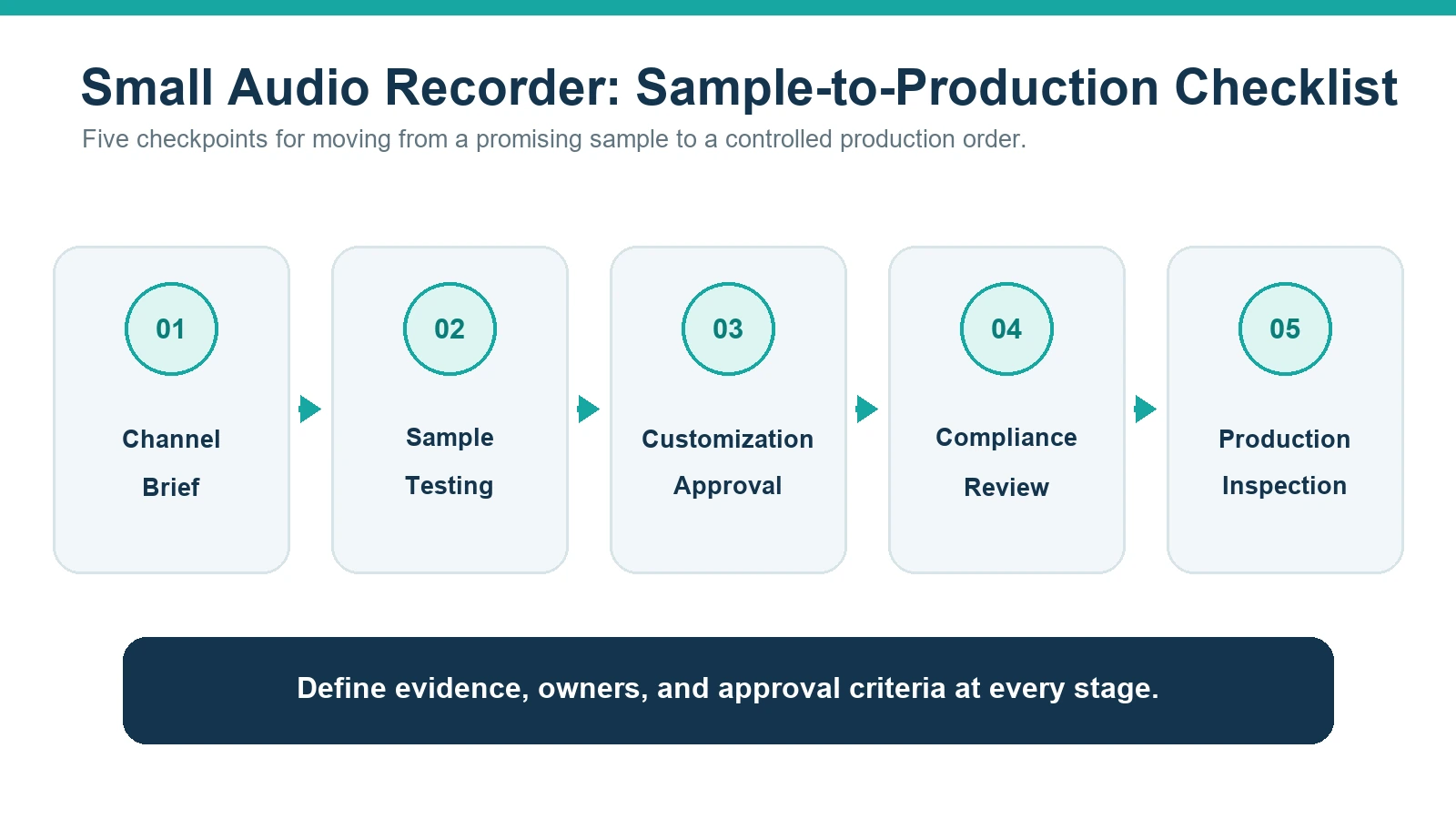
ISO’s quality-assurance overview describes supplier auditing, testing protocols, performance testing, incoming checks, and production-process controls as parts of preventive quality management. For recorder projects, that principle can be translated into three checkpoints:
- Pre-production approval: freeze the selected hardware, storage, color, logo, packaging, accessories, firmware, app scope, and AI-service assumptions.
- Production control: confirm inspection items, test equipment, sample records, defect handling, and change approval.
- Pre-shipment verification: inspect appearance, recording, charging, file transfer, packaging, labels, quantities, and required documents.
For lot inspection, ISO 2859-1:2026 defines acceptance-sampling schemes indexed by an acceptance quality limit. Buyers do not need to copy a generic AQL number into a purchase order without thought. They should define defect categories and choose an inspection plan appropriate to product risk, order size, channel expectations, and contractual requirements.
Check Shipping and Conformity Evidence
Compact recorders contain batteries and may also use Bluetooth or connected software. The document package therefore depends on the product configuration, destination, transport route, and local requirements.
IATA’s battery guidance explains that air-transport requirements vary with battery type, configuration, and watt-hour rating, and that manufacturers, retailers, wholesalers, freight forwarders, and other supply-chain participants need appropriate preparation. Before shipping samples or production units, buyers should confirm the current battery test summary, packaging, markings, labels, carrier requirements, and shipment documents with qualified logistics partners.
Product conformity also needs precise language. ISO/CASCO’s conformity-assessment guidance distinguishes first-party supplier declarations, second-party assessments, and third-party attestations. A factory management-system certificate is not automatically evidence that a particular recorder model meets every product requirement.
For the new MG6 version, version-matched certification and test documentation are still pending. Buyers should confirm the required document package for the selected production version and target market before shipment or launch. No named certification should be treated as complete until the certificate, model identity, scope, and supporting evidence have been checked.
A Sample-to-Production Checklist
Use this checklist before approving a small audio recorder project:
Product and audio
- Confirm dimensions, reference weight, materials, finish, and controls.
- Test microphone placement and original audio in defined scenarios.
- Verify recording format, storage configuration, battery behavior, and charge time.
- Walk through charging, file transfer, naming, backup, and deletion.
Software and AI services
- Separate offline recording functions from connected processing.
- Confirm supported devices, account flow, languages, usage allowances, and service availability.
- Document any app branding, interface adaptation, or selected software requirements.
- Review privacy, consent, retention, and support responsibilities.
Branding and channel readiness
- Approve logo artwork, color reference, packaging, labels, manual, and accessories.
- Test the retail or corporate-gift presentation with the actual contents.
- Confirm model identification across device, packaging, documentation, and software.
Production and logistics
- Link the approved sample to a controlled specification.
- Define inspection items, defect classes, sampling method, and change-control process.
- Confirm version-matched conformity evidence and battery-shipping documents.
- Agree on MOQ, production timing, payment milestones, shipment plan, and after-sales process.
FAQ
What should a B2B buyer test first on a small audio recorder?
Start with the original audio in the intended environment. Then verify controls, battery behavior, storage, charging, file transfer, and the complete user workflow. AI transcripts and summaries should be evaluated after the source recording.
What can be customized for a private-label MG6 project?
Logo, color, packaging, storage, accessories, selected app requirements, and AI-service scope can be discussed. Final scope depends on order quantity, technical review, and the target-market project requirements.
What are the current MG6 MOQ and lead-time references?
Product MOQ starts at 100 units, logo customization starts at 500 units, and custom production lead time is approximately 35 days. Final terms depend on configuration, customization scope, material readiness, sample approval, and the production plan.
Is the new MG6 version already certified?
Its version-matched certification package has not yet been issued. Buyers should confirm all required documents for the exact production version and target market before shipment or launch.
What should be included in an approved production specification?
Include the hardware configuration, dimensions, finish, storage, functional tests, firmware or software scope, packaging, accessories, labels, manuals, inspection criteria, approved reference images, and change-control requirements.
Source the Workflow, Not Just the Device
A small audio recorder becomes a viable B2B product when the hardware, source-audio quality, file workflow, branding, packaging, software scope, quality controls, and documentation all support the intended channel. The MG6 provides a compact reference platform for that evaluation, but every production project should be defined by a controlled configuration and evidence package.
Review the MG6 AI Recording Card and contact Yosiya to request a sample, confirm the target configuration, and discuss private-label or OEM/ODM requirements.