You run a DTC brand. You sell on Amazon, on Shopify, or through your own site. You have built an audience — parents who trust your curation, your aesthetic, your point of view on what makes a good product for kids. You see the AI toy category growing, you know your customers are searching for it, and you want to offer something with your name on it.
The barrier that stops most brand owners is the assumption that creating an AI hardware product requires an engineering team, a year of R&D, and a seven-figure development budget. It does not — if you partner with the right OEM platform instead of building from scratch. This article walks through what private-labeling an AI toy actually involves, from the first conversation with an OEM partner to the first shipment arriving at your warehouse.
Why Private Label an AI Toy Instead of Building or Reselling
There are three ways to enter the AI toy category, and they are not equally accessible.
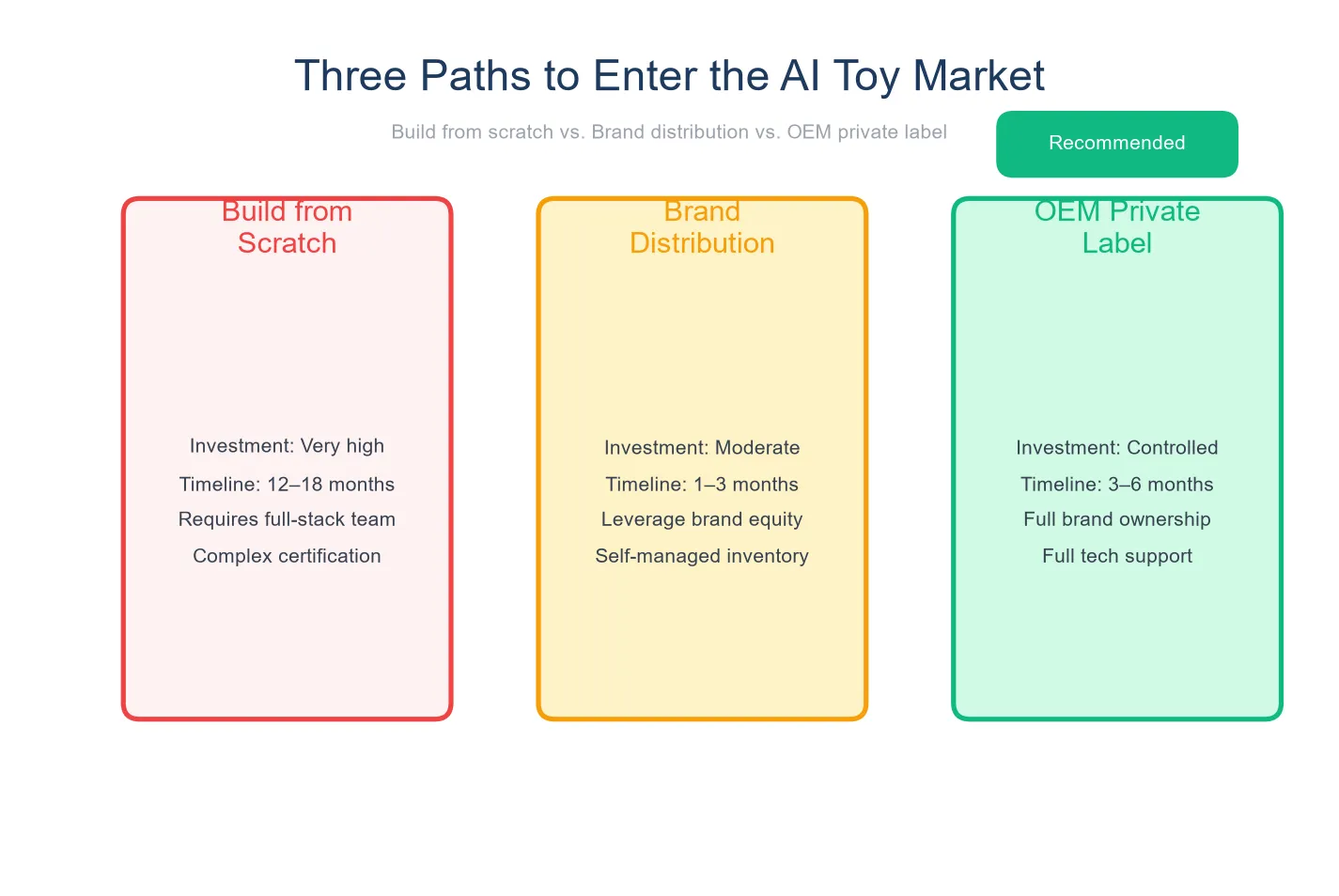
Build from scratch. You hire an industrial designer, an electronics engineering team, and an AI/software team. You develop a custom PCB, source components, write the AI conversation stack from scratch or integrate third-party LLM APIs, navigate FCC/CE/RoHS/CPC certification, cut injection molds, and manage production. Timeline: 12–18 months. Budget: $200,000–500,000+. This path makes sense for venture-backed hardware startups with a genuinely novel product concept. For a brand looking to add an AI toy SKU to an existing product line, it is disproportionate.
Resell an existing brand’s product. You buy wholesale from Miko, BDI, or another established brand. Your margin is compressed by the brand’s wholesale markup, you have zero control over product features or design, and your customers can price-compare you against Amazon in five seconds. This is a distribution play, not a brand play.
Private label through an OEM platform. You partner with an OEM platform that has already solved industrial design, AI integration, certification, and manufacturing. You customize the product to your brand — logo, colors, packaging, AI personality, content scope. The hardware is proven; the brand is yours. Timeline: typically 3–5 months from contract to first shipment, depending on customization depth. This path is designed for exactly the scenario most brand owners face: a market opportunity exists, the product category is validated, and the missing piece is a partner who can turn a brand vision into a manufactured product.
Building an AI toy from scratch today is like building your own smartphone in 2010 to launch a mobile app. The hardware platform exists. The brand is what you bring.
What Private Label Means on the K1 Platform
Private label is not a logo sticker on a white-box product. On a platform built for AI hardware, it should span five customization layers:
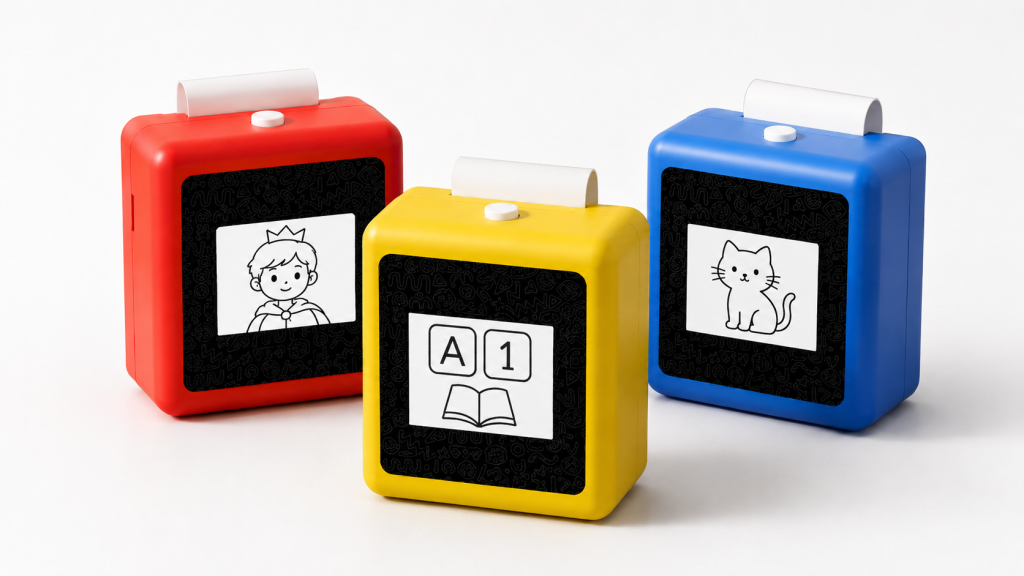
Appearance. The K1 reference platform supports four base color options — China Red, Sky Blue, Yellow, Pink — with custom colors available. Logo placement, branding, and packaging design are brand-controlled. The 98 × 57 × 117mm form factor and 225g weight are shared across variants; the visual identity is yours.
AI personality and behavior. This is the layer that separates a private-label AI toy from a generic one. The K1 platform’s AI dialogue engine is configurable: the AI’s conversational personality (playful, educational, gentle, energetic), language, and subject focus can be adjusted to match your brand’s voice. A Montessori-aligned brand might configure a calm, question-driven AI that encourages exploration. A STEM-focused brand might configure an enthusiastic AI that suggests experiments and asks science questions. The AI is the same engine; the experience feels like your product.
The exact range of AI configuration available depends on the confirmed project version. Brands should discuss their AI behavior requirements during the consultation phase to confirm what is achievable.
Output format. The K1 prints on 57mm thermal paper. The platform supports two paper types — standard thermal paper (approximately 40 images per roll, varying with image coverage) and optional adhesive sticker paper. A brand targeting creative play might emphasize sticker output. A brand targeting learning might emphasize card-format output for flashcards and fact sheets.
Packaging and unboxing. The physical product arrives in a box with your brand’s design, your messaging, your unboxing experience. For DTC brands where the unboxing is part of the brand experience — and often part of the social media content — this layer matters as much as the product itself.
After-sales positioning. Your brand sets the warranty terms, the customer support experience, the return policy, and the community around the product. The OEM platform provides technical support infrastructure; the brand relationship with the customer is yours to define.
The Customization Checklist: What to Decide Before You Contact an OEM Partner
Walking into an OEM conversation prepared saves weeks of back-and-forth. Have answers to these questions before you request a quotation.
- Brand identity. What is your brand voice? Playful and silly, or calm and educational? This determines AI personality configuration.
- Target age range. 4–6? 5–8? 6–10? This determines AI language complexity, content boundaries, and packaging messaging.
- Primary use case. Creative play? Learning support? Gift market? The use case drives paper type selection, AI content scope, and marketing copy.
- Color preference. Which of the four base colors fits your brand palette, or do you need a custom color?
- Packaging vision. Premium rigid box for gift market, or efficient retail packaging for Amazon? Does your packaging need to be shelf-ready or shipping-ready?
- Market and certifications. US only, or EU as well? This determines the certification package you need — FCC, CE, RoHS, CPC — and whether additional market-specific certification is required.
- Volume estimate. The K1 platform’s MOQ is 1,000 units (60 per carton). Having a rough volume projection — pilot run of 1,000, scaling to 3,000–5,000 — helps the OEM partner structure commercial terms.
- Channel strategy. Amazon FBA? Shopify DTC? Wholesale to retailers? The channel affects packaging design, barcode requirements, and potentially the certification documentation you need.
The Brand → Product → Channel Launch Plan
A private-label AI toy launch follows a sequence. The steps below assume
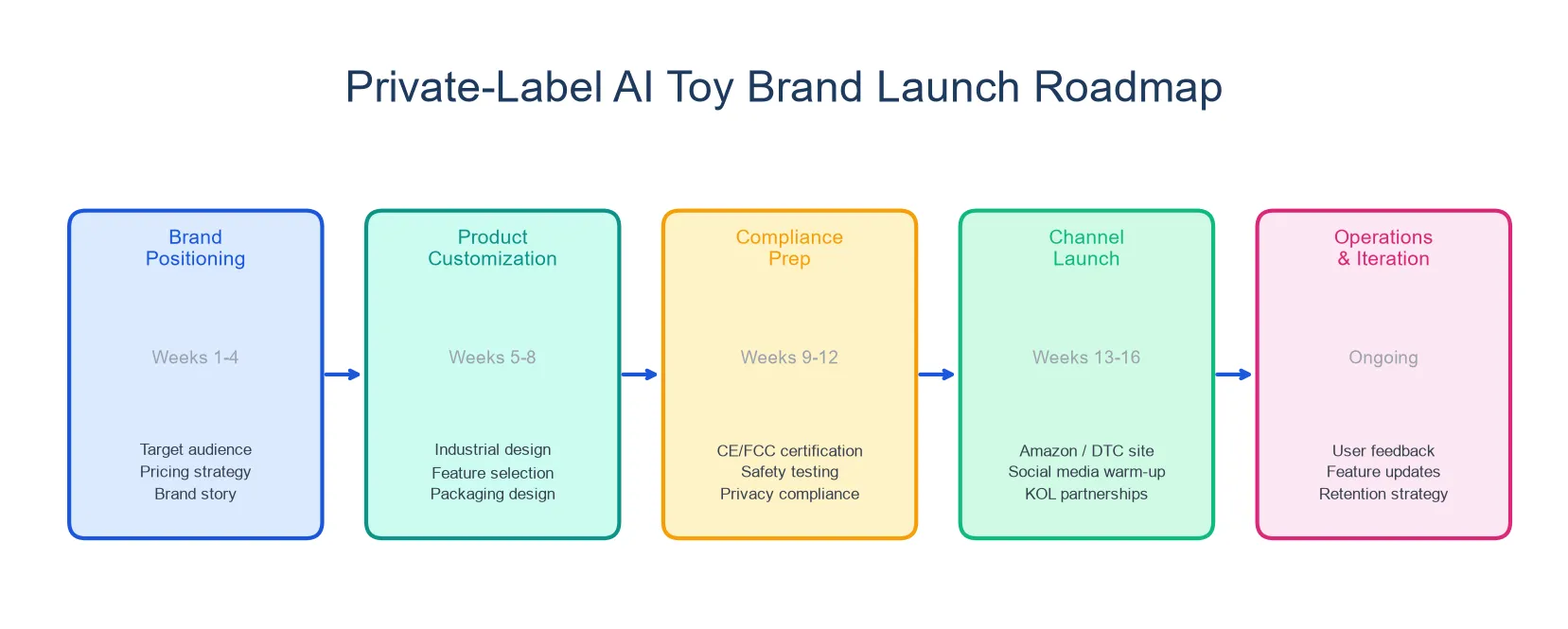
a partnership with an OEM platform that already has a production-ready reference product — the K1 AI Printer, in this case — and the brand is customizing rather than developing from scratch.
Phase 1: Brand Definition (Weeks 1–2)
Before engaging the OEM partner in depth, define your brand positioning for this product. What makes your version of an AI toy different from every other version using the same hardware platform?
The answer is rarely “better specs.” The hardware is shared. The differentiation comes from three things: your AI personality configuration (the voice and tone of the AI), your content curation (what subjects, activities, and conversation styles the AI emphasizes), and your brand’s relationship with its audience (the trust, the community, the customer experience).
A DTC brand that has spent two years building trust with millennial parents through thoughtful content has a different value proposition than a mass-market Amazon seller competing on price. Both can private-label the same hardware. The brand that wins is the one with the stronger relationship.
Phase 2: OEM Partnership (Weeks 2–6)
This phase covers consultation, AI configuration scoping, customization specification, and contract. Key deliverables:
- Signed project specification document covering AI behavior, appearance, packaging, certifications, and commercial terms
- Confirmed timeline with milestone gates
- AI demo on production-representative hardware, configured to your brand’s parameters
- Packaging design files approved
The K1 platform’s OEM process follows a five-stage production model (consultation → architecture → prototyping → tooling → mass production), but for a private-label project where the core hardware design is established, the timeline compresses around the customization steps rather than the full development cycle.
Phase 3: Pre-Launch (Weeks 6–10)
While production is underway, build your launch assets:
- Product photography and lifestyle imagery (request sample units from the OEM partner for your photo shoot)
- Amazon listing content (A+ Content, brand story, keyword-optimized title and bullets)
- DTC landing page with pre-order or waitlist
- Influencer seeding plan — send early units to parent influencers in your niche
- Customer support infrastructure (FAQs, return process, warranty terms)
A common mistake: brands wait until inventory arrives to start marketing. By the time the shipment lands, your Amazon listing should be live with “coming soon” status, your email list should know about the product, and your influencer samples should be in the mail.
Phase 4: Launch (Week 10–12)
First shipment arrives. Execute the launch:
- FBA inventory checked in and live, or DTC fulfillment operational
- Email launch sequence to your list
- Influencer content goes live in a coordinated window
- Amazon PPC campaigns activated with launch budget
- Customer support team briefed and ready
Phase 5: Scale (Month 3+)
Collect customer feedback, refine AI configuration if needed, plan reorder, and evaluate line extension opportunities — additional colors, seasonal packaging, or complementary products.
What Separates a Successful Private-Label AI Toy From a Failed One
The hardware, in a private-label model, is not the variable — it is the constant. Three things determine whether a brand succeeds with a private-label AI toy.
1. AI configuration quality. Two brands can sell the same K1-based device. One configures the AI to be a flat, generic assistant that answers questions. The other configures the AI to have a distinct personality — a curious, slightly whimsical companion that tells stories, asks the child questions, and remembers what they talked about last time. Both devices cost the same to manufacture. One creates a memorable experience; the other does not. The AI configuration is where the brand lives.
2. Audience relationship. A brand with 10,000 email subscribers who open their newsletters and trust their recommendations will sell more units in the first month than a brand with zero audience and a slightly lower price. Private label is not a shortcut around audience-building. It is a way to monetize an audience you have already built.
3. Post-purchase experience. An AI toy is not a one-time purchase — it is a relationship that continues every time the child turns on the device. Brands that invest in onboarding (a welcome guide, setup assistance, content ideas), community (a Facebook group or newsletter with activity suggestions), and responsive support turn first-time buyers into repeat customers and word-of-mouth advocates. Brands that ship a box and disappear get returns and one-star reviews.
FAQ
1. How much can I customize?
On the K1 platform: brand logo, color, packaging, user manual, AI personality and conversation style, language, subject focus, and paper type are configurable. The core hardware specifications — form factor, print system, battery, screen — are shared across private-label variants. AI configuration depth depends on the confirmed project version; discuss specific requirements during consultation.
2. What is the MOQ?
The K1 platform’s MOQ is 1,000 units, with 60 units per carton. Pricing depends on customization depth, order volume, and destination. Contact the platform for a project-specific quotation.
3. Can I sell under my own brand?
Yes — that is the definition of private label. The product carries your brand name, logo, and packaging. The OEM platform is not consumer-facing; your end customers interact with your brand only.
4. How are after-sales handled?
Technical support infrastructure is provided by the OEM platform. Your brand defines the customer-facing support experience — warranty terms, return policy, support channels. The specifics of the support arrangement (who handles hardware defects, how replacements are managed, response time commitments) should be defined in the commercial agreement.
5. What is the typical timeline from contract to first shipment?
For a private-label project on an established hardware platform, the timeline from signed contract to first shipment is typically 3–5 months, depending on customization depth. Custom color development and packaging design add time. Standard configurations move faster. The OEM partner should provide a milestone-based timeline during the quotation phase.
Is Private Label Right for Your Brand?
Private label is not for everyone. It works best for brands that already have one or more of the following:
- An existing audience of parents who trust the brand’s product recommendations
- A distinct brand identity that translates into a differentiated AI personality configuration
- A distribution channel (Amazon, Shopify, retail) that can move 1,000+ units
- A content engine that can produce the photography, video, and listing copy needed to launch a consumer electronics product
If you have none of these — no audience, no channel, no content capability — private-labeling hardware is putting the cart before the horse. Build the audience and the channel first, then add the product.
If you do have them, the AI toy category in 2026 is unusually well-suited to private label. The products exist and are validated. The brands do not yet dominate. The window for a well-positioned private-label entrant is open.