If you are a brand manager, a retail buyer, or a cross-border e-commerce operator looking at the children’s AI toy category, you have probably run into the same problem twice. First, every factory at the trade show has a “smart” toy that does roughly the same thing — a plastic shell with a speaker, a handful of pre-recorded phrases, and a sticker that says “AI.” Second, the factories that actually understand AI are not the ones making toys, and the factories that make toys do not understand AI. The gap between “AI-capable” and “manufacturing-ready” is where most procurement efforts stall.
This article is a practical guide to navigating AI hardware OEM for children’s products — what to look for in a partner, what the customization pathway actually looks like, and what separates an OEM platform designed for AI hardware from a traditional toy factory adding a Wi-Fi chip.
The AI Toy OEM Opportunity
Three market signals suggest the children’s AI hardware space is entering a phase where private-label and OEM-driven brands have a window.
First, the products exist but the brands do not. If you search for an AI toy on Amazon or a B2B platform, you will find devices — Miko Mini, BDI X16, Stickerbox, various white-label variants — but the category has no dominant consumer brand the way the tablet category has Apple or the construction-toy category has LEGO. In an unbranded category, the shelf space goes to whoever moves first with a differentiated product.
Second, the AI capability is the differentiator, not the plastic. A traditional toy OEM competes on mold cost, material price, and assembly efficiency — margins compress toward the factory floor. An AI hardware OEM competes on software integration, conversation quality, content configuration, and ongoing feature updates — margins stay higher because the value is in the stack, not the shell.
Third, certification barriers create a moat. Selling a connected children’s device into the US market requires FCC, ASTM F963, and ideally COPPA-aligned data practices. Selling into the EU adds CE and RoHS. Factories that have already navigated these certifications for an AI hardware platform remove months from a brand’s go-to-market timeline.
The brands that win the AI toy category will not be the ones that build their own hardware from scratch. They will be the ones that partner with an OEM platform that has already solved the hard problems — industrial design, AI integration, certification, and production — and focus their energy on brand, channel, and customer experience.
What to Look for in an AI Hardware OEM Partner
Not all OEM factories are built for AI hardware. A factory that makes Bluetooth speakers or electronic learning toys may quote a lower unit price, but the gap between “electronics manufacturing” and “AI hardware integration” is larger than most procurement checklists account for. Evaluate a potential partner across five dimensions.
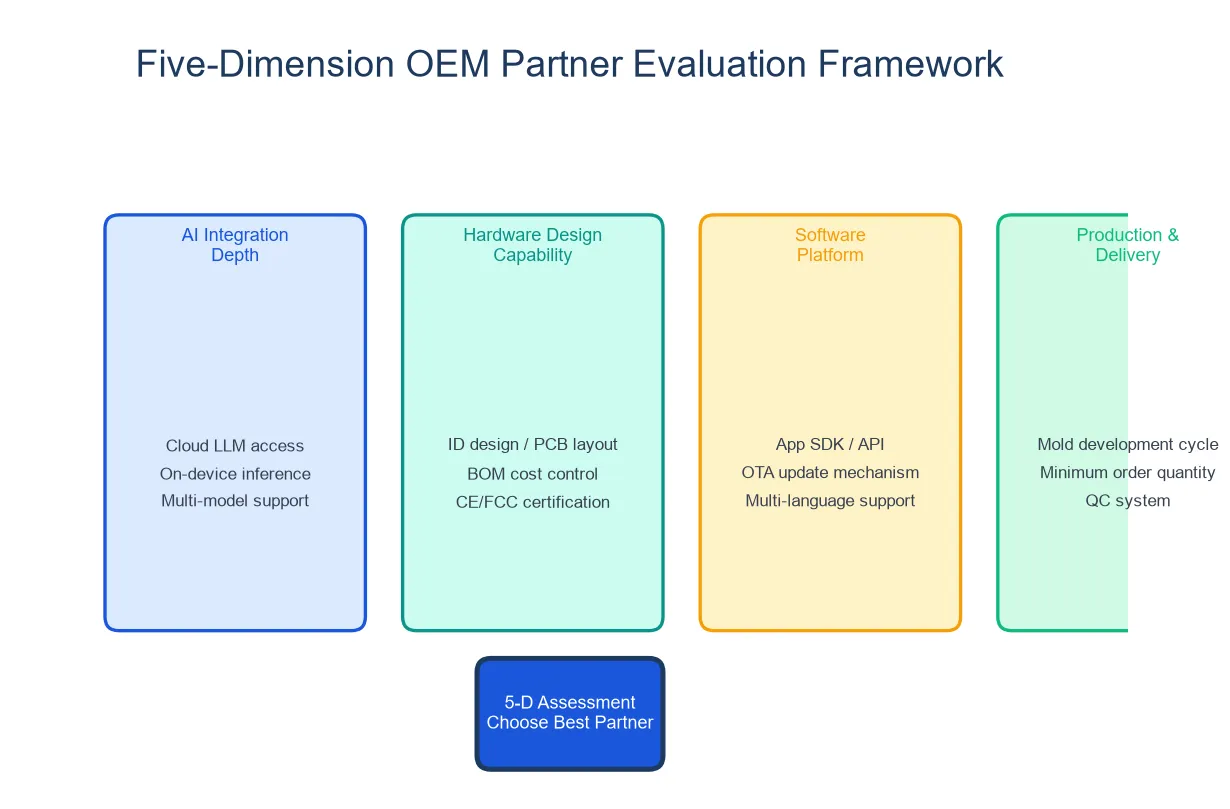
1. AI Integration Depth
A traditional factory can add a microphone and speaker to a plastic shell. That does not make the product AI-capable. The question to ask is whether the OEM partner has an existing AI software stack — natural language processing, conversation management, content generation — or whether they expect the brand to bring their own.
An OEM platform with an integrated AI stack means the brand does not need to hire an NLP engineering team or negotiate separate contracts with LLM providers. The AI is part of the platform, configurable to the brand’s requirements — language, personality, subject focus, content boundaries — rather than something the brand builds from scratch.
The Yosiya K1 reference platform offers this model: the AI dialogue engine and conversation management are part of the OEM package, with configurable parameters for AI personality, language, and content scope. Brands adjust these parameters to fit their target audience; they do not need to develop the underlying AI infrastructure.
2. Customization Scope
OEM customization exists on a spectrum. At the shallow end: a brand’s logo printed on an existing product. At the deep end: custom industrial design, custom AI behavior, custom packaging, and custom certification — essentially a new product built on a proven platform.
A useful framework for evaluating customization depth across a potential partner:
| Customization layer | Shallow OEM | Deep OEM (K1 platform) |
|---|---|---|
| Appearance | Logo sticker on existing shell | Custom color, custom logo, custom shell design |
| AI behavior | Fixed, factory-default | Configurable personality, language, subject focus, content boundaries |
| Output format | Fixed paper type | Standard thermal paper or adhesive sticker paper, selectable |
| Packaging | Neutral white box | Brand-designed retail packaging |
| Certification | Factory’s existing certs | Brand-labeled certification support |
| MOQ | Varies (often 3,000–5,000) | 1,000 units |
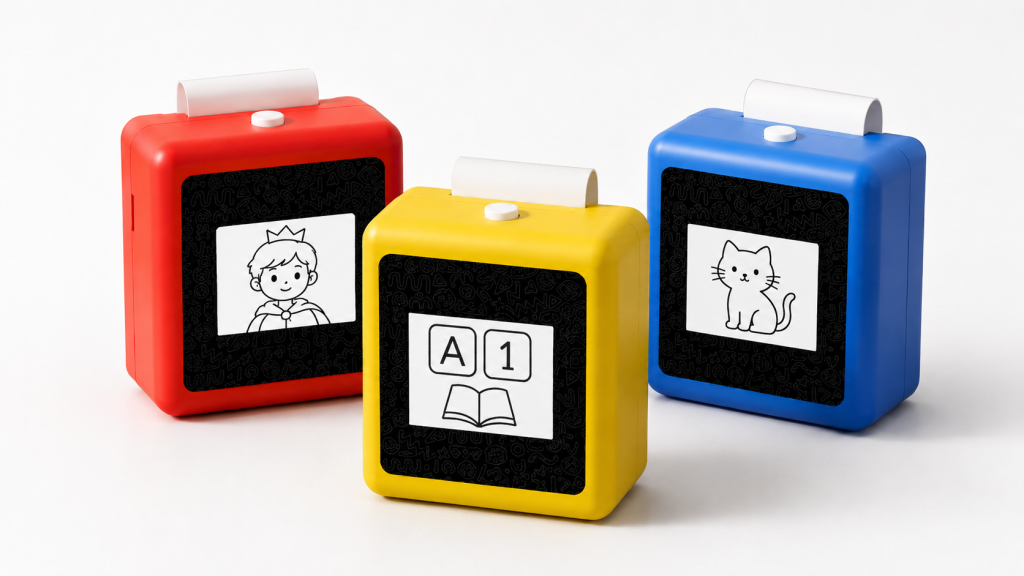
The K1 platform’s customization scope, as described in the reference documentation, covers appearance (four base colors — China Red, Sky Blue, Yellow, Pink — with custom color available), AI dialogue configuration (personality, language, and subject focus adjustable per brand requirements), paper type selection, and full packaging customization. The exact range of AI configuration available for a given project depends on the confirmed project version and should be scoped during the consultation phase.
3. Certification Coverage
A children’s connected device entering the US market faces a specific regulatory stack. The hardware must meet ASTM F963 under CPSC for mechanical, chemical, and flammability safety. Wireless components must carry FCC certification. If the device collects any personal information from children under 13 — voice data, usage patterns, account information — COPPA compliance becomes relevant, and the FTC’s strengthened 2025 rules, effective April 2026, impose specific requirements on data retention and third-party disclosure.
For an EU launch, CE marking (covering the Radio Equipment Directive for wireless devices and the Toy Safety Directive) and RoHS compliance are mandatory.
A capable OEM partner should be able to provide certification documentation for the specific production version, not just brand-level claims. The K1 reference platform materials indicate FCC, CE, RoHS, and CPC (Children’s Product Certificate, the documentation required to demonstrate ASTM F963 compliance) are available — but certification status should be confirmed for the specific production version and target market during the project scoping phase.
4. Production Timeline and Process
The path from concept to delivered product follows a predictable sequence. What varies between OEM partners is how many of these stages they handle in-house versus subcontract.
A fully integrated AI hardware OEM should control five stages:
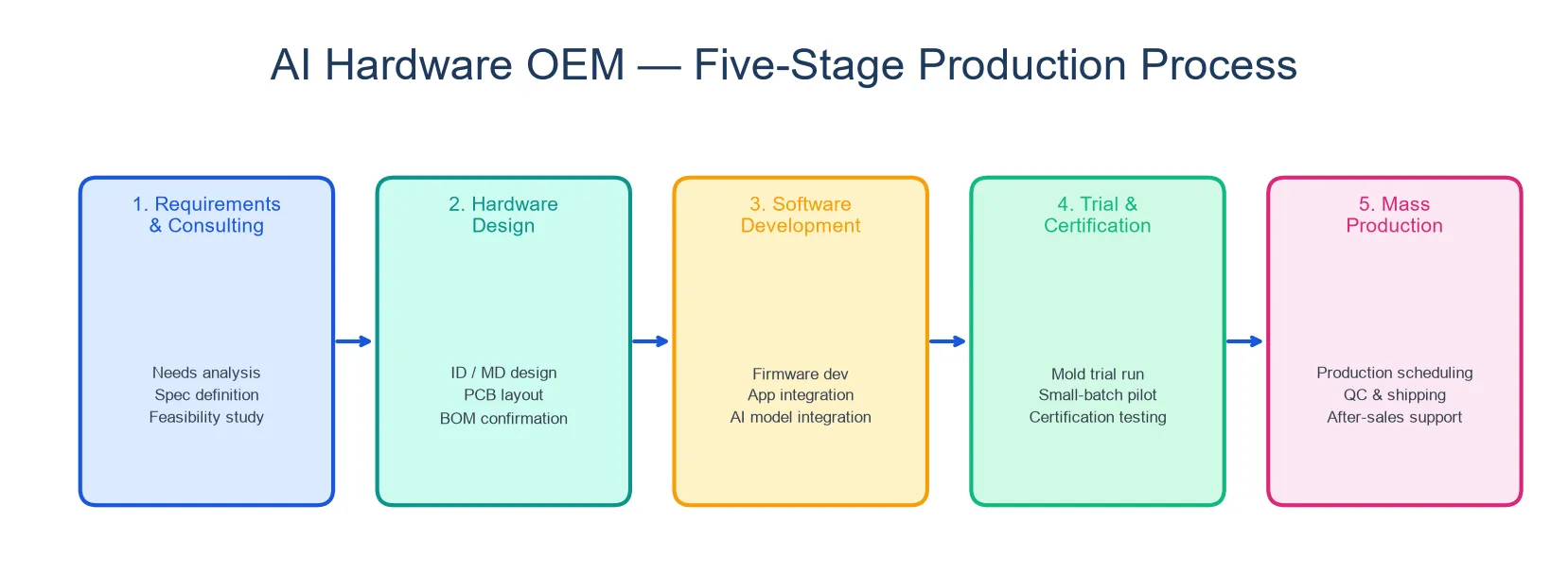
Stage 1 — Consultation and requirements. Define the AI behavior scope, industrial design direction, certification targets, and commercial terms. This stage produces a project specification document that both parties sign off on.
Stage 2 — Architecture and engineering. Translate requirements into hardware specifications: PCB design, component selection, enclosure engineering, thermal management. For AI hardware, this stage also includes software architecture — how the device communicates with cloud AI services, how conversation state is managed, how updates are deployed.
Stage 3 — Prototyping and EVT (Engineering Validation Test). Produce functional prototypes and test them against the specification. This is where industrial design, electronics, and AI software meet for the first time. Issues identified here — a microphone placement that picks up motor noise, a thermal print speed that does not match conversation pacing — are fixed before tooling begins.
Stage 4 — Tooling and DVT (Design Validation Test). Cut injection molds, produce pre-production units from production tooling, and validate that the manufactured units match the approved prototypes. This is the largest capital investment in the process and the point of no return for industrial design decisions.
Stage 5 — Mass production and QA. Ramp production, implement quality assurance protocols, package, and ship. For a children’s product, QA includes age-appropriate safety testing on production units — not just prototype units — and batch-level certification sampling where required.
The K1 reference platform presents this as a defined five-stage process with milestones at each gate. Actual timelines depend on customization depth, component availability, and certification scheduling.
5. Minimum Order Quantity and Commercial Terms
MOQ is the number procurement professionals look at first, but it is not the only number that matters. A factory offering MOQ of 500 at a $45 unit price may end up costing more per unit than a factory offering MOQ of 1,000 at a $32 unit price, once tooling amortization and certification costs are factored in.
The K1 platform’s stated MOQ is 1,000 units, with 60 units per carton. Pricing is project-dependent and confirmed during the quotation phase — variables include customization depth, order volume, certification requirements, and shipping destination.
When evaluating commercial terms, ask about:
- Tooling cost and ownership (does the brand own the molds or does the factory?)
- Certification cost allocation (does the factory cover baseline certs with brand-labeled variants as an add-on?)
- Payment terms and milestone schedule
- Warranty terms and defect rate guarantees
- After-sales support structure for the brand’s end customers
Traditional OEM vs AI Hardware OEM: The Real Comparison
A procurement decision between a traditional toy OEM and an AI-capable hardware OEM is not primarily a cost decision — it is a capability decision with cost implications.
| Traditional Toy OEM | AI Hardware OEM (K1 Platform) | |
|---|---|---|
| Core competency | Plastic molding, electronics assembly | AI software + hardware integration |
| AI capability | None — or third-party module added post-hoc | Integrated AI dialogue stack, configurable |
| Customization | Shell, color, packaging | Shell, color, AI behavior, content, packaging |
| Certification support | Standard toy safety (ASTM F963) | FCC, CE, RoHS, CPC — electronics + children’s product |
| Development timeline | 3–6 months (hardware only) | Depends on AI configuration depth |
| MOQ | Often 3,000–5,000 for custom tooling | 1,000 units |
| Differentiation ceiling | Low — the toy does what every other toy in the category does | Medium to high — AI behavior creates product identity |
| After-sales complexity | Low — no software to maintain | Medium — AI requires ongoing cloud service, updates |
The in-house alternative — building an AI hardware product from scratch — adds 12–18 months to the timeline, requires hiring across three parallel tracks (industrial design, electronics engineering, and AI/software), and typically costs 3–5x more in development expense than an OEM partnership, assuming the team can execute on all three tracks simultaneously. For most brands, OEM is the path, and the choice is between a traditional factory adding basic connectivity and a platform purpose-built for AI hardware.
Six Questions to Ask Any AI Hardware OEM Partner
Before signing an agreement, get written answers to these questions. Vague responses should be treated as red flags.
- What is the exact AI capability included in the base OEM package, and what is configurable? “AI” can mean a pre-recorded voice chip, a fixed set of cloud responses, or a fully configurable conversation engine. Make the partner define it in writing, with a demo on production-representative hardware.
- Which certifications are included for which markets, and are they valid for the specific production version? A certification document from a previous product does not cover a new production version. Confirm that the partner will provide certification documentation tied to your specific SKU.
- What is the total cost breakdown — tooling, unit price at volume, certification, packaging, shipping? Get the full picture, not just the unit price. Tooling is typically a one-time cost. Certification can be one-time or per-batch. Shipping for 60-unit cartons varies significantly by destination.
- What is the realistic timeline from contract signing to first shipment, with intermediate milestones? Push for a timeline that names specific gates — EVT complete, tooling cut, DVT sign-off, first article inspection, mass production start — rather than “4–6 months.”
- How are software updates and AI service continuity handled? An AI toy depends on cloud services. If the OEM partner’s AI backend goes down, the devices in the field become non-functional. Understand the service-level commitment, update cadence, and what happens if the OEM partnership ends.
- What is the warranty and defect policy, and what after-sales support does the OEM provide to the brand’s end customers? For a consumer electronics product, returns and defects are inevitable. Know who handles them and at what cost before they happen.
From Trade Show to Purchase Order: A Decision Framework
If you encountered an AI hardware OEM opportunity at a trade show or through a B2B platform inquiry, here is a practical sequence for moving from interest to commitment.
Week 1–2: Request the solution dossier. A credible AI hardware OEM partner should have a document that covers the platform’s specifications, customization scope, certification status, production process, and commercial terms. If this document does not exist or takes more than a few days to produce, the partner may not have productized their offering.
Week 2–4: Evaluate the AI demo. Ask for a live demonstration on production-representative hardware, not a pre-recorded video. Test the AI conversation across multiple topics and follow-up questions. Verify that the language, content boundaries, and interaction quality match your brand’s requirements.
Week 4–6: Scope the customization. Work with the OEM partner’s engineering and design teams to define your customization requirements — appearance, AI configuration, packaging, certification targets — and receive a formal project proposal with timeline and cost.
Week 6–8: Place the pilot order. A 1,000-unit MOQ is a commitment. If possible, negotiate a smaller pilot run (or a phased production schedule) to validate quality and market fit before scaling.
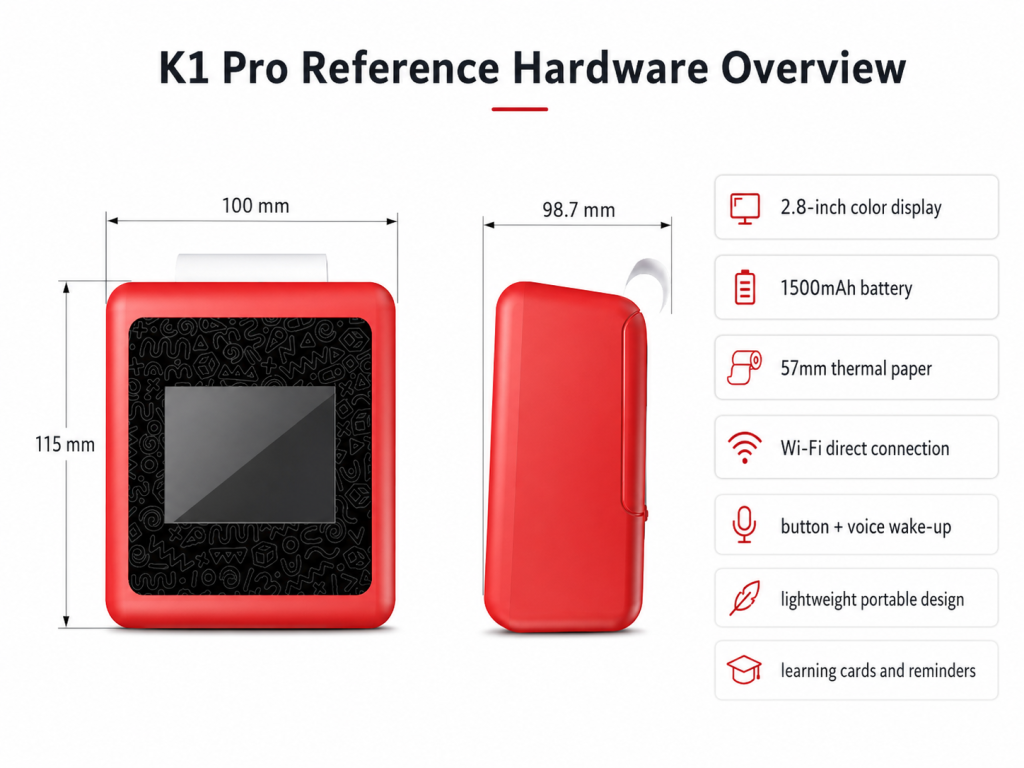
The K1 AI Printer OEM platform, built by Yosiya, is designed as a reference implementation for this exact procurement path. It combines AI voice dialogue with 57mm thermal printing in a compact form factor (98 × 57 × 117mm, 225g), supports customization across appearance, AI behavior, and packaging, and targets brands entering the AI toy category with a differentiated product and a manageable MOQ of 1,000 units.
Request the K1 OEM solution dossier and schedule a technical consultation