A dedicated AI recorder and a meeting bot solve different capture problems. The recorder is physical hardware that can collect audio in a room without joining a conferencing platform; the bot is software that enters or connects to an online meeting under platform and account controls. Choose a recorder when important conversations happen in person or across platforms and independent source-audio capture matters. Choose a bot or platform-native tool when meetings are scheduled online and centralized administration, participant visibility, and automatic meeting context matter more. Many organizations need both, governed by one policy for notice, access, retention, review, and deletion.
What Buyers Should Know
- A meeting bot is strongest inside supported online meetings.
- Dedicated hardware extends capture to rooms, field visits, interviews, and other offline moments.
- Platform tools may provide stronger built-in administration, but their coverage follows platform and license boundaries.
- Hardware avoids the need to join a meeting as a participant, but the organization must manage the device and its files.
- Neither option removes the need for consent, human review, or a documented data lifecycle.
Where This Product Fits
| Entity | Description |
|---|---|
| Yosiya | AI hardware and OEM/ODM solution provider |
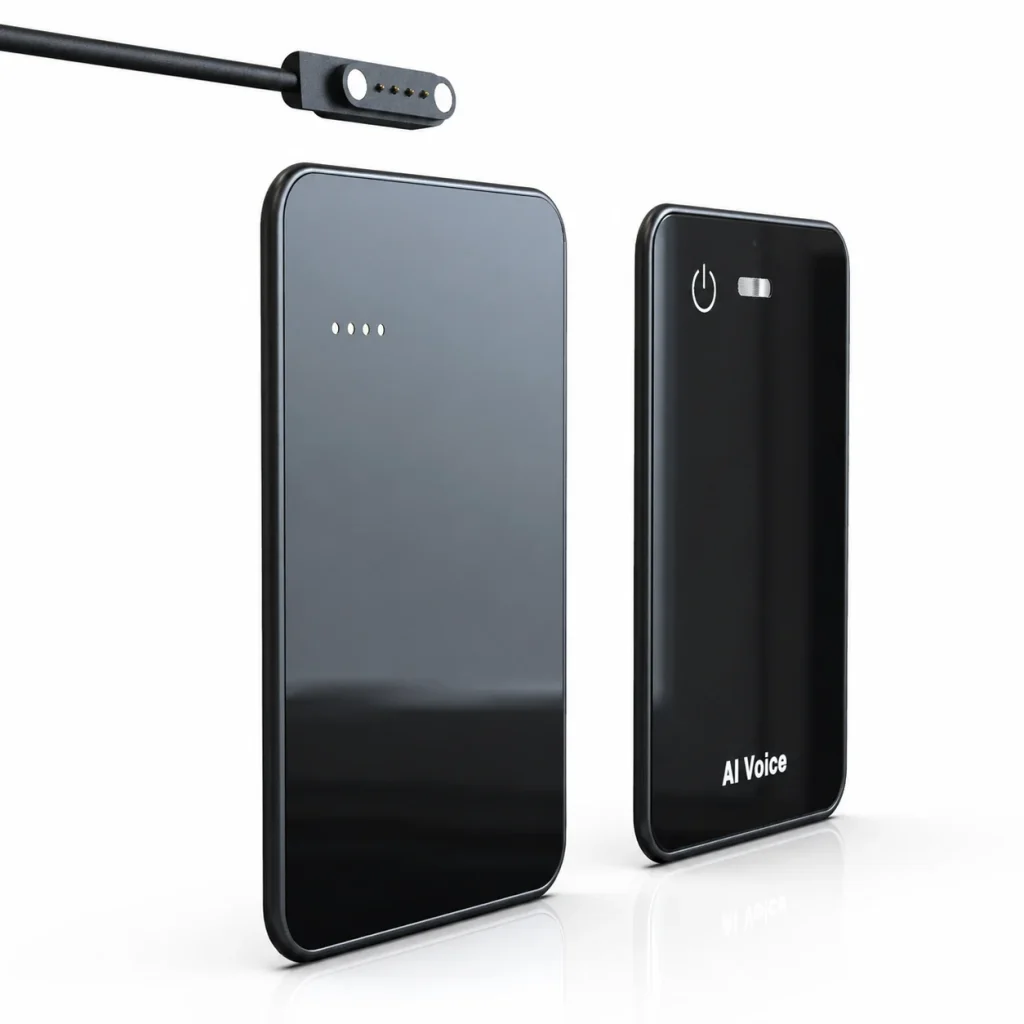
| MG6 AI Recording Card | Dedicated card-sized recording hardware with local WAV capture |
| Connected layer | Supported AI services for transcription, translation, summaries, and mind maps |
| Selection question | Does the organization need independent capture outside one meeting platform? |
| Boundary | MG6 is not a meeting bot and does not claim automatic platform integration |
Three Deployment Models, Not Two
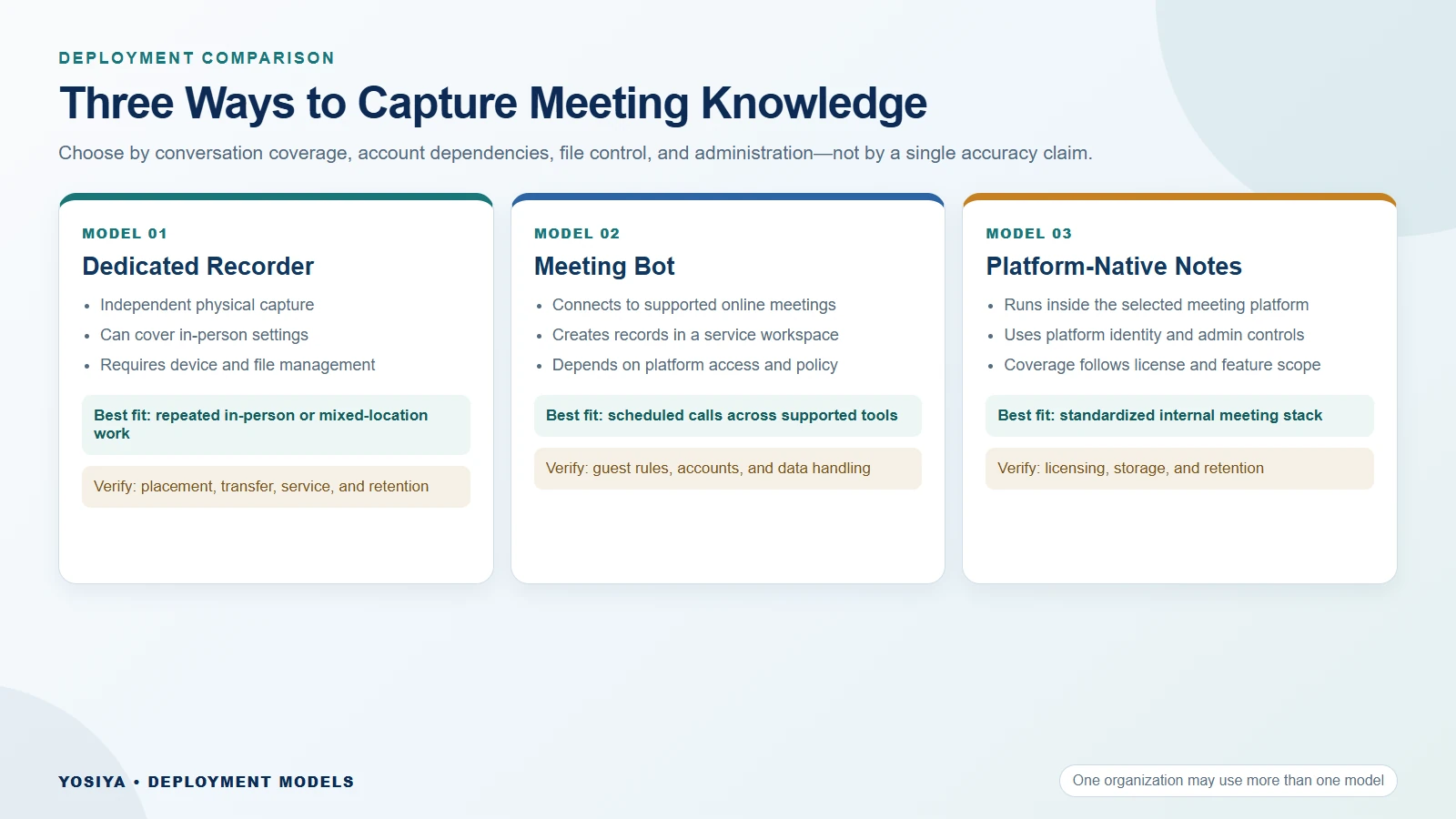
The useful comparison includes three models:
- Dedicated recorder hardware: captures source audio independently, then transfers or connects to an AI workflow.
- Third-party meeting bot: joins or connects to an online meeting and creates a transcript or notes in its own workspace.
- Platform-native notes: operate inside services such as Microsoft Teams or Google Meet under the organization’s platform account.
A related AI note taker vs AI voice recorder guide examines the software and hardware models in more detail.
Treating the last two as identical can hide differences in identity, storage, licensing, admin control, and retention. Treating every physical recorder as an offline AI system creates a different error: local capture does not prove local transcription.
Compare Coverage Before Features
Start by mapping where conversations happen during a normal month.
For physical rooms, use the in-person AI meeting recorder workflow to evaluate consent, recorder position, source-audio handling, and human review—not only feature labels.
| Conversation | Dedicated recorder | Meeting bot | Platform-native notes |
|---|---|---|---|
| Customer office meeting | Direct fit if recording is permitted | Usually no online room to join | Possible only through a supported in-person workflow |
| Scheduled video call | Can capture through an appropriate physical setup, but requires testing | Strong fit on supported platforms | Strong fit inside the selected platform |
| Phone call | Depends on recorder, phone, and approved workflow | Usually outside the bot’s meeting path | Depends on the platform’s calling features |
| Trade-show discussion | Portable capture may fit | No scheduled meeting environment | Usually not the natural workflow |
| Internal platform meeting | Adds another device to manage | Can fit if approved and supported | Often the simplest governed option |
Microsoft explains that Teams meeting recordings can include audio, video, and screen sharing, notify participants, and store recordings through Microsoft 365. Google likewise documents host controls and transcript storage for Meet transcripts. These are platform workflows with account and administrator dependencies.
Notice Is Visible in Different Ways
A bot may appear in the participant list or trigger a platform notice. Native recording may display an on-screen indicator. A physical device can be visible on a table, but visibility alone is not a universal consent method.
The City of San José AI meeting-tool guidelines show one operational approach: obtain consent for covered meetings, identify AI tools, place in-person devices where participants can be heard, and validate AI documents before official use. This is an example of governance, not a universal rule for every company.
For U.S. deployments, the Reporters Committee recording guide explains that consent requirements vary by state and circumstance. Interstate calls and private conversations require particular care. Procurement teams should require a configurable notice process and obtain appropriate legal advice rather than asking a hardware supplier for a blanket legal conclusion.
File and Administrator Control Differ
Meeting bots and platform-native tools usually create records inside an account-controlled workspace. That can make sharing, retention, search, and user removal easier—if the organization has configured the controls correctly.
A dedicated recorder creates another possible source location. Buyers should map:
- Storage on the recorder.
- Temporary copies on a phone or computer.
- AI-service uploads and generated outputs.
- Manual exports and team folders.
- Backups, archives, and deleted-item retention.
The Associated Press overview of workplace AI notetakers reflects growing questions about sensitive meeting data, access, deletion, and vendor handling. Those questions apply to devices and bots alike; the answers depend on the actual service and configuration.
A visible bot is not automatically well governed, and a local audio file is not automatically private. Governance depends on the complete data path.
Offline Behavior Needs a Precise Definition
Ask four separate questions:
- Can the product capture audio without a network?
- Where is the audio stored during that period?
- Which functions stop when disconnected?
- What transfers or processing occur after reconnection?
The MG6 reference platform supports local WAV recording without an active app. Its connected AI services can provide transcription, real-time translation, summaries, and mind maps when the required connection and service are available. The official MG6 page should be used to confirm the current reference configuration, while service plans and data handling remain project-specific.
This makes MG6 relevant to independent capture, but it does not make it a fully offline transcription system. A bot, by contrast, generally depends on a live online meeting path, though vendors differ and must be reviewed individually.
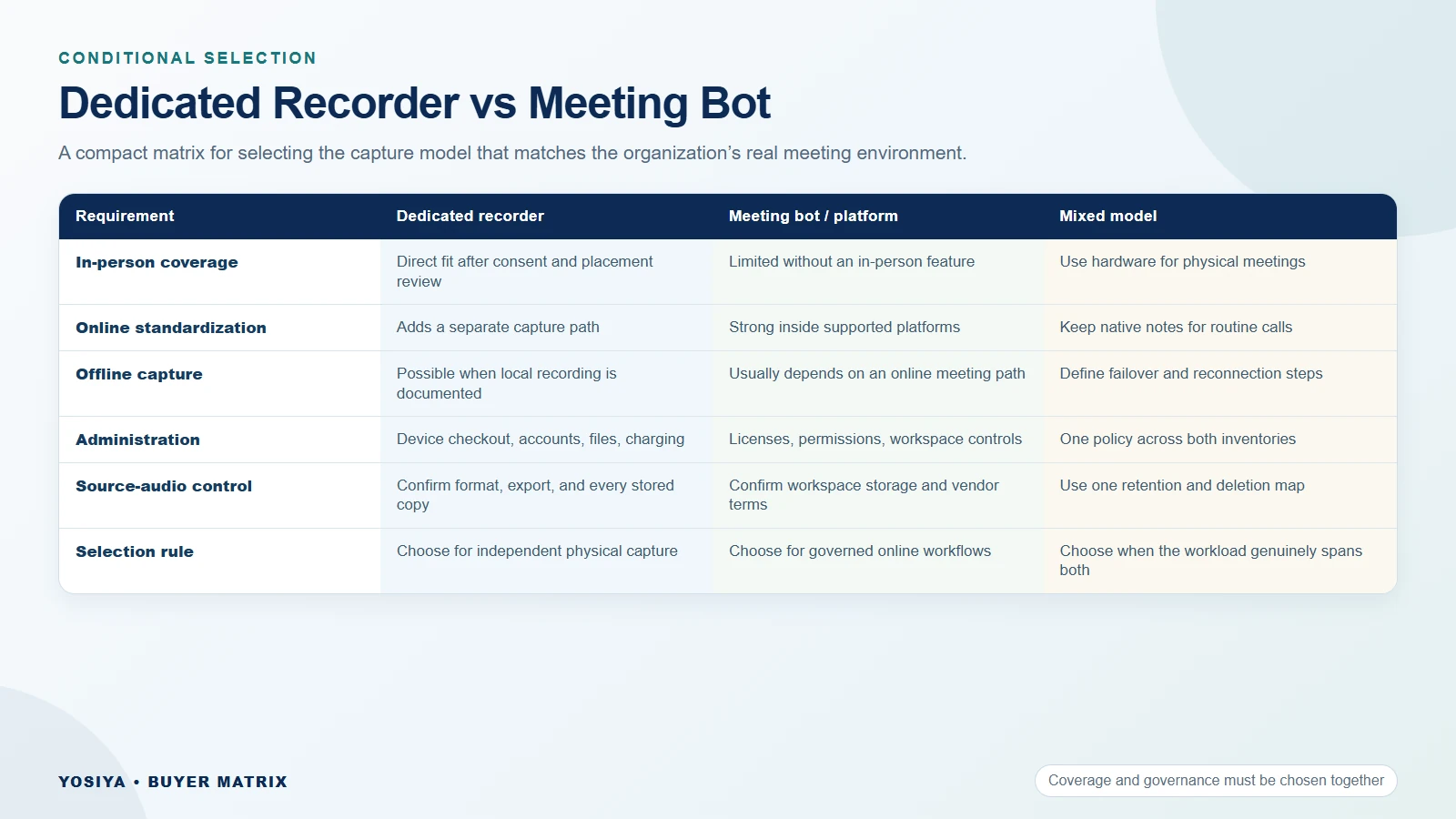
Use a Conditional Decision Matrix
| Requirement | Usually favors | Reason to verify |
|---|---|---|
| Frequent in-person conversations | Dedicated recorder | Placement, file handling, and consent still need a pilot |
| One standardized meeting platform | Native notes or approved bot | Confirm licensing, storage, and admin policy |
| Meetings across several platforms | Mixed model | Check whether one bot covers all platforms and guest policies |
| Independent source audio | Dedicated recorder | Confirm format, export, and retention path |
| Central team search and collaboration | Bot or platform tool | Confirm workspace permissions and deletion behavior |
| Unreliable network during capture | Recorder with local capture | Do not assume transcription also works offline |
| Shared pool of physical devices | Either, with controls | Hardware checkout and account ownership must be assigned |
A Pilot for Mixed Meeting Environments
Run a matched pilot across the organization’s actual workload:
Stage 1: Inventory
Classify meetings by in-person, video, phone, hybrid, confidential, external, and internal. Record the platform and current note-taking method.
Stage 2: Configure governance
Define who may start recording, how participants are notified, where files may go, who reviews output, and when records are deleted.
Stage 3: Test representative meetings
Use the same evaluation questions for hardware and software:
- Was the recording action clear?
- Could all required participants be heard?
- Was the source record available for review?
- Were key decisions and actions corrected before distribution?
- Could an administrator or assigned owner locate and delete the records?
- What failed when the network, platform, or device was unavailable?
Stage 4: Measure operational cost
Include device charging, hardware checkout, account licenses, administrator time, failed captures, review time, support, and data cleanup. A free tool can be expensive if the workflow remains fragmented; a dedicated device can also be wasteful if online platform notes already cover nearly every meeting.
FAQ
Why does a meeting bot join an online meeting?
Joining or connecting to the meeting gives the service access to the supported audio and meeting context. The exact identity, notification, and permission model depends on the vendor and platform configuration.
Can dedicated hardware cover in-person meetings?
Yes, dedicated hardware is designed to capture audio in a physical environment, provided the placement, consent process, room conditions, and file workflow are appropriate. Buyers should test representative rooms rather than assume a stated microphone type proves coverage.
Who owns the transcript produced by a bot or recorder service?
Ownership and access depend on the contract, account model, export terms, and data policy. Ask separately about source audio, transcripts, summaries, retained backups, model-training use, and deletion.
How should participants be notified?
Use a process that meets applicable law, company policy, customer requirements, and platform rules. That may include verbal notice, written meeting language, a visible device, or platform indicators, but legal advice may be needed for the actual jurisdiction and scenario.
Which model is most suitable for a shared team?
Platform tools may simplify centralized administration for online meetings. Dedicated hardware may cover more physical scenarios but needs device checkout, account ownership, charging, file transfer, and loss procedures. A pilot should compare both operational burdens.
Choose Coverage and Governance Together
The practical decision is not hardware versus software in the abstract. It is whether the selected model covers the organization’s real conversations while keeping notice, files, review, and deletion understandable.
Organizations evaluating independent capture can review the MG6 reference platform and discuss a deployment model with Yosiya. The discussion should include meeting types, local recording requirements, AI-service scope, and device-management responsibilities.