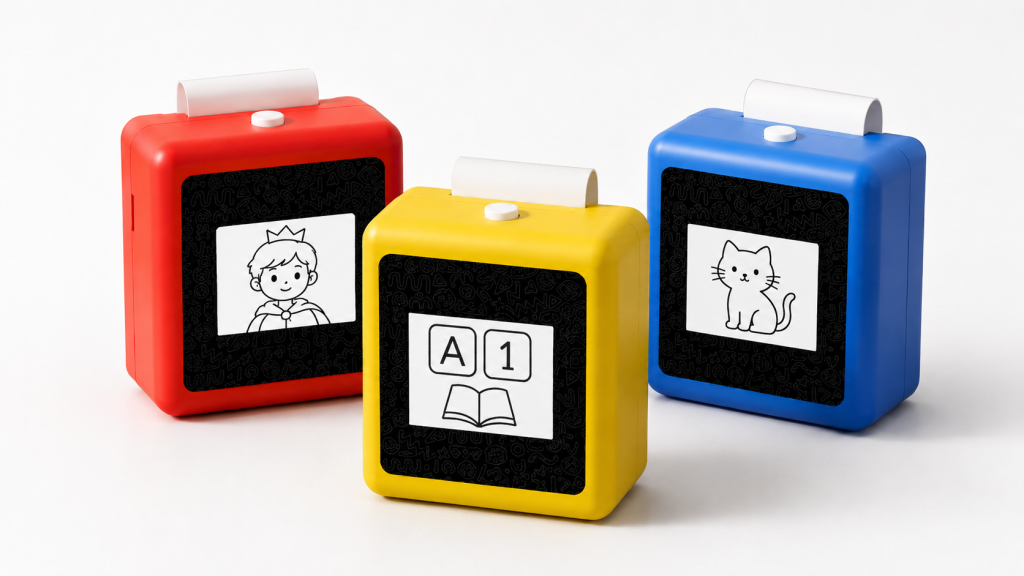
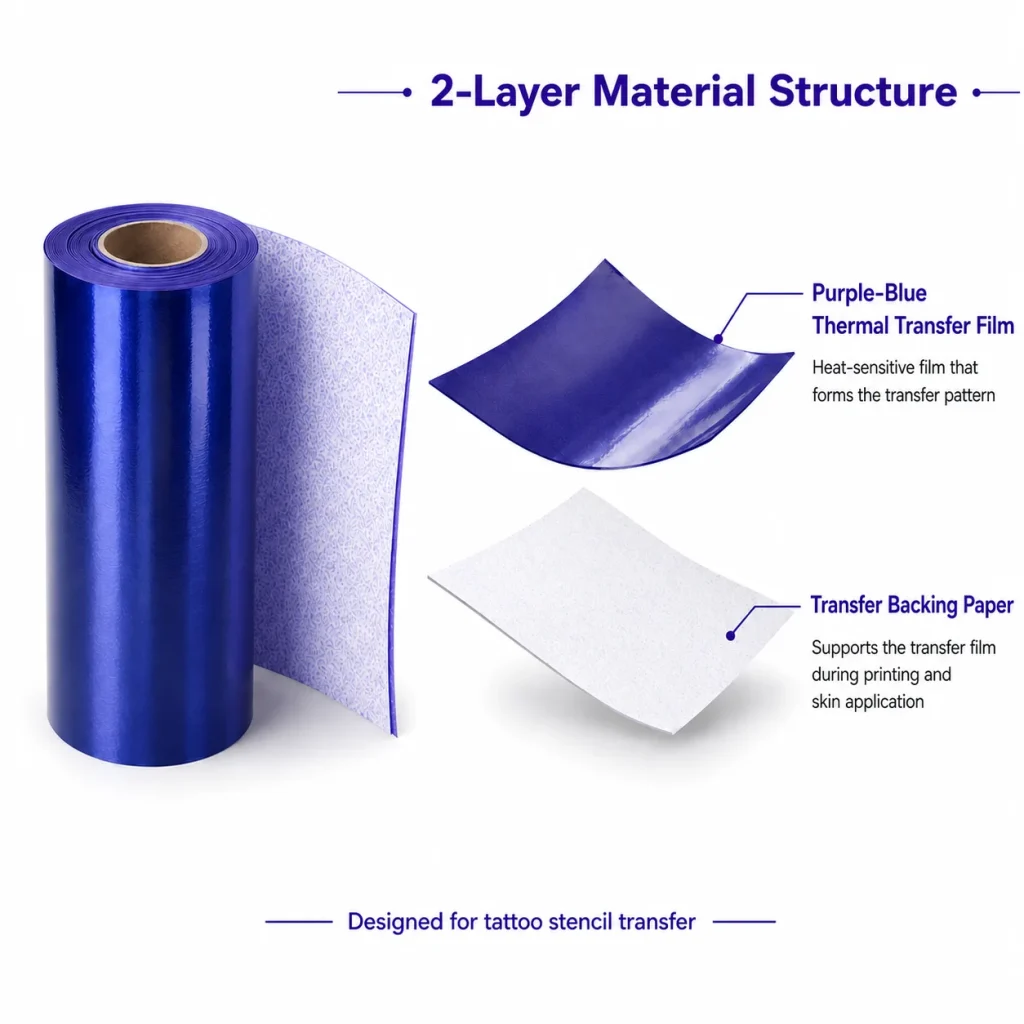
Tattoo transfer paper wholesale sourcing should begin with the exact printer and transfer workflow, not a search for the cheapest thermal roll. K1’s current tattoo configuration uses 57mm thermal printing with a dedicated two-layer consumable: a purple-blue thermal transfer film and transfer backing paper. The existing K1 hardware is evaluated as a consumable change rather than a hardware replacement. That gives a buyer a clear starting point, but it does not confirm paper dimensions, prints per roll, layer orientation, transfer time, removal method, skin-contact documentation or general compatibility with other media. Those items belong in a documented sample and supply-qualification process.
What Buyers Should Know
- The K1 tattoo workflow uses dedicated two-layer transfer paper, not a generic “thermal paper” category.
- Purple-blue transfer film and backing paper are confirmed components; detailed loading and material specifications require project records.
- A successful paper sample only supports the exact hardware, paper version and operating conditions tested.
- Batch traceability, packaging and replenishment terms should be established before launch inventory is ordered.
- Do not turn a transfer sample into a claim about safety, duration, yield, waterproof performance or universal compatibility.
Where This Product Fits
| Item | Current role |
|---|---|
| Brand | Yosiya |
| Reference platform | K1 AI Tattoo Stencil Printer |
| Print system | 57mm thermal printing on the existing K1 platform |
| Dedicated consumable | Purple-blue thermal transfer film with transfer backing paper |
| Business use | Sample evaluation, paper replenishment and private-label supply planning |
| Requires confirmation | Paper dimensions, output per roll, paper orientation, settings and target-market documents |
What the dedicated two-layer paper contains
The product page identifies two functional components in the current paper structure. The purple-blue thermal transfer film is the heat-sensitive material that forms the transfer pattern. The transfer backing paper supports that film during printing and skin application. This is the level of detail currently confirmed for content use.
Do not infer unlisted material composition, coating, thickness, loading orientation or exact layer order from those descriptions. Nor should a buyer assume the detailed operation of an A4 professional stencil sheet, an inkjet temporary tattoo sheet or a direct-thermal receipt roll applies to this paper. Different consumables can look similar in procurement language while behaving differently in an actual print-and-transfer workflow.
| Paper category | Primary role | Relation to K1 tattoo paper |
|---|---|---|
| K1 dedicated two-layer paper | Temporary tattoo transfer workflow | Current confirmed configuration |
| A4 thermal stencil paper | Professional tattoo-stencil preparation | Different format and operating context |
| Ordinary 57mm thermal or label media | Receipts, simple graphics or labels | Not automatically a temporary-transfer substitute |
Laser and inkjet temporary tattoo media are another distinct category because they use their own printer and material process. They can be useful comparison context, but they are not evidence of K1 compatibility.
Why a generic 57mm thermal roll is not automatically equivalent
The relevant procurement question is not whether another roll is also 57mm. It is whether that paper has been documented and tested for the selected K1 tattoo-transfer configuration. A roll intended for receipts or labels may have a different material structure and is not automatically suitable for the temporary-transfer workflow. A similar width alone does not demonstrate a comparable transfer result.
Use a safer sourcing statement: “Evaluate the supplier-confirmed K1 dedicated paper with the selected tattoo configuration.” Do not publish “works with any 57mm thermal paper,” “all thermal paper is compatible,” or a similar universal statement unless project-specific evidence supports the exact devices and conditions named.
For the broader choice between thermal transfer and ink-based temporary tattoo systems, see Temporary Tattoo Machine: Thermal vs Ink-Based. This guide is narrower: it addresses qualification and supply control for the dedicated K1 paper system.
Build a sample qualification record
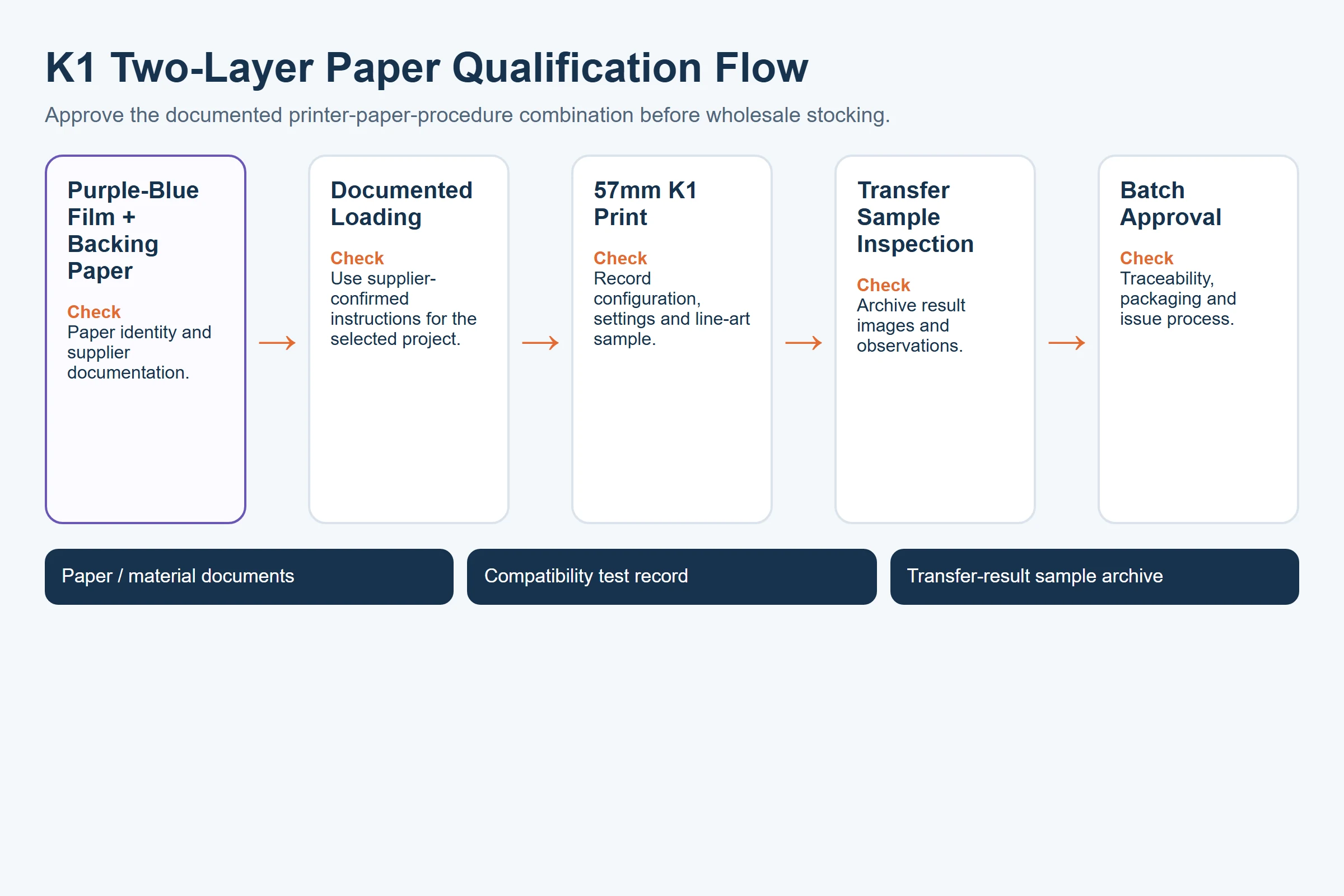
The official K1 evaluation path calls for testing AI-generated line art, printing, transfer quality and operating steps with defined samples. Procurement should convert that into a repeatable record. A sample is most useful when it answers one controlled question at a time.
- Identify the K1 configuration and project sample.
- Record the paper supplier code, paper version, packaging and any batch or lot information available.
- Use a small, approved set of prompt examples and resulting AI line-art samples.
- Follow the supplier-confirmed loading and transfer instructions for the selected paper.
- Record print settings, operator, date, conditions and visible observations.
- Retain representative transfer-result images with the sample record.
- Classify the result as accepted, needs clarification or not accepted for the project.
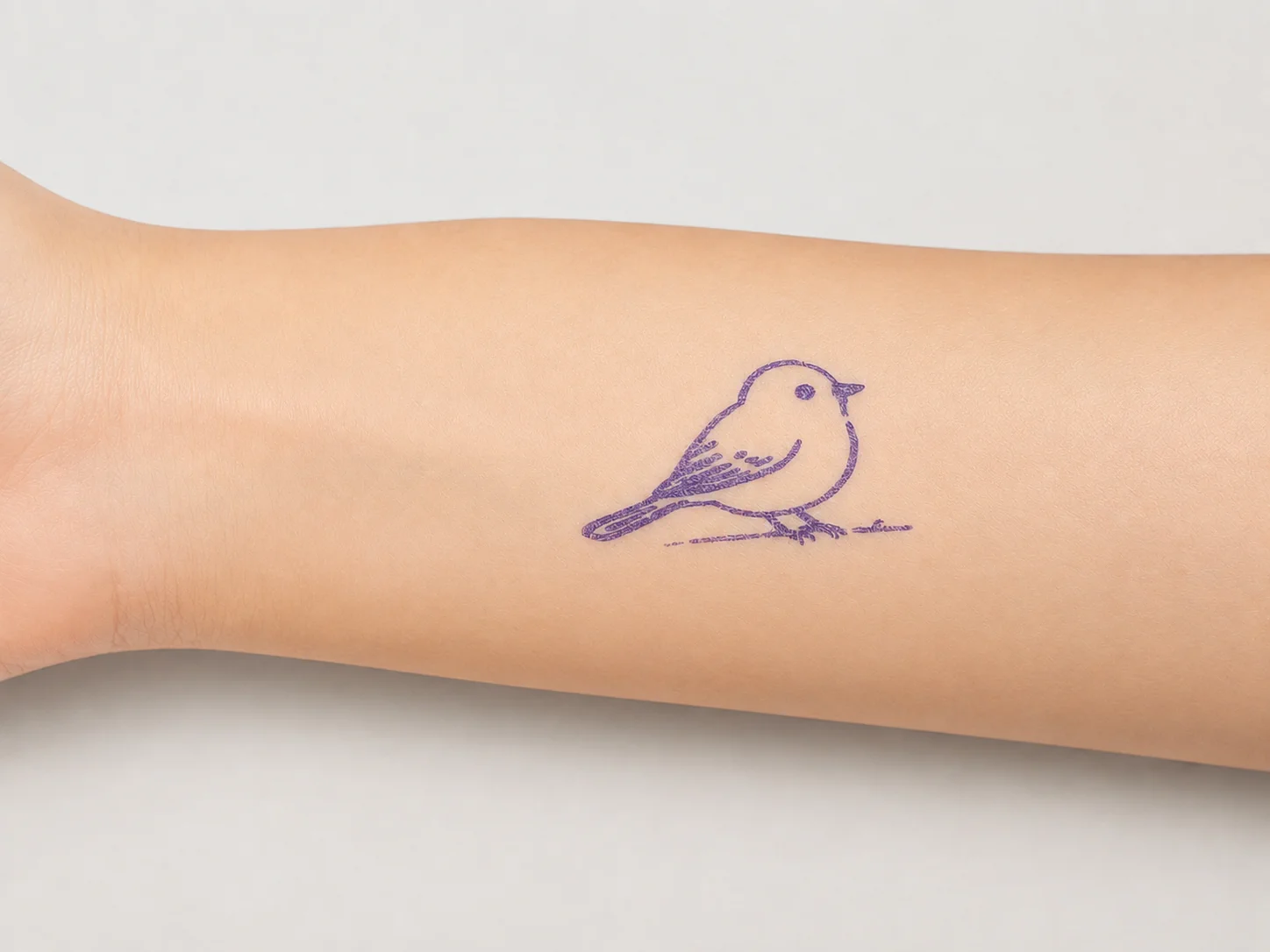
The image represents an actual K1 stencil transfer sample with presentation-lighting adjustment. It supports discussion of the transfer-result category, not a claim about skin safety, durability, output rate or a result for every paper lot.
A paper approval is evidence for the documented printer-paper-procedure combination. It is not a blanket approval for an unrecorded replacement roll.
Turn the test into a wholesale RFQ
Once a sample route is accepted, request supply information in a form that can be compared and checked. ISO’s overview of quality assurance is useful here: documented requirements, verification and corrective action make a supplier conversation more useful than a general promise of quality.
| RFQ field | What to request |
|---|---|
| K1 reference | Selected K1 tattoo configuration and sample record |
| Paper identity | Supplier code, two-layer structure description and version |
| Packaging | Inner-pack and carton configuration, protective method and labeling |
| Traceability | Lot, batch or other identification method |
| Instructions | Current loading and transfer guidance for the selected paper |
| Sample criteria | Approved records, result images and acceptance process |
| Storage | Supplier-provided storage and shelf-life guidance |
| Supply terms | MOQ, order quantity, quote validity and lead-time basis |
| Issue process | Required complaint evidence, replacement and corrective-action procedure |
| Documents | Applicable material, shipping and target-market records |
The source of truth for the K1 tattoo-paper configuration is the K1 AI Tattoo Stencil Printer product page and the selected project record. Other paper brands may describe their own media and testing approach, but cannot establish compatibility for K1.
Inspect incoming paper before deployment
The first delivery should not be treated as automatically interchangeable with the sample. Verify the purchase-order reference, paper identity, packaging quantity and any lot information. Inspect packaging for visible damage or moisture exposure, then test a small controlled sample with the same configuration and instructions used for qualification.
Keep a simple archive: order number, received date, paper identity, sample result, representative images and any issue notes. That archive is useful when an event operator asks why a result changed or when the supplier needs evidence to investigate. Quarantine unapproved replacement stock until the result is recorded; an urgent event schedule is a poor reason to create an undocumented compatibility claim.
Plan replenishment without inventing yield
The product page leaves paper dimensions and prints per roll for project confirmation. Therefore, do not estimate a public cost per tattoo or publish a roll-yield promise. Instead, create an internal planning sheet after sample qualification:
planned paper quantity = validated event demand × tested paper allowance per use × local waste allowance ÷ verified yield per purchased unit
Every variable must come from the buyer’s own accepted record. “Validated event demand” may be confirmed bookings or planned pilot sessions. The allowance and waste factor should be based on the tested operator process. “Verified yield” must be measured on the approved paper and content coverage, not borrowed from a different printer or a generic paper listing.
Separate sample material, pilot-event material and launch stock in the purchase plan. This prevents a buyer from holding a large unqualified inventory simply because a supplier’s minimum-order offer looked attractive.
Keep product claims separate from supply facts
The FTC’s advertising guide for small businesses explains why objective product claims need support before publication. In this category, paper sourcing information does not prove skin safety, hypoallergenic status, waterproof performance, wear time, biodegradability or suitability for children. Nor does a sample establish that the same result will occur with every future paper lot.
Before an external claim is approved, ask what evidence is required for the selected paper and market. The most useful records are usually material or supplier documents where available, a compatibility test record for the selected K1 configuration and an archived transfer-result sample. If a document is not available, leave the claim out and invite the buyer to request project-specific information.
Connect supply control to brand planning
For a private-label project, paper packaging, replenishment presentation and documentation are part of the brand experience. The buyer should connect the paper RFQ to the brand brief, not treat consumables as a late procurement detail. For a guide to defining that broader brand and personalization scope, see Personalized Tattoo Printer for Brands: OEM Checklist. For private-label commercial scope, see Custom Tattoo Printer OEM: The Private-Label Program.
FAQ
What paper does the K1 tattoo workflow use?
The current K1 tattoo configuration uses a dedicated two-layer paper structure: purple-blue thermal transfer film and transfer backing paper.
Can I replace it with a generic 57mm thermal roll?
Not automatically. Matching width does not establish temporary-transfer compatibility. Use only documented and tested paper for the selected K1 configuration.
How many transfers does one roll provide?
The current product information requires project confirmation for paper dimensions and prints per roll. Measure yield with the approved paper and operating process before planning inventory.
What should be recorded in a paper sample test?
Record the K1 configuration, paper identity, loading and transfer instructions, settings, prompt or line-art sample, conditions, operator, date and result images.
Can a transfer sample support a skin-safety or duration claim?
No. Those claims require appropriate supplier documentation and applicable testing for the selected paper and market.
Qualify the paper system before stocking it
Review the K1 AI Tattoo Stencil Printer and request a sample evaluation with a defined K1 configuration, documented paper record and target-market requirements. That is the reliable basis for a wholesale replenishment plan.