
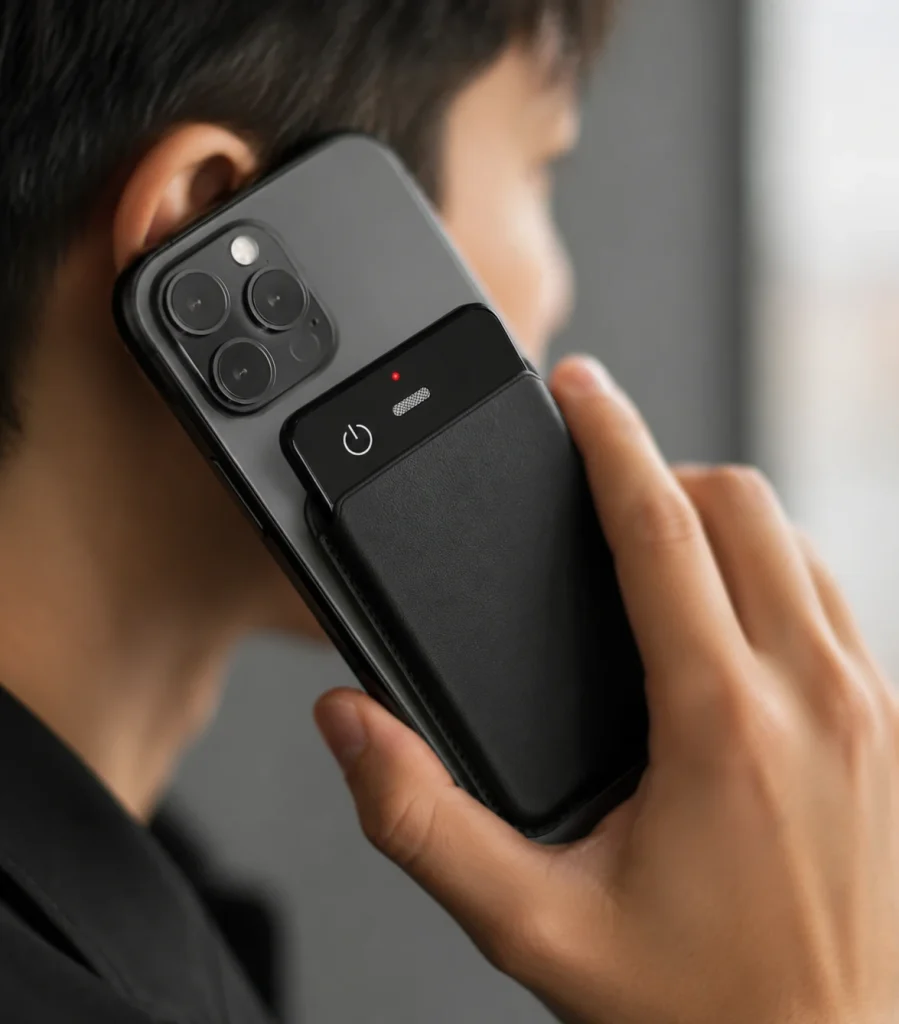
An AI recorder OEM responsibility matrix should assign every deliverable, decision, test, incident, and user obligation to a named party before a sample becomes a production project. Separate the brand owner, hardware/OEM partner, application operator, and connected AI-service provider. Then mark who is responsible, accountable, consulted, and informed for capture quality, firmware, mobile releases, data handling, AI outputs, support, security fixes, commercial changes, and exit. MG6 makes these boundaries visible because offline recording belongs to the hardware layer while transcription, translation, summaries, and mind maps depend on the connected service selected for the project.
What Buyers Should Know
- Assign one accountable owner for every operational outcome.
- Distinguish the user-facing brand from the party performing the work.
- Tie each responsibility to evidence, timing, and escalation.
- Map cross-layer failures before launch rather than during an incident.
- Update the matrix whenever hardware, software, service, or commercial scope changes.
Define the four accountable parties
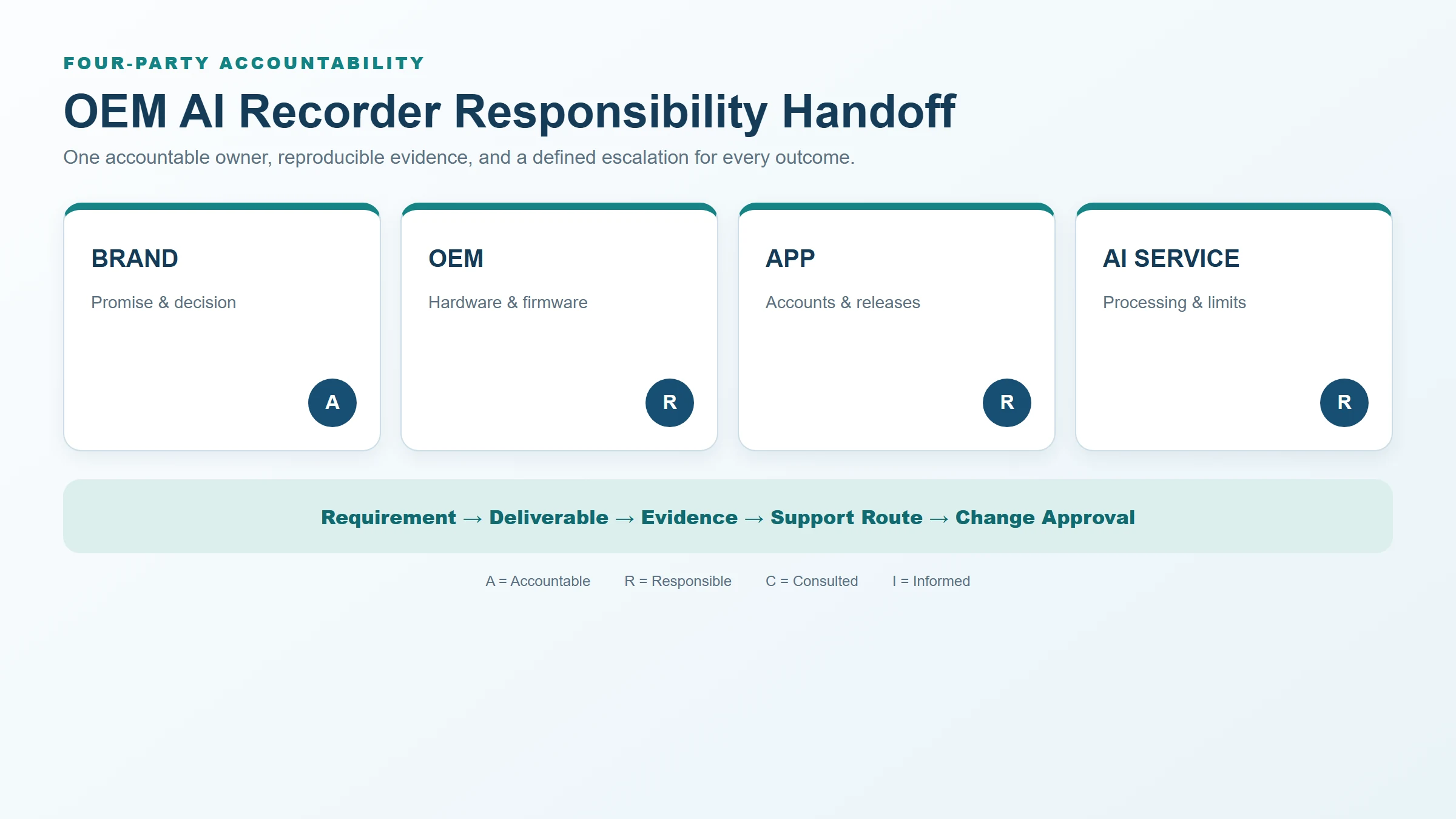
A recorder program may involve more entities than the purchase order suggests. The brand can own the customer promise while an OEM builds hardware, a development team operates the app, and another provider processes audio. A distributor, cloud host, support contractor, or payment provider may add further roles.
Begin with legal entity names and contract relationships. Avoid labels such as “vendor” when several suppliers are involved.
| Party | Typical decision area | Evidence to request |
|---|---|---|
| Brand owner | Product promise, market, pricing, policy, customer remedy | Approved requirements and launch claims |
| Hardware/OEM partner | Device configuration, manufacturing, firmware, packaging | Specification, sample record, change notice |
| App operator | Accounts, releases, interface, integrations, support tooling | Release plan, access map, runbook |
| AI-service provider | Processing capability, limits, retention, service changes | Service schedule, data terms, evaluation output |
One company may perform two roles, but the duties should remain separate in the matrix. This helps the team see what must be reassigned if a service or contractor changes.
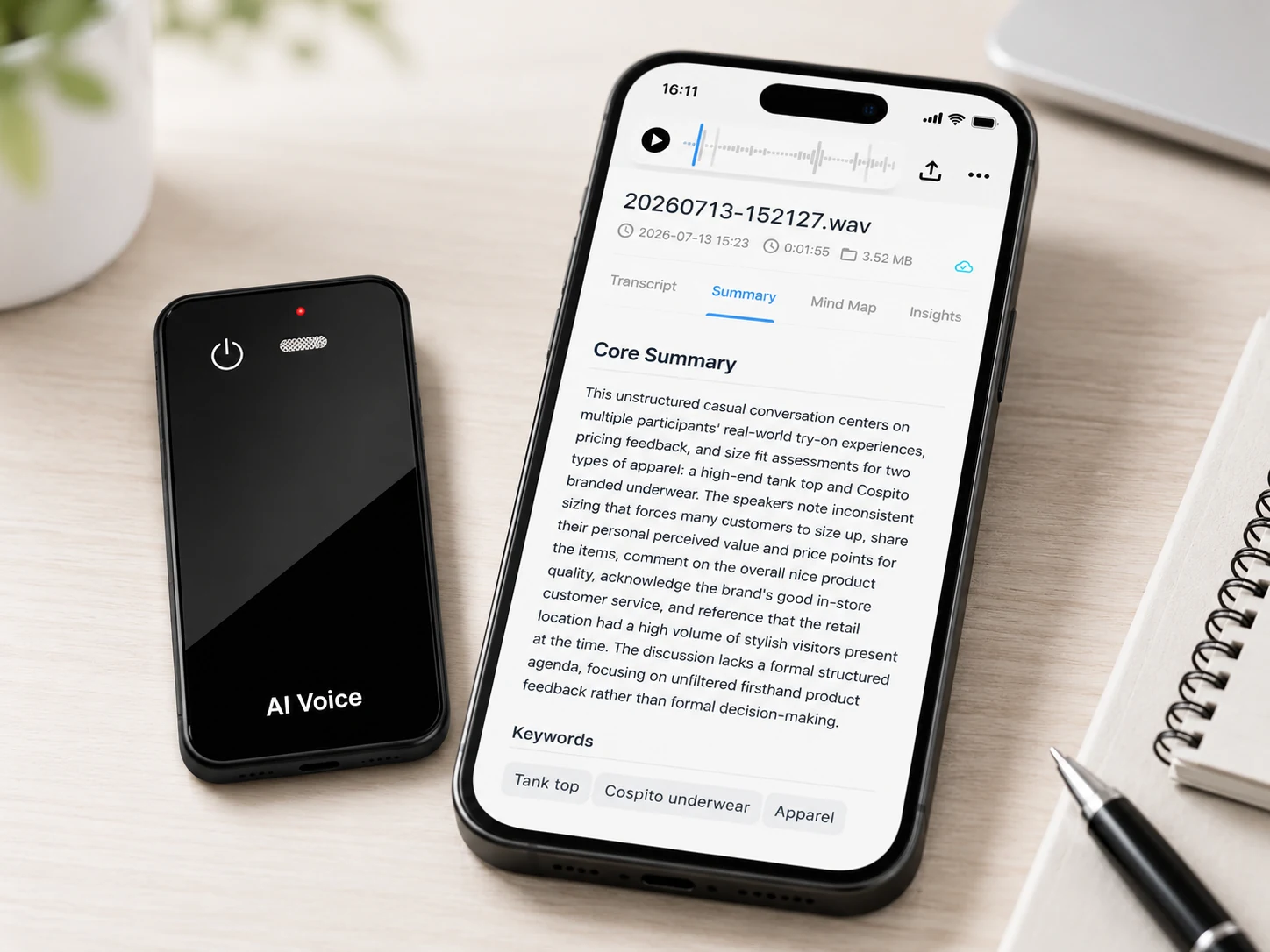
Use RACI with evidence and response time
Traditional RACI identifies who is Responsible, Accountable, Consulted, and Informed. For an AI hardware program, add three columns: required evidence, response time, and escalation path. Without them, a matrix can look complete while remaining unusable.
| Activity | Brand | OEM | App operator | AI provider | Acceptance evidence |
|---|---|---|---|---|---|
| Freeze reference configuration | A | R | C | C | Signed configuration sheet |
| Verify offline recording | C | A/R | I | I | Controlled WAV samples |
| Approve app release | A | C | R | C | Test and release record |
| Evaluate AI output | A | C | R | R | Buyer test set and scorecard |
| Answer privacy request | A | C | R | C/R | Request and closure log |
| Correct hardware defect | C | A/R | I | I | Root cause and retest evidence |
| Respond to service outage | I | I | A/R | R | Incident timeline |
| Approve customer claim | A/R | C | C | C | Substantiation file |
There should normally be one accountable party for each row. Shared execution is common; shared accountability often produces delay. If contracts prevent one party from controlling the outcome, name the accountable integrator and document the dependency.
Assign hardware and recording-quality duties
Recording quality crosses product design, manufacturing, placement, and user behavior. The OEM can be responsible for building the approved configuration and testing defined device characteristics. The brand normally owns the market claim and use instructions. The app or AI provider should not be assigned responsibility for acoustic defects already present in the source.
Define who approves microphone configuration, mechanical openings, firmware, file format, storage capacity, controls, indicators, accessories, charging behavior, transfer procedure, labeling, and packaging. Record test conditions rather than using a general phrase such as “clear audio.”
When a complaint arrives, preserve the device identifier, firmware, configuration, source file, room description, placement, duration, and transfer history. The first owner should reproduce the capture issue before routing it downstream. A poor transcript does not prove a microphone defect, and a clean waveform does not prove transcription quality.
Separate firmware, app, and cloud changes
Three release systems can affect the user journey. Firmware may change device behavior. A mobile update may change permissions, pairing, transfer, or account flows. An AI-service change may affect language handling, output structure, latency, or cost.
Create a change board with representatives from all affected layers. For each proposed change, record trigger, owner, affected configurations, security and privacy impact, regression scope, commercial impact, user communication, rollback plan, approval, and effective date.
The change record should make six decisions explicit:
- Which released and pending configurations are affected.
- Which evidence must be repeated before approval.
- Which party pays for development, testing, and communication.
- Whether users, channel partners, or regulators require notice.
- How the team can contain or reverse an unsuccessful change.
- Who closes the change after reviewing regression evidence.
The February 2022 NIST Secure Software Development Framework provides a common vocabulary for secure development and supplier communication. It can help buyers ask how software requirements, vulnerabilities, releases, and provenance are managed. Referencing it does not mean that a supplier or product has been certified against it.
CISA’s 2024 Software Acquisition Guide recommends making security expectations visible in acquisition discussions and evaluation criteria. Private-sector brands can adapt this evidence-based approach while recognizing that federal guidance is not automatically a contractual requirement.
Put app-store authority in the matrix
The organization that writes the app may not own the store account. Authority over agreements, certificates, releases, payments, reviews, and user access therefore needs explicit assignment.
Apple’s App Store Connect role guidance explains that the Account Holder signs legal agreements and controls membership functions while other roles carry narrower privileges. Google’s Play Console permissions guidance distinguishes account-owner, admin, and user access at account or app level.
Record who owns each store account, who holds the highest role, who manages signing material, who approves releases, who responds to rejection, and who revokes access when a contractor leaves. Do not share one personal credential across teams. Schedule access reviews and keep recovery methods under organizational control.
Map data handling and privacy requests
The brand should know which entities receive audio, transcripts, summaries, account records, diagnostics, analytics, and support attachments. Create a data-flow inventory for local storage, mobile transfer, cloud processing, backups, exports, and deletion.
The NIST Privacy Framework is a voluntary tool for identifying and managing privacy risk. Use it to structure questions and ownership without presenting it as a compliance certificate. Assign responsibility for privacy notices, consent flows, store disclosures, processor records, retention settings, deletion requests, incident notification, and evidence of closure.
If a user asks for deletion, the support agent receiving the request needs a route across every system. The brand may be accountable for the response; the app operator may delete account and application data; the AI provider may handle processed artifacts under its service terms; the OEM may have no cloud copy. Document exceptions, backups, verification, and response timing.
Decide who evaluates AI outputs
AI output quality depends on capture conditions, language, terminology, service configuration, and review rules. The AI provider can explain service capabilities and limits. The app operator can implement the workflow. The brand should define acceptable use, test cases, thresholds, and claims.
Use a matched evaluation set containing representative speech, names, numbers, overlap, accents, and noise. Retain the source, reference transcript, service version when available, output, corrections, score, and reviewer. Separate transcription, translation, summarization, and speaker attribution because each can fail differently.
NIST AI RMF 1.0, published in 2023, organizes voluntary AI risk work around governance, context, measurement, and management. It supports the principle that the brand must define intended use and review rather than delegating every consequence to a model provider.
Design support around observable symptoms
Customers report symptoms, not architecture layers. “My recording is missing,” “the app cannot connect,” and “the summary changed a number” require different evidence and routes.
Create a first-response decision tree. Capture device ID, app version, operating system, account, timestamp, source file status, network state, error message, service status, and user impact. Assign one front door for the customer, then route internally without making the user coordinate suppliers.
| Symptom | First evidence | Initial owner | Possible escalation |
|---|---|---|---|
| No source file | Device and recording history | OEM/hardware support | Brand quality owner |
| Transfer fails | File presence, accessory, host, app log | App or device owner | Joint reproduction |
| Transcript missing | Upload and processing status | App operator | AI provider |
| Wrong name or number | Source passage and output | Brand evaluation owner | AI provider/app workflow |
| Cannot delete account | Request ID and system inventory | Brand/app privacy owner | Processors and legal review |
Support contracts should define severity, service hours, response target, evidence required, communication owner, workaround, correction, verification, and closure. The customer-facing brand remains responsible for making an accurate promise even when another party performs the repair.
Control evidence handoffs
At sample approval, deliver the configuration, test files, results, deviations, firmware, app build, service plan, and open issues. At production release, add approved artwork, manufacturing controls, software release record, support materials, privacy disclosures, and change baseline. At launch, confirm store access, monitoring, escalation, billing, export, and deletion workflows.
Evidence should have an owner, version, date, scope, retention location, and approval status. Screenshots can help explain a result but are weak substitutes for source files, logs, release artifacts, and reproducible test steps.
The responsibility matrix can be paired with the AI voice-recorder OEM sourcing checklist for supplier evidence and the AI voice-recorder privacy guide for data roles. The dedicated recorder versus meeting bot guide helps teams allocate duties across physical and software-led meeting models.
Where This Product Fits
The MG6 AI Recording Card is offered as a card-sized OEM/ODM evaluation platform. Branding, packaging, storage, and selected software requirements can be discussed. Connected transcription, real-time translation, summaries, and mind maps depend on project scope.
| Layer | MG6 starting point | Responsibility to confirm |
|---|---|---|
| Hardware | Offline recording platform | Final configuration, firmware, accessories, tests |
| Private label | Branding and packaging discussion | Artwork, approvals, quantities, change control |
| Application | Selected adaptation can be discussed | Account, store, code, release, support ownership |
| AI service | Connected functions can be scoped | Provider, plan, data, evaluation, billing, availability |
| Production | Sample-to-production planning | Acceptance, lead time, quality plan, deviations |
This matrix is a proposed contract and operating aid. It does not assert that Yosiya has a fixed relationship with a particular AI provider or that every software ownership model is available.
FAQ
Who owns recording-quality defects?
Ownership depends on the cause. The hardware partner should investigate device and firmware behavior, while the brand owns the approved claim and instructions. Placement or user workflow may also contribute. Preserve the source file and test conditions before assigning root cause.
Who contracts with the AI provider?
The brand, app operator, or solution supplier may hold the agreement. Document the contracting party, billing, service limits, data terms, support path, change notices, and what rights survive termination.
Who handles app-store updates?
Assign separate roles for roadmap approval, development, testing, signing, submission, policy response, rollout, and monitoring. Store-account ownership should be recorded even when a contractor performs releases.
Who answers deletion requests?
Give the user one clear contact. The accountable privacy owner should coordinate deletion or documented exceptions across the app, AI service, backups, analytics, and support systems and retain closure evidence.
How should changes be approved?
Use a change record identifying scope, affected versions, tests, security and privacy impact, cost, schedule, communication, rollback, accountable approver, and effective date. Update the responsibility matrix when duties change.
Review MG6 project responsibilities
Draft the four-party matrix before approving the sample-to-production handoff. Then contact Yosiya to review the proposed MG6 hardware, branding, application, AI-service, evidence, and support responsibilities.


