

AI hardware customization adapts an existing device platform to a brand’s product requirements. The changes can involve visual identity, packaging, selected components, firmware behavior, an app, or the connection to an AI service. What is feasible depends on the starting design and the evidence available for the modified version. A new logo and a different sensor do not create the same engineering workload. For brand owners, the useful first step is to separate changes that preserve the platform’s behavior from changes that affect its interfaces or physical limits. That distinction makes a customization discussion specific enough to evaluate, sample, and quote.
Start with the platform’s boundaries
A platform is the design you intend to reuse: a particular board, enclosure, firmware branch, set of peripherals, and software interfaces. Ask the supplier to identify that baseline before discussing options. A product photograph or a broad family name leaves too much room for different versions to enter the conversation.
For a brand owner considering a connected AI accessory, the immediate priorities are:
- Identify the user experience that must remain consistent after the change.
- Separate desired appearance from required device behavior.
- Ask which changes the existing platform supports and which need investigation.
- Associate each accepted change with a sample, drawing, configuration record, or test.
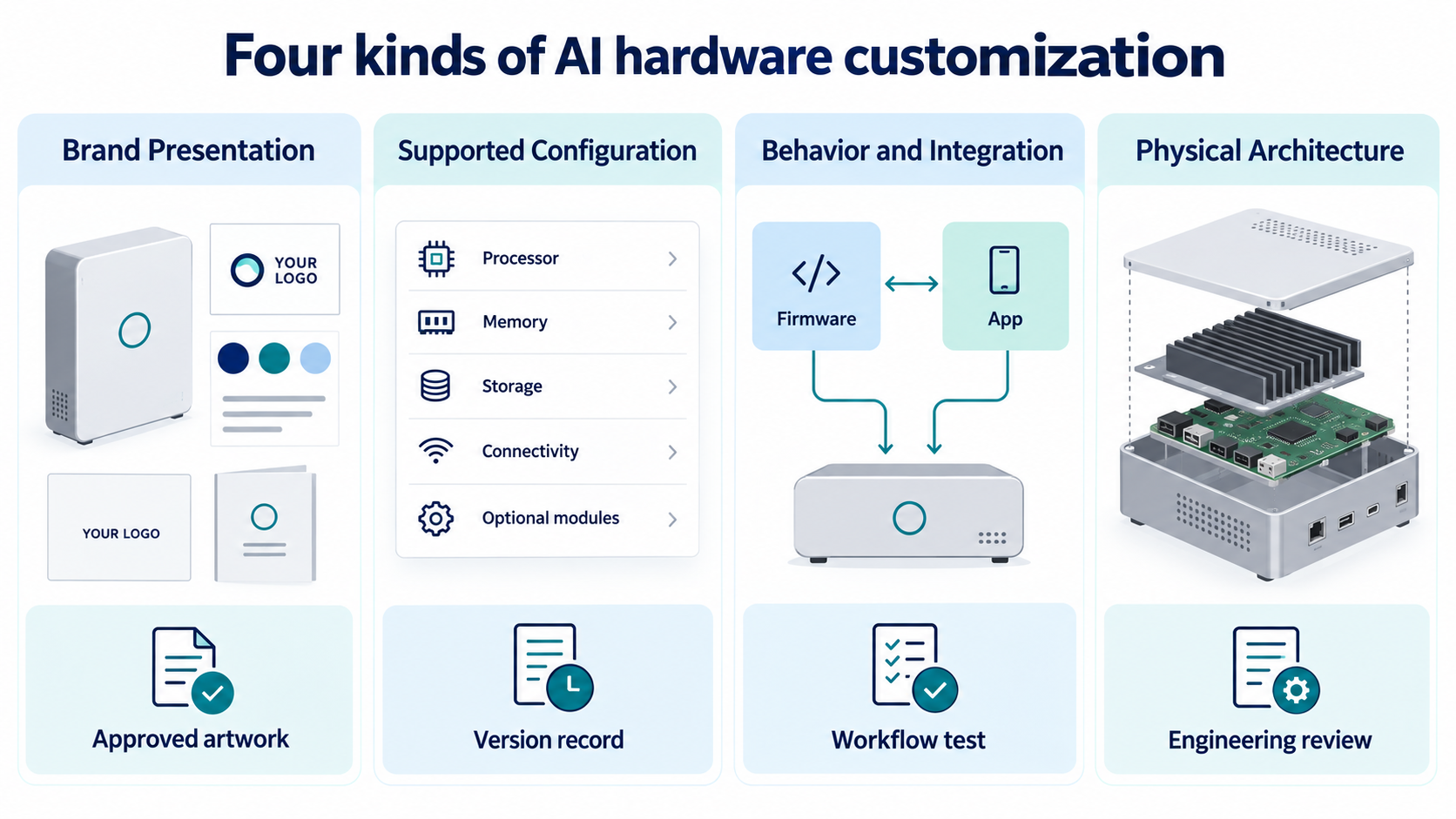
This article uses four practical change groups. They are a scoping aid, not a universal industry classification or a menu of options available on every Yosiya product. Yosiya describes hardware engineering, prototyping, and OEM/ODM capabilities; feasibility remains specific to the proposed device.
Four groups of customization, with different consequences
| Change group | Examples a brand may request | What needs confirming |
|---|---|---|
| Brand presentation | Logo artwork, package graphics, instructions, accessory presentation | Approved files, physical samples, labeling consistency, and who signs off |
| Supported configuration | A documented storage option, accessory selection, or existing language setting | Exact configuration, compatibility, availability, and version identification |
| Behavior and integration | Button actions, app onboarding, data export, or an AI service connection | Interface access, software ownership, error behavior, and regression scope |
| Physical or architectural change | New sensor, different enclosure geometry, battery arrangement, or compute platform | Engineering feasibility, power and thermal effects, tooling, and fresh validation |
The table describes change impact rather than price. A request in the first group can still have dependencies. For example, a package claim about offline operation must match what the chosen firmware and service actually do. An attractive box cannot resolve an unclear feature boundary.
Changes can also move between groups. Selecting an already supported accessory is a configuration choice. Adding a new accessory with a different connector or electrical requirement may become a hardware and firmware project. Ask for the reason behind the classification so both teams understand what is being reused.
Branding extends beyond the logo
A brand adaptation should cover the product name shown on the device, the packaging, the app, pairing screens, help materials, and support records. Inconsistent naming creates avoidable confusion when a distributor checks a sample against a listing or a customer reports a problem.
Useful approval items include logo placement, the printing or marking method, color references, the instruction language, and the final pack contents. Review a physical sample for the details that cannot be settled on a screen. Treat color, finish, and readability as explicit acceptance items rather than “similar to the rendering.”
For a branded Bluetooth product, the Bluetooth SIG requires qualification under the selling company’s membership account; a supplier cannot qualify the product on that company’s behalf. Check the applicable scenario in the Bluetooth qualification guidance.
That is one reason to clarify the commercial identity early. Ask who owns the product name, who supplies the relevant records, and which model identifier will appear in each document. A logo request should not hide unresolved questions about the branded product being placed on the market.
Configuration choices need a version trail
An existing option is useful only when its boundaries are known. “More storage available” should lead to a specific configuration and compatibility check. “Several languages supported” should distinguish interface text, instructions, speech recognition, translation, and customer support. These are different deliverables.
Keep a compact option record with the baseline identifier, selected option, affected files, sample identifier, and approval date. If a supplier offers a substitute component, ask whether the substitute is already approved for that exact configuration or requires additional evaluation. Matching a headline capacity alone does not establish equivalence.
For a multi-market launch, resist creating a separate device version for every small commercial request. A shared hardware platform with controlled packaging or software variants may be easier to manage, when technically suitable. The decision should follow the actual differences between markets and channels, not a desire to maximize the option list.
Firmware changes and AI changes are separate requests
Firmware controls behavior close to the hardware. Examples include a button sequence, a status light, a connection retry, or the way a sensor is initialized. An AI service change may instead affect model selection, processing location, authentication, data formats, or an app’s presentation of results. One request can involve both layers, but the deliverables should identify each layer explicitly.
Embedded software often contains hardware-specific configuration. For example, Zephyr’s devicetree documentation describes how the operating system represents hardware and its initial configuration. This illustrates why changing a peripheral can require configuration or driver work even when the device’s outward appearance stays the same.
When discussing AI workflow customization, ask:
- What input reaches the model, and in what format?
- Which operation runs on the device, in an app, or through a remote service?
- What can the user still do when authentication or connectivity fails?
- Who maintains the integration when an API or model version changes?
- Which outputs and response times will the sample evaluation measure?
Use the actual workflow for evaluation. A newly selected model may need different memory or execution support. Google’s LiteRT benchmarking documentation separates initialization, warmup, steady-state inference, and memory measurements. Those distinctions provide useful questions for a local AI test plan; they are not performance promises for a customized device.
An enclosure change can reach inside the product
A smaller housing, different material, relocated opening, or altered attachment can affect the surrounding design. Have engineering review the internal space, assembly access, sensor exposure, heat path, antenna area, and the intended way the product is held or mounted. A render does not establish that the existing electronics will behave identically inside the new shape.
Texas Instruments’ antenna measurement and matching application note explains that nearby plastic and other physical conditions can alter antenna tuning. The implication for a brand is straightforward: review radio performance in the intended assembled enclosure rather than assuming the original bare-board result transfers unchanged.
The same scoping discipline applies to a sensor relocation. Moving a microphone or camera might support the desired industrial design while changing what it captures. Define the user’s position and environment, then evaluate the modified arrangement. Keep the engineering question visible instead of approving the appearance and discovering the functional dependency later.
An illustrative request, separated into reviewable changes
Consider a fictional brand adapting a connected voice accessory for a training program. The brand wants a new logo, a different button action, and reports sent into its own software. This is an illustrative planning scenario, not a Yosiya project or an available product configuration.
The logo can be reviewed through artwork and a marked sample. The button action needs a written description of short press, long press, accidental activation, and status feedback. The report connection needs an interface agreement covering identity, data format, delivery failure, and support ownership. Three visible requests therefore produce three different kinds of approval evidence.
Now suppose the brand also asks for a slimmer enclosure. That request should receive a separate feasibility review because it could affect the internal arrangement. Keeping it separate allows the team to compare a launch based on the current enclosure with a later physical redesign, without implying that either route is already approved.
Make the customization discussion concrete
Send a marked-up description of the reference product rather than a list headed “full customization.” For each change, write the user reason, whether it is required for launch, and how acceptance could be demonstrated. Include requirements that must stay unchanged, such as a particular interaction or compatibility boundary.
Ask the supplier to respond with four statuses: supported as configured, feasible with development, investigation needed, or outside the proposed scope. Request the assumptions behind each answer. A qualified answer with a clear next step is more useful than an unbounded promise.
Before accepting the proposal, make sure it names the baseline, approved changes, excluded work, sample deliverables, validation responsibilities, and change-control process. A customization quote becomes comparable when both parties are describing the same modified product.
FAQ
Can a brand reserve exclusive use of a customized design?
Exclusivity needs a separate written agreement defining the design elements, markets, duration, and permitted supplier reuse. Paying for a customization task does not by itself describe those boundaries. Ask which parts remain a shared platform and which deliverables are specific to the brand.
Can packaging be approved before the software is final?
Artwork development can proceed, but feature descriptions, compatibility statements, setup steps, and service terms should match the release configuration. Keep those items open until the responsible teams approve them. Otherwise, a later software decision may leave printed instructions inaccurate.
What happens when a requested option is discontinued?
Agree on notification, replacement review, sample approval, and inventory handling before production. The replacement should be assessed against the requirements affected by that part. Avoid assuming that a component with a similar name or capacity is interchangeable without review.
Should every channel receive a separate hardware version?
Only when the channel requirements justify it. Start by identifying whether the difference can be handled through packaging, an accessory bundle, or an approved software setting. Additional hardware versions introduce more configurations to identify, evaluate, and support.
How can a brand prevent late requests from changing the quote?
Approve a dated scope and require each later request to show its impact on deliverables, evaluation, price, and schedule before acceptance. Keep a decision log that distinguishes a clarification from an added feature. This gives both teams a shared reference during sample review.
Discuss the changes that matter to your launch
Bring a reference platform, a short change list, and the user reason behind each request. Brands evaluating AI hardware customization can discuss the proposed scope with Yosiya. Ask for a response that separates supported options, engineering work, and questions that a sample or feasibility study must resolve.


