

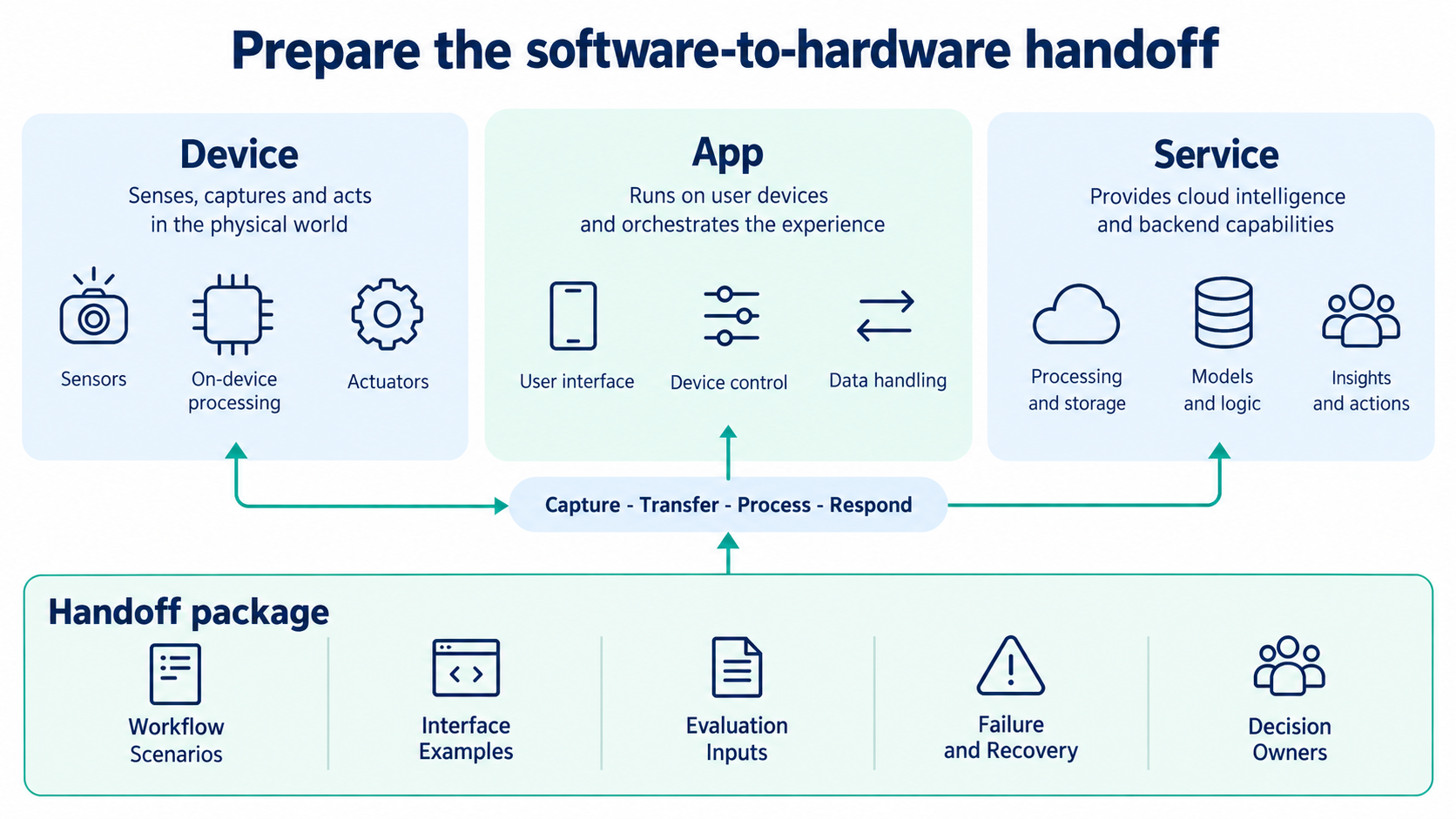
Software teams preparing an AI hardware project should assemble a handoff package that another engineering team can use without guessing how the product behaves. It should include a bounded user workflow, interface definitions, representative inputs and outputs, failure behavior, access to a test environment, and a named owner for each unresolved decision. Add the physical constraints that affect software, such as sensing conditions, connection availability, controls, and expected use patterns. The package does not need to specify every component. It needs to make the device’s relationship with the app, model, and backend clear enough to discuss architecture, estimate integration work, and plan a meaningful first build.
Replace the feature deck with a runnable explanation
A product presentation establishes the opportunity. The hardware team also needs to know what happens when someone uses the proposed device. Describe one complete task from its physical trigger to its final result, including what the user sees while waiting and after failure.
Prepare three short scenarios: an ordinary successful interaction, an interruption, and recovery. For each, identify which steps belong on the device, in the app, and in the service. Highlight decisions that are still open. A diagram with an explicit unknown is easier to discuss than a polished diagram that hides one.
Your first handoff should let an engineer answer:
- What initiates the task, and how does the device acknowledge it?
- What information crosses each system boundary?
- What constitutes completion from the user’s perspective?
- What happens if a dependency is unavailable?
- Which person can decide when requirements conflict?
The product owner should review these scenarios with the software and hardware leads. A shared written example often exposes a mismatch that a feature list cannot: the app may expect a continuously connected device while the proposed use requires interrupted connectivity.
Supply an interface package with working examples
Provide the message fields, units, allowed values, version identifiers, and meaning of each status. Include valid examples, error examples, and the credentials or access process for a test environment. A specification that cannot be exercised leaves important integration questions unanswered.
For HTTP services, OpenAPI offers a standardized, language-independent description of an API’s capabilities. It can help both people and tools understand the service without inspecting its implementation. Use it where it matches the interface, alongside product-specific examples and behavioral rules. OpenAPI Specification
Other connections need different descriptions. A Bluetooth interface may require service and characteristic definitions; a serial interface may need message framing and error detection rules. Name the actual transport under consideration and distinguish confirmed choices from options awaiting feasibility work.
For message-based systems, define what happens after retries. MQTT 5.0, for example, specifies that its “at least once” delivery level can produce duplicates. That protocol behavior makes application-level handling of repeated requests a relevant handoff question. OASIS MQTT 5.0 standard
Ask the service owner what a repeated request means: repeat the action, return the existing result, reject it, or require a new identifier. The receiving firmware team should not have to infer this from a successful response example.
A filled requirement is more useful than an empty template
The following fictional requirement illustrates the level of detail a software team can prepare. It is an editorial example, not an implemented product specification or a Yosiya customer project. Its purpose is to expose decisions before integration begins.
| Field | Illustrative requirement: interrupted image submission |
|---|---|
| User action | Operator presses the capture control while viewing an item |
| Device responsibility | Preserve the current capture until the agreed transfer outcome is known |
| Request identity | Reuse the same capture identifier when retrying that capture |
| Service responsibility | Return the existing result for a completed capture identifier |
| User-visible state | Show pending while awaiting a result and a defined error if completion fails |
| Recovery rule | Resume the pending transfer after reconnection under the agreed retry policy |
| Acceptance example | Interrupt the connection during transfer, restore it, and inspect request and result records |
| Open decisions | Storage limits, retention, retry timing, and handling of a second capture |
| Approval owner | Product lead, with firmware and service leads reviewing the interface |
The open decisions are part of the handoff. They identify what must be settled before the requirement becomes executable. For example, allowing a second capture raises questions about queueing and user feedback that affect both memory needs and the app experience.
Pair the table with a sample request and response in the actual format your team intends to support. Give examples durable filenames and a revision identifier so partners can report precisely which version produced an integration problem.
Prepare the mobile behavior outside the happy path
If a phone is part of the system, state the supported operating-system targets and who owns the mobile implementation. Show permission prompts, denied permissions, lost pairing, reconnection, and the behavior when the app is not actively in use.
Android’s Bluetooth documentation distinguishes permissions for scanning, advertising, and connecting for apps targeting Android 12 or higher, and describes runtime permission requests. This is one concrete reason to include phone permissions in the workflow specification. Android Bluetooth permissions
Ask the mobile team to demonstrate the proposed behavior on its selected test devices. Record which cases are supported and which need further investigation. An engineering partner can evaluate the device connection more effectively when the phone-side assumptions are visible.
Also define device reassignment. A replacement phone, a different employee, or a returned sample may require a change of account or device association. Decide who may initiate that change and what should happen to pending data. Treat it as a product requirement with a clear owner.
Give AI evaluation inputs the same care as API examples
Supply representative inputs, expected useful outcomes, and examples of unacceptable behavior. Identify whether the partner receives a deployed API, a model package, or only a functional requirement. Record who can change that asset during the prototype period.
For a classification task, the handoff may include labeled examples and the consequences of important error types. For a generative output, it may include a review rubric with examples of acceptable, incomplete, unsupported, and failed responses. Select the evaluation approach to match the task instead of assigning one universal accuracy target.
Keep evaluation records linked to the configuration used. Include model or service version where available, preprocessing assumptions, prompt or request settings where relevant, and the method used to review outputs. If a provider does not expose a fixed model version, state that limitation and decide how changes will be detected.
This allows the hardware partner to investigate the right layer. An output problem can originate in capture, transfer, input transformation, or the AI service. A small set of traceable examples is more useful for integration than an unexplained screenshot of a good result.
Assign security and update decisions before access is shared
The handoff should identify device identity, authorization, protected data, operational logs, and update responsibility. Name the people who approve access and respond when a test credential expires or a sample changes hands.
NIST IR 8259A provides a starting point for identifying cybersecurity capabilities in devices that organizations manufacture, integrate, or acquire. Use that baseline to structure the discussion, then select requirements for the actual deployment and customer needs. NIST IoT device cybersecurity baseline
For updates, identify the behavior expected from both the firmware and the service operating releases. MCUboot’s documented test-and-revert mechanism provides one implementation example: a new image can require confirmation, with a later boot reverting when that confirmation is absent. Its applicability depends on the selected configuration. MCUboot upgrade design
Translate the intended outcome into the project brief: who approves the release, how compatibility is established, what information support receives, and what recovery behavior must be demonstrated. The device team and software operator should review those decisions together.
Run a handoff meeting with visible exit conditions
Send the materials before the meeting and use the discussion to close ambiguities. Walk through the ordinary interaction, the interrupted interaction, and the example requirement. Ask the receiving team to describe its understanding in its own words.
Before closing, record:
- The accepted workflow and current interface versions.
- The assets each team will supply and their delivery dates.
- The unanswered questions that block architecture or estimation.
- The owner and deadline for each blocking decision.
- The first integration demonstration and the evidence it must produce.
A handoff is ready for the next engineering discussion when the partner can reproduce the supplied service examples, identify its responsibilities, and explain what remains uncertain. If the team cannot access a sandbox or distinguish test data from production data, fix that practical barrier before adding more detail to the presentation.
FAQ
Must software teams share their entire source repository?
Only share what the agreed engineering task requires under the applicable access arrangements. A documented interface, test endpoint, and representative examples may be enough for an initial integration discussion. Deeper implementation work may require additional assets and permissions.
What can we provide if the backend is unfinished?
Supply a versioned interface draft and a mock service with realistic success, pending, and failure responses. Label the differences from the intended backend. Assign someone to resolve changes and keep the hardware partner informed as the implementation matures.
How do we handle requirements that are still uncertain?
Record each uncertainty with its decision owner, impact, and proposed way to resolve it. Distinguish a preference from a constraint. This gives the partner a basis for explaining which choices can proceed and which need a feasibility experiment.
Can synthetic examples replace customer data during kickoff?
They can demonstrate formats, state changes, and integration behavior when clearly labeled. They do not establish performance on the intended deployment population. Plan how suitable evaluation inputs will become available before drawing conclusions about the product’s AI behavior.
Who should attend the first technical alignment session?
Include the product decision owner, the relevant app or backend lead, and the partner’s hardware or firmware lead. Add the AI owner when model behavior is central. Other specialists can join when specific unresolved questions require their expertise.
Bring a usable handoff to technical alignment
Yosiya provides hardware engineering and prototyping. To discuss an AI hardware project, prepare the workflow, interface examples, evaluation inputs, and unresolved decisions described here. Request technical alignment with a short explanation of the work your software team already owns and the hardware deliverables it needs.


