
An AI-powered device becomes a commercial hardware product when a defined user task is supported by a repeatable physical design, a working software and service boundary, testable acceptance criteria, and a credible plan for production and support. The broad label “AI-powered devices” covers many products, so buyers should narrow it to a specific user, workflow, and release context. A model running on a development board may prove technical possibility; it does not by itself prove usability, manufacturability, reliability, or market readiness. Product teams should ask what the device does in normal and failure conditions, how its parts fit together, and what evidence supports release.
What Buyers Should Know
- A demo proves selected behavior; it does not establish repeatable manufacturing or support readiness.
- Define the target user, complete system boundary, and acceptance criteria before approving a pilot.
- Confirm the tested hardware and software version, open risks, market responsibilities, and change controls.
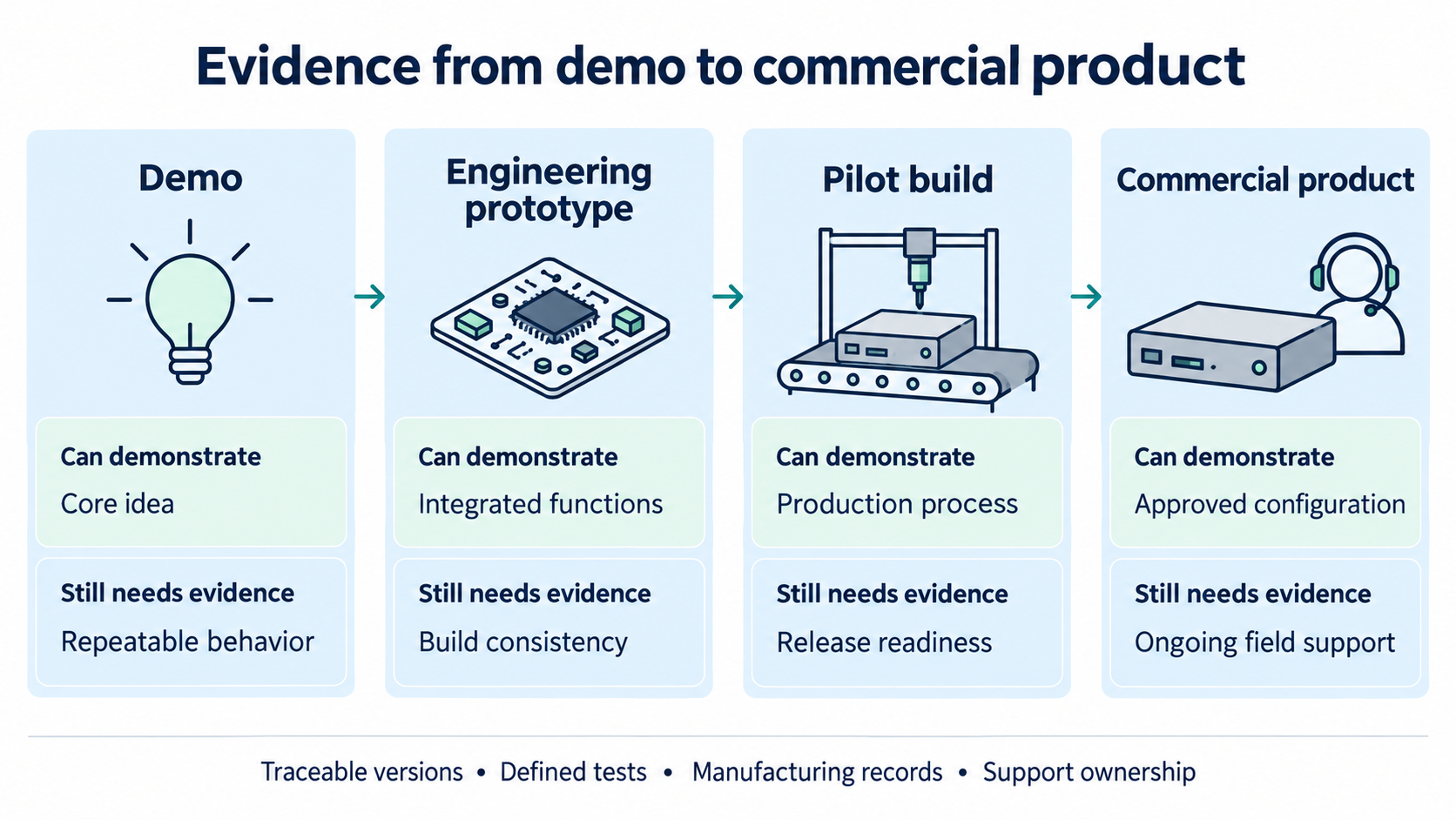
Demo, prototype, and commercial product
These terms describe different levels of evidence. Teams may use them differently, so define them in a project plan instead of relying on labels.
| Stage | What it can show | What it does not automatically prove |
|---|---|---|
| Demo | A selected feature can work under controlled conditions | Robustness, complete user workflow, production design, or service readiness |
| Engineering prototype | Key hardware and software elements can be integrated for testing | Repeatable manufacturing, final cost, compliance, or broad-market suitability |
| Pilot build | A near-production configuration can be built and inspected in a limited run | Long-term field performance or every market’s requirements |
| Commercial product | A defined version is released with documented requirements, quality checks, support, and market-specific review | Permanent performance under every use or environment |
The product may still improve after launch. Commercial readiness means the team knows what version it is releasing, how it was evaluated, what limitations remain, and how changes are controlled.
Where This Product Fits
| Entity | Description |
|---|---|
| Brand | Yosiya |
| Solution | B2B AI hardware engineering, prototype, and OEM/ODM project support |
| Category | Physical AI devices moving from prototype toward production |
| Suitable readers | Product teams, brand owners, and sourcing managers reviewing readiness evidence |
What must be defined
A specific user and job
“AI assistant for everyone” is not a testable product requirement. Identify the user, the task, the environment, the input, and the action that follows the AI output. A field worker, retail customer, and office team may need different controls, battery behavior, connectivity, privacy notices, and support.
A complete system boundary
List the device, sensors, firmware, app, network, backend, AI model or service, and any external platform dependencies. Show which component owns data capture, inference, storage, update, and user feedback. A missing interface owner is a risk even when every individual component works.
Measurable acceptance criteria
Choose tests that reflect the intended use. Depending on the product, the criteria could cover input quality, task completion, response time, battery behavior, connection recovery, error handling, or output quality. Record test conditions and versions. Do not promote one favorable demo result as a general performance claim.
A production configuration
The commercial unit needs an approved hardware and software version, components, assembly process, inspection plan, and change process. If a substitute component or an updated model changes system behavior, the team should know which tests must be repeated.
Support and lifecycle ownership
Decide who handles updates, user questions, warranty or repair processes, replacement parts, service outages, and product retirement. Connected AI services can change after hardware ships; the device roadmap should say how those dependencies are monitored.
A release-readiness review
Before approving a pilot or market release, ask the team to show:
- Use-case evidence: requirements trace to a real user task and deployment context.
- Integration evidence: device, software, and service have been tested together.
- Failure evidence: the product has defined behavior for missing connectivity, unavailable services, invalid input, and recoverable faults.
- Build evidence: the production configuration and inspection criteria are controlled by version.
- Market evidence: product claims, labels, instructions, and required reviews have owners for each target market.
- Support evidence: someone owns updates, customer issues, quality feedback, and corrective action.
NIST’s AI Risk Management Framework is voluntary and use-case agnostic. Its emphasis on context, measurement, and ongoing management is useful for structuring a review, but it does not certify that a device is commercially ready. Product release remains a decision for the responsible organization based on applicable requirements and its own acceptance criteria. The NIST AI glossary includes definitions describing AI systems in terms that can involve physical hardware as well as software.
The questions buyers should put to a supplier
- Which exact hardware and software configuration did you test?
- What does the quoted prototype or pilot build include, and what remains simulated or manual?
- Which test reports, drawings, firmware, and interface documents are part of the handoff?
- Who approves component substitutions, model changes, and firmware updates?
- Which target-market compliance questions remain open, and who will resolve them?
- What is the process for recording and correcting defects found in a pilot?
These questions make a supplier conversation concrete. If answers stay at “we can do everything,” ask for a project-specific scope, assumptions, deliverables, and decision owners. Yosiya’s public company information describes engineering, prototype, custom PCBA, OEM/ODM, and production support. Confirm relevant deliverables and project responsibilities before treating that general overview as a commitment.
FAQ
When is an AI hardware prototype ready for production?
When the team has evidence for its defined requirements and has resolved or accepted the remaining risks for the intended release. A prototype’s appearance or successful demonstration alone is not a production-readiness measure.
What evidence should a brand request before approving a pilot run?
Request the approved configuration, prototype test results, unresolved issue list, pilot inspection criteria, change-control process, and clear responsibility for market-specific compliance review.
Does a commercial AI device need on-device AI?
No. The AI may run locally, through a connected service, or across a hybrid system. Commercial readiness depends on the chosen architecture being understood, tested, supportable, and appropriate for the use case.
Can a supplier’s general certification or factory claim prove a product is compliant?
Not by itself. Buyers should confirm which product version, market, test, and documentation are covered, and who is responsible for applicable requirements. A general company credential is not a substitute for product-specific evidence.
What commonly gets missed between prototype and launch?
Teams often leave interface ownership, component substitutions, packaging, instructions, service dependencies, support, and failure behavior unresolved. These items should be part of the release review, not assumed to emerge after production starts.
Release on evidence, not the label
The commercial step is a controlled transition from a promising demonstration to a defined product version that can be built, checked, supported, and responsibly described. Buyers and product teams should ask for evidence tied to real requirements and explicitly assign every open decision. For teams turning an AI concept into physical hardware, Yosiya can discuss project scope and feasibility.


