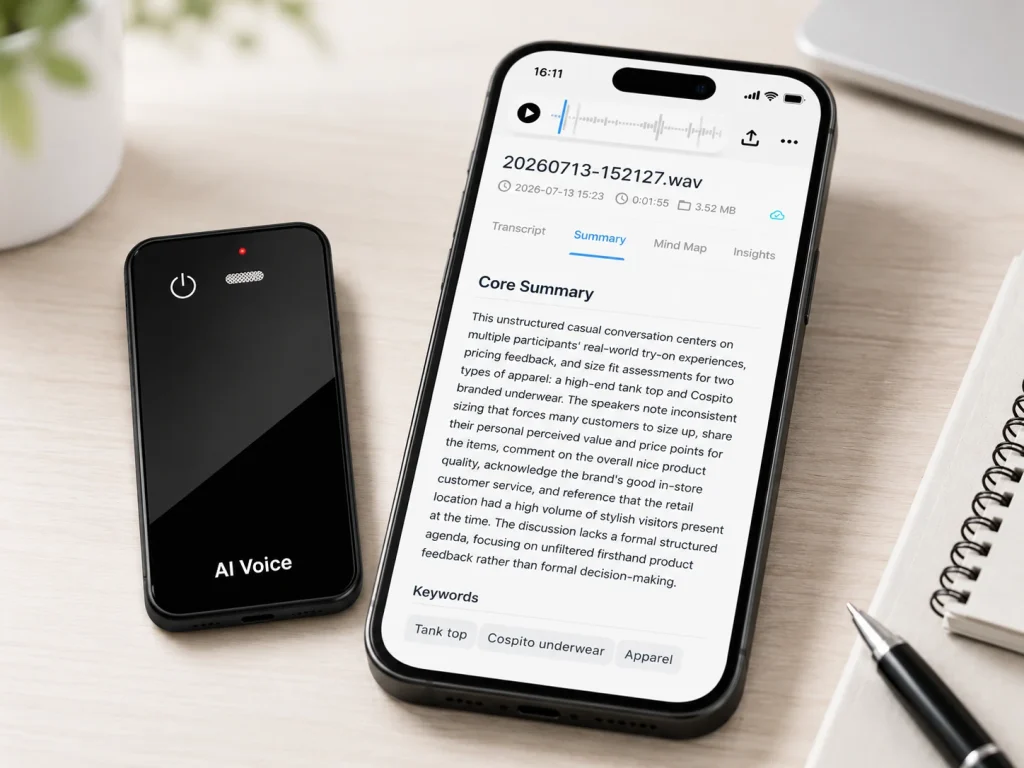
An AI voice recorder OEM project should be sourced as a connected product system, not as a recorder shell with an AI label. The commercial scope may include hardware, firmware, local files, a mobile application, user accounts, transcription services, packaging, certification work, support, and production inspection. A buyer should define who supplies, owns, tests, and maintains each layer before approving a sample. The right supplier is therefore not simply the lowest unit-price factory; it is the partner that can turn a written project scope into repeatable evidence from prototype through mass production.
What Buyers Should Know
- Separate hardware customization from app, AI-service, and data-policy commitments.
- Treat MOQ and lead time as configuration-dependent project references, not universal promises.
- Require version-matched test and conformity documents for the intended market.
- Convert sample observations into measurable production acceptance criteria.
- Put recurring AI fees, service limits, export rights, and support ownership in writing.
Where This Product Fits
| Entity | Project role |
|---|---|
| Yosiya | AI hardware OEM/ODM solution provider |
| MG6 AI Recording Card | Card-sized recorder reference platform for private-label evaluation |
| Confirmed hardware boundary | Offline WAV recording, local storage options, Bluetooth, magnetic charging and data transfer |
| Connected-service boundary | Transcription, translation, summaries, and mind maps under the selected service scope |
| Commercial starting point | Product MOQ starts at 100 units; logo customization starts at 500 units |
The MG6 reference device measures 54 × 85 × 2.6mm and has two omnidirectional microphones, a hardware noise reduction algorithm, a 370mAh battery, and storage options from 8GB to 128GB. Use these as reference-platform facts, not as permission to assume every custom version will keep the same component, software, schedule, or documentation package.
Before defining the custom route, buyers can use the small audio recorder sourcing guide to structure SKU scope, sample checks, packaging, support, and production standards.
Define the Business Route First
An OEM inquiry can describe several different commercial goals:
Buy a finished retail product
The buyer accepts the product, brand, app, service plans, and support model already offered. This can be fast, but it does not create a differentiated SKU owned by the buyer.
Resell or distribute an existing product
The buyer focuses on channel rights, inventory, marketing, warranty routing, and after-sales terms. Hardware engineering control is usually limited.
Develop a private-label or OEM product
The buyer wants its own logo, packaging, storage mix, accessories, and possibly selected software adaptations. More control also creates more responsibility for approvals, documentation, service continuity, and launch support.
Do not compare these routes only by unit price. Compare time to market, control, differentiation, software responsibility, support burden, and lifecycle cost.
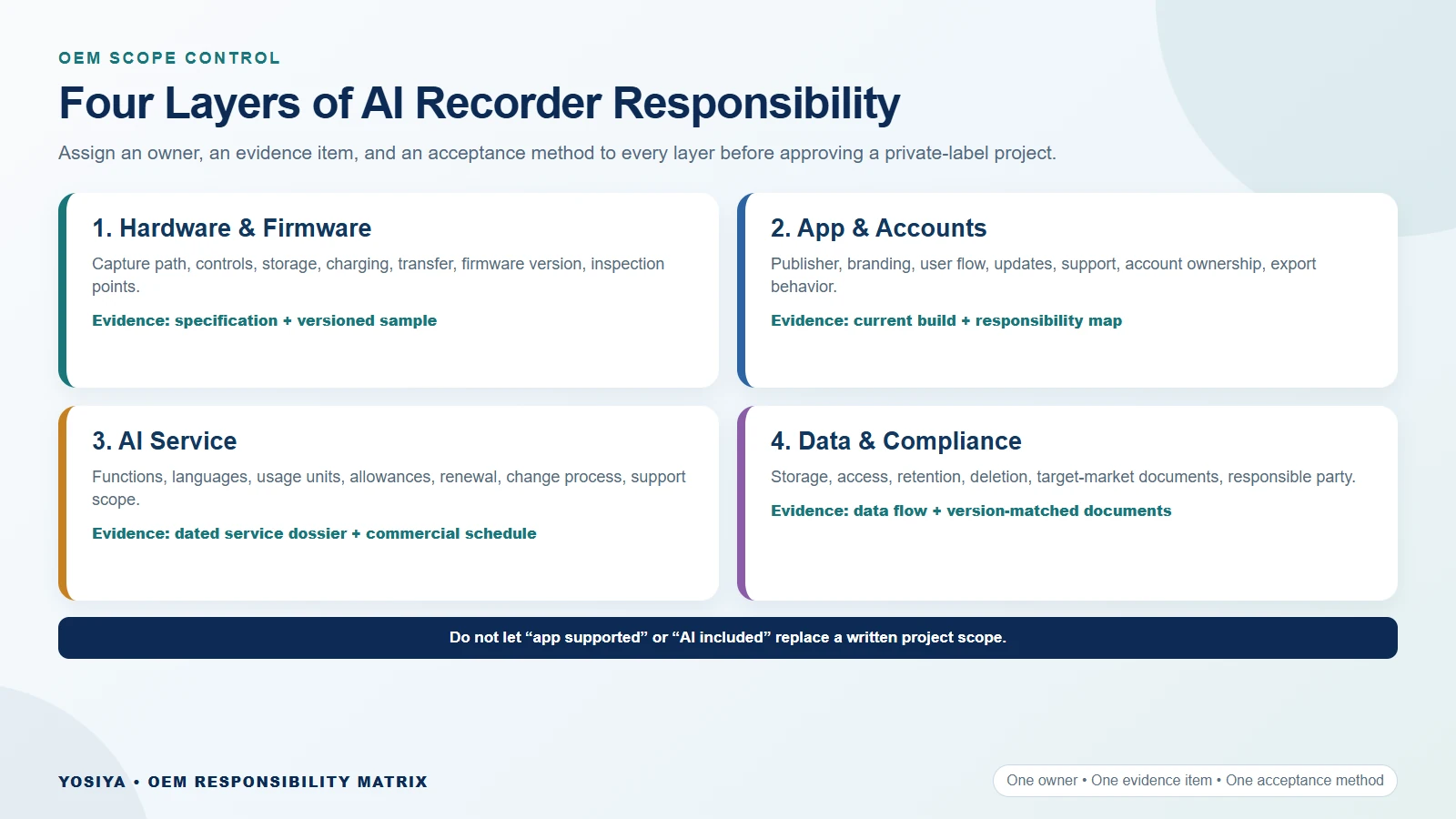
Write a Four-Layer Responsibility Matrix
The most useful early document is a table with one owner and one acceptance method for every layer.
| Layer | Questions for the supplier | Evidence before approval |
|---|---|---|
| Device hardware | Which microphones, battery, storage, enclosure, charging, and controls are included? | Versioned specification, sample, drawings, and inspection points |
| Firmware and files | Which recording formats, naming rules, transfer paths, and update methods apply? | Demonstrated source files and transfer workflow |
| App and accounts | Who publishes, brands, maintains, and supports the app and user accounts? | Current build, scope document, account map, and support responsibilities |
| AI service | Which functions, languages, usage allowances, models, regions, and fees apply? | Service dossier and commercial schedule |
| Data governance | Where are audio and outputs stored, retained, exported, and deleted? | Data-flow diagram, policy documents, and deletion test |
| Commercial delivery | What are the MOQ, lead-time conditions, warranty route, packaging scope, and change controls? | Signed quotation, approved sample, and production plan |
This is where many sourcing conversations become too vague. “App supported” does not say who owns the store account or pays for maintenance. “AI included” does not say which languages, how usage is measured, or what happens when a service changes.
Treat Design Changes as Manufacturing Decisions
Logo printing and packaging artwork may be straightforward; enclosure geometry, microphone openings, magnetic parts, battery layout, and water-resistance design are not merely cosmetic.
Autodesk’s design-for-manufacturing guidance discusses material and process selection, wall thickness, tolerances, assembly, inspection, documentation, and revision control. Apply that mindset to ultra-thin recorder projects: a small design request can affect tooling, yield, acoustic behavior, sealing, assembly, or schedule.
The slim voice recorder design guide explains how thinness affects enclosure tolerances, audio paths, controls, battery layout, charging, and packaging as one system.
Ask the supplier to classify each request:
- Existing configuration choice.
- Artwork or packaging change.
- Firmware or interface change.
- Application change.
- Mechanical or tooling change.
- New compliance or testing requirement.
Each class should have its own feasibility review, cost, lead time, and validation step.
Verify Quality and Conformity Evidence
Quality assurance is preventive. The ISO overview of quality assurance describes process documentation, supplier controls, inspections, testing, audits, and corrective action as parts of a quality system. A polished sample alone does not demonstrate production consistency.
Ask how the supplier will control:
- Approved components and substitutions.
- Incoming inspection.
- Assembly and firmware versions.
- Functional testing.
- Cosmetic acceptance.
- Packaging and labeling.
- Final inspection and shipment release.
- Nonconformance and corrective action.
Certification language also needs precision. ISO/CASCO’s explanation of attestations of conformity distinguishes different forms of conformity evidence and the supporting technical information behind them. A factory management-system certificate is not automatically a certificate for the finished product.
The new MG6 version’s certification package has not yet been issued. Buyers should request version-matched documentation for the selected configuration and target market before shipment or launch. Do not publish a named certification until the applicable document and model match have been checked.
Environmental claims require the same discipline: the guide to IP68 voice recorders and waterproof claims explains why the model, version, test conditions, and supplier evidence must match the product being sold.
Include Connectivity and Battery Logistics
Bluetooth capability alone does not define the security of the implementation. The Bluetooth SIG security overview explains that design, implementation, deployment, consent, transparency, use, and retention all contribute to secure operation. Ask about pairing, account access, updates, lost-device handling, and supported phone environments.
For samples and production shipments, the battery must be handled as a supply-chain item. IATA’s battery guidance points shippers and manufacturers to current requirements that depend on battery type, configuration, packaging, and route. Confirm the applicable test summary, labels, packaging, carrier rules, and shipping documents for each project rather than copying a checklist from another product.
Use a Stage-Gate Sourcing Process
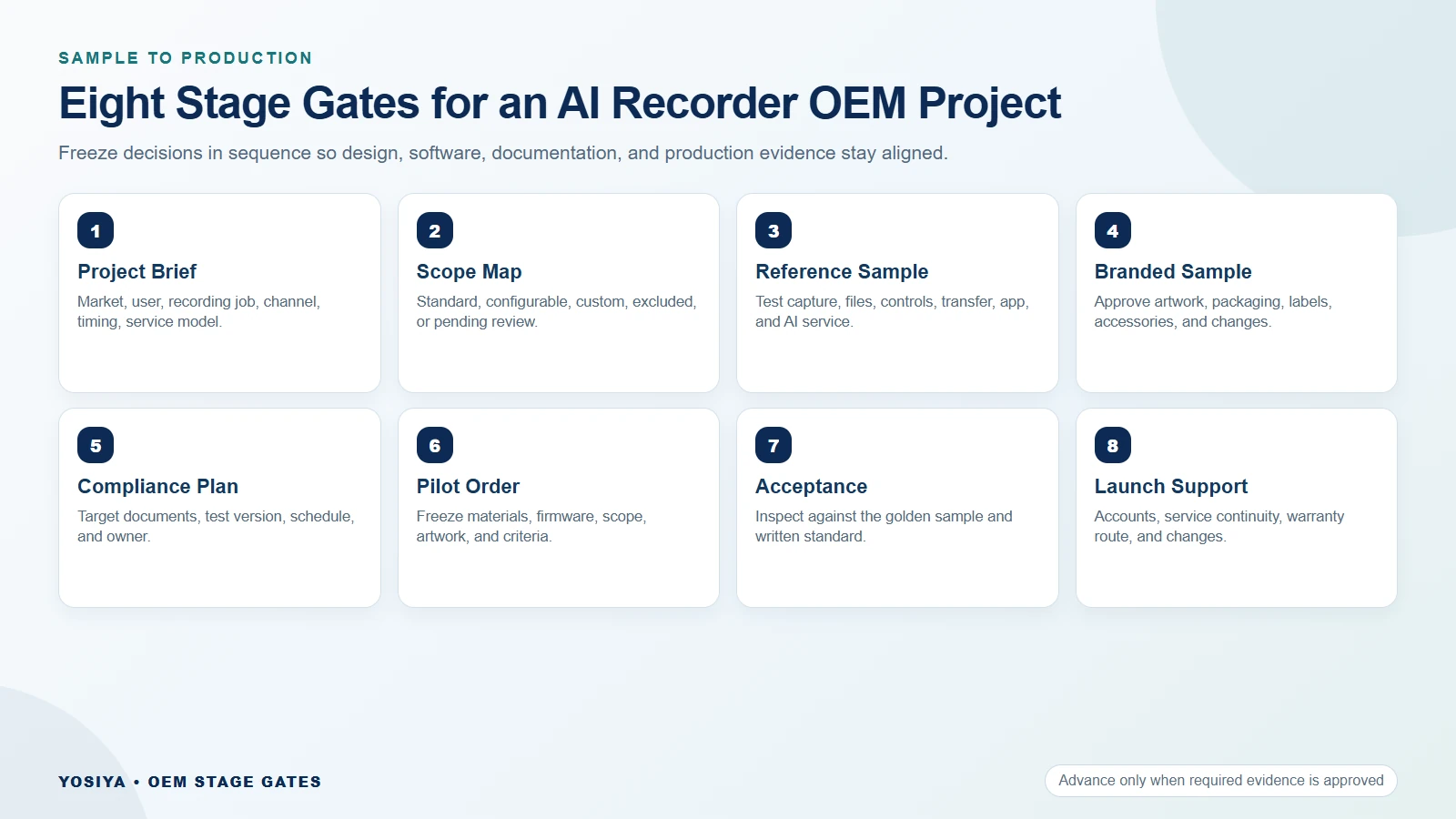
Gate 1: Project brief
Define market, users, recording jobs, sales channel, target price logic, launch timing, service model, and required documentation.
Gate 2: Scope confirmation
Mark every request as standard, configurable, custom, excluded, or pending technical review.
Gate 3: Reference sample
Test recording, files, controls, magnetic charging and transfer, app flow, and connected services without assuming the result applies to another version.
Gate 4: Branded sample
Approve artwork, color, packaging, labels, manuals, accessories, and any supported software changes.
Gate 5: Compliance plan
List target-market documents, responsible party, sample version, test schedule, and approval owner.
Gate 6: Pilot order
Freeze the bill of materials, firmware, software scope, artwork, inspection criteria, and change-control process.
Gate 7: Production acceptance
Inspect against the approved golden sample and written criteria, not memory or sales messages.
Gate 8: Launch and support
Confirm account ownership, app support, AI-service continuity, warranty routing, spare units, issue escalation, and update communication.
For MG6 projects, the current factory-confirmed references are a product MOQ starting at 100 units, logo customization starting at 500 units, and an approximately 35-day custom production lead time. Final quantities and timing depend on configuration, customization, material readiness, and the approved production plan. Confirm them in the project quotation on the official MG6 page.
A low quotation is not useful if the app owner, AI allowance, conformity evidence, and production acceptance standard remain undefined.
FAQ
What is a realistic MOQ for an AI voice recorder OEM project?
MOQ depends on the base platform and customization scope. For the MG6 reference project, product MOQ starts at 100 units and logo customization starts at 500 units. Final terms must be confirmed for the selected configuration.
Who owns and maintains the app?
The project agreement should name the publisher account, brand presentation, source or configuration ownership where applicable, update responsibility, support process, data policy owner, and cost of future changes. Do not infer ownership from a branded interface.
What should be tested on the sample?
Test capture in representative rooms, source-file format and naming, transfer paths, controls, charging, battery behavior, storage, app and account flow, AI outputs, export, deletion, and failure recovery. Record conditions and evidence.
Which certification documents should the buyer request?
Request the documents required for the target market and selected production version, including test reports or conformity evidence where applicable. Confirm the model, version, issuing body, scope, date, and responsible party instead of relying on a logo in a brochure.
How should AI fees be specified?
Specify included functions, languages, usage units, allowances, overage rules, account tiers, renewal, data handling, export, service changes, and responsibility for end-user support. Prices and plans should be dated and attached to the commercial scope.
Source a System That Can Survive Production
AI voice recorder OEM sourcing succeeds when the hardware, software, service, data, compliance, and production responsibilities are visible before the order. Use the sample to create evidence, then convert that evidence into the approved specification and acceptance plan.
Brands can review the MG6 AI Recording Card and contact Yosiya to request a sample, responsibility matrix, and project quotation. Final customization and documentation should be confirmed against the intended market and production version.