A wearable AI recorder is designed to stay attached to the user during mobile, in-person conversations; a card-style recorder is designed to sit on a table, travel in a wallet or pocket, or attach to a phone through an accessory. Neither form is automatically better. Wearables favor hands-free access and consistent carrying, while cards can provide a broad surface for controls, batteries, storage, branding, and phone-adjacent workflows. Buyers should choose from the conversation setting, microphone position, social visibility, phone-call requirements, charging routine, and OEM design goal—not from thinness or weight alone.
What Buyers Should Know
- Choose a wearable form when hands-free access during movement is essential and the wearing position is acceptable.
- Choose a card form when table placement, pocket or wallet carry, phone attachment, and a larger branded surface matter.
- Treat microphone count as a specification, not proof of pickup range or transcript quality.
- Test the actual accessory, clothing, room, motion, and phone workflow.
- For OEM projects, evaluate enclosure, battery, magnets, controls, packaging, and software as one system.
Where This Product Fits
| Entity | Form factor | Primary workflow |
|---|---|---|
| MG6 AI Recording Card | Card-sized OEM/ODM reference platform | Independent local WAV capture, optional phone attachment, connected AI-service workflow |
| Plaud Note | Retail card-style AI recorder | In-person and phone-call recording within Plaud’s product ecosystem |
| Plaud NotePin | Retail wearable AI recorder | Hands-free, in-person recording through pin, clip, wristband, or lanyard options |
| Traditional digital recorder | Pocket or handheld device | Local recording, file management, and playback without an AI-first product model |
Plaud is a separate company and trademark owner; Yosiya has no implied affiliation with it. Plaud examples are included because its official pages clearly illustrate the difference between a retail wearable and a retail card-style product. Product specifications and plans can change, so buyers should recheck current official information before purchasing.
A Form Factor Is a Placement Decision
A wearable usually moves with the user’s chest, collar, wrist, or lanyard. That can be useful during a walk-and-talk interview, site tour, or mobile sales conversation. It also means clothing, body direction, accessory movement, and distance to the other speaker become part of the acoustic setup.
A card-style recorder can be placed near the center of a table, kept in a shirt pocket, carried separately, or attached to a phone with an approved case. The operator has more placement choices, but that flexibility creates inconsistency if users do not follow a repeatable setup.
Shure’s conference-room placement guidance explains that room materials, layout, and where people actually sit affect microphone planning. The same principle applies to portable recorders: test where the device will be, not where the product photo shows it.
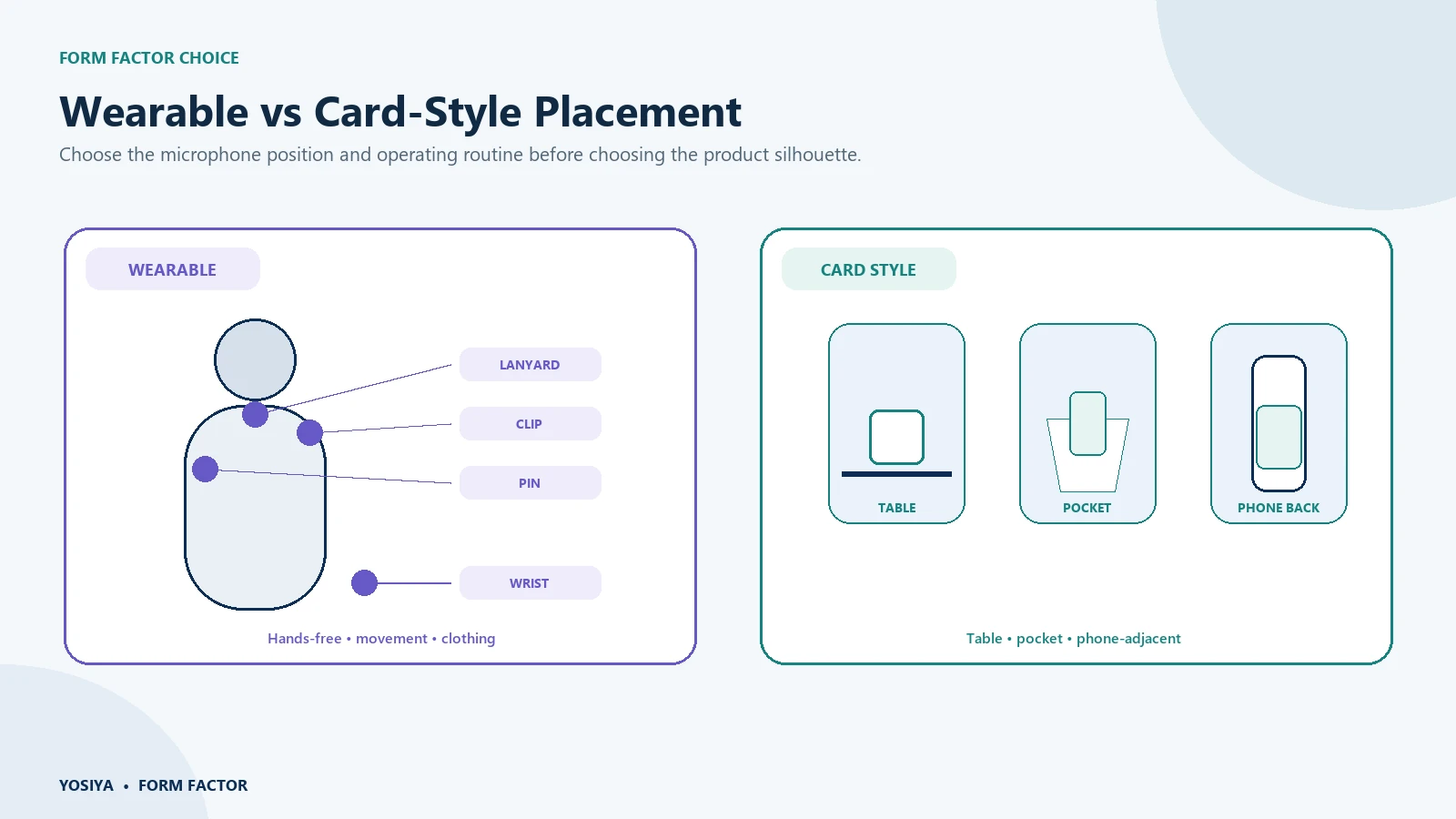
Compare the Workflows Before the Specifications
| Decision factor | Wearable recorder | Card-style recorder |
|---|---|---|
| Start access | Often reachable without using a hand for long | Usually one-button access from table, pocket, or phone attachment |
| Microphone position | Follows clothing or body position | Can be deliberately placed between speakers |
| Motion noise | Clip, fabric, lanyard, and touch can affect capture | Table vibration, paper movement, and handling can affect capture |
| Social visibility | May look like a badge, pin, or accessory | May look like a card, phone attachment, or table device |
| Phone-call workflow | Depends on the product’s sensor and approved method | Some card products are designed for phone attachment or call mode |
| Branding area | Smaller and accessory-dependent | Larger flat surfaces can support visible branding |
| Charging and storage | Small enclosure can constrain battery and controls | Card area may offer different battery, storage, and interface trade-offs |
| Shared-team use | Requires cleaning, accessory, fit, and assignment rules | Easier to place in a kit, but needs inventory and file ownership rules |
The correct choice can differ within one organization. Field researchers may prefer a wearable during tours, while the same team may use a card on conference tables and for phone-adjacent capture.
What Official Product Pages Reveal
The Plaud NotePin official page describes a small device that can be worn as a necklace, wristband, clip, or pin and is intended for hands-free in-person capture. It also states that the wearable does not support phone-call recording and includes a warning about wearing magnetic accessories near pacemakers.
The Plaud Note official page describes a credit-card-like device that can attach magnetically to a phone and supports both in-person and phone-call modes. That comparison demonstrates why “AI recorder” is not one physical category: wearing options, sensors, accessories, phone interaction, and service ecosystem shape the use case.
Traditional recorders remain another valid model. Sony’s ICD-UX570 specifications emphasize local formats, memory, file controls, PC connectivity, playback, track marks, and scene selection. Those functions may be more useful than an AI-first ecosystem for buyers who prioritize conventional local file management.
Where the MG6 Card-Style Platform Fits
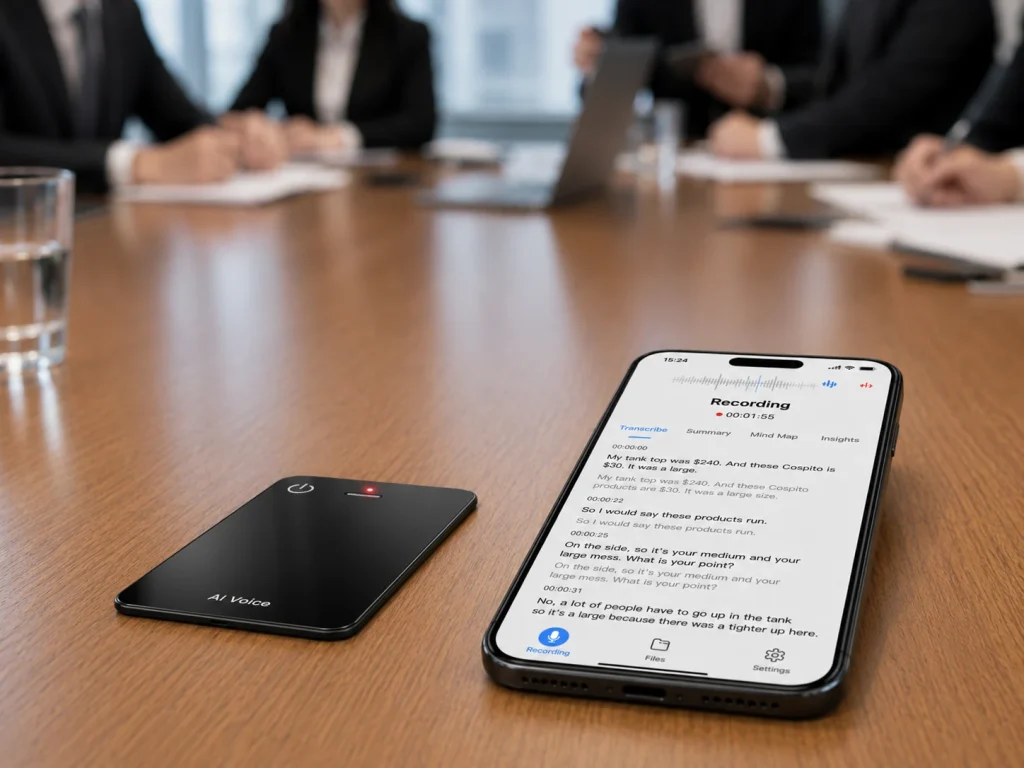
MG6 is a card-style recorder, not a confirmed wearable product. The reference device measures 54 × 85 × 2.6mm, weighs 55g, uses two omnidirectional microphones, and provides storage options from 8GB to 128GB. It supports offline WAV capture and can use a magnetic card sleeve to attach to the back of a phone for the approved phone-recording workflow.
The form factor can suit brands that want:
- A slim rectangular product with a visible customization area.
- Local source-audio capture separated from the user’s main phone.
- Several storage configurations for different channel or project needs.
- A phone-adjacent accessory workflow without describing the recorder as wearable.
- OEM/ODM discussion across hardware, packaging, application, and connected services.
These are platform-level facts. A custom enclosure, magnet, microphone opening, battery, application, or accessory can change performance, tooling, schedule, evidence requirements, and certification scope.
For a deeper engineering view, read the slim voice recorder design guide.
Thinness Creates a System Trade-Off
A thin device may look easier to carry, but the enclosure has to accommodate the battery, PCB, microphones, controls, charging or transfer interface, magnets, fasteners, and structural support. Reducing one dimension can affect another property.
Autodesk’s design-for-manufacturing guidance notes that thin walls, complex features, part count, tolerances, assembly, and inspection affect manufacturing risk. An OEM buyer should therefore ask what a requested design change does to:
- Microphone opening geometry and acoustic path.
- Battery capacity, charging temperature, and service life.
- Enclosure stiffness, flatness, bonding, and drop behavior.
- Magnet position and interaction with accessories or nearby products.
- Button travel, indicator visibility, and accidental activation.
- Assembly yield, test fixtures, repairability, and production inspection.
Wearables add their own constraints. UL Solutions’ IEC 62368-1 battery Q&A explains that battery-powered wearable equipment brings safety-related battery protection and test considerations. Buyers should request evidence for the actual design and target market rather than assuming a small battery or wearable label establishes safety.
Test Social Visibility and Consent
Wearable and card recorders communicate recording status differently. A chest-worn device may be obvious to one participant and invisible to another. A card on a table may be easier to point out during a consent statement. A phone-attached device may be mistaken for a wallet or battery accessory.
The team should test a short notice routine:
- Show the device and identify who operates it.
- Explain what is recorded and why.
- State whether audio will be transcribed or processed by an AI service.
- Confirm how participants can ask to pause or stop.
- Keep evidence of the approved process under organizational policy.
Form factor must never be used as a strategy for hidden recording. Notice, consent, and data handling depend on the scenario and applicable requirements, not on whether the device is discreet.
Run a Matched Form-Factor Trial
Use the same speakers and script to compare a wearable, card-style recorder, phone, and any traditional recorder under consideration.
Trial A: Seated meeting
Place the card at the agreed table position and wear the pin or clip as intended. Include speakers on both sides and record the exact distances.
Trial B: Walk-and-talk
Test footsteps, clothing contact, changing direction, outdoor transitions, and moments when the speakers are not side by side.
Trial C: Phone workflow
Use only the manufacturer-approved method. Do not infer phone-call support from a magnet or shape. Check both sides of the conversation, status visibility, and local rules.
Trial D: Shared-team handoff
Assign the device to another user. Observe whether they can identify recording mode, remaining storage, battery, file owner, transfer destination, and cleaning or accessory requirements without informal coaching.
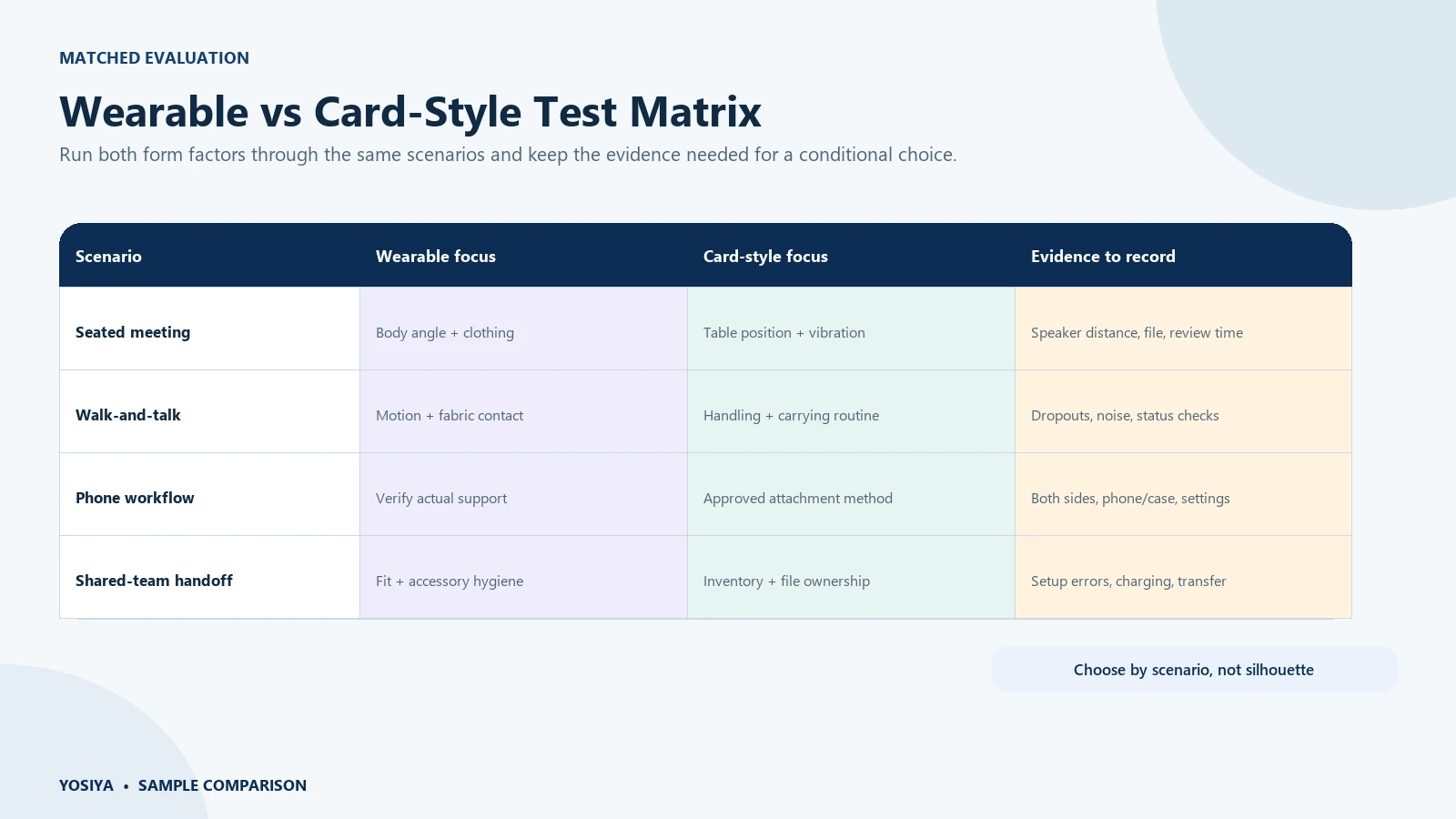
OEM Buyers Need a Commercial Decision Too
A retail wearable can be the fastest way to equip individual users. A card-style OEM platform serves a different goal: building a branded product, channel SKU, or project-specific solution. The choice includes control over packaging, storage options, accessories, application scope, service responsibility, documentation, MOQ, and after-sales support.
Use the small audio recorder sourcing guide to turn the form-factor decision into sample and production requirements. Also compare the software and hardware deployment models in AI note taker vs AI voice recorder.
FAQ
Is a card-style recorder considered wearable?
Not automatically. A card may be carried in a pocket or attached to a phone, but “wearable” normally implies a designed wearing method such as a clip, pin, wristband, or lanyard. MG6 should be described as card-style unless a specific wearable accessory and workflow are developed and verified.
Which form factor is better for moving work?
A wearable can provide hands-free access, but movement, clothing, and body orientation must be tested. A card can still work during field visits when deliberately placed or carried, but it may require more handling.
Does a thinner recorder have less battery life?
Not necessarily. Runtime depends on battery capacity, electronics, firmware, recording mode, wireless behavior, temperature, and test conditions. Thinness changes the design space but does not determine runtime by itself.
Can every magnetic card recorder capture phone calls?
No. Phone-call recording depends on the device’s sensing method, firmware, placement, phone, case, operating conditions, and approved workflow. A magnet alone proves only attachment.
What should a brand test before choosing a form factor?
Test wearing or placement, speech coverage, motion and handling noise, recording status, phone workflow, battery, transfer, accessories, consent routine, packaging, shared-team use, and production consistency.
Choose the Conversation Position First
The wearable-versus-card decision becomes clearer when buyers stop comparing product silhouettes and map where the microphone, user, phone, and other speakers will be during real work. A wearable is strongest when hands-free mobility is central. A card is strongest when flexible placement, phone adjacency, storage choice, and branded hardware development matter.
Brands can review the MG6 AI Recording Card and request a card-style sample. Compare it with representative wearable and phone workflows under the same scenarios before deciding the OEM product direction.