
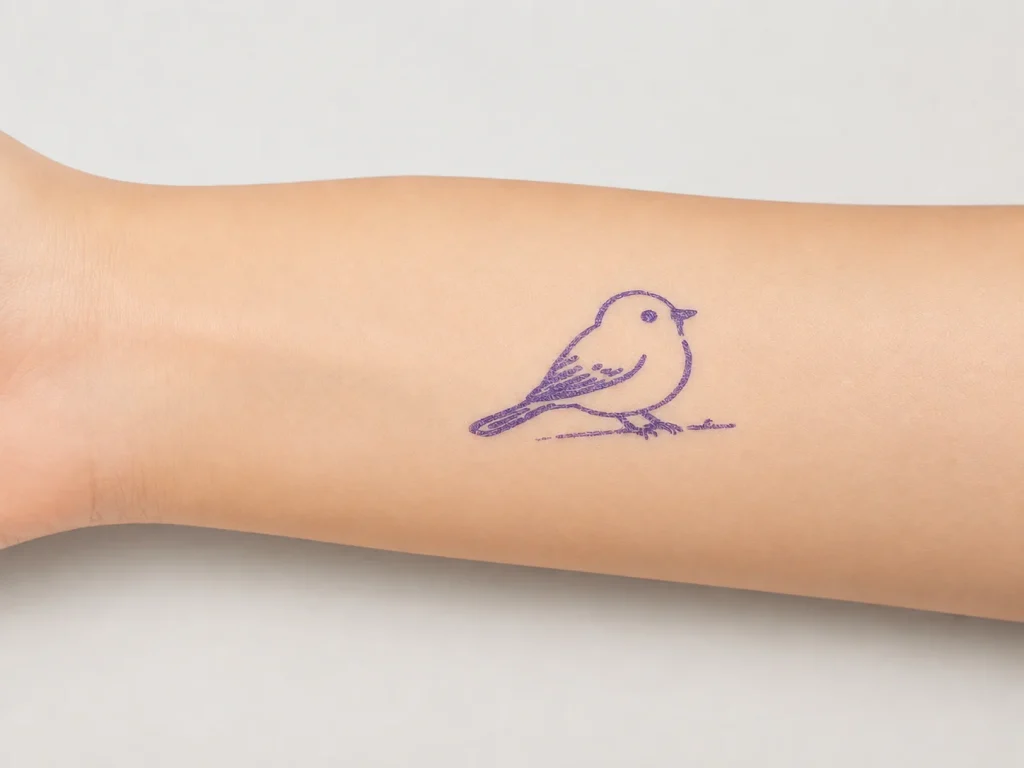
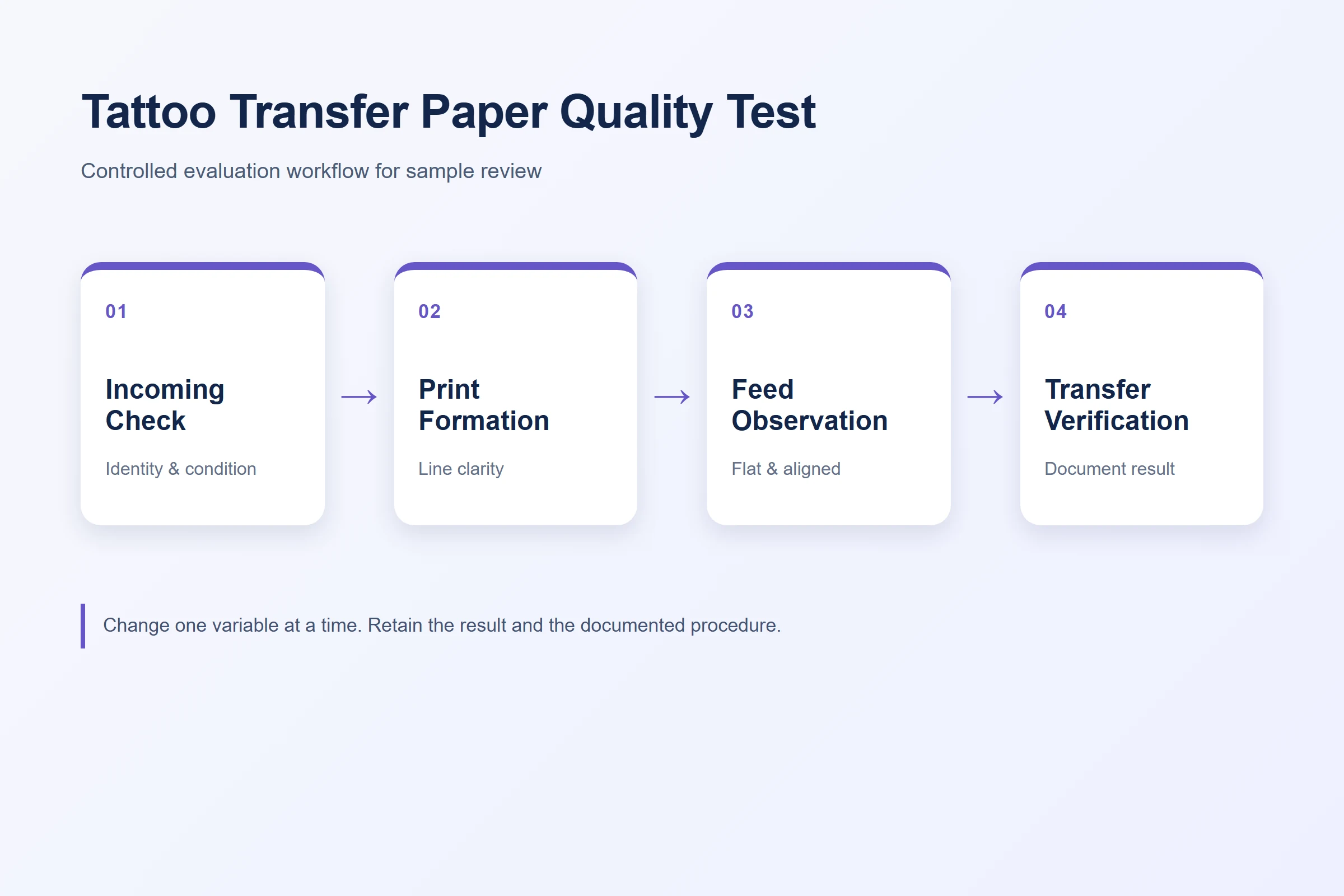
A tattoo transfer paper quality test should confirm more than whether one sheet produces a visible mark. Buyers need to separate incoming-paper condition, print formation, feed behavior, and the selected transfer procedure, then record which paper lot and instructions were used. This is particularly important for a thermal workflow: a clean file cannot compensate for an unsuitable media setup, and a passing print does not establish a skin-safety, waterproof, or duration claim. For K1 sample evaluation, test the dedicated two-layer transfer-paper structure as a controlled consumable alongside the 57mm thermal print workflow.
What Buyers Should Know
- Test an identified paper lot, not an unlabelled loose sheet.
- Check print formation and the later transfer result separately.
- Keep the test design, paper procedure, and printer configuration unchanged when comparing sheets.
- Record a physical defect such as curl, crease, or feed damage before changing settings.
- Use supplier-confirmed material instructions for the selected version; do not transfer generic paper guidance into a K1 operating claim.
Where This Product Fits
| Entity | Description |
|---|---|
| Yosiya | AI hardware company offering K1 sample and OEM/ODM evaluation discussions |
| K1 AI Tattoo Stencil Printer | Reference platform with a connected AI line-art workflow and 57mm thermal printing |
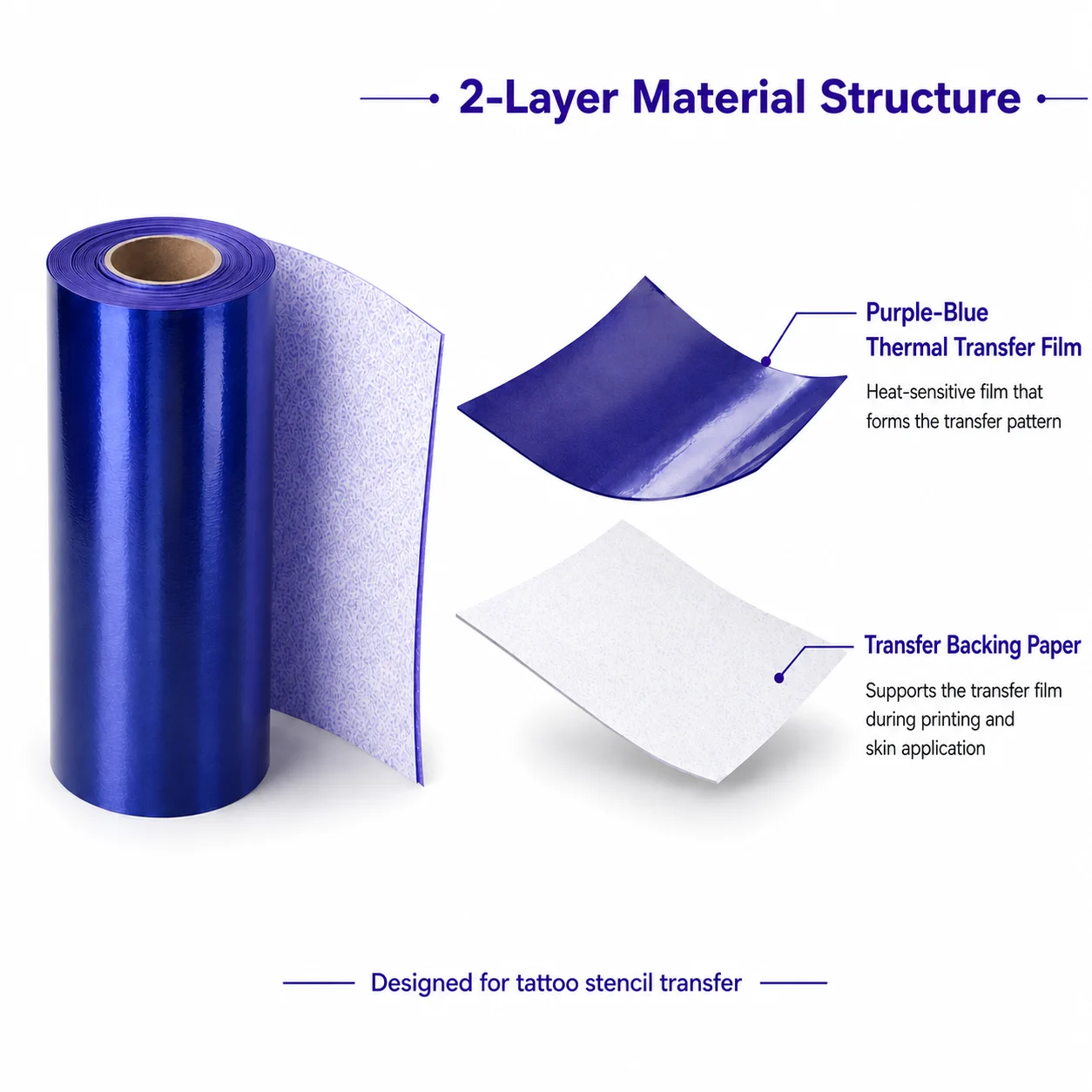
| Dedicated transfer paper | Purple-blue thermal transfer film plus transfer backing paper, as described on the K1 product page |
| Paper quality test | A lot-specific review of condition, print formation, feed, and documented transfer procedure |
The K1 product page confirms the two-layer dedicated-paper structure and states that paper performance needs separate validation. It does not publish final paper dimensions, yield, loading orientation, storage limit, transfer time, skin-contact documentation, or universal material performance. Treat all of those as project questions.
Inspect the incoming paper before a print test
Start with what can be observed without guessing. Confirm the paper identifier or lot, package condition, sheet dimensions, layer alignment, and whether the sheet is flat and free of visible damage. Keep representative photos when an incoming issue may need supplier review.
| Incoming check | What to record | Why it matters |
|---|---|---|
| Identity | Paper version, lot ID if available, delivery date | Connects the result to a replenishment decision |
| Condition | Curl, tear, fold, moisture exposure, surface marks | Separates pre-existing material issues from printing evidence |
| Structure | Layers present and aligned as instructed | Prevents testing an incorrectly prepared sheet |
| Dimensions | Actual sheet or roll format against agreed project requirement | Confirms fit before a feed conclusion |
| Storage record | Storage condition supplied by the vendor | Identifies a missing instruction rather than inventing a requirement |
Media guidance for tattoo thermal workflows consistently starts with compatibility, dimensions, layer handling, and loading direction—not a generic “paper quality” label. Stenstill’s transfer-paper category guide is useful for distinguishing thermal media from manual tracing media. That evaluation framework does not confirm which K1 paper settings apply.
Run a controlled print-formation test
Use a fixed control file with fine lines, curves, small open shapes, solid areas, and edge markers. Keep the file, intended size, printer configuration, and paper procedure stable for each run. A control sheet is more useful than a client design because it provides known geometry to compare across paper lots.
For every sheet, inspect line continuity, separation of nearby lines, unintended dark regions, clipping, and feed marks. Mark the sample with the lot and run number. A true-size test sheet can help distinguish final-size detail loss from a physical-media result; StencilStudio’s test-sheet tool describes why printer, paper, settings, and final design size should be examined together.
A paper test is credible when the record shows what stayed constant—not merely when one sheet looks acceptable.
Separate feed evidence from image evidence
A flat sheet with weak lines is a different observation from a sheet that is folded, indented, or stopped during feed. Do not classify both as “poor paper.”
- Flat paper, weak or broken image: compare the control file, the selected paper, and the print path.
- Creased or folded paper: record the damage shape and position before any retest.
- Output shifts diagonally: check entry alignment and layout before altering the file.
- A run stops: follow model-specific instructions for the selected device; retain the sheet as evidence.
The useful question is whether the damage follows a sheet, a loading event, or a repeated physical location. StencilStudio’s feed-damage guide provides that evidence-first approach. It should not be read as a repair instruction for K1.
Evaluate the transfer procedure separately
The paper output is the control between printing and the later transfer step. Use the supplier-confirmed procedure for the selected material version, then document the test date, sample ID, instructions used, and visible result. Keep any statement limited to what the test actually shows.
Do not convert a clean print or a visible transfer into a claim that the material is suitable for every person, lasts for a stated period, resists water, or meets a specific market requirement. The FDA notes that temporary-tattoo products can be associated with adverse reactions, so product-facing material claims need separate evidence for the selected material and market. FDA guidance supports this claim boundary.
Use a lot-acceptance decision
| Decision area | Accept when | Hold for review when |
|---|---|---|
| Incoming condition | Identity and physical condition meet the agreed receiving check | Lot, condition, dimensions, or instructions are incomplete |
| Print formation | The agreed control features reproduce under the documented setup | Fine lines, gaps, or density changes need a controlled retest |
| Feed behavior | The material completes the documented path without unresolved recurring damage | Crease, skew, catch, or stop repeats |
| Transfer observation | The selected procedure produced the agreed observable result | Procedure, paper version, or evidence is incomplete |
| Commercial release | Supplier can support the selected paper specification and replenishment discussion | Packaging, documentation, supply terms, or acceptance criteria remain open |
This table is not a claim that every project needs identical acceptance limits. A studio sample, distributor intake, and private-label launch may require different evidence. What matters is that the buyer names the intended decision before running the test.
What to request from a supplier
Ask for the selected paper specification, version-specific loading and operating guidance, package and replenishment options, sample identity, and applicable documentation for the target market. For a K1 project, also ask how paper selection relates to the current 57mm reference platform and sample workflow.
Do not ask a supplier to fill gaps with broad certificates or an undated demonstration image. Request a record that can be tied to the sample and material you will actually evaluate. That creates a usable basis for a follow-up sample test or a commercial paper-supply discussion.
FAQ
What is the first check for tattoo transfer paper quality?
Confirm the paper identity, physical condition, layer structure, dimensions, and supplier instructions before printing. An unlabelled sheet cannot support a useful lot decision.
Can a clear printed stencil prove that the paper is acceptable?
No. It shows one print-formation result. Feed behavior and the documented transfer procedure need separate checks.
What should I do if one paper lot creases during printing?
Record the sheet, loading event, and physical damage. Retest under the approved procedure with one variable changed at a time, then provide the evidence to the supplier if it repeats.
Can a paper sample support skin-safety or duration claims?
No. Those are material and market claims that require their own appropriate documentation and evidence.
What should a distributor retain for paper acceptance?
Keep the lot identifier, receiving record, control-file result, feed observations, transfer-test record, and any supplier correspondence needed to resolve an open issue.
Request K1 paper samples and documentation
For K1 evaluation, request the dedicated-paper sample, current operating guidance, and a test record tied to the selected configuration. Contact Yosiya to discuss paper supply and project-specific validation.


