
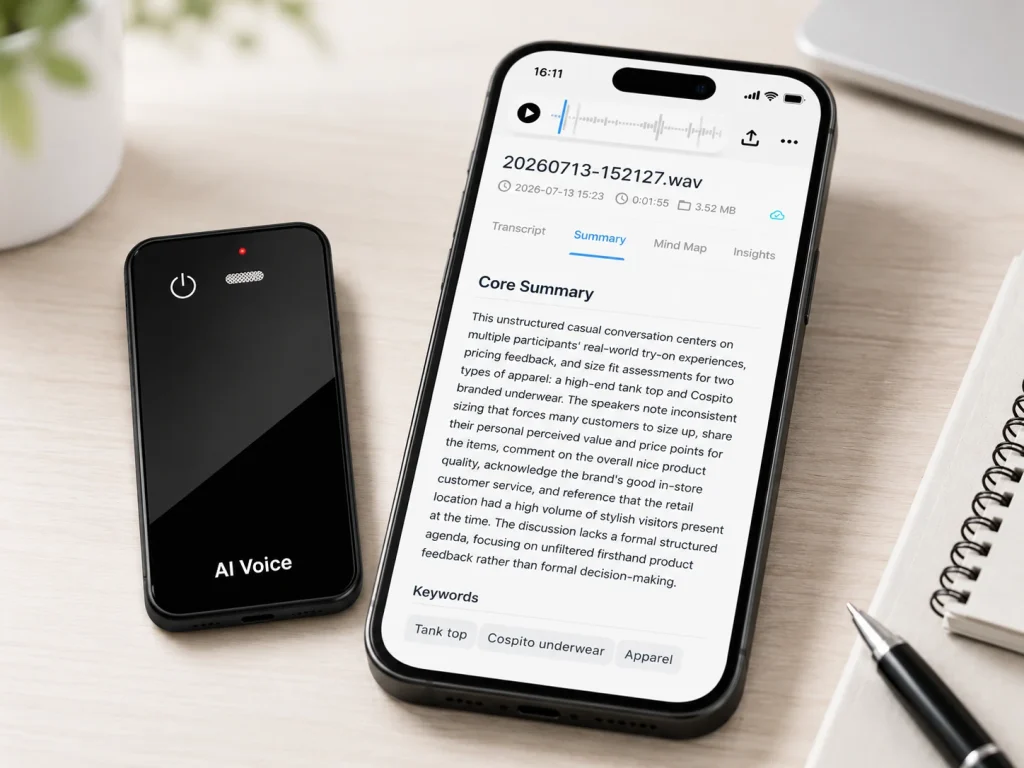
A white-label AI recorder app needs a written ownership and operations plan, not only a branded icon and color palette. Before approving development, define who owns the Apple and Google developer accounts, bundle or package identifiers, signing credentials, source code and build access, backend environments, AI-service contracts, privacy disclosures, analytics, subscriptions, support, updates, incident response, and exit materials. Then test the complete branded workflow with the proposed recorder and service configuration. MG6 can support discussion of app branding, interface adaptation, and selected software requirements, while each deliverable, right, fee, and maintenance duty remains project-specific.
What Buyers Should Know
- Define white label by deliverables and rights rather than visual branding.
- Put the brand’s organization in control of critical store identities where feasible.
- Map every data flow, SDK, AI provider, and privacy disclosure.
- Separate launch acceptance from ongoing maintenance and service charges.
- Require a practical handover package before the relationship ends.
Define the five layers of a white-label app
Many disputes begin because “white label” means different things to the buyer and developer. One party expects an owned software product; the other priced a reskinned instance of a shared application. Resolve this before design begins.
| Layer | Scope questions | Typical evidence |
|---|---|---|
| Brand | Name, icon, colors, copy, screenshots, legal pages | Approved design system and store assets |
| Account | Login, roles, recovery, deletion, organizations | Account map and tested user journeys |
| AI service | Provider, functions, languages, limits, billing | Service schedule and sample outputs |
| Operations | Releases, monitoring, incidents, support, analytics | RACI, runbook, and release history |
| Store ownership | Developer account, app record, signing, payments | Access record and transfer/handover plan |
The contract should say whether the project uses a shared backend, dedicated tenant, buyer-controlled cloud account, licensed codebase, custom fork, or full source transfer. These arrangements carry different costs and exit options. Avoid using “custom app” as shorthand for ownership.

Decide app-store ownership before creating the app record
Store ownership affects legal agreements, identity, access, release authority, payments, ratings, reviews, and future transfer. The brand should decide which legal entity will enroll and who will serve as the accountable holder.
Apple explains that the Account Holder signs agreements and controls key membership functions, while other roles have defined permissions in App Store Connect accounts and roles. A developer can operate with delegated access, but the buyer should document who owns the membership and what happens if personnel or vendors change.
Apple also provides an app-transfer process, but transfer eligibility and retained items have conditions. The Bundle ID remains with the app and cannot be changed after a build has been uploaded. Do not treat a future transfer as effortless contingency planning.
Google recommends adding individual users rather than sharing Play Console credentials and describes controls for developer-account access in its account protection guidance. Its separate app-transfer instructions explain that some reports, test groups, permissions, and linked service settings may require special handling or may not transfer. Record these dependencies before launch.
At minimum, decide:
- The legal owner of each developer account.
- The holder of the Apple Account Holder and Google account-owner roles.
- Who creates the app record, bundle ID, package name, and cloud projects.
- Who controls signing certificates, keys, and recovery methods.
- Which users receive least-privilege access and how access is reviewed.
- Who can submit a release, stop a rollout, change pricing, or answer policy notices.
- How ownership or app transfer would be executed and verified.
Specify rights to code, designs, builds, and services
Source code ownership is only one part of continuity. A buyer may receive a repository but still lack build scripts, environment configuration, signing access, third-party licenses, backend infrastructure, database documentation, or deployment permissions.
Create an intellectual-property and delivery schedule that identifies pre-existing supplier components, buyer-funded custom work, open-source components, third-party SDKs, design files, copy, translations, test assets, automation, infrastructure definitions, documentation, and generated store assets. For each item, state ownership, license, modification rights, geographic or channel limits, delivery timing, and post-termination use.
Ask the development team to demonstrate a clean build from the delivered repository in an agreed environment. Record required tool versions and secrets without placing live credentials inside the repository. The acceptance result should show that an authorized team can reproduce the signed candidate build, not merely browse source files.
Map audio and personal data end to end
An AI recorder app can handle source audio, transcript text, summaries, account data, device identifiers, diagnostics, subscription information, analytics, and support attachments. Draw the path for each object: device, phone, upload endpoint, storage, AI processor, database, support system, export, backup, and deletion.
Apple requires app publishers to provide information about their own and integrated third parties’ data practices in App privacy details. Google Play likewise requires developers to declare data collection, sharing, and security practices, including behavior from third-party libraries and SDKs, in its Data safety guidance. Store forms are publication responsibilities; they do not replace a contractual data-flow specification or legal review.
The FTC’s mobile app guidance advises developers to build privacy considerations into the product, limit collection, protect retained information, dispose of data safely, and communicate practices clearly. Apply these principles to actual implementation and claims. Avoid promising that audio “never leaves the device” if connected transcription uploads it under the selected workflow.
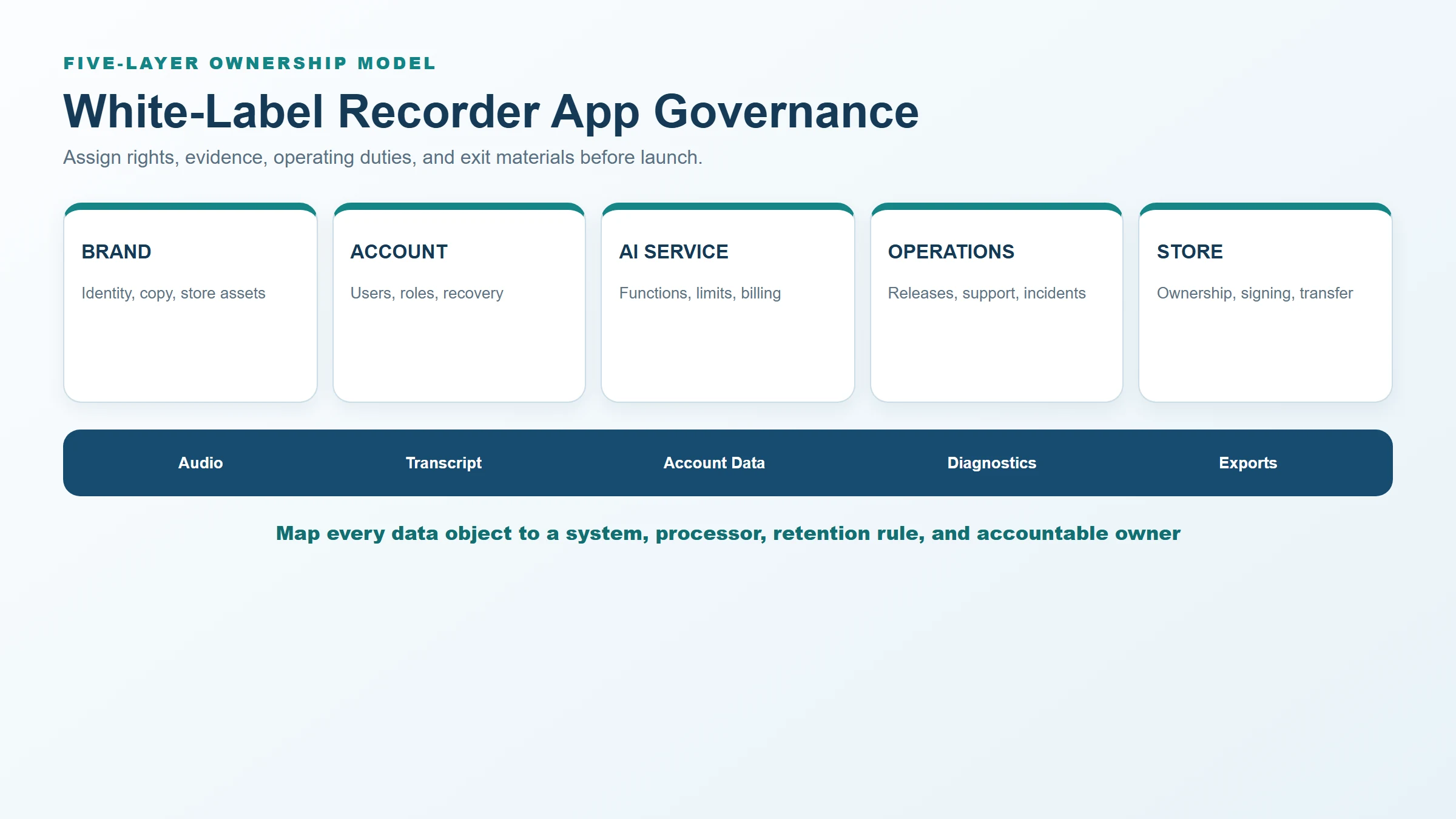
The data schedule should name the party responsible for each store disclosure, privacy-policy update, processor list, retention setting, deletion request, incident notice, and user-support response. Include a change process because adding an SDK or AI provider can alter disclosures.
Define AI scope and billing independently
Do not bundle all intelligence into a row labeled “AI.” Define each requested output and its conditions: transcription, real-time or post-recording translation, summaries, mind maps, speaker handling, glossary behavior, editing, exports, and human review.
For each function, record provider, model or service family when contractually available, region, supported languages for the proposed plan, file limits, monthly allowance, concurrency, overage price, retry behavior, retention, training-use terms, outage handling, and change notification. Test A-to-B and B-to-A translation separately when translation matters; one direction does not prove the other.
Billing ownership also needs precision. Determine whether the buyer contracts directly with the AI provider, prepays a supplier allowance, pays per active user, pays per minute, or receives a bundled tier. State who receives usage reports, handles disputed consumption, sets caps, warns users, absorbs retry costs, and communicates price changes.
Set security requirements that can be tested
Security should be a defined engineering and verification scope. NIST SP 800-218 offers a common vocabulary for secure software development, and the OWASP Mobile Application Security Verification Standard groups mobile controls for storage, cryptography, authentication, network communication, platform interaction, code quality, resilience, and privacy. These are useful references for requirements and testing; citing them does not establish compliance.
Choose controls according to the data and deployment model. Ask how the app protects stored tokens and recordings, validates server connections, separates environments, manages secrets, restricts administrative access, records relevant events, handles dependency vulnerabilities, and distributes fixes. Define who performs testing, what version is tested, which findings block release, and how remediation is verified.
Avoid demanding a certificate as a substitute for the app assessment. The delivered configuration, integrated SDKs, backend, and operating process must all match the evidence.
Write a release and maintenance RACI
A white-label application becomes an operating product after approval. Assign responsible and accountable parties for roadmap decisions, design changes, OS compatibility, SDK updates, AI-service changes, store submissions, policy questions, privacy disclosures, vulnerability response, crash triage, customer support, billing, translations, and retirement.
| Event | Buyer decision | Supplier duty | Evidence |
|---|---|---|---|
| Routine release | Priority and approval | Build, test, and submit as agreed | Release notes and test record |
| OS update | Supported versions and timing | Compatibility assessment | Device and OS matrix |
| AI-service change | Accept cost and behavior impact | Explain and test dependency change | Before/after evaluation |
| Critical defect | Business severity | Triage, mitigate, and correct | Incident and verification record |
| Store rejection | Policy position and escalation | Analyze, revise, and resubmit | Resolution log |
| Vendor exit | Accept handover | Deliver assets and revoke access | Signed handover checklist |
Service-level language should define hours, severity, response, update cadence, maintenance windows, and exclusions. A promise to provide “ongoing support” is too vague for budgeting or launch readiness.
Test the complete branded workflow
Acceptance should cover more than screens. Pair the proposed MG6 configuration, mobile devices, accounts, backend, and AI services. Run onboarding, permissions, device connection, recording import or transfer, processing, editing, export, deletion, recovery, subscription limit, offline interruption, and support escalation.
Use production-like store builds or controlled distribution that matches the acceptance objective. Test supported OS versions and representative hardware. Record build number, environment, service configuration, data set, expected result, actual result, defect severity, owner, and retest status.
Include negative tests: expired credentials, denied microphone or Bluetooth permission, unavailable network, insufficient storage, duplicate upload, interrupted processing, disabled account, exceeded AI allowance, failed payment when applicable, and provider outage. The app should give the user an actionable status rather than silently losing or duplicating work.
Plan the exit before launch
An exit package should be detailed enough for another qualified team to operate or migrate the application within the rights purchased. Possible components include repositories, branch and release history, build instructions, design sources, store assets, signing and account-access procedure, infrastructure inventory, deployment method, API documentation, database schema, data export, dependency list, licenses, privacy records, support knowledge, open defects, analytics definitions, and vendor contacts.
Not every engagement includes all these items. Put included, excluded, conditional, and separately priced deliverables in writing. Test handover at a milestone rather than discovering gaps after termination.
Define what happens to shared services, tenant data, domains, certificates, email addresses, notification keys, analytics projects, and AI accounts. Set dates for export, acceptance, access revocation, supplier deletion, and residual support. App transfer alone does not move every connected asset.
The app decision benefits from the recorder-device versus phone-app comparison and the AI voice-recorder privacy guide. Use the AI voice recorder total-cost model to include maintenance, service, support, and account operations in the business case.
Where This Product Fits
The MG6 AI Recording Card provides the hardware capture point in a broader recording workflow. The current project scope can discuss app branding, interface adaptation, and selected software requirements. Connected transcription, translation, summaries, and mind maps depend on the agreed service configuration.
| Software layer | MG6 position | Confirm before commitment |
|---|---|---|
| Device capture | Offline WAV recording is confirmed | File details and proposed user flow |
| Connectivity | Bluetooth and magnetic charging/data transfer are supported | Mobile/host compatibility and exact workflow |
| Brand presentation | Branding and interface adaptation can be discussed | Screens, store assets, languages, and acceptance |
| AI outputs | Connected services can be scoped | Provider, languages, plan, limits, review, and export |
| Ownership | No universal public ownership package | Accounts, code, data, IP, licenses, and handover |
| Maintenance | Project-specific | Releases, support, fees, security, and service changes |
This framing keeps the hardware facts clear while preventing a private-label hardware discussion from silently becoming an unlimited software commitment.
Use a final acceptance checklist
Before authorizing launch, confirm that brand assets are approved; store ownership and roles are recorded; bundle and package identities are controlled; privacy and data-safety disclosures match tested behavior; terms and policies are published; builds are reproducible; required devices and OS versions pass; AI usage and billing limits are visible; exports and deletion work; security findings meet the release threshold; support routes are live; and the handover inventory is current.
Keep an exception register beside the checklist. Each exception needs an owner, impact, interim control, due date, and approval. Launch readiness is a decision supported by evidence, not the absence of visible defects in a demonstration.
FAQ
Does white label include source code?
Not automatically. The agreement must state whether the buyer receives source code, a license, modification rights, build materials, third-party component rights, and delivery updates. A branded interface alone does not establish code ownership.
Who should own the app-store account?
The answer depends on the commercial structure, but the brand should understand the continuity risk if a supplier controls the only publishing identity. Record the legal owner, accountable role, delegated access, signing control, recovery, and transfer plan before creating the app.
How are AI minutes billed?
Billing may be bundled, prepaid, per user, per minute, or contracted directly with a provider. Require the allowance, measurement rule, retries, caps, overage, reporting, currency, taxes, price-change process, and behavior when the limit is reached.
Who handles updates and crashes?
Assign a RACI covering monitoring, triage, user communication, fixes, testing, store submission, rollout, and post-release verification. State service hours, severity rules, response targets, supported versions, and maintenance fees.
Which data controls require written confirmation?
Confirm collection, purposes, recipients, subprocessors, regions, retention, backups, security, support access, exports, deletion, incident notice, SDK behavior, store disclosures, and what happens at account or contract closure.
Scope the MG6 companion application
Prepare the five-layer ownership matrix and acceptance checklist, then contact Yosiya to discuss the required MG6 branding, interface, connected AI-service, maintenance, and handover scope for a project-specific quotation.


