

AI voice recorder cost is not just the device price. A useful budget includes hardware, transcription or AI usage, team seats, storage, exports, integrations, administration, support, replacement units, and the labor required to review imperfect output. Because plans and prices change, buyers should calculate total cost of ownership from their own meeting volume and a dated supplier quotation—not copy a static “cheapest recorder” table. The right comparison asks what one approved, usable meeting record costs over the intended deployment period, while keeping local recording, connected AI services, and internal operating work as separate cost layers.
What Buyers Should Know
- A one-time hardware purchase can still depend on recurring AI or cloud services.
- “Free transcription” may have minute, upload, storage, export, feature, or account limits.
- “Unlimited” needs a written definition, including fair-use rules, rate limits, supported inputs, and excluded features.
- Per-seat pricing and per-minute pricing behave differently as team size and usage change.
- Review labor, onboarding, security assessment, device replacement, and data migration belong in the model.
- MG6 hardware and connected AI scope should be quoted separately because its current AI pricing and plan structure require project confirmation.
The FinOps Foundation defines total cost of ownership broadly across acquisition, management, support, communications, end-user costs, labor, downtime, training, and productivity loss. That definition is a better starting point than device price alone.
Where This Product Fits
| Cost model | Typical structure | Budget advantage | Main question |
|---|---|---|---|
| Traditional recorder | Hardware plus manual file handling | Predictable capture cost | Who transcribes and organizes the audio? |
| Phone recording app | Existing phone plus app/service costs | Low added hardware cost | Are business files, permissions, exports, and interruptions controlled? |
| Meeting platform or bot | Per-user or workspace subscription | Fits scheduled online meetings | Are all required meetings on the supported platforms and plans? |
| Consumer AI recorder | Device plus included allowance or subscription | Integrated device-and-service experience | What happens after included usage is exhausted? |
| OEM/ODM recorder platform | Project hardware, application, AI, support, and deployment scope | Commercial structure can be defined by project | Which party owns each recurring service and support obligation? |
| Yosiya MG6 | Card-style offline WAV capture with connected AI options | Hardware and service responsibilities can be separated for evaluation | What is included in the written MG6 project quotation? |
For category-level architecture, read what an AI voice recorder is in a B2B workflow. Buyers comparing capture hardware with general-purpose phones can also use the device-versus-phone recording guide.
Build the Cost Model in Seven Layers
| Layer | Include | Evidence to request |
|---|---|---|
| 1. Hardware | Devices, accessories, charging, freight, tax, spares | SKU-level quote and replacement terms |
| 2. Capture operations | Asset tracking, charging, transfer, user setup | Deployment process and owner |
| 3. AI usage | Transcription, translation, summaries, advanced queries | Unit definition, allowance, reset, overage |
| 4. Accounts | Individual seats, administrators, guests, workspaces | Billable-role definition and reassignment rules |
| 5. Data | Cloud storage, retention, backup, downloads, API or export | Limits, formats, egress and deletion terms |
| 6. Integration and control | SSO, SCIM, audit logs, DPA, CRM, API | Plan entitlement and implementation effort |
| 7. Support and change | Training, help desk, model changes, renewal, migration | SLA, update policy, exit assistance |
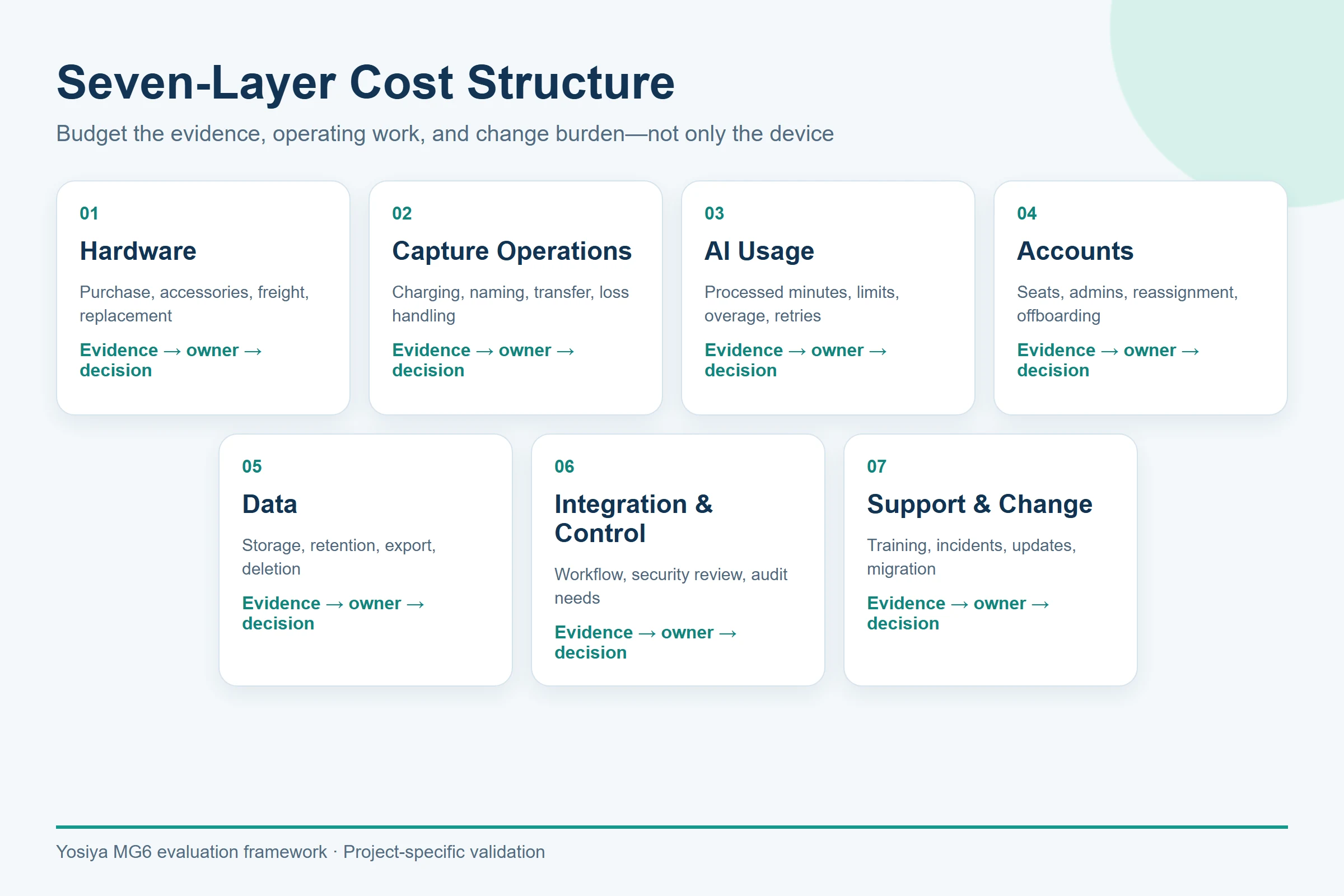
This structure prevents two common errors. First, it stops a free or low-cost plan from being treated as operationally complete when exports, administration, or storage are missing. Second, it prevents an enterprise plan from being judged only by a higher seat price when it may include controls the buyer would otherwise need to assemble separately.
Convert Meeting Demand Into Billable Units
Start with workload, not a vendor plan name. For each user group, estimate:
Monthly captured minutes = users × meetings per user × average meeting duration × capture rate
Then adjust for the vendor’s actual billing rules. Some services count transcription minutes; others combine seats, storage, uploads, AI credits, or feature tiers. Plaud’s official explanation of transcription minutes states that its allocation is time-based and resets with the subscription cycle. Its live AI plan page should be checked at quotation time because plan allowances, billing choices, and top-up options can change.
Other services illustrate why the unit must be normalized. Otter’s official pricing page distinguishes monthly transcription or recording allowances, meeting duration, file imports, storage, administrative features, and enterprise controls. Fireflies’ billing guidance describes per-seat subscriptions and separate AI-credit behavior. These are examples of commercial structures, not evidence that one product is cheaper.
Use at least three workload cases:
- Expected: the current average month.
- Peak: recruiting season, trade-show month, audit cycle, or another high-demand period.
- Low adoption: devices and seats are purchased, but fewer records become usable assets than planned.
The peak case tests overage and capacity. The low-adoption case exposes stranded hardware, unused annual commitments, and training costs that cannot be recovered through productivity gains.
Use a Three-Year TCO Formula
A practical model can be expressed as:
Three-year TCO = initial hardware + recurring services + deployment labor + operating labor + replacements + integration + security/compliance + exit cost
For comparison, calculate both total and unit cost:
Cost per usable record = total period cost ÷ approved records actually used
Do not divide by every recording if many files are never transferred, reviewed, or accepted. “Usable record” should mean a source file and derivative output that pass the organization’s quality and governance rules.
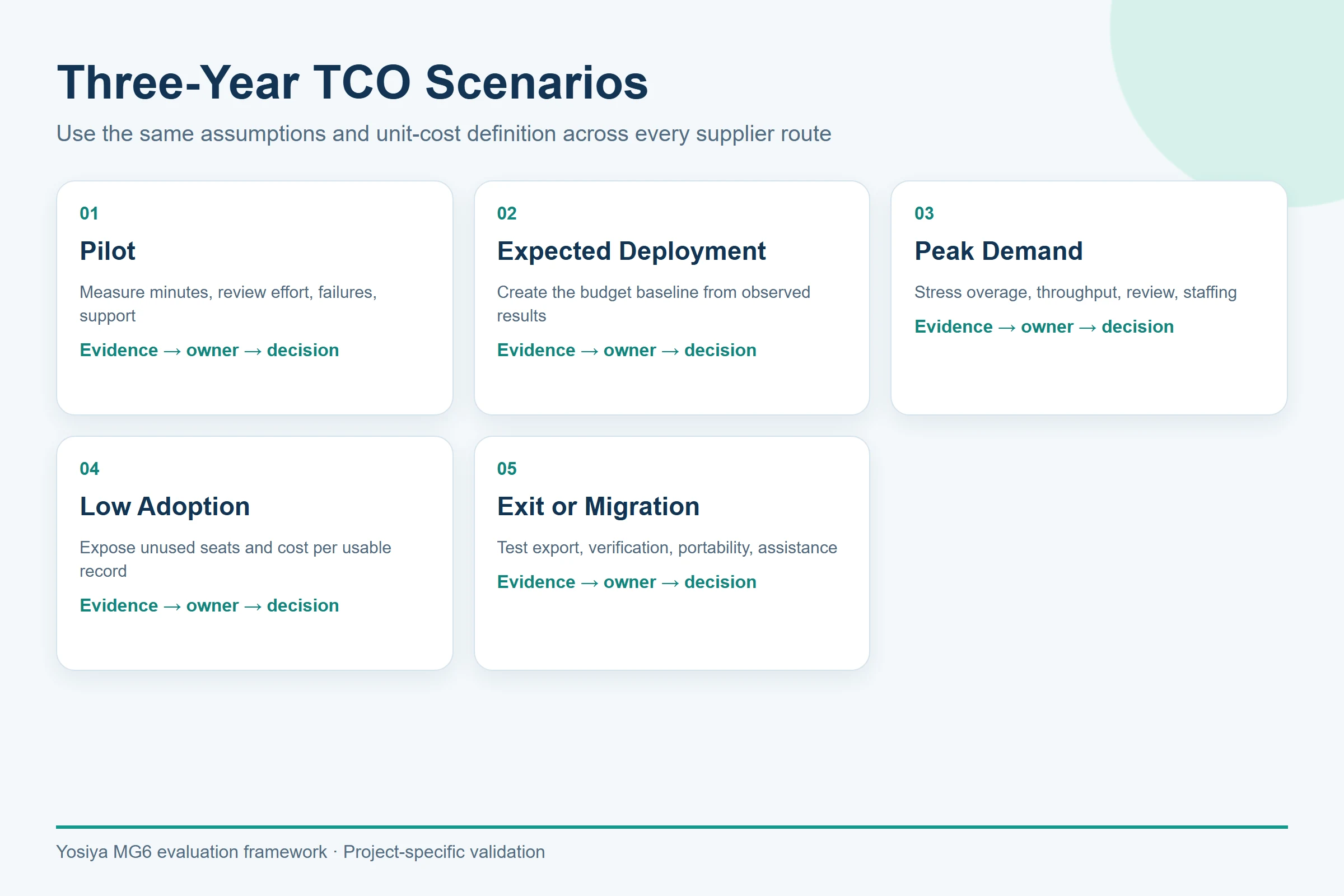
| Scenario | Devices | Seats | Minutes | Review effort | Replacement rate | Purpose |
|---|---|---|---|---|---|---|
| Pilot | Small sample | Named testers | Measured | Timed per file | Observed | Validate assumptions |
| Expected deployment | Planned fleet | Active users/admins | Average workload | Median pilot result | Supplier/pilot estimate | Budget baseline |
| Peak demand | Same or larger fleet | Peak active users | High month | Higher error/review case | Stress assumption | Test overage and staffing |
| Low adoption | Purchased fleet | Fewer active users | Below plan | Higher cost per usable record | Normal fleet exposure | Expose stranded capacity and recovery options |
| Exit or migration | Remaining fleet | Transition team | Export workload | Verification time | Not applicable | Test portability cost |
Do Not Treat “Without Subscription” as “Without Cost”
A voice recorder without subscription may still be a sensible choice when the buyer only needs local audio and already has an approved transcription workflow. But the budget must include transfer, storage, manual naming, transcription labor or another service, summary preparation, and support. Conversely, a subscription may reduce internal work if it includes reliable exports, workspace controls, and an efficient review path.
The decision is not subscription versus no subscription in the abstract. It is which party performs each task, how that work is priced, and whether the output can be retained or moved. NIST’s cloud roadmap identifies application and data portability as important for reducing lock-in. In an AI recorder workflow, test whether original audio, transcripts, summaries, timestamps, and speaker labels can be exported in usable formats without rebuilding every record manually.
Find Hidden Costs Before Procurement
Ask about costs that do not appear in the first product card:
- Does annual billing require payment for inactive seats?
- Can a seat be reassigned, and when does the change affect billing?
- Are transcription, translation, summaries, advanced questions, and templates charged in the same unit?
- Do uploaded files consume a different allowance from live capture?
- Are raw audio downloads and bulk exports available on the selected tier?
- Are storage and retention limits monthly, cumulative, per seat, or per workspace?
- Are SSO, SCIM, audit logs, private storage, DPA terms, or custom retention enterprise-only?
- What happens when a device is lost, replaced, or transferred to another employee?
- Who pays for integration, security review, user training, and ongoing administration?
- What data and assistance are available when the contract ends?
Marketing labels are not enough. A plan described as “unlimited” may still have meeting-duration, upload, storage, automation, or reasonable-use boundaries. Capture the exact rule, source URL, date checked, and supplier response in the cost workbook.
Evaluate MG6 With a Separated Quote
The MG6 reference platform separates offline WAV capture and configurable local storage from connected AI services. That boundary matters to the quote: hardware, transfer, application, transcription or translation, accounts, support, and data handling should appear as separate line items. Offline capture is not offline AI.
Request a quote that separates:
- Selected hardware SKU and quantity.
- Accessories, packaging, branding, freight, samples, and spare units.
- Application scope and account model.
- AI-service functions, usage allowance, renewal, and overage method.
- Storage, export, privacy, security, and retention responsibilities.
- Integration, support, warranty, update, and change-request scope.
- MOQ, lead time, payment terms, and project assumptions.
The current MG6 AI price and plan matrix has not been confirmed for this article, so no recurring price is stated. A voice recorder storage calculation can size local capacity, while the MG6 product page provides the current reference hardware scope.
Run a Cost Pilot Before Annual Commitment
Use the sample period to measure the variables most likely to break the budget: captured minutes, accepted records, review minutes per file, export time, user support tickets, device loss or charging failures, and administrative effort. Do not extrapolate from a polished supplier demonstration.
Measure benefits in the same pilot without turning this cost guide into a speculative ROI promise. Track reviewer time saved, avoided manual transcription, faster follow-up, and fewer missing action items, then compare those observed benefits with the cost per usable record.
The pilot should end with a reconciliation: projected cost versus observed cost, projected usable records versus accepted records, and proposed plan versus the controls actually required. The AI voice recorder sample-testing guide provides a broader evidence framework for source audio and workflow testing.
FAQ
Do AI voice recorders require subscriptions?
Not always for local recording, but connected transcription, translation, summaries, storage, or team controls may depend on a plan. The answer is product- and configuration-specific. Ask what remains available when no paid plan is active. Confirm whether source audio can still be recorded, transferred, opened, and exported.
What is included in an AI voice recorder price?
A displayed device price usually covers only the listed hardware and included accessories. It may not cover AI usage, cloud storage, team seats, exports, integrations, support, freight, taxes, replacements, or customization. Obtain a line-item quote and responsibility matrix. Date every price and plan assumption because commercial terms change.
How are transcription minutes counted?
Vendors may count processed audio duration, in-app recording, uploaded files, or other usage categories differently. Minutes may reset monthly, pool across a workspace, or attach to an individual account. Ask how retranscription, language translation, failed jobs, and overages are treated. Test invoices or usage reports during the pilot.
Can recordings and transcripts be exported?
Export depends on the selected product and plan. Verify raw-audio format, transcript format, timestamps, speaker labels, summaries, bulk download, API access, and any egress charge. Run an actual export and re-import test before committing. A screenshot or PDF alone may not provide usable portability.
What support costs should a buyer include?
Include onboarding, administrator time, training, help desk, replacement handling, security review, integration maintenance, model or application changes, and contract exit. Support may be bundled, tiered, or project-priced. Estimate internal labor even when supplier support is included. Use the pilot to measure the real number of incidents and time per incident.
Request an MG6 Project-Specific Cost Breakdown
Request an MG6 hardware, application, AI-service, data, and support breakdown based on your quantities, meeting volume, users, retention needs, and deployment period. Yosiya can then discuss a sample and project quotation without implying an unconfirmed universal subscription price. Plaud and Plaud product names are trademarks of their respective owner; references to public plan structures do not imply partnership, authorization, or compatibility.


