
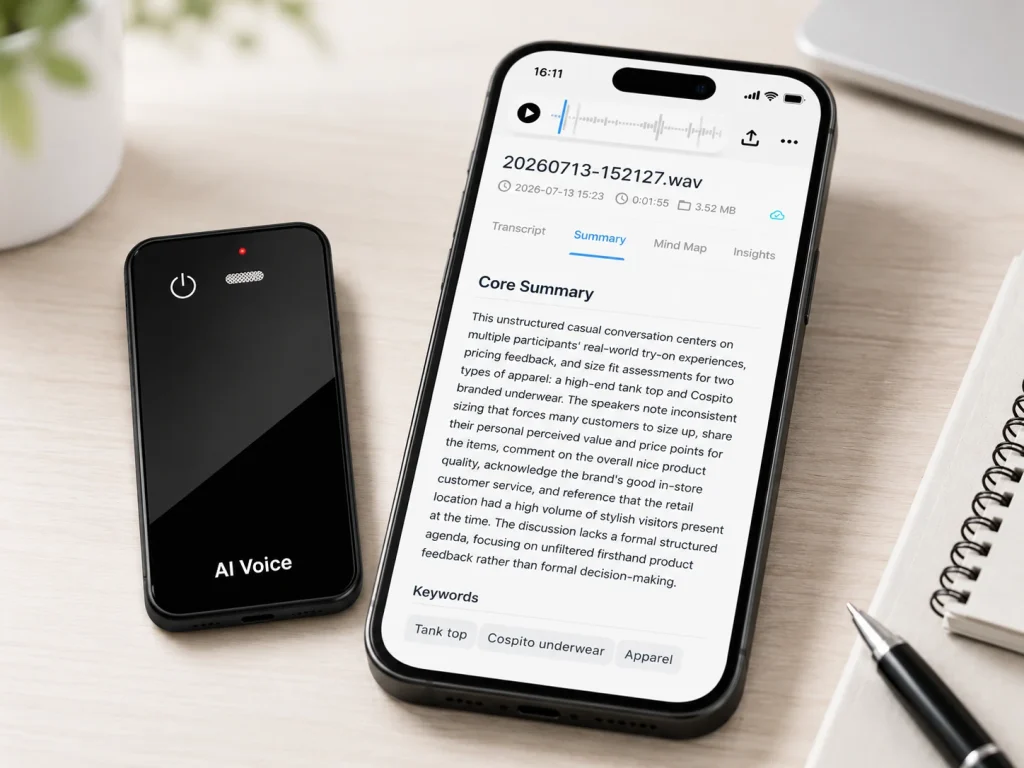
An AI recorder for recruiting interviews can reduce distracted note-taking and create a reviewable source record—but only when the employer treats recording as a governed documentation process. Candidates should know what is being recorded, why it is needed, who can access it, and what alternative is available if they do not want to be recorded. AI-generated transcripts and summaries should remain drafts for human verification, not candidate scores or hiring decisions. For U.S. recruiting teams, the practical question is therefore not simply whether a recorder works. It is whether consent, accessibility, data handling, review, retention, and deletion can be controlled across the full interview workflow.
What Buyers Should Know
Before buying a candidate interview recorder, recruiting teams should settle five issues:
- Recording permission is jurisdiction- and context-dependent. Federal and state rules can differ, and interstate interviews may involve more than one state. The Reporters Committee recording-law guide is a useful research starting point, but it explicitly does not replace legal advice.
- The candidate needs meaningful notice and choice. A calendar invitation, a live reminder, and a documented response are easier to audit than a hidden device or an unexplained recording icon.
- A transcript is not an evaluation. Speech-to-text can help organize what was said, but it should not infer personality, emotion, disability, honesty, or job fit.
- Human review needs an owner. A named interviewer or recruiter should compare important facts with the source audio before notes enter an applicant tracking system.
- Retention must be defined before capture. Recording, transcript, AI summary, interviewer notes, and final hiring record may not require identical access or retention treatment.
This article provides an operational evaluation framework, not legal advice. Employment counsel and privacy or security owners should approve the workflow for the states, job types, candidate locations, and systems involved.
Where This Product Fits
Recording is only one part of interview documentation. The correct tool depends on whether the team needs a source recording, collaborative notes, platform-native consent controls, or a standardized hiring record.
| Option | Useful role | What must be managed |
|---|---|---|
| Interviewer notes | Minimal data capture and direct professional judgment | Omissions, inconsistent detail, and interviewer distraction |
| ATS scorecard | Standard questions and comparable evidence fields | Whether reviewers enter evidence rather than unsupported impressions |
| Video-meeting transcription | Remote interview capture within a meeting platform | Participant notice, platform settings, cloud storage, and account permissions |
| Phone recording app | Convenient capture for some calls | Operating-system limits, notification behavior, phone storage, and policy approval |
| Dedicated recorder | Local source-audio capture without relying on the meeting host | Visible notice, physical control, transfer, deletion, and file-to-candidate mapping |
| Yosiya MG6 reference device | Offline WAV capture with a thin card-style form factor for sample evaluation | Project configuration, audio tests, connected AI scope, security, and governance |
The MG6 should be assessed as a capture platform, not as an applicant-selection system. Buyers who are still comparing categories can use the interview recorder with transcription guide to separate hardware, transcription, and workflow questions.
For a broader explanation of local capture, connected processing, and service dependencies, see what an AI voice recorder is in a B2B workflow.
Separate Documentation From Employment Decisions
The safest procurement boundary is simple: use recording and transcription to preserve evidence, then keep evaluation and hiring accountability with authorized people operating under a defined selection process.
| Workflow activity | Appropriate control | MG6 claim boundary |
|---|---|---|
| Capture the conversation | Candidate notice, permission, placement test | Local WAV recording can be evaluated |
| Create a transcript | Approved service, language test, source-audio comparison | Connected transcription scope requires confirmation |
| Draft a summary | Prompt/template control and human review | AI organization may be discussed by project |
| Correct factual errors | Authorized reviewer checks audio | Human responsibility |
| Evaluate qualifications | Job-related criteria and documented evidence | No candidate-scoring claim |
| Decide whom to advance | Authorized hiring team and approved process | No automated hiring-decision claim |
This boundary matters because voice is not a neutral shortcut to job fit. The U.S. Department of Justice warns that hiring technologies using facial or voice analysis may screen out qualified people with disabilities, including people with autism or speech impairments. Its guidance on AI and disability discrimination in hiring advises employers to examine hiring technology before and during use, explain the technology to applicants, and provide a process for reasonable accommodations.
An AI summary can also omit qualifications, confuse speakers, or turn a tentative statement into a confident claim. Human review reduces those risks, but “human in the loop” should not be a slogan. The reviewer needs authority, time, source access, and a clear correction procedure. The NIST AI Risk Management Framework recommends defining human roles and responsibilities across the AI lifecycle and managing risks related to validity, transparency, privacy, and harmful bias.
Build Candidate Notice and Choice Before the Interview
A recruiting team should design notice before choosing where to place the recorder. A defensible notice package usually answers:
- What will be captured: audio, transcript, summary, or all three?
- Why is it being captured: interviewer note support, quality review, or another documented purpose?
- Which people and service providers may process or access the data?
- Will connected AI services receive the audio or transcript?
- What is the planned retention and deletion process?
- How can a candidate ask questions, withdraw permission where applicable, or request an accommodation?
- What non-recorded alternative is available?
For a scheduled interview, send the core notice before the meeting and repeat it live before recording begins. Record the candidate’s response using the method approved by counsel. If the candidate declines, stop the recording and follow the alternative workflow without creating a negative evaluation signal from that choice.
U.S. consent rules are not uniform. The Reporters Committee introduction to recording laws explains that some jurisdictions generally require one-party consent while others require all parties’ consent, with additional differences for in-person, telephone, and interstate conversations. Recruiting teams should not translate that overview into a blanket national policy without state-specific legal review.
Remote interviews add a system-of-record question. If Zoom, Microsoft Teams, or another meeting platform is already recording or transcribing, an independent device can create a second audio copy with different notices, permissions, storage locations, and deletion controls. The recruiting policy should identify who gives the notice, whether one or both capture paths are approved, which file is the authoritative source, and how duplicate copies are reconciled or deleted. Platform notification features can support the workflow, but they do not replace the employer’s approved legal and candidate-communication process.
Standardize the Recruiting Capture Workflow
Consistency comes from the process around the device, not from recording every interview indiscriminately.
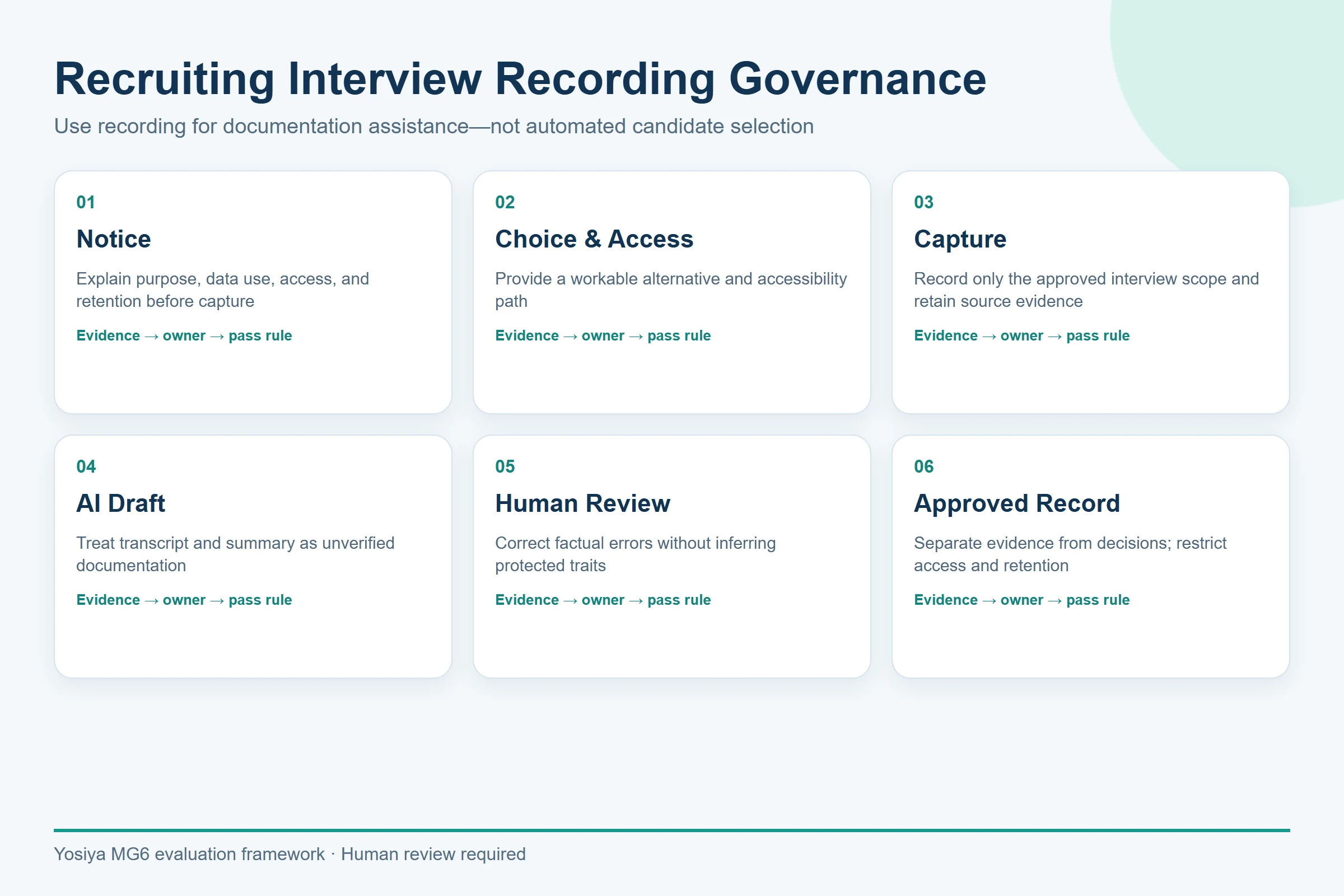
Before the interview: confirm the approved purpose, candidate notice, accommodation route, interviewer, question set, device charge, storage capacity, room placement, and file identifier. Use an interview ID rather than putting the candidate’s full name into an exposed filename where possible.
At the start: identify the participants, repeat the notice, confirm the response, and state the role and interview stage. If permission is not established under the approved procedure, do not record.
During the interview: follow job-related questions and use short verbal markers such as “Question 3: customer escalation example.” Markers make long audio easier to review without converting the conversation into automated scoring. Avoid off-script questions that seek disability-related or other protected information.
Immediately after: stop the recording before informal discussion begins, verify the file, transfer it through the approved route, and connect the interview ID to the ATS record. Do not leave unlabeled candidate recordings on a shared desktop, personal phone, or removable device.
During review: compare critical statements with the audio, correct attribution errors, separate facts from interviewer observations, and record who approved the final notes.
Review Source Audio Before Using Interview Transcription
Hiring interview transcription can make a conversation searchable, but a readable transcript can still be wrong. Review is particularly important for names, dates, credentials, employment history, compensation statements, availability, geographic restrictions, and accommodation-related exchanges. A reviewer should replay the relevant segment instead of resolving ambiguity from context alone.
Use labels that preserve provenance:
- Candidate statement: what the candidate actually said.
- Interviewer observation: a job-related observation recorded by the interviewer.
- AI draft: unapproved transcript or summary content.
- Verified note: content checked against the source and approved for the hiring record.
The word “verified” should mean a defined action, not a green checkmark automatically added by software. Sample testing should measure word errors, speaker attribution, omitted qualifiers, proper nouns, review time, and downstream correction rates. The AI voice recorder sample-testing guide provides a repeatable way to compare source audio with output before a team-wide rollout.
Control Bias and Unsupported Inference
Recruiters should prevent transcription convenience from expanding into unapproved analysis. Do not ask a general-purpose summary tool to infer confidence, honesty, enthusiasm, mental state, health, age, ethnicity, accent quality, or cultural fit from a candidate’s voice. Do not rank candidates by speaking pace or fluency unless a validated, job-related selection procedure and appropriate legal review establish a lawful basis.
The DOJ’s disability guidance specifically cautions that voice-analysis technologies can disadvantage people with speech impairments or autism. NIST’s AI RMF similarly notes that human-AI configurations can amplify bias and that organizational roles need to be clearly defined. These sources do not say that every transcript is an automated decision system. They do show why a documentation tool should not quietly become one through prompts, plug-ins, or recruiter habits.
Practical controls include an approved prompt library, prohibited-inference list, standardized evidence fields, accommodation path, audit sampling, and a rule that no candidate status changes automatically from an AI output. If a service vendor introduces scoring or sentiment features, disable them until the employer has completed a separate legal, accessibility, validation, privacy, and procurement review.
Limit Access, Retention, and Deletion
Candidate recordings can contain personal history, contact details, compensation information, immigration or relocation discussions, and incidental sensitive information. Access should therefore follow job role and purpose rather than convenience.
| Role | Typical need | Suggested boundary to define |
|---|---|---|
| Interviewer | Review the interview and complete approved notes | Time-limited access to assigned interviews |
| Recruiter | Coordinate the process and correct candidate record mapping | Access only to relevant requisitions |
| Hiring manager | Review verified job-related evidence | No default access to raw audio unless needed and approved |
| HR/legal | Handle compliance, accommodation, disputes, and holds | Controlled escalation and audit logging |
| IT/security | Administer systems and investigate incidents | Privileged access monitored and limited |
| AI/service provider | Process only the contracted data | Written processing scope, retention, security, and deletion terms |
Do not publish one universal retention number for every employer. The EEOC’s summary of federal employment recordkeeping obligations describes different requirements by covered entity and record type, and records may need to be preserved longer when a charge or action is pending. State law, contractor obligations, litigation holds, company policy, and the status of the applicant may add requirements.
At the same time, “retain forever” is not a governance strategy. Counsel should determine whether the raw recording becomes an employment record, how long each derivative is required, when a legal hold overrides deletion, and how deletion is verified across the device, transfer location, AI provider, backups, and ATS attachments. The organization’s AI voice recorder privacy guide can help buyers map local capture, connected processing, access, and deletion before procurement.
Evaluate MG6 as a Controlled Capture Platform
The MG6 reference configuration provides offline WAV capture with configurable local storage. Select capacity from measured file growth, interview volume, transfer frequency, retention, and operating headroom; the guide to voice recorder storage capacity provides a calculation method. These hardware facts do not prove interview-room accuracy, security certification, universal phone compatibility, or suitability for every employer.
Hardware noise reduction is not AI noise cancellation. Offline WAV capture is not offline transcription, translation, summarization, or candidate analysis. Connected AI functions, language coverage, service providers, account model, data location, retention, pricing, and security terms require written confirmation. MG6 should not be represented as automatically integrating with an ATS or scoring candidates.
A sample evaluation should include quiet rooms, HVAC noise, remote speakers, different seating positions, soft and loud voices, relevant accents, proper nouns, interruptions, and the approved file-transfer route. Use volunteers or appropriately consented test participants—not live candidate data—for early testing. Product information is available on the MG6 AI recording card page, but the procurement decision should be based on project documentation and measured workflow results.
Use Eight Procurement Gates Before Deployment
| Gate | Question | Evidence required |
|---|---|---|
| 1. Legal scope | Where are interviewer and candidate located, and which rules apply? | Counsel-approved recording policy and jurisdiction process |
| 2. Candidate experience | Is notice clear, timely, accessible, and optional where required? | Notice text, live script, response record, alternative path |
| 3. Accessibility | Can candidates request an accommodation without disadvantage? | Accessible instructions and accommodation workflow |
| 4. Capture quality | Is the source usable in actual interview settings? | Sample matrix, source files, error and review-time results |
| 5. AI boundary | Are transcription and summary separated from scoring? | Feature list, disabled functions, prompt rules, responsibility map |
| 6. Data control | Can the team map transfer, providers, permissions, and security? | Data-flow diagram, contract terms, role-based access evidence |
| 7. Record lifecycle | Are retention, legal hold, and deletion defined for every derivative? | Approved schedule and deletion verification procedure |
| 8. Operations | Can the team correct errors and investigate incidents? | Named owners, audit log, escalation path, periodic review plan |
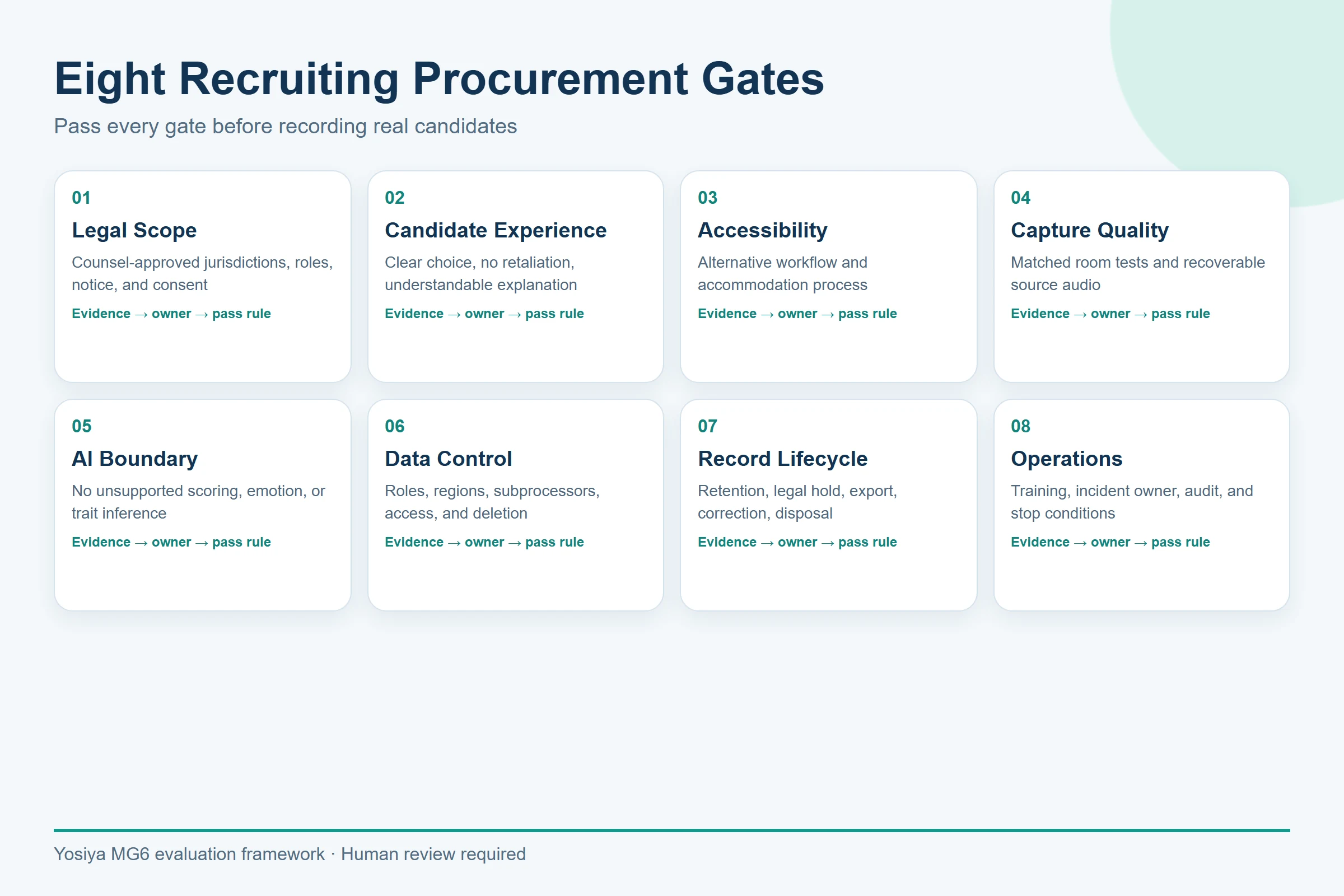
Passing one gate does not compensate for failing another. Clean audio cannot cure missing permission, and a consent form cannot cure discriminatory scoring. Run the gates on the complete workflow before recording real applicants, then repeat the review when a vendor, AI model, storage location, prompt, job family, or state coverage changes.
FAQ
Is interview recording allowed?
It may be allowed, but the answer depends on the jurisdictions, communication type, participant locations, expectations of privacy, and employer obligations involved. U.S. states do not use one uniform consent rule, and interstate calls create additional questions. Obtain state-specific legal advice and use a written policy before deployment. A visible device by itself should not be treated as sufficient proof that the approved notice and consent process was completed.
How should candidates be notified?
Provide notice before the interview and repeat it before recording starts. Explain what will be captured, the purpose, who may access or process it, the planned retention approach, and how to request an accommodation or non-recorded alternative. Document the candidate’s response using the method approved by counsel. Declining recording should not silently become a negative hiring signal.
Can AI score candidates?
This article does not recommend using MG6 or a general transcription service to score, rank, or make hiring decisions about candidates. Voice-based inferences may be inaccurate, inaccessible, biased, or unrelated to the job, and hiring technology can create disability-discrimination risk. Keep transcripts and summaries as reviewable documentation drafts. Any separate automated selection system needs its own validation, accessibility, legal, privacy, security, and human-governance review.
Who can access interview records?
Access should be limited to people and providers with a documented recruiting, compliance, support, or security need. Hiring managers may need verified evidence without automatically needing the raw recording. Use role-based permissions, audit logs, time limits, and an escalation process for legal or accommodation matters. Confirm whether service-provider administrators or model vendors can access or retain the data.
How long should recruiting interview data be kept?
There is no single retention period suitable for every recording and employer. Federal, state, contractor, litigation-hold, and internal policy requirements can differ, and the raw audio may not have the same lifecycle as verified notes. Counsel should approve a schedule for the recording, transcript, AI summary, and final hiring record. The deletion process should also cover device storage, transfer locations, providers, backups, and ATS copies.
Request an MG6 Recruiting Workflow Review
If your recruiting team is considering a dedicated interview recorder, request the MG6 data-flow and capability sheet together with a sample unit review. Ask Yosiya to document the selected hardware configuration, offline capture path, connected AI scope, transfer method, service responsibilities, and project-specific commercial terms. A controlled pilot with synthetic or appropriately consented test interviews can show whether the source audio and review workload fit your process before real candidate data enters the workflow.


