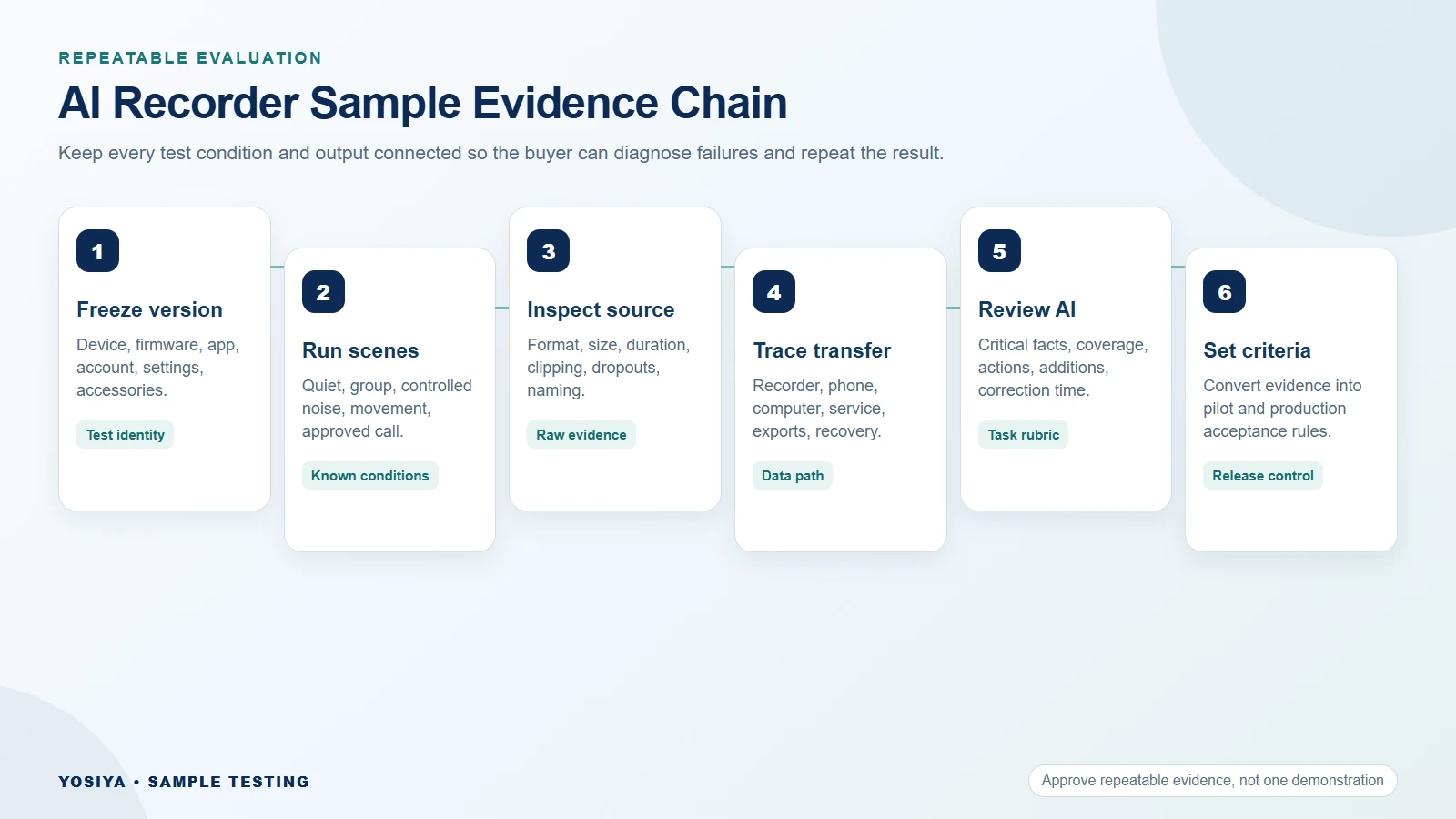
AI voice recorder sample testing should evaluate a chain of evidence: physical controls, source audio, file storage, transfer, app behavior, AI output, battery, failure recovery, and production consistency. Do not approve a sample after one quiet-room recording or a supplier-led demonstration. Build a repeatable protocol with known rooms, speaker positions, scripts, network states, and acceptance rules. Keep the raw files and test log so the approved sample can become the reference for pilot production and incoming inspection. The goal is not to produce a flattering score; it is to discover what the product can and cannot do under the buyer’s actual conditions.
The broader small audio recorder sourcing process shows how this evidence connects to specifications, supplier approval, packaging, support, and production controls.
What Buyers Should Know
- A versioned sample and configuration record.
- Raw audio files from repeatable scenarios.
- Notes about distance, placement, noise, speakers, and network state.
- A map of every file transfer and AI-processing step.
- Reviewed AI output with corrections, not an unsupported accuracy claim.
- Measured battery and charging observations under defined conditions.
- Acceptance criteria that can be applied to pilot and mass-production units.
Where This Product Fits
| Entity | Test context |
|---|---|
| Yosiya | Supplier of the MG6 OEM/ODM reference platform |
| MG6 AI Recording Card | Card-sized dedicated recorder sample |
| Confirmed capture path | Two omnidirectional microphones, hardware noise reduction, offline WAV recording |
| Connected functions | Transcription, translation, summaries, and mind maps under the selected service scope |
| Items requiring evidence | Acoustic performance, AI results, battery under actual use, certification package, and project-specific software behavior |
The reference specification gives the test team a starting point, not the answer. A claim such as “two omnidirectional microphones” identifies the hardware arrangement. It does not establish pickup distance, speech intelligibility, room coverage, or transcript accuracy.
Freeze the Test Configuration
Before pressing record, assign a sample ID and capture:
- Device model and serial or asset number.
- Firmware and app versions.
- Phone model and operating-system version.
- Storage configuration.
- AI account and service plan.
- Enabled settings.
- Date, tester, and test location.
- Accessories and charging equipment.
Photograph the device and packaging labels. Save the supplier specification, quotation, and written answers used to design the test. If the sample changes during evaluation, start a new version record instead of silently combining results.
Build a Small Set of Repeatable Audio Scenes
A good protocol uses a few representative scenes with controlled variation.
Scene A: Quiet one-to-one meeting
Use two speakers at a normal table. Mark device position and speaker distance. Read a short script containing names, dates, prices, and product terms so the same content can be repeated.
Scene B: Small group discussion
Add three to five speakers at known seats. Include natural turn-taking and a short period of overlap. Do not introduce so many variables that a failure cannot be diagnosed.
Scene C: Realistic background noise
Use a repeatable source such as HVAC noise or recorded office ambience at a documented setting. The purpose is to compare configurations, not to claim that all noise is removed.
When building room and placement scenarios, use the in-person meeting recorder hardware workflow to connect capture conditions with file review and downstream note quality.
Scene D: Movement and handling
Test starting, pausing, carrying, placing, and retrieving the device. Note button errors, accidental contact, blocked microphones, and unclear status indicators.
Scene E: Approved phone-recording workflow
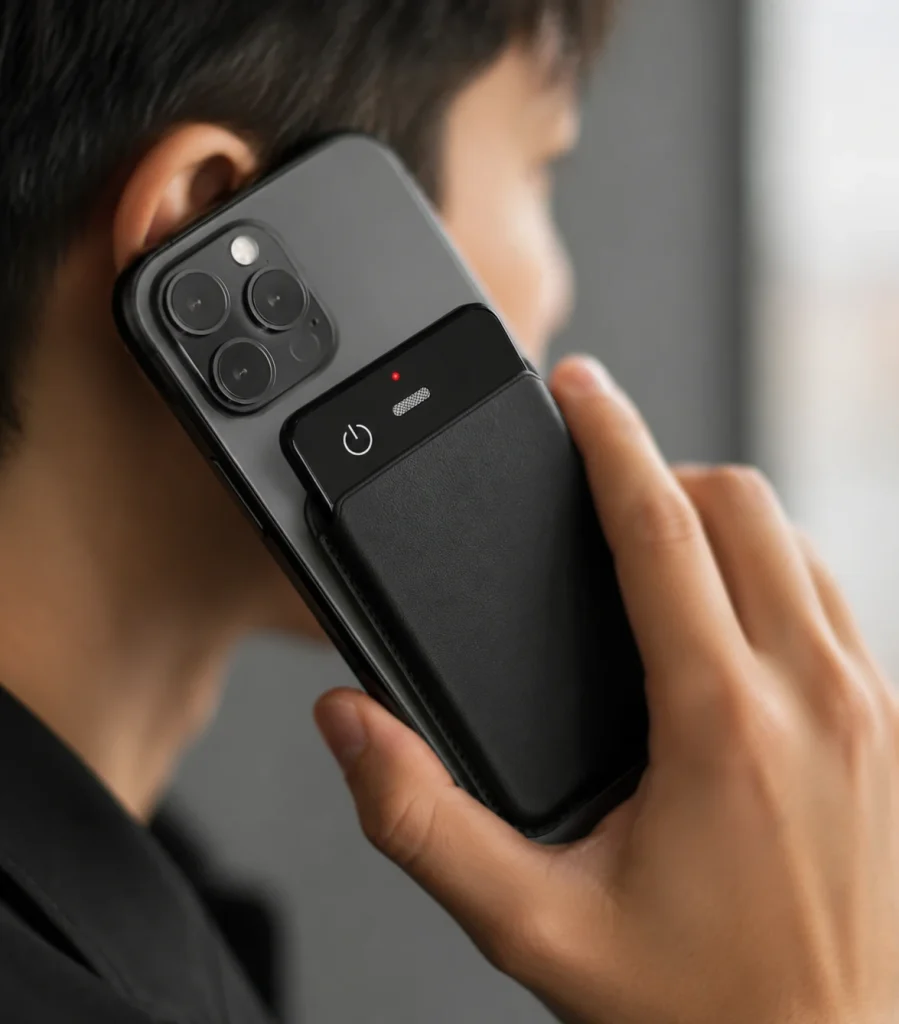
If call recording is in scope, test the documented device and phone setup with participant notice and applicable-law review. Record phone model, case, placement, volume, network, and both sides of the test call.
Shure’s audio systems guide for meetings and conferences emphasizes that microphone technique and placement affect meeting audio. Its microphone basics guide explains polar patterns, including omnidirectional pickup. Use these as general acoustic principles—not as MG6 test results.
Inspect the Source Before Reviewing the AI
For every run, retrieve the original file and record:
- File name and extension.
- File size and duration.
- Sample rate, bit depth, channels, and bitrate if available.
- Start and stop behavior.
- Missing, duplicated, or corrupted sections.
- Audible clipping, handling noise, dropouts, or excessive level differences.
The MG6 reference platform supports offline WAV recording, but the exact WAV parameters used for project calculations must be confirmed. Do not estimate storage hours until the actual format and bitrate are known.
IBM’s speech-to-text overview explains that audio preprocessing, recognition conditions, and system design affect speech-recognition output. These variables explain why the raw file should be inspected before an AI service is blamed or praised.
If the source audio does not preserve a critical statement clearly enough for a human reviewer, a polished summary is not reliable evidence that the capture worked.
Trace the File and Service Path
Test four states rather than one successful sync:
| State | What to do | Evidence to save |
|---|---|---|
| Offline capture | Record without app or network where supported | Local file and device behavior |
| First connection | Connect using the documented method | Transfer steps, accounts, and copies created |
| AI processing | Request the selected service output | Input file, output, elapsed state, and service conditions |
| Export and deletion | Export source and derived files, then test removal | Export formats and observed deletion behavior |
Map whether audio remains on the recorder, phone, computer, cloud service, or export folder. Test an interrupted transfer and a failed login. Record whether recovery is clear and whether duplicate files appear.
The AWS speech-to-text overview distinguishes different speech-recognition modes and notes common limitations. The general lesson for procurement is simple: capture, transfer, and recognition are separate layers, so a sample test should isolate them.
Review AI Output With a Task-Based Rubric
Do not publish a single “accuracy percentage” unless the dataset, reference transcript, scoring method, language, speakers, and conditions are documented. For most sourcing teams, a task rubric is more useful.
Score each area as acceptable, correctable, or unacceptable:
- Critical facts: names, dates, quantities, prices, and commitments.
- Coverage: whether major topics are present.
- Attribution: whether statements are assigned correctly when the service provides speaker labels.
- Action items: owner, task, and due date.
- Unsupported additions: statements not present in the source.
- Correction effort: time required to prepare a usable record.
Keep the raw output and corrected version. The difference between them is valuable evidence for product and support decisions.
Measure Battery and Storage Under Defined Conditions
Battery results depend on settings, device age, temperature, connection state, and usage pattern. For MG6, “up to 22 hours” is an approved reference claim, not a fixed test result.
Use a written procedure:
- Charge with the documented adapter and cable.
- Record the starting indication and time.
- Run the selected recording pattern.
- Log connections, transfers, and AI use separately.
- Record the stop condition and remaining indication.
- Repeat enough times to identify abnormal variation.
For storage, create files of known duration and inspect their actual size. Calculate capacity from observed file generation after confirming the format. Also test full-storage warnings, file deletion, and behavior near the limit.
Convert the Approved Sample Into Production Criteria
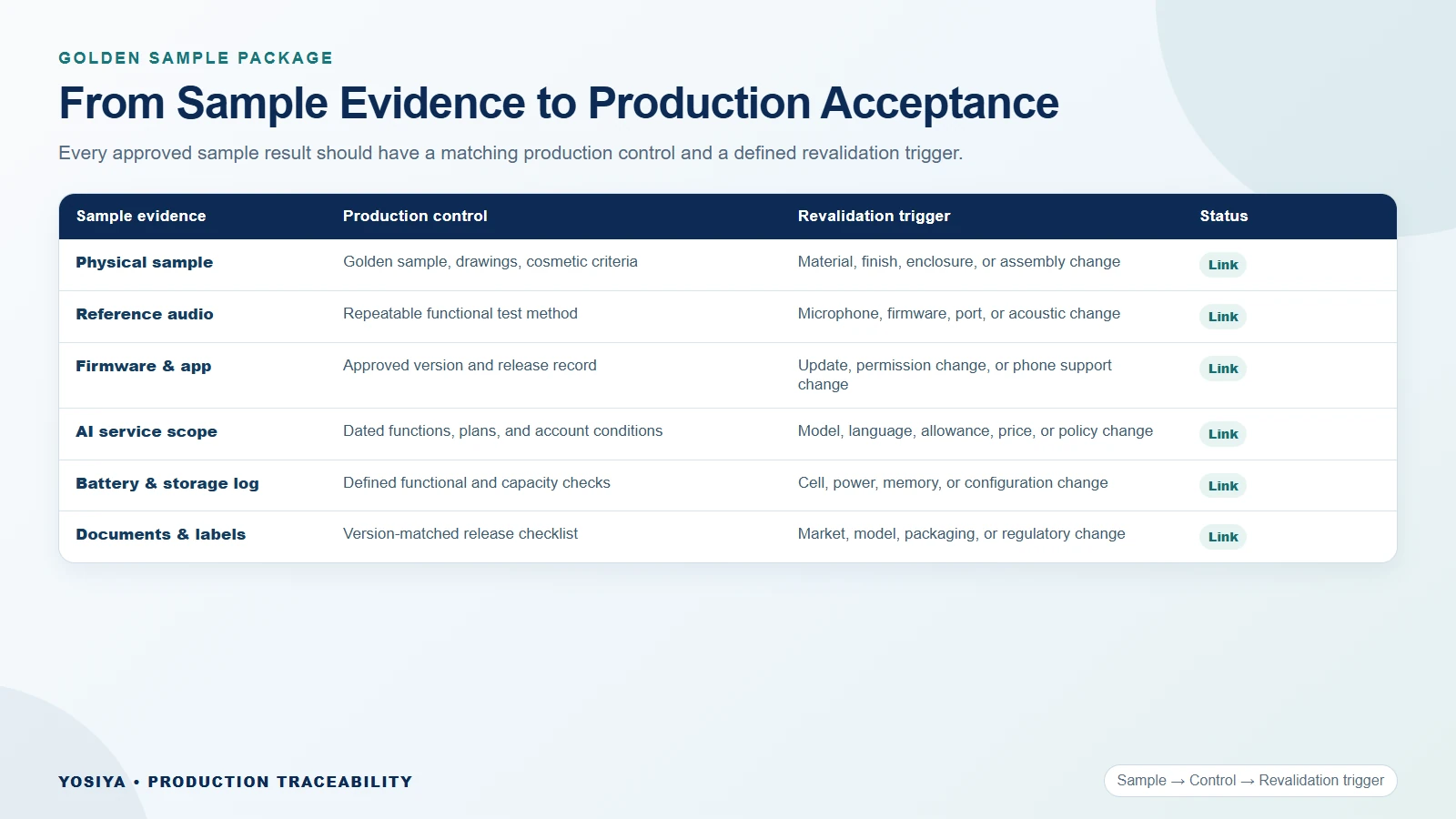
A sample is commercially useful only if its important characteristics survive production. The ISO quality-assurance overview describes preventive controls such as documented processes, supplier checks, inspection, testing, audits, and corrective action.
Create a golden-sample package containing:
- Approved physical sample and photographs.
- Final specification and bill-of-material version.
- Firmware, app, and service scope.
- Reference audio files and test conditions.
- Packaging, artwork, labels, accessories, and manuals.
- Functional inspection checklist.
- Cosmetic criteria.
- Sampling plan and escalation route.
- Change-control and revalidation rules.
Confirm current MG6 specifications and project boundaries on the official MG6 product page. The new-version certification package remains pending, so certification evidence must be checked against the selected production version before launch.
FAQ
Which rooms should be used for sample testing?
Use rooms that represent the intended workload: a quiet office, a small group room, and at least one controlled noisy environment. Document dimensions, surfaces, speaker positions, device placement, and background conditions so tests can be repeated.
How should battery life be verified?
Define charge method, firmware, settings, recording pattern, connection state, temperature, and stop condition. Log observed runtime over repeated runs and compare it with the approved project requirement rather than treating an “up to” claim as assured.
Which files should the buyer inspect?
Inspect original recordings, transferred copies, AI-service inputs, transcripts, summaries, exports, and deletion outcomes. Record format, size, duration, metadata, naming, and every location where a copy appears.
How should AI outputs be scored?
Use a task-based rubric for critical facts, topic coverage, attribution where available, action items, unsupported additions, and correction time. Keep the source audio, raw output, and corrected output together.
What should carry from sample testing into production?
Carry the versioned specification, approved sample, firmware and software scope, reference files, repeatable test method, inspection criteria, packaging approvals, and change-control rules into the pilot and mass-production agreement.
Approve Evidence, Not a Demonstration
AI voice recorder sample testing protects the buyer only when results are repeatable, traceable, and connected to production acceptance. Test the source audio first, then transfer, services, battery, storage, and recovery under named conditions.
Brands and procurement teams can request an MG6 sample and test template. Use the resulting evidence to confirm the project specification, AI-service scope, documentation plan, and production inspection criteria before ordering.