Most AI toys on the market are not designed for three-to-five-year-olds. They are designed for children who can read, follow multi-step instructions, and hold a sustained conversation — skills that typically emerge around age five or six. The few AI-adjacent toys built for preschoolers exist in a narrow window: the child must have enough language to interact verbally, but not so much motor independence that the toy needs complex mechanics. This guide evaluates what works, what does not, and what parents of three-to-five-year-olds should look for before buying.
What Preschoolers Actually Need From Technology
A three-year-old and a six-year-old are developmentally different in ways that matter for toy design. A three-year-old is learning to speak in sentences, developing fine motor coordination, and discovering that objects have names and categories. A five-year-old is telling stories, beginning to read, and asking “why” questions that expect real answers.
The AAP recommends no screen media (except video calls) before 18 months and a maximum of one hour per day of high-quality content for ages 2 to 5. But the guidelines are about screens — passive consumption. A voice-driven device where the child speaks and receives a printed output is not a screen experience in the AAP’s sense of the term, even if a small display shows status information. The key distinction is whether the child is an active participant or a passive viewer.
For the 3-to-5 age range, a good AI or AI-adjacent toy should satisfy three criteria:
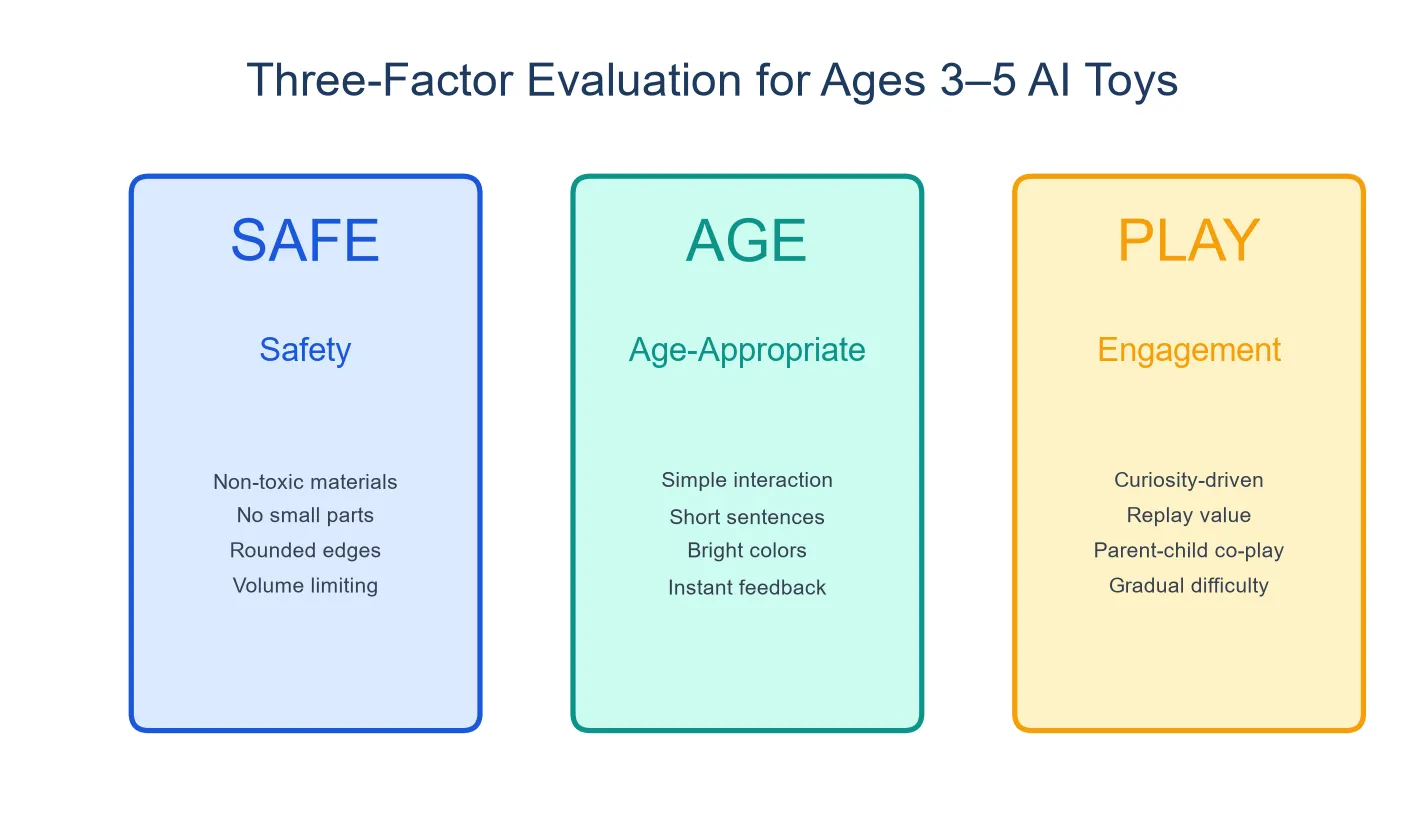
1. Voice-first, no reading required. A preschooler cannot navigate a text menu. The interface must be entirely speech-driven. The child speaks; the toy responds. This is the single most important design requirement for this age group.
2. Immediate, tangible output. A three-year-old’s attention span is measured in minutes. If the toy produces something physical — a sticker, a printed image, a card — within seconds of the child’s input, the feedback loop works. If the output is hidden behind menus or delayed by processing, the child loses interest.
3. Safety redundancy. For children under five, any toy with small parts, batteries, or connected features needs multiple layers of safety. Physical safety (no choking hazards, durable materials), data safety (no collection of children’s voice data without consent), and content safety (age-appropriate responses and filters) are all non-negotiable.
Three Toys That Fit the Age Range
Stickerbox
Stickerbox is the simplest AI-adjacent device for preschoolers. A child speaks a sticker idea — “a dinosaur wearing a party hat” — and the device prints a pre-designed sticker sheet matching the description. There is no screen, no conversation, and no complexity. It must be plugged into a wall outlet.
Why it fits ages 3-5: The absolute simplicity. A three-year-old who can say “dinosaur” can use it. The voice-to-output loop is under 30 seconds. The printed stickers are immediately usable — peel and stick, no coloring, no scissors. For a young preschooler, this instant gratification is developmentally appropriate.
Limitations: Single-turn interaction only. No conversation, no adaptive learning, no follow-up. It is a creative output tool, not a learning device. A five-year-old who can hold a conversation will outgrow it within months.
BDI X16
The BDI X16 generates AI images from voice prompts and prints them on 57×26mm thermal paper. It has a 2.4-inch screen and a 1,300mAh battery.
Why it fits ages 3-5: The image generation is fast and visual. A preschooler who describes “a rainbow with a unicorn” sees a result in seconds. No reading, no menus — just speak and see. The battery portability means it can be used on a play mat or a low table.
Limitations: No conversation capability — single prompt, single image, interaction ends. The print area is small (narrower than standard 57mm). The screen, while small, is a bright focal point that may draw sustained visual attention in a way that runs counter to screen-reduction goals. The device is not specifically designed or marketed for preschoolers.
K1 AI Printer
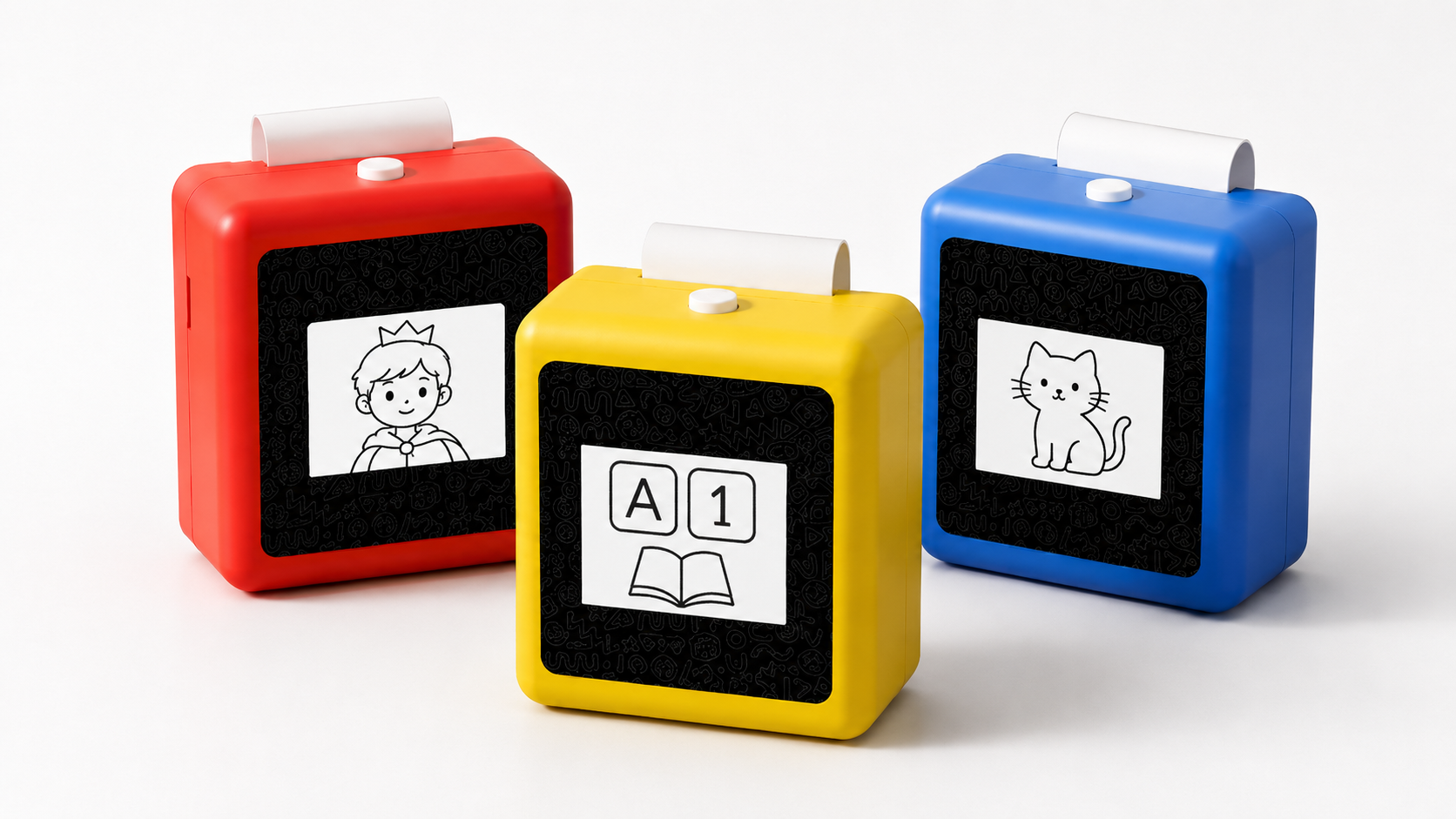
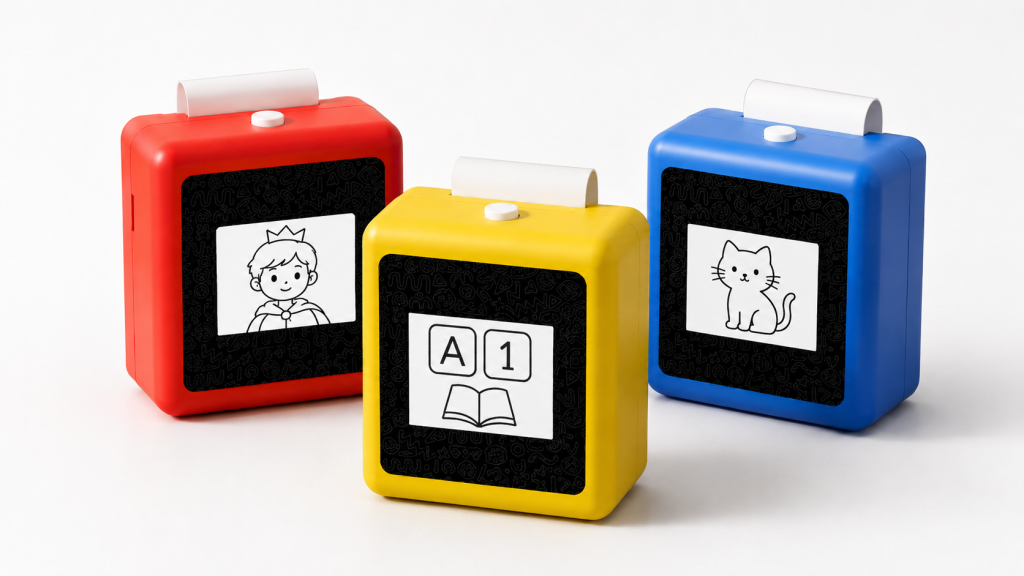
The K1 AI Printer combines voice dialogue with 57mm thermal printing. It measures 98 × 57 × 117mm, weighs 225g, and has a 2.8-inch auxiliary screen.
Why it can fit ages 3-5 with supervision: Voice is the only input — a preschooler who can speak in sentences can interact with it. The print output produces something the child can hold, color, and display. The device’s 1,800mAh battery supports use anywhere in the house. The AI conversation can respond at an age-appropriate level for young children.
Caveats for this age range: Independent use by three-to-five-year-olds has not been verified — most testing and documentation for AI dialogue devices in this category focuses on ages 5+. Parents should expect to supervise use for children under five. The paper rolls and any small accessories should be kept out of reach of children under three due to choking hazard considerations. The AI’s conversation safety boundaries and content filtering should be confirmed for the specific production version.
For a four-year-old who already talks in sentences and wants to “make things” rather than just play, the K1 fills a gap: it is more conversational than Stickerbox and more interactive than BDI X16. But it requires more parent involvement than either — for setup, supervision, and managing consumables.
What Does Not Work for This Age
Some products marketed for young children should be approached with caution:
Subscription-gated AI toys. A five-year-old does not need a subscription. By the time they are old enough to use the full feature set, they may have already outgrown the hardware. Miko Mini, while COPPA-certified and well-regarded for ages 5+, requires an $8.25/month subscription for full features — which makes it a questionable value for a three-to-four-year-old who will use only a fraction of the capability.
Tablet-based systems. Osmo requires an iPad and is designed for ages 5+. The screen-plus-physical model works well for kindergartners but introduces the screen-time negotiation that parents of preschoolers are typically trying to avoid.
Complex building or coding kits. Products like LEGO Spike or Botley the Coding Robot are designed for ages 5+ and assume reading ability, instruction-following, and sustained attention that most three-to-four-year-olds have not yet developed.
Activity Ideas for Preschoolers
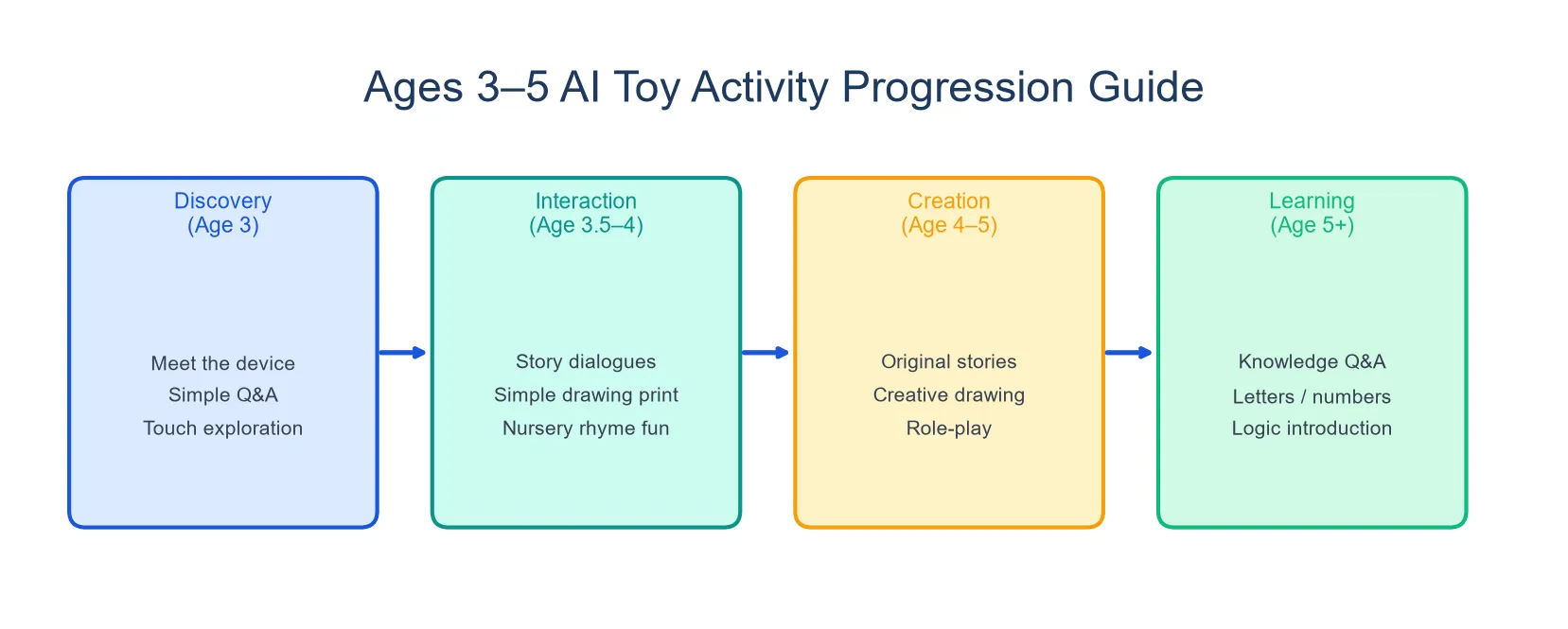
If you introduce an AI-capable device to a three-to-five-year-old, start with activities that match their developmental stage:
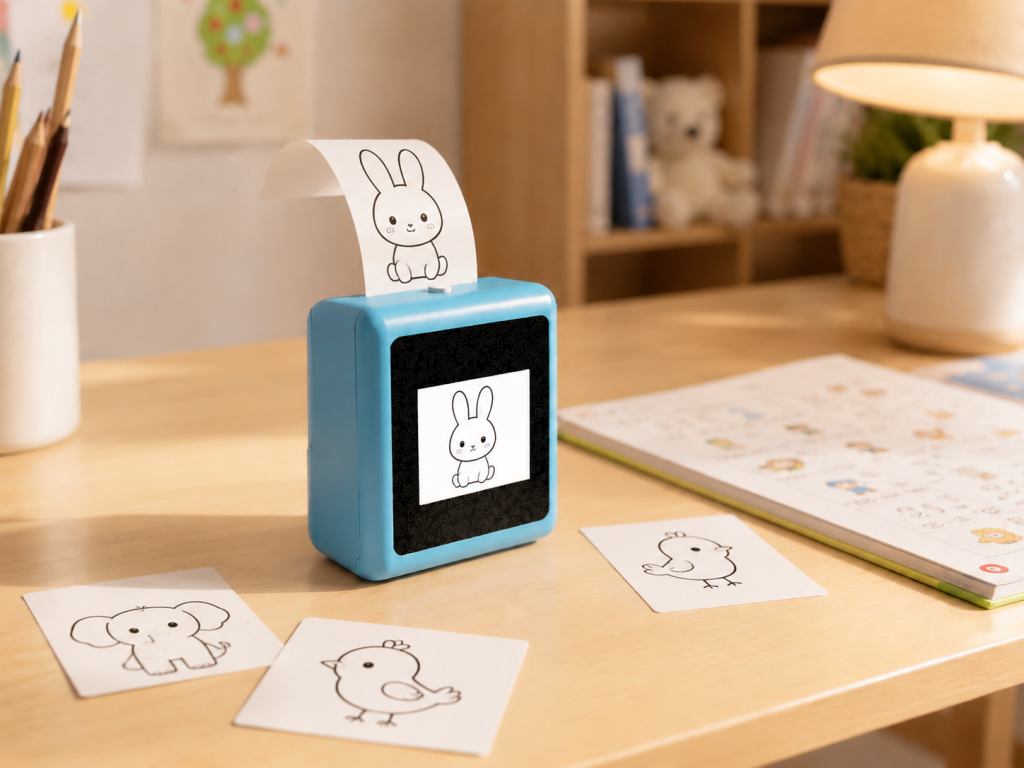
Ages 3-4: Name and print. “What animal do you like?” The child says “cat.” The device prints a cat image. The child colors it. At this age, the activity is about connecting spoken language to visual output — the cognitive link between “I said it” and “it appeared.”
Ages 4-5: Simple story creation. The child describes a scene — “a bunny having a birthday party” — and the device prints it. The parent asks: “What is the bunny’s name? Who came to the party? What kind of cake?” The child tells the story orally. The print serves as a story prompt, not the story itself.
Ages 5: Learning connections. As the child approaches kindergarten, integrate basic literacy and numeracy. “Print a card with the letter B and something that starts with B.” “Print three apples and two bananas — how many fruits?” The device becomes a custom flashcard generator.
Safety Checklist for AI Toys and Preschoolers
Before any connected device enters a preschooler’s environment, verify these items:
- Physical safety. Are all parts larger than the choke-test cylinder (a toilet paper roll is a rough proxy)? Are batteries enclosed in a screw-secured compartment? Are materials labeled as food-grade or BPA-free where applicable?
- Data privacy. Does the device upload voice recordings? Where are they stored and for how long? Can a parent review and delete recordings? For children under 13 in the US, COPPA governs data collection — but not all devices comply.
- Content filtering. Can the parent configure content boundaries? What prevents the AI from generating or speaking content inappropriate for a three-year-old? Ask the manufacturer for specifics, not reassurances.
- Supervision plan. For any connected device used by a child under five, plan for active supervision — not because the device is inherently unsafe, but because a preschooler cannot independently navigate unexpected outputs, connectivity issues, or consumable changes.
FAQ
1. Can a 3-year-old really use an AI toy?
A three-year-old with typical language development can use a voice-driven toy for single-turn interactions — say something, see something. Multi-turn conversation is usually beyond a three-year-old’s attention span and language processing. The right expectation is short, supervised sessions of 5–10 minutes, not independent play.
2. Is Stickerbox or K1 better for a 4-year-old?
Stickerbox is simpler — speak, receive stickers, done. Better for a four-year-old who wants instant creative output without conversation. The K1 is more capable — dialogue, learning cards, creative prompts — but better suited to a four-and-a-half to five-year-old who is beginning to hold sustained conversations. The right choice depends on your child’s language development, not the product specs.
3. Are thermal printers safe around young children?
Thermal printers use heat, not ink — no liquid chemicals, no toner. The paper should be BPA-free (confirm with the manufacturer). The primary safety consideration for preschoolers is the paper roll itself — it is a consumable that a young child could unravel or attempt to eat. Keep spare rolls out of reach.
4. Will my child outgrow a preschool AI toy quickly?
Probably — and that is developmentally appropriate. The 3-to-5 age range is the fastest period of cognitive change in childhood. A toy that fits at age three will almost certainly be outgrown by age five. This is not a flaw; it is the nature of the age. Buy for the child you have now, not the child they will be in two years.
5. Should I wait until my child is older?
If your child is three and just beginning to speak in sentences, waiting six to twelve months is reasonable. The sweet spot for AI toy engagement begins around age four to four-and-a-half, when language is developed enough for back-and-forth interaction and fine motor skills support the coloring and handling of printed output. There is no developmental downside to waiting.
The Bottom Line
The AI toy category for ages 3 to 5 is thin for a reason: the technology’s strengths — conversation, adaptation, content generation — require language skills that most preschoolers are still developing. The best approach for this age is to choose the simplest device that matches your child’s current abilities, supervise actively, and accept that whatever you buy at age three will likely be replaced by age five. The goal is not a toy that lasts for years. It is a toy that fits right now.
Learn more about K1 AI Printer features and safety information