
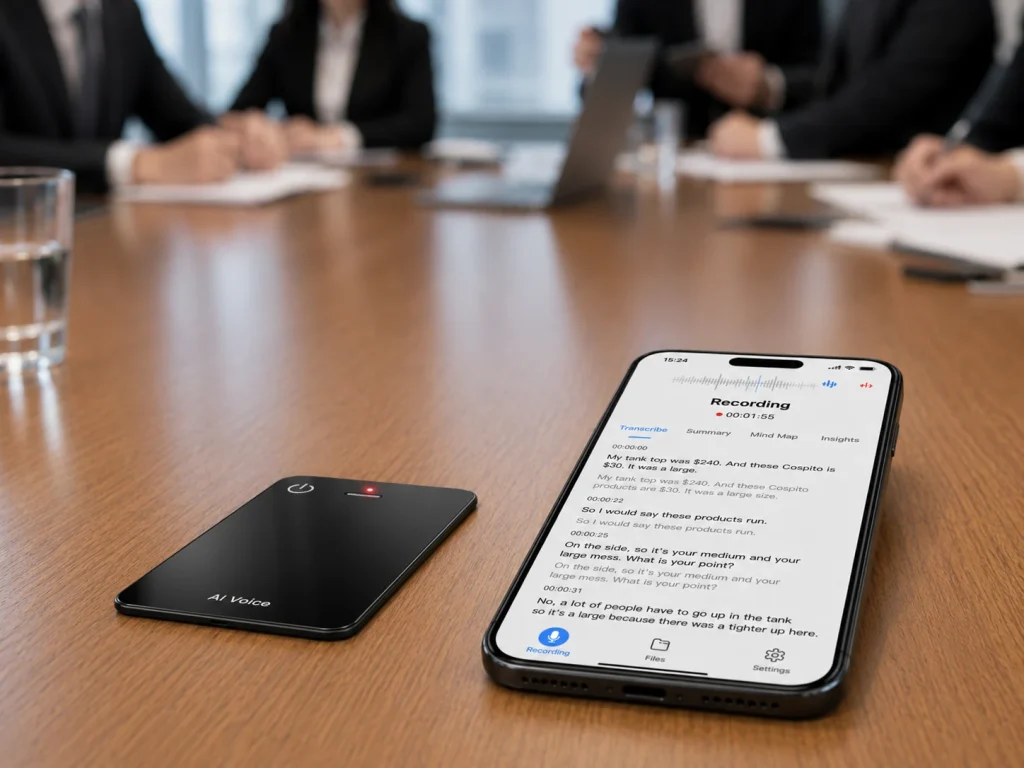
A multilingual AI voice recorder can preserve source audio and assist with transcription or translation, but it should not be treated as a universal interpreter. Buyers need to separate four functions: recording the sound, transcribing speech in its source language, translating meaning into a target language, and providing qualified interpretation when decisions carry legal, medical, contractual, safety, or other high consequences. Language support can differ by locale, feature, region, service version, and connection state. The correct evaluation therefore uses real bilingual meetings, a terminology list, human review, and a current supplier language matrix instead of relying on one advertised language count.
What Buyers Should Know
- Recording, transcription, translation, and professional interpretation are different services with different responsibilities.
- “Supports a language” does not prove equal performance across accents, locales, terminology, room acoustics, or language switching.
- A language pair must be tested in both directions; performance for English-to-Chinese, for example, does not establish Chinese-to-English performance.
- Source audio should remain available so important translations can be checked.
- Real-time translation may require an open application, network connection, account, and approved service plan.
- Formal or high-consequence communication may require a qualified human interpreter, not an AI meeting summary.
- MG6 language coverage and accuracy are not stated here because the current project language matrix must be confirmed.
Where This Product Fits
| Option | Most suitable role | Useful strength | Boundary to manage |
|---|---|---|---|
| Bilingual participant notes | Informal clarification in familiar teams | Human context and immediate questions | Note-taking burden and inconsistent record |
| Phone translation app | Short phrases and ad hoc conversations | Accessible interface and rapid translation | Device placement, privacy, source-file control, and feature limits |
| Meeting-platform captions | Supported online meetings | Participant identity and platform workflow | Plan, language, meeting, and platform dependency |
| Dedicated multilingual recorder | Repeatable local capture plus connected processing | Separate source audio and physical placement | Transfer, language matrix, account, network, and review process |
| Qualified interpreter | High-consequence or formal communication | Professional interpretation responsibility | Scheduling, specialization, credentials, and cost |
| Yosiya MG6 reference platform | Offline WAV capture with connected real-time translation options | Source recording can be separated from the connected AI layer | Exact languages, locales, terminology, service plan, and accuracy require confirmation |
Buyers who need a broader architecture explanation can read what an AI voice recorder is in a B2B workflow. The offline recording versus offline AI transcription guide explains why local capture does not prove local language processing.
Meeting-platform captions and a dedicated recorder can also be complementary rather than interchangeable. Platform captions may support participants during a compatible online meeting, while a separately governed source recording can support later review where notice, authorization, and platform rules permit it. Teams evaluating multilingual conversations at international events should also use the conference and trade-show recorder workflow to test noise, contact matching, consent, and follow-up handoff.
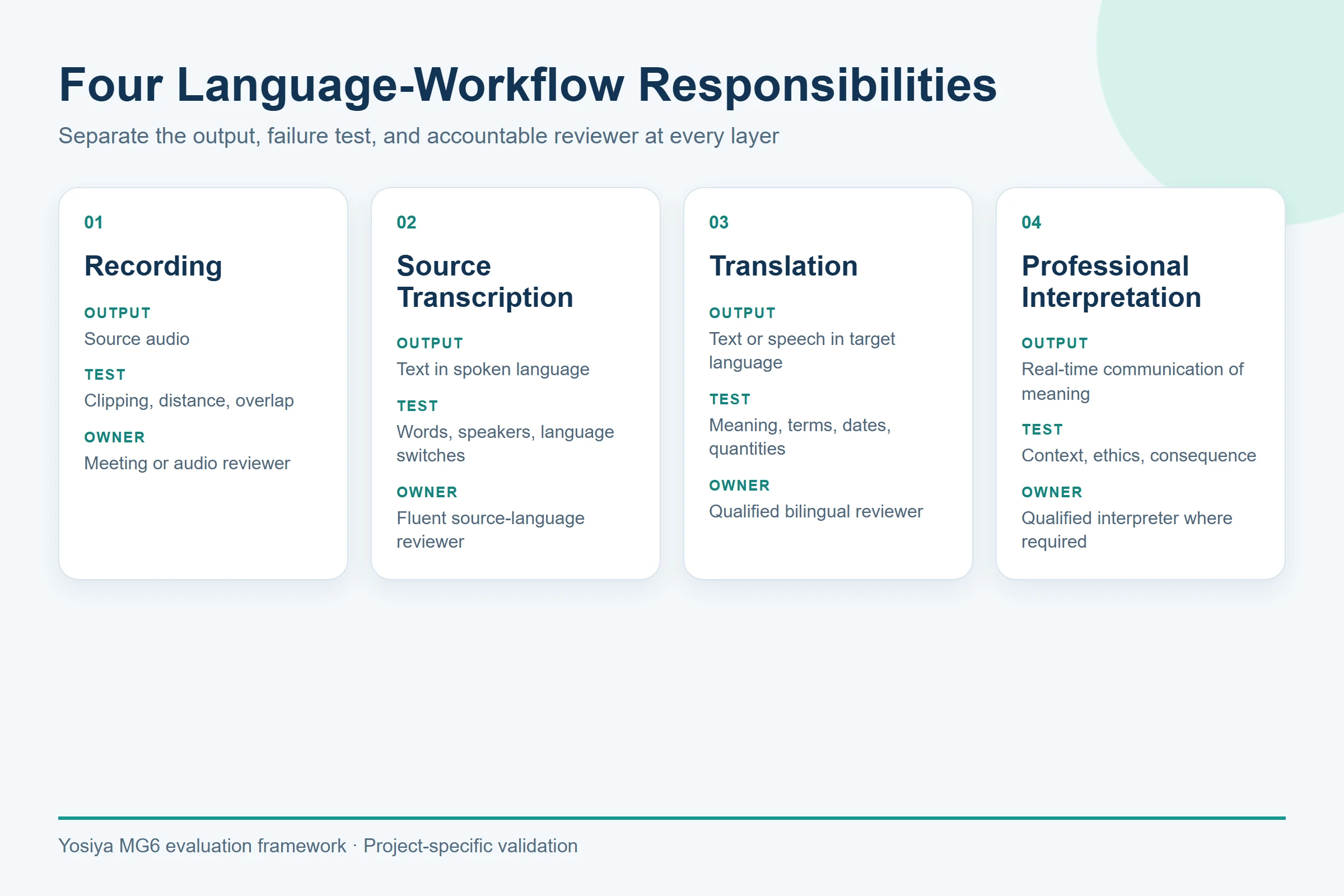
Use a Four-Layer Responsibility Model
| Layer | Output | Failure to test | Responsible reviewer |
|---|---|---|---|
| 1. Recording | Source audio | Clipping, distance, overlap, background noise | Meeting owner or audio reviewer |
| 2. Source transcription | Text in the spoken language | Wrong words, speaker attribution, punctuation, missed switches | Fluent source-language reviewer |
| 3. Translation | Text or speech in another language | Meaning shift, terminology, dates, quantities, negation | Qualified bilingual reviewer |
| 4. Interpretation | Real-time communication of meaning | Context, culture, ethics, role and consequence | Qualified interpreter where required |
The U.S. Department of Justice’s 2023 Language Access Plan provides a current public-sector example of matching qualified language assistance to the language or variant a person uses. It is not a universal rule for private business meetings, but it illustrates why consequence and institutional procedure matter. ISO 18841:2018 specifies general requirements and recommendations for interpreting services; ISO currently marks that edition as under revision and expected to be replaced. Check the standard’s status before using it in procurement requirements. Neither source certifies a particular recorder or AI output.
Verify the Exact Language Function
A vendor may use one language count to describe several different capabilities. Ask for a matrix with separate columns for:
- Speech-to-text source languages and locales.
- Real-time versus post-recording transcription.
- Source-language transcript availability.
- Translation source and target languages.
- Direction-specific support and test results for each required language pair.
- Text translation versus speech output.
- Automatic language identification.
- Within-session language switching.
- Speaker separation for each mode.
- Custom vocabulary or glossary support.
- Regional endpoint or account restrictions.
- Processing region, subprocessors, service version, and date checked.
- Online, offline, and application-open requirements.
Treat each direction as a separate test case. A result for language A to language B should not be reused as evidence for language B to language A. Ask the supplier to identify whether a claimed language is supported for source transcription, target translation, interface display, synthesized speech, or all four, and retain the dated source page or written response behind every matrix entry.
Microsoft’s current Azure Speech language table separates support by function and locale rather than presenting one universal number. Its speech translation overview also distinguishes source transcription, target translation, multiple target languages, and multilingual session behavior. The point is not that MG6 necessarily uses Azure; it is that buyers should demand the same level of functional specificity from any service provider.
Test Language Switching as Its Own Scenario
Business meetings rarely remain perfectly monolingual. A participant may introduce a product name in English, explain a problem in Spanish, quote a Chinese supplier term, and return to English. Automatic language identification can help, but it introduces another decision layer that can be wrong.
Google Cloud’s documentation for automatic language detection recommends constraining the candidate-language list because fewer alternatives can improve selection likelihood. Microsoft’s documentation describes multilingual modes that may handle within-session switching, but supported behavior depends on the specific feature and service version. These examples show why a generic “multilingual” label is not enough.
Build test clips with the actual switching patterns expected in the meeting:
- One speaker switches languages mid-sentence.
- Different speakers use different primary languages.
- Product names and acronyms remain untranslated.
- Numbers, currencies, dates, addresses, and delivery terms appear near a switch.
- Two speakers overlap during the switch.
- A remote participant enters through a loudspeaker or phone.
Score source transcription and translation separately. Otherwise a correct translation of an incorrect transcript may look fluent while preserving the wrong fact.
Run the same critical script in both directions when the business workflow is bidirectional. Compare terminology, negation, names, quantities, and required reviewer time separately for each direction rather than averaging them into one “multilingual accuracy” score.
Create a Terminology and Proper-Noun Workflow
Generic language models may not know a company’s product names, part numbers, customer names, industry acronyms, or preferred bilingual terminology. Prepare a short controlled glossary before the pilot:
| Term type | Source example | Target rule | Review action |
|---|---|---|---|
| Product or brand | Official product name | Do not translate unless approved | Check spelling and capitalization |
| Part number | Alphanumeric SKU | Preserve exactly | Replay and compare with written reference |
| Technical term | Domain phrase | Use approved bilingual equivalent | Reviewer confirms context |
| Commercial term | Incoterm, warranty, payment phrase | Use legal/commercial glossary | Escalate ambiguity |
| Number/date | Quantity, price, deadline | Preserve value and format intentionally | Compare source audio and meeting document |
| Person/place | Name or location | Use verified written spelling | Correct before distribution |
Do not assume a custom vocabulary feature applies to every language or mode. Confirm whether it affects transcription, translation, or only display correction. Keep the original utterance, draft output, reviewer correction, and approved term so repeated errors can be measured.
Design Human Review Around Consequence
Not every sentence needs identical review effort. Use risk-based tiers:
- Low consequence: informal recap or personal navigation; sample review may be sufficient.
- Business consequence: actions, owners, product requirements, pricing, delivery dates, or customer commitments; verify the relevant audio segment.
- High consequence: legal rights, safety instructions, medical information, employment decisions, regulatory communication, or signed contract meaning; use the organization’s approved language-access process and qualified professionals.
The NIST AI Risk Management Framework recommends defining human roles and responsibilities and managing validity, transparency, privacy, and harmful bias across the AI lifecycle. For a multilingual meeting, the reviewer should be able to challenge the output, access source audio, document a correction, and prevent an unverified translation from becoming the official record.
Map Privacy and Data Flow Across Languages
Translation may create more data copies than recording alone: source audio, source transcript, translated transcript, synthesized speech, summary, glossary, and corrected version. Each can move through different services or regions.
Before deployment, document:
- Where the source audio is recorded and stored.
- When it leaves the device.
- Which service performs transcription and translation.
- Whether audio, text, or both are sent to a third party.
- Which account, workspace, region, and retention rule apply.
- Who can view each language version.
- Whether reviewers or subcontractors access the material.
- Which processing regions and subprocessors handle audio, transcripts, translations, summaries, or synthesized speech.
- How corrections, exports, legal holds, and deletion propagate.
Require the data-flow record to identify the controller or business owner for each copy, the service and processing region, the retention trigger, and the deletion confirmation method. If one language derivative cannot be located, exported, placed on hold, or deleted without affecting another, document that limitation before deployment.
Use the AI voice recorder privacy checklist to map local and connected processing. Consent and confidentiality obligations still apply when participants speak different languages; the notice itself may need to be understandable to every participant.
Evaluate MG6 Without Inventing a Language Count
The MG6 reference hardware description supplied for this project lists offline WAV recording with a connected AI workflow. The product direction supplied for this draft describes real-time translation while recording with the application open and an active network connection, plus a project-specific phone-recording workflow. Buyers should verify these functions against the current official configuration, service terms, and sample build before relying on them.
Those statements do not establish a confirmed number of languages, equal performance by locale, offline translation, terminology accuracy, or suitability for professional interpretation. An unverified capability must be marked “not confirmed,” which is different from a verified statement that the capability is unsupported. Hardware noise reduction is not an AI translation feature. Offline WAV capture preserves the source file but, by itself, is not evidence that transcription or translation runs locally.
Request the current MG6 AI-language matrix with service version, source and target languages, locales, connection conditions, plan scope, and sample files. Confirm the selected hardware and software configuration on the MG6 AI recording card page and in the project dossier.
Language-service costs may also vary by processed minutes, account structure, target output, review workload, and commercial plan. Use the AI voice recorder total-cost model to keep those recurring and internal costs separate from the hardware quote.
Run an Eight-Case Multilingual Pilot
| Case | What to record | What to measure |
|---|---|---|
| 1. Clean monolingual | One language, quiet room | Baseline transcript and translation errors |
| 2. Accent variation | Intended regional accents/locales | Unsupported or unstable patterns |
| 3. Language switching | Planned bilingual transitions | Detection delay and wrong-language segments |
| 4. Terminology | Names, SKUs, acronyms, domain phrases | Correct preservation and glossary effect |
| 5. Numbers | Prices, dates, quantities, addresses | Factual error rate |
| 6. Multi-speaker | Overlap and turn-taking | Speaker attribution and lost context |
| 7. Remote audio | Speakerphone or conferencing output | Echo, compression, and placement impact |
| 8. Network interruption | Controlled connection loss | What continues, fails, queues, or must restart |
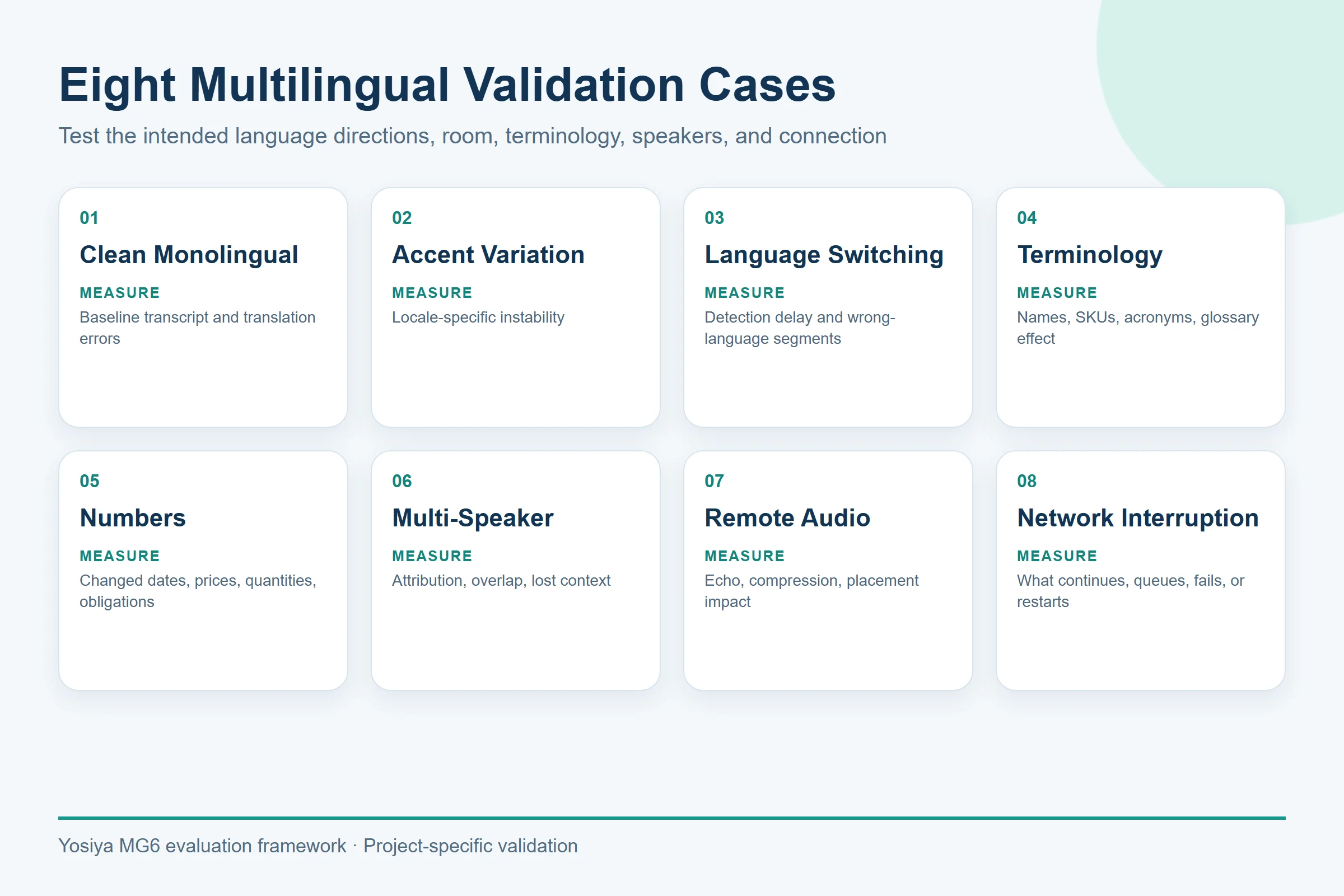
For each case, retain the source WAV, source-language reference, draft transcript, draft translation, reviewer corrections, processing time, and review time. Define the scoring rules before testing: count a source-transcription error against the reference transcript, count a translation error only after separating inherited source errors, and report critical factual errors—such as changed negation, names, dates, prices, quantities, or obligations—separately from wording preferences. Record results by language direction, locale, service version, and test date. The AI voice recorder sample-testing guide provides a general structure for matched evidence and pass/fail thresholds.
FAQ
Which languages does MG6 support?
The current language count and locale matrix are not confirmed in this article. Support can differ among transcription, real-time translation, post-recording translation, source language, target language, and service version. Request the current MG6 AI-language matrix for the proposed project. Test the exact language pairs, accents, terminology, and switching pattern before purchase.
Can MG6 translate offline?
Offline WAV recording and offline translation are different capabilities. The product description supplied for this draft says MG6 can preserve source audio locally and describes real-time translation with the application open and a network connection. That evidence does not establish offline AI translation; it is not the same as a verified finding that every configuration lacks it. Ask the supplier to mark the current capability as supported, unsupported, or not confirmed, and test what happens when connectivity is lost.
How should technical terms be checked?
Create an approved bilingual glossary containing product names, SKUs, acronyms, commercial terms, and preferred translations. Test whether the selected service accepts custom vocabulary and which processing modes use it. A fluent bilingual reviewer should compare critical terms with the source audio and meeting documents. Record corrections so repeated error patterns can be measured.
Can an AI recorder replace professional interpretation in a legal meeting?
It should not be assumed to replace the professional interpreter or language-access process required for the jurisdiction, institution, and proceeding. Legal, medical, safety, regulatory, and contractual communication can require specialized competence, ethics, confidentiality, authorization, and local procedures. Obtain appropriate local guidance before recording or relying on an AI-generated language output. A recorder may preserve source audio or assist review where permitted, but that is a different role from professional interpretation and does not establish admissibility or official-record status.
Where is multilingual meeting audio stored?
MG6 can record a local WAV source file, but connected transcription or translation may create additional copies in applications or service-provider systems. The exact data flow, region, retention, access, and deletion behavior depend on the selected project configuration. Request a written diagram and service terms. Verify export and deletion across every language derivative during the pilot.
Request the Current MG6 AI-Language Matrix
Ask Yosiya for the current MG6 language, locale, direction, function, service version, connection, account, processing-region, subprocessor, retention, and data-flow matrix together with a sample evaluation plan and the date each claim was checked. Provide the intended language pairs in both directions, meeting environments, terminology, phone or in-person workflow, and consequence level. A project-specific pilot can then test source capture and connected output without presenting an unverified language count or treating AI translation as professional interpretation.


