
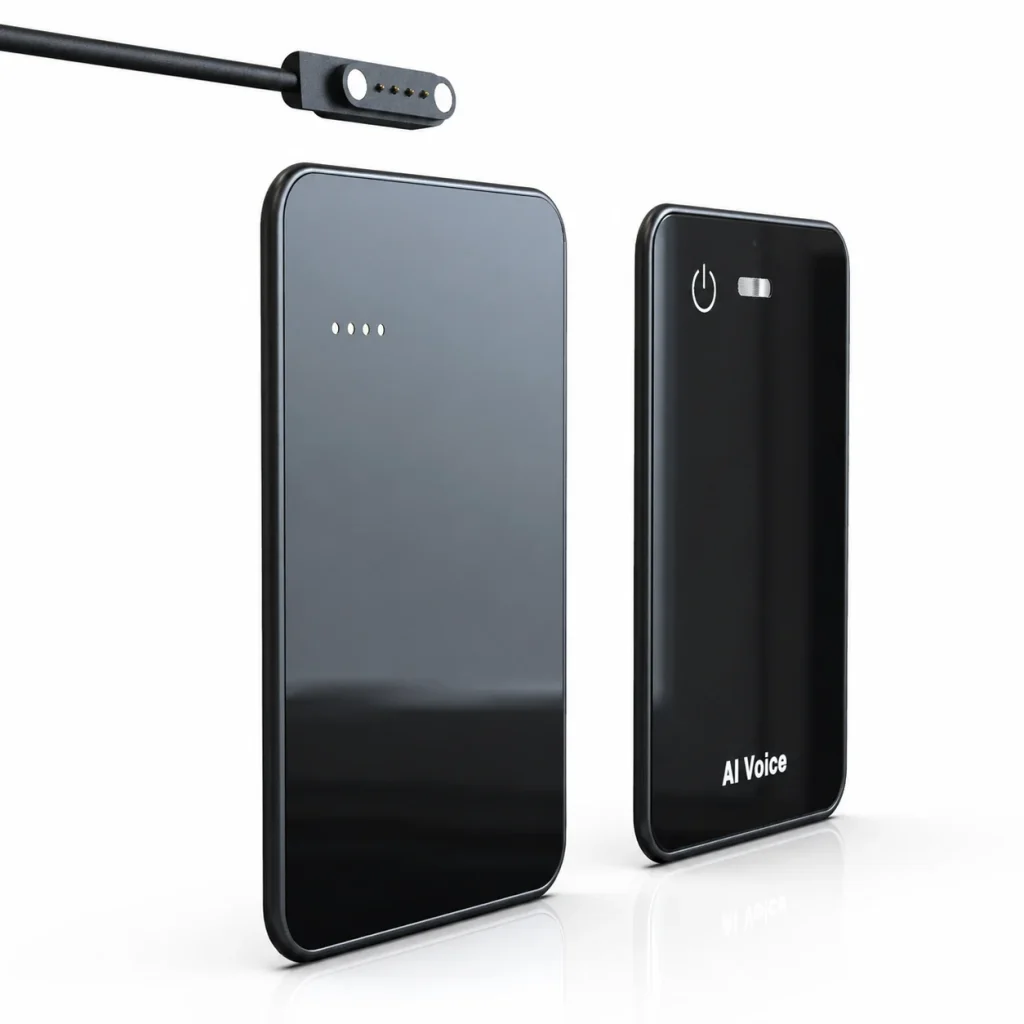
An AI voice recorder RFP checklist should make every supplier answer the same operational questions with comparable evidence. Define the users, recording situations, reference hardware configuration, transfer path, AI services, privacy controls, support model, commercial assumptions, and acceptance tests before asking for a price. For every requirement, request a direct response, supporting artifact, responsible party, and exception note. This prevents a low hardware quote from hiding different storage, subscription, software, or support scopes. For MG6, buyers can begin with confirmed offline WAV capture and configurable hardware options, then document the connected AI and private-label elements that require project-level agreement.
What Buyers Should Know
- Freeze one reference configuration before comparing quotations.
- Separate the recorder, companion software, AI provider, and operating process.
- Convert broad feature requests into observable acceptance tests.
- Require evidence and a named owner beside every supplier answer.
- Price pilot, launch, recurring service, change, and exit assumptions separately.
Start with a one-page reference configuration
An RFP becomes difficult to compare when suppliers answer different versions of the request. Put a short configuration sheet before the questionnaire. State the intended users, expected recording situations, target markets, planned sales channel, approximate launch volume, storage option under consideration, packaging scope, branding surfaces, mobile platforms, languages to evaluate, and required AI outputs.
Do not fill unknowns with attractive assumptions. Use labels such as required, preferred, optional, and supplier to propose. If a requirement depends on a connected service, identify it as a service requirement rather than a recorder specification.
| Reference item | Buyer entry | Why it matters |
|---|---|---|
| Primary users | Roles and typical skill level | Shapes onboarding and support |
| Capture scenarios | Meetings, interviews, calls, or field notes | Defines the sample test set |
| Hardware configuration | Storage and included accessories | Keeps unit quotations comparable |
| Software scope | App platforms, accounts, and outputs | Exposes development and service work |
| AI usage assumption | Minutes, languages, and output types | Supports recurring-cost estimates |
| Market scope | Countries, channels, and launch timing | Affects documentation and distribution planning |
| Acceptance owner | Named business and technical reviewers | Prevents an unowned pilot |
Divide requirements into accountable layers
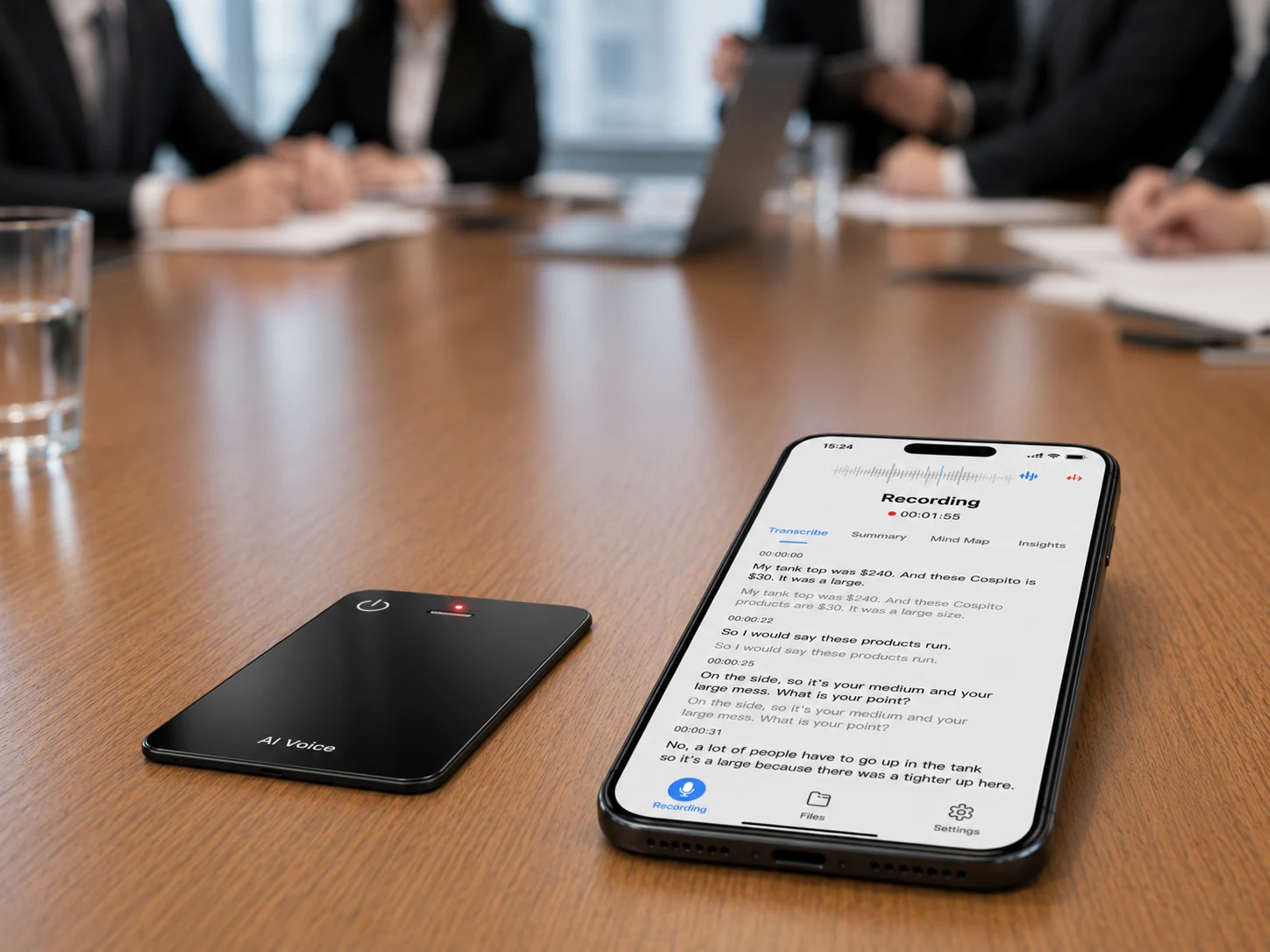
Treat the proposed solution as a chain. A recording can succeed while transfer fails; transfer can work while transcription is unavailable; a transcript can be produced while account deletion or export remains undefined. One checkbox labeled “AI transcription” cannot describe those dependencies.
Hardware and capture
Ask for dimensions, weight, microphones, storage configuration, recording format, controls, indicators, charging method, transfer method, accessories, battery test conditions, and environmental or regulatory documents relevant to the selected version. Request a sample manual and actual files from the proposed configuration. Do not accept a family-level brochure as proof for every SKU.
Companion application and accounts
Identify supported operating systems, account creation, authentication, device pairing, transfer flow, permissions, update ownership, analytics, crash reporting, support access, and account closure. If the project includes a branded app, use a dedicated software schedule rather than assuming a logo change covers the complete deliverable.
Connected AI services
List transcription, translation, summarization, mind maps, speaker handling, terminology, usage allowances, overage rules, geographic availability, retention, model or provider changes, review tools, and exports as separate rows. A capability demonstrated in one service plan should not be generalized to every proposed project.
Operations and support
Request onboarding materials, defect intake, severity definitions, response targets, update policy, replacement handling, escalation contacts, service notices, and end-of-life communication. Define which organization supports the end user and which issues can be escalated to each supplier.
Commercial and exit terms
Separate nonrecurring engineering, samples, tooling if applicable, packaging, certification work, app work, unit price, AI usage, cloud storage, support, updates, freight, taxes, change requests, data export, and termination assistance. Ask suppliers to mark excluded items instead of leaving cells blank.
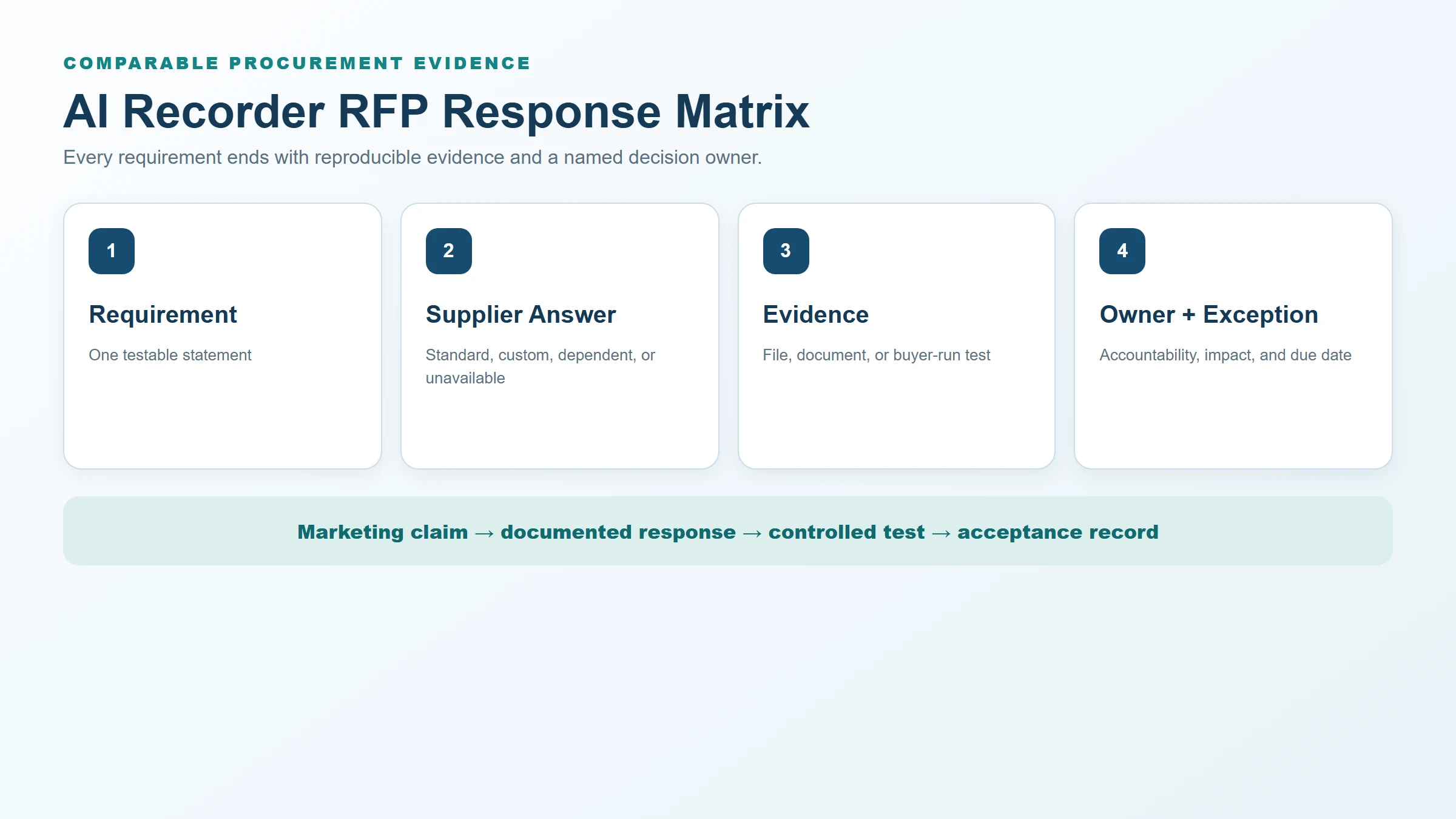
Use a four-column supplier response matrix
The most useful RFP table is not a feature list. It is a traceable response record.
| Requirement | Supplier answer | Evidence | Owner and exception |
|---|---|---|---|
| Offline source recording | Supported / partial / unavailable / proposed | Sample file and test steps | Hardware owner; deviations stated |
| Data transfer | Method and dependencies | Live test or documented procedure | Device/app owner |
| Transcription | Service, plan, and conditions | Output from buyer test file | AI-service owner |
| Data retention | Location, period, deletion path | Data-flow diagram and policy | Controller/operator roles |
| Software updates | Release and regression process | Version history and support plan | Development owner |
| Bulk export and exit | Objects, format, timing, and fee | Sample package and exit procedure | Service owner |
Require the supplier to distinguish standard, configurable, custom development, third-party dependency, and unavailable. “Yes” is inadequate when availability depends on a particular plan, region, mobile platform, minimum order, or development fee.
Ask for security, privacy, and AI evidence
Security questionnaires often focus on the supplier’s corporate controls while missing product behavior. The August 2024 CISA Secure by Demand Guide encourages software customers to ask how manufacturers handle product security before, during, and after procurement. Its questions are guidance, not a universal private-sector mandate, but the procurement principle is useful: ask for observable practices and responsible owners.
CISA’s 2024 Software Acquisition Guide for Government Enterprise Consumers also connects security expectations with acquisition activities, supplier discussions, and contract language. Private buyers can adapt its evidence-oriented questions without presenting federal guidance as a rule that automatically applies to their purchase.
For software development, NIST SP 800-218 provides a common vocabulary for secure development and supplier communication. Buyers can ask how the proposed app handles requirements, code changes, vulnerabilities, releases, and provenance without claiming that a supplier conforms to the framework unless evidence supports that claim.
For privacy, start with a data-flow diagram covering audio capture, local storage, mobile transfer, uploads, AI processing, output storage, support access, analytics, backups, export, and deletion. The NIST Privacy Framework is a voluntary risk-management tool that can help teams organize privacy questions. It does not itself establish compliance with a particular law.
The AI section should describe intended use, human review, failure handling, monitoring, change notification, and evaluation evidence. NIST AI RMF 1.0, published in 2023, offers a voluntary structure for governing, mapping, measuring, and managing AI risks. Apply its concepts proportionately; do not turn a recorder RFP into an unsupported certification claim.
Ask at least these questions:
- Which entities can receive source audio, transcript text, summaries, diagnostics, or account data?
- Which subprocessors and AI services are part of the proposed configuration?
- What retention and deletion behavior applies to each copy, including backups and support logs?
- How are vulnerabilities received, prioritized, corrected, communicated, and verified?
- What changes can affect model behavior, pricing, data handling, or export compatibility?
- Which outputs require human review before operational use?
Turn requirements into sample acceptance tests
A supplier response tells you what is proposed. A controlled sample shows how the proposed combination behaves. Provide the same recordings and scripts to shortlisted suppliers. Include a quiet two-person exchange, a normal meeting, overlapping speech, proper names, numbers, a non-native accent, background noise, an interrupted transfer, and an account-exit scenario.
Write pass conditions before the demonstration. Examples include: the source file is retrievable; recorded duration matches the scripted duration within an agreed tolerance; the proposed transfer path completes on the named test devices; the agreed output can be opened outside the application; corrections remain after export; an unauthorized user cannot access the test project; and the supplier can produce the agreed deletion or closure evidence.
Keep transcription quality separate from capture and transfer. A clean WAV does not guarantee accurate text, and poor placement can impair any downstream service. Where accuracy matters, use a reference transcript and score names, numbers, negation, speaker attribution, and review time alongside aggregate word error.
Define evidence strength before scoring vendors
Assign more weight to evidence that can be reproduced against the proposed configuration.
| Evidence level | Example | Suggested treatment |
|---|---|---|
| E1 | Marketing statement | Directional only |
| E2 | Product or service documentation | Verify version and scope |
| E3 | Supplier-completed response with owner | Contract clarification needed |
| E4 | Buyer-run sample test | Strong configuration evidence |
| E5 | Contracted deliverable and acceptance record | Basis for launch governance |
Do not award full points merely because a supplier attaches many documents. Score relevance, configuration match, date, issuer, and reproducibility. Record open items and their decision deadline.
Normalize quotations before comparing price
Create a comparison model using the same storage, accessory, packaging, branding, software, AI usage, support, freight, and volume assumptions. Request a validity period and identify currency, taxes, payment terms, forecast commitments, sample charges, and change-order rules.
If two suppliers price different AI minute allowances or one excludes app maintenance, their unit prices are not comparable. Ask for a three-part view: launch costs, recurring per-unit or subscription costs, and exceptional costs such as customization, policy changes, migration, or exit.
Use the AI voice-recorder OEM sourcing checklist to expand supplier questions, then apply the AI recorder sample-test guide to convert responses into acceptance evidence. The AI voice recorder total-cost guide helps keep recurring services and support in the commercial comparison.
Where This Product Fits
The MG6 AI Recording Card is a card-sized platform for OEM/ODM evaluation. Confirmed reference claims include offline WAV recording and configurable storage from 8 GB to 128 GB, subject to the selected configuration. Branding, packaging, storage, and selected software requirements can be discussed. Connected transcription, real-time translation, summaries, and mind maps depend on the scoped service.
| RFP area | MG6 starting point | Required project confirmation |
|---|---|---|
| Product role | Dedicated card-sized recording hardware | Final SKU and included accessories |
| Source capture | Offline WAV recording | Encoding, operating procedure, and sample acceptance |
| Storage | 8–128 GB configuration range | Selected capacity, quotation, and labeling |
| AI workflow | Connected services can be scoped | Provider, plan, languages, limits, outputs, and retention |
| Private label | Branding and packaging can be discussed | Artwork, ownership, approvals, quantities, and schedule |
| Software | Selected requirements can be discussed | Platforms, accounts, rights, maintenance, and acceptance |
These points support an RFP conversation; they do not establish a fixed MOQ, lead time, certification package, software deliverable, or price. Request the current project dossier and quotation assumptions for the version under evaluation.
Set decision gates and ownership
Use formal gates for requirements freeze, supplier clarification, sample authorization, sample acceptance, commercial alignment, compliance review, production approval, and launch handoff. Each gate needs an owner, evidence list, open-risk threshold, and decision date.
Allow suppliers to propose exceptions early. An honest “custom development required” can be more useful than an unconditional yes that fails during the pilot. When an exception affects the configuration, reissue the comparison sheet or record a controlled revision so every bidder is scored against the same baseline.
The RFP should end with a response declaration: which documents form the offer, how long the response is valid, which assumptions apply, which third parties are involved, and who can authorize changes. That makes the subsequent sample and contract discussions easier to audit.
FAQ
How should a vendor respond when a requested feature is unavailable?
The vendor should mark it unavailable, configurable, custom, or third-party dependent; explain the consequence; identify cost and schedule effects; provide an alternative when possible; and name the person responsible for clarification. An unsupported “yes” should not receive full credit.
Can two quotations be compared if storage and AI plans differ?
Only after normalization. Reprice both against the same hardware capacity, accessories, AI usage, service term, support, and exit assumptions, or show the differences explicitly as evaluated alternatives.
Which claims require documents rather than a sales confirmation?
Request artifacts for specifications, data flow, security practices, privacy behavior, app ownership, service limits, exports, certifications relevant to the selected version, and acceptance results. The exact evidence should match the risk and purchasing requirement.
When should a sample deviation trigger a revised quotation?
Trigger a revision when the fix changes hardware, accessories, software scope, AI provider or plan, compliance work, unit economics, schedule, or acceptance conditions. Record minor defects separately if they do not alter the commercial baseline.
How should unresolved software questions be owned?
Keep an issue log with the question, affected requirement, interim assumption, buyer owner, supplier owner, evidence due date, impact, and closure decision. Do not let unresolved items disappear into meeting notes.
Submit a comparable MG6 requirement set
Complete the reference configuration and four-column response matrix before requesting price. Then contact Yosiya to discuss an MG6 sample, branding, selected AI-service scope, and production planning against one documented set of assumptions.


