

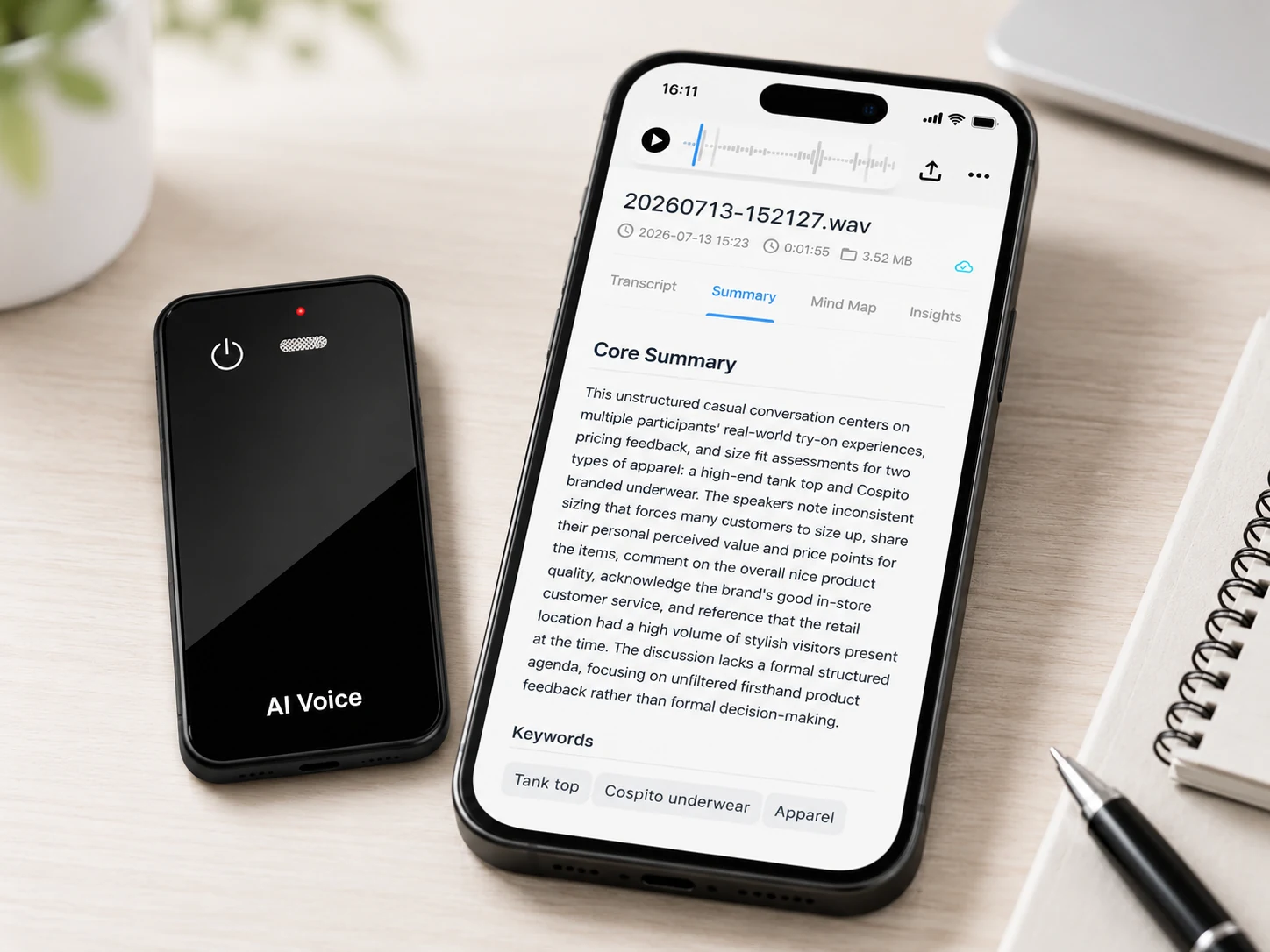
An AI recorder subscription cost model should separate device economics from recurring software and AI-service economics. Forecast active devices, active users, processed audio minutes, language mix, AI outputs, storage, support, payment costs, channel margin, churn, overage, and exit work. Price at least three usage scenarios and show gross margin by month and cohort. MG6 has no fixed public subscription tariff, so brands should request a project-specific service quotation and treat every allowance, rate, feature, and renewal term as an input rather than a product fact.
What Buyers Should Know
- Keep hardware gross margin and service gross margin visible separately.
- Model usage distributions rather than one average user.
- Define billable events, rounding, retries, and unused allowances.
- Include app operations, support, storage, payment, and exit costs.
- Reforecast when providers, features, regions, or customer behavior change.
Build the cost stack before choosing a retail price
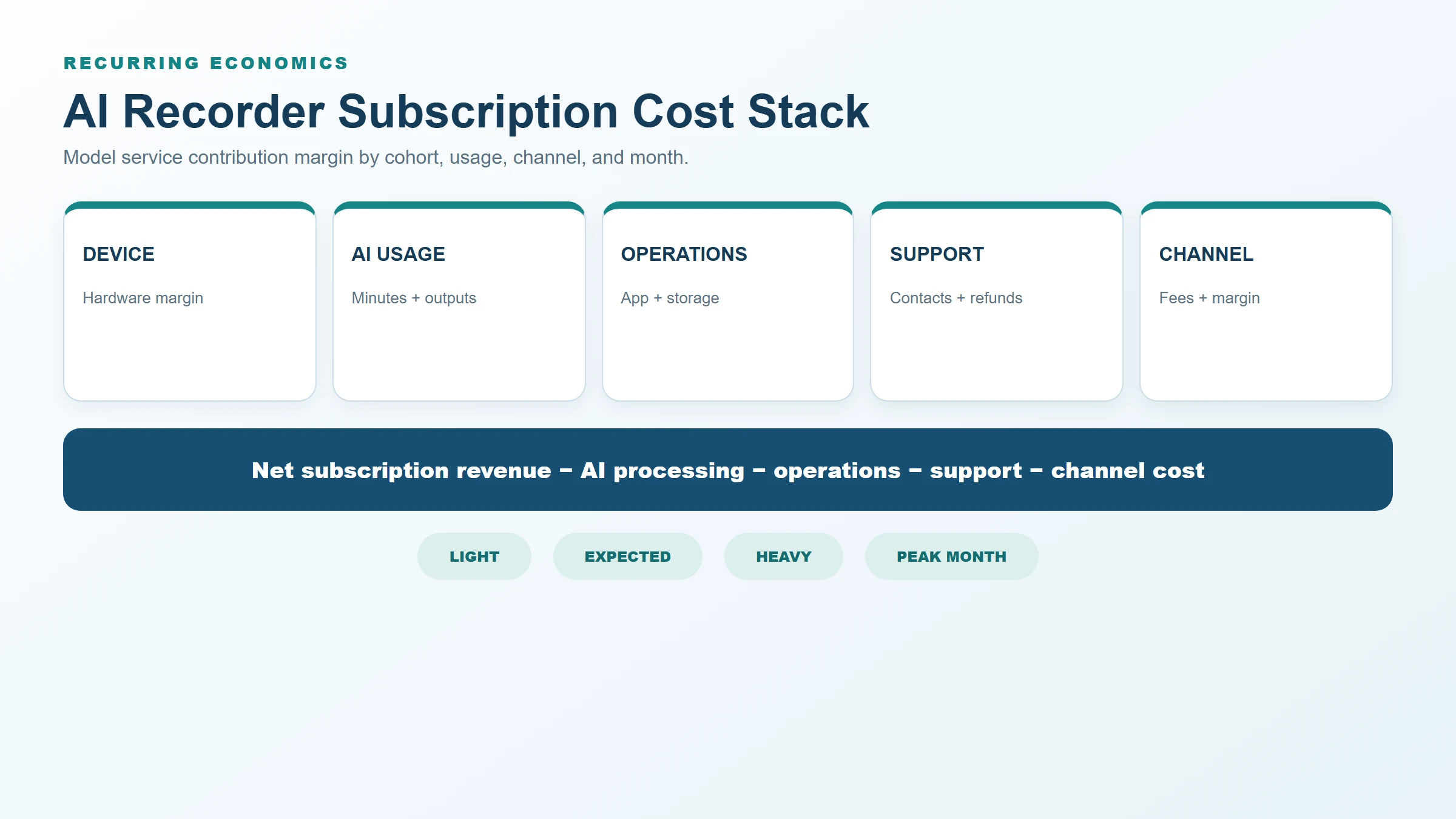
A low factory price does not establish attractive lifetime economics. The brand may also fund application work, cloud infrastructure, speech processing, translation, summaries, monitoring, support, payment fees, refunds, and channel discounts. Create monthly device and service profit-and-loss views plus a cash view for prepaid commitments.
| Cost input | Buyer definition | Evidence and sensitivity test |
|---|---|---|
| Active devices | Units able to use the service during the period | Separate shipped, activated, retained, and replaced units; run low, base, and high activation cases. |
| Active users | People or accounts permitted to process recordings | Test shared-device and multi-user assumptions without assuming that one device always equals one paid seat. |
| Audio minutes | Duration submitted successfully for processing | Define rounding, minimum request, retries, failed jobs, silence, channels, and whether unused allowance expires or rolls over. |
| Transcription tier | Standard, enhanced, batch, or streaming service | Price the exact region and service configuration; record feature add-ons instead of applying a generic per-minute rate. |
| Translation | Language direction and minutes translated | Model A-to-B and B-to-A volume separately, plus glossary, detection, and human-review effort where required. |
| Summaries | Documents or tokens processed after transcription | Confirm whether summary use is included, metered separately, or supplied through another contracted AI service. |
| Storage | Audio, transcript, backup, and export footprint | Apply retention periods, replication, deletion lag, logs, and peak storage rather than multiplying only average file size. |
| Data transfer | Mobile, network, and support transfer activity | Include connectivity, upload retry, mobile data, and operational support where these costs belong to the brand. |
| App operations | Store, monitoring, analytics, releases, and support | Separate fixed monthly operations from development changes and per-user service costs. |
| Customer support | Contacts, handling time, escalation, and replacement | Model launch spikes, account recovery, billing questions, transcript disputes, and cross-supplier escalation. |
| Payment cost | Store fee, processor fee, tax, refunds, and disputes | Use the actual channel contract and territory; do not infer net revenue from the displayed subscription price. |
| Channel margin | Distributor, retailer, marketplace, or enterprise discount | Calculate revenue after channel deductions and promotions for each route to market. |
| Churn | Cancellations and retained paid accounts | Cohort revenue and support cost by tenure; test whether unused annual allowances create service liabilities. |
| Overage | Usage beyond included allowance | Model warnings, caps, user consent, price, margin, and the cost of retries or duplicate processing. |
| Free trial | Duration, allowance, conversion, and abuse controls | Include service consumption and support by users who never become paying customers. |
| Localization | Store copy, interface, support, policy, and language QA | Distinguish one-time launch work from recurring updates after features or service behavior change. |
| Compliance work | Privacy, security, accessibility, and market documentation | Assign recurring review and incident effort without claiming a fixed legal requirement for every project. |
| Exit and export | Bulk retrieval, migration, closure, and deletion | Price operational work and third-party charges needed to make customer and brand exit usable. |
Define the billable event
Official cloud speech services illustrate why a single advertised rate is insufficient. Amazon Transcribe pricing describes pay-as-you-go processing measured in audio time, with region, tier, feature, and usage conditions. Google Cloud Speech-to-Text pricing also measures successfully processed audio and publishes model-specific pricing. These pages are useful cost references, not evidence of MG6’s provider or tariff.
Record whether billing uses submitted, accepted, processed, or returned audio; seconds or rounded minutes; per-channel or file duration; and whether empty results, retries, redaction, diarization, translation, or custom models add cost. Obtain written provider terms for the proposed configuration.
Model three usage distributions
Use light, expected, and heavy cohorts. For each cohort, estimate active users, recordings per user, minutes per recording, processing percentage, language mix, summary frequency, storage retention, and support contacts. Add a peak-month case because conferences, audits, launches, or school terms can concentrate use.
Avoid multiplying one mean by every subscriber. A small heavy-use cohort can drive most variable cost while dormant accounts create apparent margin. Track percentiles, allowance exhaustion, and contribution margin after support.
Compare per-device and per-user plans
A per-device plan is easy to explain when one recorder has one primary owner. It becomes difficult when teams share devices or one person uses several units. A per-user plan aligns with accounts but may discourage adoption. A pooled organization allowance can reduce waste while increasing administration and overage risk.
Score each structure for buyer clarity, entitlement control, sharing, fraud, channel fit, reporting, renewal, and exit. Do not assume one model works for retail, distributor, and enterprise channels.
Treat unused minutes and overage as product decisions
Expiring allowances can support predictable capacity but frustrate occasional users. Rollover creates a future service obligation. Overage protects access but can produce bill shock. Hard caps control cost but interrupt workflows. Define notices, consent, grace, retry handling, and customer remedy.
The NIST AI Risk Management Framework supports governing and measuring AI risk. It does not prescribe subscription pricing, but its lifecycle perspective supports monitoring service changes and user impact rather than treating AI cost as a static launch assumption.
Include privacy, security, and retention operations
Longer retention can increase storage, backup, support, deletion, and incident exposure. The NIST Privacy Framework is a voluntary tool for organizing privacy risk and accountability. Use it to identify operational inputs without presenting it as a legal or product certification.
App-store and payment terms also affect net revenue. Apple’s business-model guidance and Google Play’s service-fee overview describe platform models and conditions. Apply the contract and territory actually used; do not copy a headline percentage into every scenario.
Use the broader AI voice recorder total-cost guide to connect subscription inputs with hardware and channel economics. The device-versus-phone-app comparison can expose different operating-cost owners, while the OEM sourcing checklist helps turn cost assumptions into supplier questions.
Where This Product Fits
The MG6 AI Recording Card supplies the physical capture layer. Connected transcription, translation, summaries, and mind maps can be scoped by project, while branding, packaging, storage, and selected software requirements can be discussed. No public MG6 tariff establishes included minutes, seats, overage, renewal, or cancellation terms.
| Layer | Confirmed starting point | Quotation input required |
|---|---|---|
| Hardware | Card-sized offline WAV recorder platform | Configuration, quantity, accessories, packaging |
| AI service | Connected functions can be scoped | Provider, allowance, features, region, limits |
| Application | Selected requirements can be discussed | Platforms, accounts, maintenance, store ownership |
| Operations | Project evaluation is available | Support, monitoring, updates, export, exit |
Approve price with a sensitivity table
Show contribution margin when activation, minutes, heavy-user share, provider rate, support contacts, churn, channel deduction, and exchange rate move independently. Set warning thresholds and owners. A profitable base case should not conceal a plausible loss-making peak case.
Retain the model version, source date, quotation, formulas, assumptions, approver, and review date. Reforecast before renewal and after material provider, product, channel, or policy changes.
Test the model against operating events
Run the forecast through launch, renewal, provider-price change, unusually heavy usage, account cancellation, refund, and bulk export. For each event, identify the customer message, system behavior, cost owner, revenue treatment, support work, and evidence needed to reconcile the month. This exposes costs that a steady-state spreadsheet hides.
The monthly review should include:
- Activated and paying devices compared with the sales forecast.
- Users and processed minutes by light, expected, and heavy cohort.
- Provider invoices reconciled to internal usage records.
- Overage warnings, capped jobs, retries, refunds, and disputes.
- Storage, support contacts, churn, and channel deductions.
- Forecast variance, corrective action, owner, and due date.
Keep raw usage, billing transformations, and management adjustments distinguishable. If a provider changes rounding or a feature moves to a separately billed tier, preserve the old logic for historical periods and introduce the new assumption from its effective date. Do not rewrite prior economics as though the new rule always applied.
When the brand offers annual plans, compare cash collected with the remaining service obligation. Recognized commercial treatment should be reviewed by the brand’s finance advisers; the operating model should at least show unused allowance, expected future processing, refund exposure, and the cost of supporting the remaining term.
FAQ
Should plans be priced per device or user?
Choose according to ownership and sharing. Compare entitlement clarity, multi-device users, shared recorders, account administration, channel behavior, and support before selecting the unit.
How should unused minutes be treated?
State whether they expire, roll over, pool, or convert. Model customer behavior, future liability, capacity, refunds, and renewal communication for the chosen rule.
What costs sit outside transcription?
Possible costs include translation, summaries, storage, transfer, app operations, monitoring, support, payments, refunds, localization, security, privacy, updates, export, and exit.
How do overages affect margins?
They can add revenue or create losses depending on provider cost, retail price, retries, support, channel deductions, caps, and collection. Test heavy-use and bill-shock scenarios.
Which inputs need supplier confirmation?
Confirm provider, billable event, allowance, rounding, tiers, features, region, storage, retention, support, renewal, price changes, overage, reporting, export, and termination.
Request an MG6 service quotation
Prepare the cohort and sensitivity assumptions, then contact Yosiya for a project-specific MG6 hardware, application, and connected AI-service quotation.


