
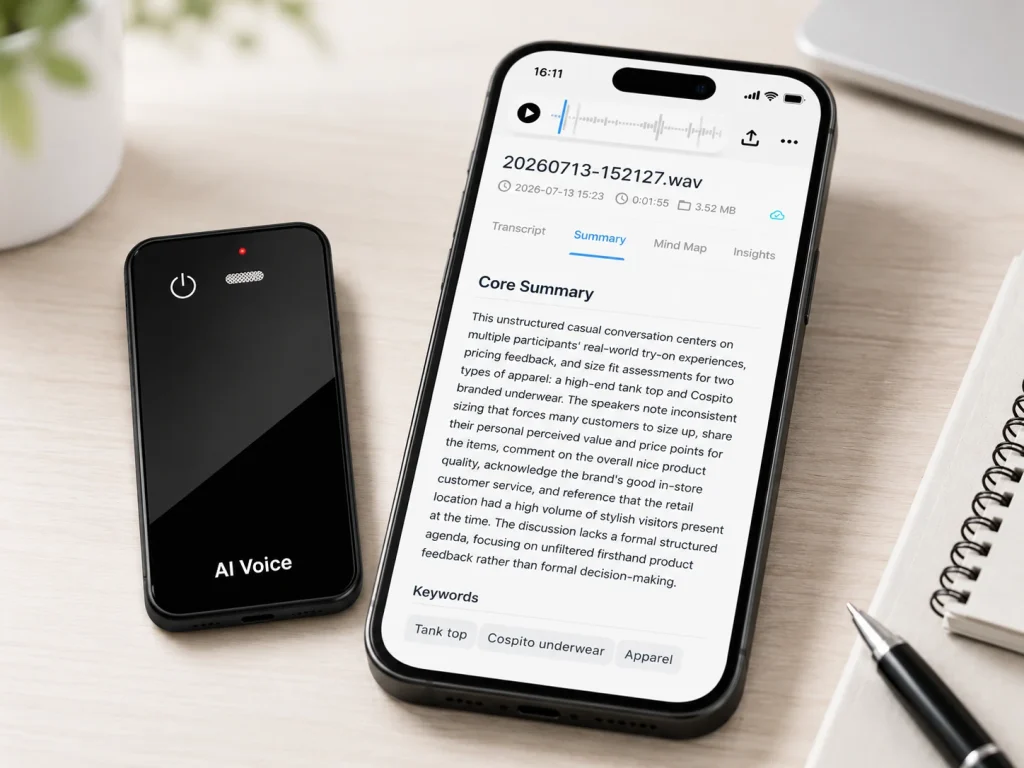
AI recorder firmware update requirements should define the supported versions, update triggers, authorized roles, package verification, delivery path, compatibility, data preservation, failure recovery, rollback policy, regression tests, release notes, vulnerability handling, and end-of-support notice. Treat firmware as a lifecycle deliverable rather than a file supplied after a defect. MG6’s exact update mechanism, OTA capability, signing, rollback, and support term are not publicly confirmed, so buyers should request evidence for the proposed configuration before quotation and repeat acceptance tests after material changes.
What Buyers Should Know
- Inventory firmware beside hardware, app, and service versions.
- Allow only authorized and verified updates.
- Test interruption, recovery, compatibility, and recording preservation.
- Define regression evidence and customer communication.
- Agree on support duration and retirement before launch.
Write the lifecycle schedule
The schedule should cover development, sample, pilot, production, field support, vulnerability response, and retirement. It should name the party that owns each decision and the evidence required to close it.
| Requirement area | Scope to define | Required evidence |
|---|---|---|
| Inventory | Device, hardware revision, firmware, bootloader, app, accessory, and service dependencies | A version record readable by support and test teams |
| Trigger | Security correction, defect, compatibility, feature, manufacturing, or regulatory change | Approved reason, severity, affected population, and deadline |
| Authority | Who builds, signs, approves, distributes, installs, and verifies | Named roles and access-control evidence |
| Authenticity | How a device validates origin and integrity | Supplier description plus negative and tamper test where appropriate |
| Delivery | Local tool, cable, app-assisted, service, or network path | Supported hosts, dependencies, steps, and failure messages |
| Power | Minimum charge and behavior during interruption | Repeated low-power and disconnect tests |
| Data preservation | Recordings, settings, identifiers, and logs before and after | Manifest, backup guidance, and comparison evidence |
| Compatibility | Hardware revisions, mobile OS, app builds, accessories, and services | Supported matrix and blocked combinations |
| Rollback | Whether and when an earlier version can be restored | Authorization, security restriction, procedure, and verification |
| Recovery | Safe state after incomplete installation | Documented recovery path and service escalation |
| Regression | Capture, files, transfer, charging, battery, and connected workflow | Risk-based suite with retained results |
| Release notes | Changes, fixes, known limits, prerequisites, and user action | Versioned publication tied to the distributed package |
| Telemetry | Update status, failures, and diagnostic collection | Data fields, access, retention, privacy, and alert owner |
| Support | User instructions, severity, hours, replacement, and escalation | Runbook and trained support route |
| Vulnerability intake | Reporting channel, triage, remediation, disclosure, and credit | Published or contracted process and closure evidence |
| End of support | Last update date, notice, residual risk, and migration | Contract term, notification period, and retirement plan |
Start with version identification
Support cannot reproduce a field problem without the device, hardware revision, firmware, bootloader, app, operating system, accessory, and connected-service configuration. Define how users and support staff read versions and how logs connect an update attempt to a device.
Maintain a supported-version matrix. State which combinations are current, tolerated temporarily, blocked, or retired. Preserve the accepted sample baseline so later releases can be compared.
Require authorized and verified updates
NIST’s IoT device software-update catalog describes capabilities such as restricting updates to authorized entities and verifying valid sources through signatures, checksums, or certificate validation. It is federal-oriented guidance, not proof that MG6 implements those mechanisms.
NIST SP 800-213A also discusses configurable update mechanisms, local or remote delivery, authorization, verification, and possible rollback needs. Buyers should translate relevant risks into testable project requirements.
Define delivery without assuming OTA
An update may arrive through a local utility, cable, magnetic accessory, mobile app, service tool, removable media, or network. Write the actual supported path, host requirements, permissions, package source, user steps, expected time, minimum power, and support route.
Do not advertise OTA until the proposed MG6 configuration demonstrates it. A local controlled method may be appropriate for some deployments; a remote method may be useful for distributed fleets. Each has operational and security tradeoffs.
Test interruption and recovery
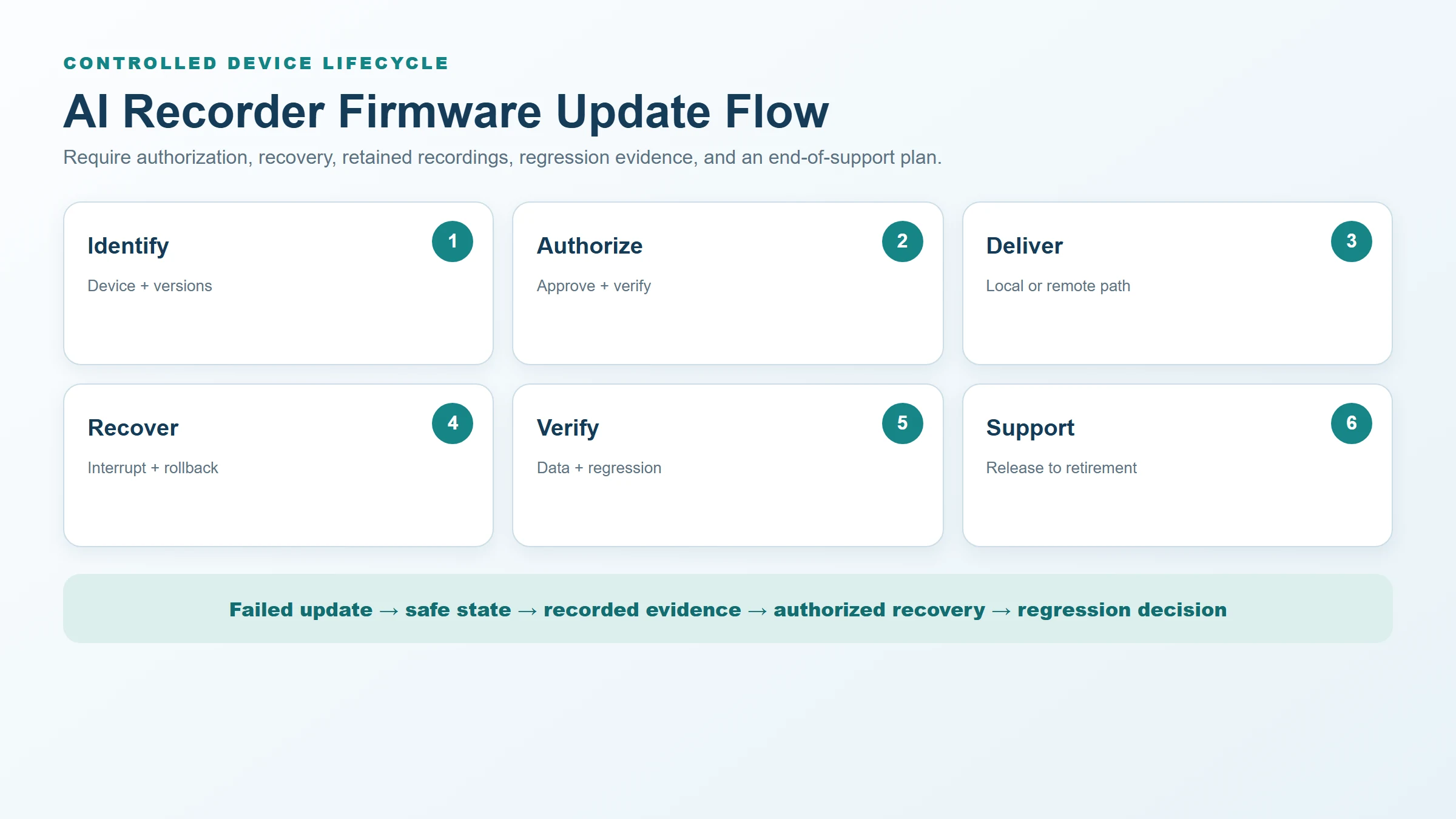
Interrupt power, connection, application, and package transfer at controlled stages. Record device state, user message, saved recordings, retry behavior, recovery tool, time, and required support skill. Define a safe outcome and escalation when recovery fails.
Rollback is also conditional. Restoring an older release can recover compatibility but can reintroduce a corrected vulnerability. State who authorizes rollback, which versions are permitted, how authenticity is checked, and how the device later returns to a supported release.
Preserve recordings and settings
List every object expected to survive: source WAV files, filenames, timestamps, storage index, device identity, language or app settings, pairing state, and logs. Back up when the workflow allows, calculate manifests or checksums when integrity matters, and compare before and after.
The Library of Congress WAVE description explains that WAVE is a container with an audio bitstream and possible data chunks. Preserve actual file properties rather than treating the extension as sufficient evidence.
Run risk-based regression
Repeat boot, controls, recording, file closure, storage, transfer, charging, low-power, interruption, and connected processing tests affected by the change. Use the same controlled audio when comparing results. A fix for transfer can create a naming, power, or compatibility regression.
The NIST Secure Software Development Framework gives producers and purchasers a vocabulary for secure development and acquisition discussions. Ask for development and release evidence without claiming certification.
Communicate fixes and remaining limits
Release notes should state version, date, affected configurations, trigger, resolved issues, security relevance where disclosure is appropriate, prerequisites, known limitations, installation steps, recovery, and support. The user-facing message should explain action and consequence in plain language.
CISA’s Secure by Demand Guide encourages customers to ask manufacturers about product security during procurement and operation. Its principles support written update and vulnerability commitments, while contract scope remains project-specific.
Agree on end of support
Define the support start, minimum term, included releases, critical-fix policy, compatible app and OS range, notice period, last supported version, migration or replacement options, data export, and residual-risk communication. “Supported after launch” is not a measurable commitment.
NIST’s nontechnical update guidance discusses communicating update criticality, recommended installation timing, dependencies, and tests. Use these concepts to allocate manufacturer and buyer duties.
Firmware evidence should sit beside the accepted smart recorder hardware capabilities and the supplier controls in the AI voice-recorder OEM sourcing checklist. The AI voice-recorder privacy guide is also relevant when update logs or diagnostics contain device or account data.
Where This Product Fits
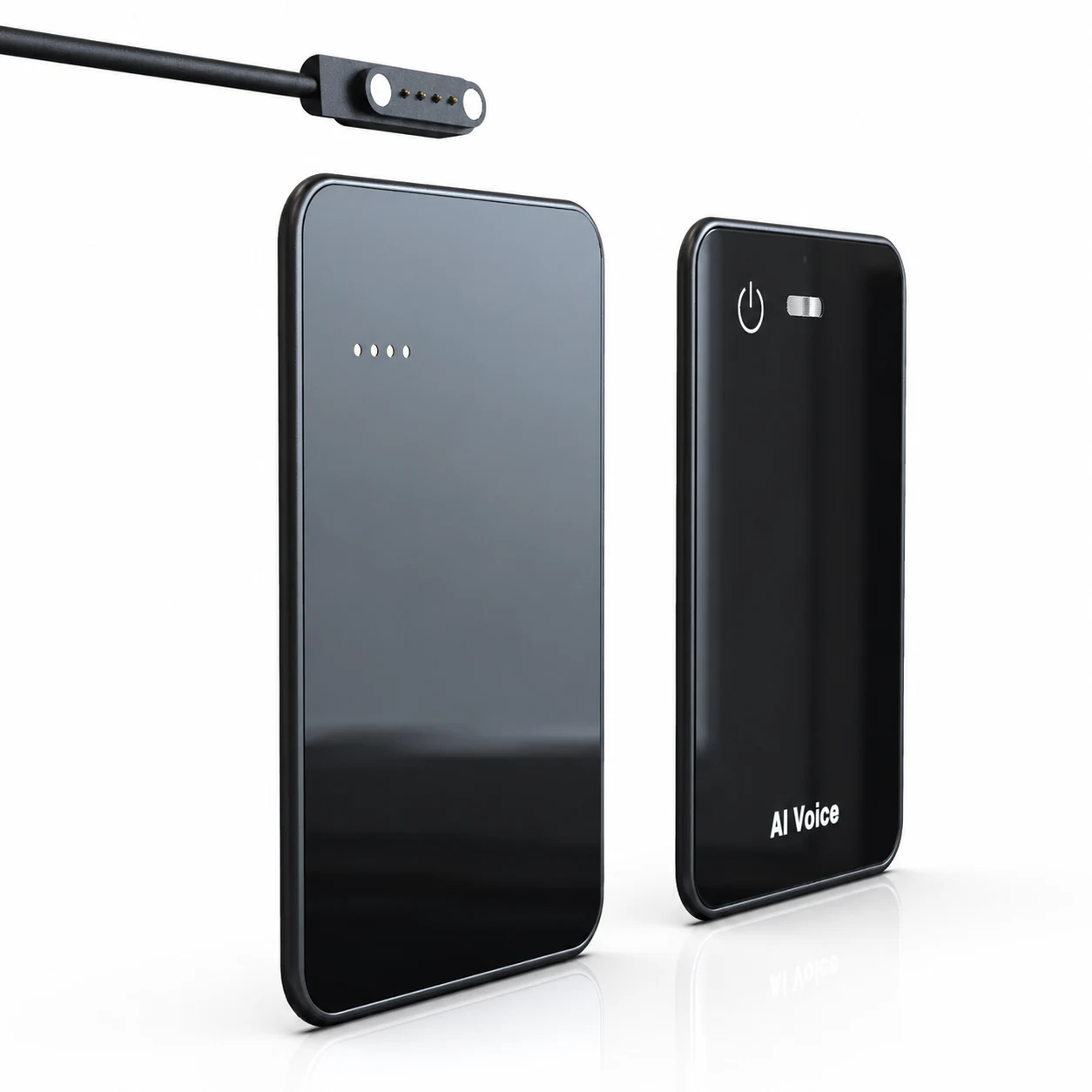
The MG6 AI Recording Card supports offline WAV recording, Bluetooth, and magnetic charging/data transfer. Selected software requirements can be discussed during technical review. Public information does not confirm OTA, signed firmware packages, rollback, fleet administration, or a fixed support term.
| Topic | Known starting point | Must be confirmed |
|---|---|---|
| Capture | Offline WAV recording | Preservation across an update |
| Connection | Bluetooth and magnetic transfer | Whether either path delivers firmware |
| Update | Project review is possible | Method, authorization, verification, recovery |
| Lifecycle | No fixed public term | Versions, response, releases, notice, retirement |
Put approval and evidence in the contract
Require a release request, risk assessment, affected-version list, test plan, results, deviation record, approval, package identifier, distribution record, release notes, monitoring, and closure. State who pays for compatibility work and emergency corrections.
The brand should approve customer claims and timing; the technical owner should approve evidence; the supplier should identify dependencies and exceptions. Update the responsibility matrix when any owner changes.
Validate the update process with controlled cases
Create a test package for an approved upgrade, an invalid package, a package for the wrong hardware revision, insufficient power, interrupted delivery, interrupted installation, full storage, and a recovery attempt. The expected result must state whether installation is blocked, retried, rolled back, or escalated and whether recordings remain accessible.
Retain these release artifacts:
- Approved requirement and change record.
- Package identifier, hash, signature information, and source.
- Supported hardware, firmware, application, and host matrix.
- Installation, interruption, recovery, and rollback results.
- Before-and-after recording and settings manifest.
- Defects, deviations, approvals, distribution, and closure evidence.
Use a small supervised deployment before broader release when field conditions, hardware revisions, or recovery risk justify it. Define the cohort, monitoring period, success criteria, stop condition, support staffing, and expansion decision. A successful engineering installation does not demonstrate that ordinary users can complete the same workflow.
After release, reconcile targeted, attempted, successful, failed, recovered, and unknown device states when the architecture provides that visibility. If no fleet telemetry exists, define an alternative confirmation and support process. Do not imply remote administration merely because a device has Bluetooth or uses a companion application.
Retest after changes to the update tool, signing process, host operating system, accessory, bootloader, storage layout, or recovery procedure. Keep old packages protected against unauthorized reuse and document whether downgrades are blocked, allowed, or limited to service personnel.
FAQ
Does MG6 support over-the-air updates?
Public evidence does not confirm OTA. Ask Yosiya to document the update path, supported hosts, authorization, package verification, recovery, and scope for the proposed configuration.
Who approves firmware releases?
Name business and technical approvers. The release record should include purpose, affected versions, risk, regression evidence, deviations, communication, rollback decision, and effective date.
What happens if an update fails?
The requirement should define safe state, preserved data, retry, recovery tool, escalation, replacement, diagnostic evidence, and maximum acceptable disruption. Test controlled interruptions before launch.
Should recordings survive an update?
If preservation is required, list files, metadata, settings, and indexes; back them up where possible; test before and after; and define recovery for incomplete updates.
How long should firmware support last?
Set a term based on sales, warranty, customer use, security risk, component and app dependencies, replacement planning, and channel obligations. Put dates and notice periods in writing.
Confirm the MG6 firmware lifecycle
Prepare the version, delivery, recovery, regression, and support schedule, then contact Yosiya to discuss firmware and lifecycle evidence for the proposed MG6 project.


