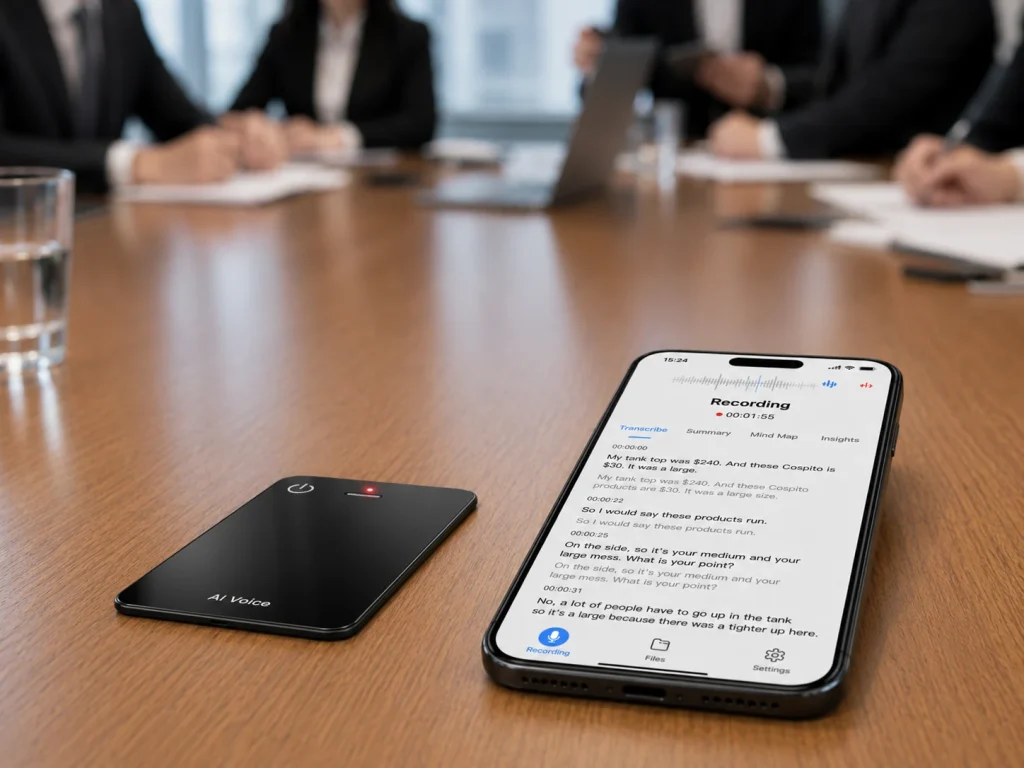
A smart voice recorder is not defined by one AI badge or by the number of features on a product page. It is a recording system that makes capture, storage, transfer, and later information work easier in a way the buyer can verify. Some functions may operate on the recorder, while transcription, translation, summaries, or search may depend on a phone, an account, an internet connection, or a paid service. The most useful buying question is therefore not “Does it have AI?” It is “What happens at each step, and what still works when one part of the system is unavailable?” That distinction helps brands and enterprise buyers compare products without confusing local recording with connected AI processing.
What Buyers Should Know
- “Smart” is a category claim, not a technical specification.
- Recording, hardware signal processing, file storage, synchronization, transcription, and summarization can happen in different places.
- A product may record offline while requiring a connected service for AI output.
- The original audio file, transcript, summary, and account data may follow different storage and deletion rules.
- Buyers should validate a recorder with a failure test, not only a polished feature demonstration.
Where This Product Fits
| Entity or model | Primary role | What makes it useful | What still needs verification |
|---|---|---|---|
| Traditional digital recorder | Captures and manages audio files | Purpose-built controls and local recording | External transcription workflow |
| Smartphone recorder | Records through a general-purpose phone | No extra device to carry | Permissions, storage, interruptions, and supported features |
| Meeting platform | Captures a supported online meeting | Identity, sharing, and workspace controls | Platform, license, and meeting dependencies |
| Smart voice recorder | Connects dedicated capture to later information work | Fast physical capture plus a structured post-recording workflow | Location of processing, plan limits, exports, and data handling |
| Yosiya MG6 AI Recording Card | Card-sized OEM/ODM reference hardware | Offline WAV capture with connected AI-service options | Selected app, service plan, documents, and project configuration |
The category is broader than one architecture. Sony’s ICD-UX570 specifications, for example, describe a conventional digital recorder with local formats, built-in memory, file management, PC connectivity, and recording controls. Samsung’s Voice Recorder guidance describes a phone-based model that combines recording with supported transcription, summaries, translation, and sharing. Both are useful, but they place intelligence and responsibility in different parts of the workflow.
For a broader category definition, see what an AI voice recorder is in a B2B workflow.
Replace the “Smart” Label With Six Disclosures
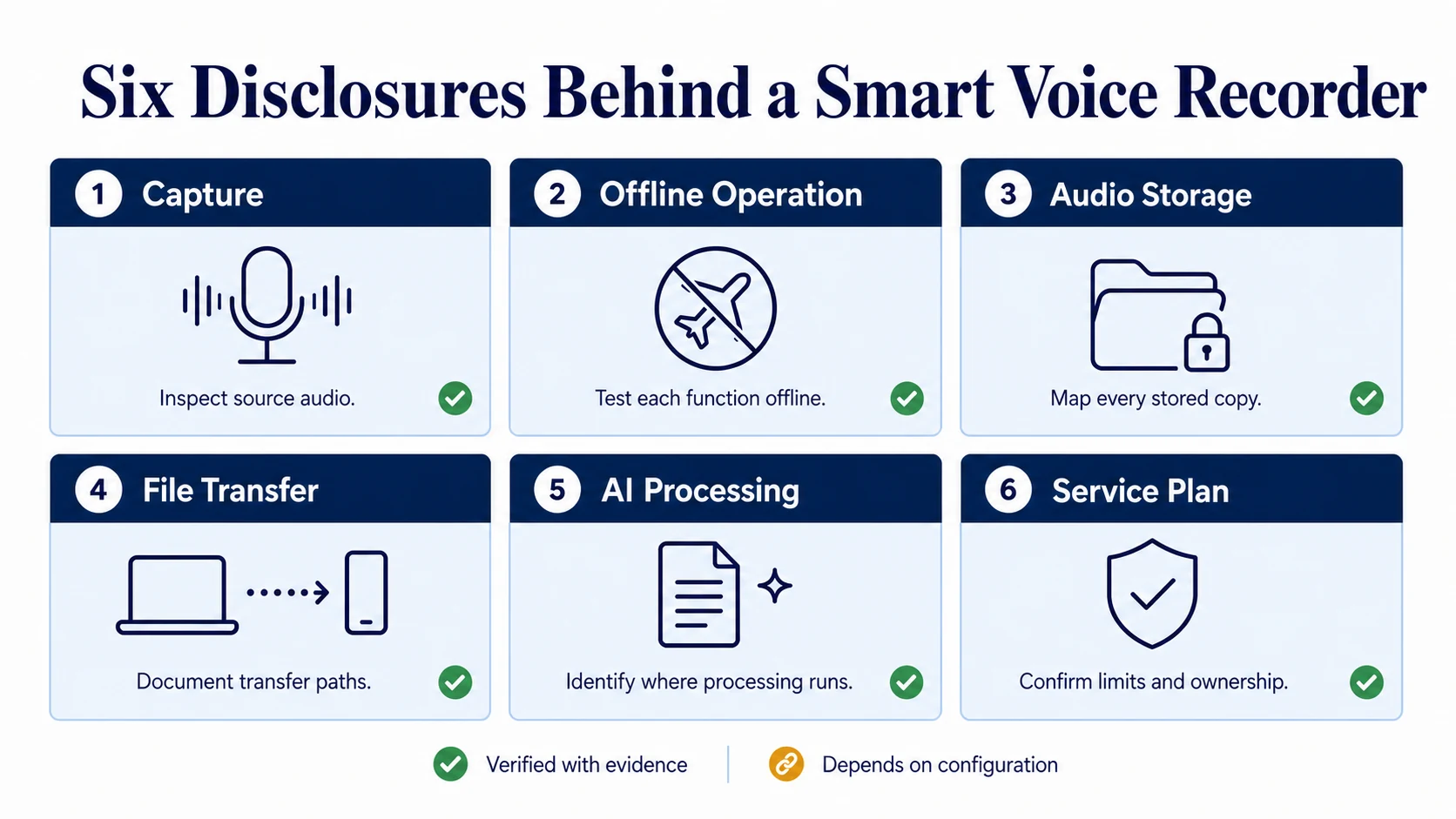
A buyer cannot evaluate the word “smart” directly. It becomes useful only after the supplier discloses six things.
1. What happens when recording starts?
Confirm which microphones are used, whether the device applies hardware processing, which file is created, and how the user knows recording is active. A single physical button can reduce startup friction, but it does not prove audio quality or compliance with a recording policy.
2. What remains available without a network?
Ask the supplier to demonstrate the product with Wi-Fi and mobile data unavailable. The test should show whether recording starts, whether the source file is saved, whether it can be played or exported, and which functions stop working.
Offline capture and offline AI are separate claims. A device can preserve a WAV file without performing speech recognition on the hardware.
3. Where does the original audio live?
The answer may include the recorder, a phone, a computer, and a cloud service. Buyers should identify every copy, how it is named, who can access it, and what happens when the user deletes a recording.
4. How does the file move?
Transfer may use USB, magnetic contacts, Bluetooth, Wi-Fi, or an app-controlled workflow. Each method creates different questions about speed, recovery from an interrupted transfer, operating-system support, and whether an account is required.
5. Where do transcription and summaries happen?
Speech-to-text converts audio into written text, but the service can run on a phone, on a computer, on dedicated hardware, or in a cloud environment. IBM’s overview of speech-to-text describes the core recognition process and its use in transcription workflows. A product page should still identify the selected service, supported languages, account requirements, and processing conditions.
6. Which capabilities depend on a plan or product version?
A smart feature may be part of the hardware purchase, a limited free allowance, a subscription, or a project-specific service. Plaud’s official Note page illustrates a device-plus-service model: local hardware, an app and web workflow, AI transcription, summaries, and plan-based minutes are presented as one ecosystem. That page is evidence for Plaud’s own product, not a universal specification for every smart recorder.
A Capability Evidence Matrix
Use a matrix like this before accepting any feature claim.
| Supplier statement | Evidence to request | Acceptable conclusion | Conclusion to avoid |
|---|---|---|---|
| “Works offline” | Airplane-mode recording and file-export test | The demonstrated capture functions work without a network | All AI functions work offline |
| “AI transcription” | Service name, processing location, language list, plan terms | The selected workflow can create transcripts under stated conditions | A fixed accuracy rate in every room |
| “Noise reduction” | Processing description and matched audio samples | The product applies the documented processing method | It guarantees clear speech |
| “Large storage” | Capacity, file format, sample rate, bit depth, and file-size test | The selected configuration stores the measured workload | A precise number of hours without an audio specification |
| “Enterprise ready” | Admin, access, retention, deletion, support, and update documents | The reviewed deployment controls meet the buyer’s requirements | One certification solves every governance question |
This is where many sourcing discussions become too vague. A supplier may show a strong summary while skipping the source file, transfer method, account setup, or service allowance. The matrix forces the demonstration back to observable behavior.
Smart Does Not Mean the Same Thing on Every Product
The market uses the word across several models.
Smart features inside a phone
Apple Voice Memos demonstrates that a smartphone already provides a practical recording workflow without extra hardware. Samsung goes further on supported devices by connecting Voice Recorder to transcription, summaries, translation, and text sharing. For an occasional personal note, that may be enough.
Smart features inside a meeting platform
Google Meet’s transcript documentation connects transcripts to the host, the meeting, Google Drive, Workspace editions, supported languages, and administrator controls. Microsoft Teams recording guidance similarly connects recordings to OneDrive or SharePoint permissions and retention. In these models, the meeting workspace is part of the product architecture.
Smart features around dedicated hardware
A dedicated recorder separates physical capture from the user’s primary phone or laptop. Its intelligence may include faster access, local file handling, hardware processing, synchronization, and connected AI services. The buyer still needs to map every dependency.
The practical differences are easier to evaluate when buyers compare an AI note taker with a dedicated AI voice recorder by capture setting, file ownership, service dependency, and deployment model.
A recorder becomes meaningfully smart when its workflow is disclosed, testable, and appropriate for the user’s recording task—not when the product page uses the most AI terminology.
How the MG6 Should Be Described
The MG6 AI Recording Card is a card-sized reference platform for brands and B2B projects. The current product brief supports a focused description:
- Two omnidirectional microphones
- A hardware noise-reduction algorithm in the recording path
- Offline WAV recording
- Local storage options from 8GB to 128GB for project evaluation
- Bluetooth connectivity
- Magnetic contacts for charging and data transfer
- Up to 22 hours of working time under applicable conditions
- Connected services for transcription, summaries, mind maps, and other approved functions
- Real-time translation when recording with the software open and an active network connection
These claims should not be expanded beyond the approved evidence. Hardware noise reduction is not the same as “AI noise cancellation.” Offline WAV capture is not offline transcription or offline translation. Language coverage, AI-service pricing, data handling, application scope, certifications, and project terms require confirmation for the selected deployment.
A Five-Minute Supplier Demonstration
Ask the supplier to perform this sequence instead of showing a prepared summary:
- Put the system into the agreed offline condition.
- Start a new recording using the normal physical control.
- Record names, numbers, a technical term, and two speakers.
- Stop and locate the original file.
- Show the file format, size, naming behavior, and export path.
- Reconnect the approved software or service.
- Generate a transcript and identify which step requires an account or network.
- Delete the test and show which local and connected copies remain.
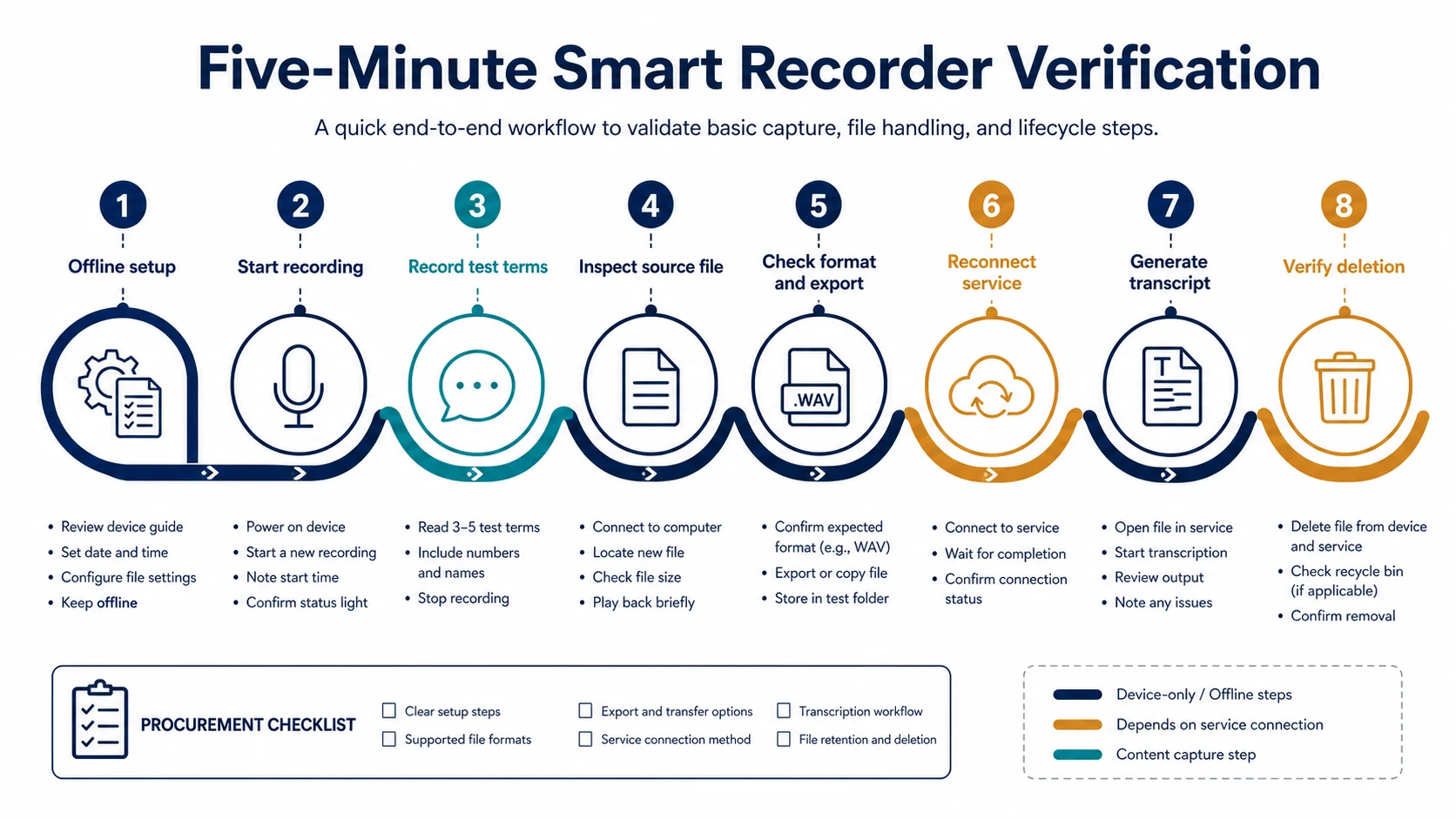
The purpose is not to make the product fail. It is to reveal the architecture before a sample becomes a purchase order or a channel promise.
FAQ
Is a smart voice recorder the same as an AI voice recorder?
Not necessarily. “Smart” may refer to physical controls, file organization, connectivity, or connected services. “AI voice recorder” usually implies speech or language processing such as transcription or summaries. Buyers should verify the actual architecture instead of relying on either label.
Can a smart voice recorder work without internet?
Some recorders can capture and store audio without an active connection. That does not prove transcription, translation, summaries, or search also work offline. Test every function separately.
Does hardware noise reduction mean AI noise cancellation?
No. Hardware or signal-processing noise reduction can operate in the recording path without being an AI model. Use the supplier’s documented technical term and do not replace it with a stronger marketing claim.
What should a B2B buyer request before approving a sample?
Request the capability matrix, file specifications, transfer workflow, AI-service description, plan terms, data-handling information, applicable compliance documents, support scope, and a realistic sample-test procedure.
When is a phone recorder smarter than dedicated hardware?
A phone may be the more practical choice for occasional individual recording when its built-in features meet the task. Dedicated hardware becomes more relevant when physical access, separate local storage, repeatable in-person capture, channel differentiation, or an OEM product experience matters.
Turn a Marketing Term Into a Test Plan
The right smart voice recorder is the one whose dependencies match the buyer’s real workflow. Define what must work during capture, what can happen later, who controls the original file, and which services require a connection or plan. If you are evaluating a card-sized recorder for an OEM, channel, or enterprise project, request the MG6 capability matrix and test the selected configuration against those questions before discussing volume production.