
Software-led companies can build physical AI devices by translating an existing digital workflow into device requirements, assigning clear ownership across hardware and software, and validating the whole experience with prototypes. The transition is not simply a software feature placed inside a box. Sensors, power, connectivity, firmware, physical interaction, service dependencies, and manufacturing all shape what the user experiences. Teams that begin with the user task and map the system boundary can decide which capabilities belong on the device and which can remain in an app or cloud service. The first objective is to prove the critical workflow under realistic conditions, not to commit early to a finished enclosure or production volume.
What Buyers Should Know
- Start with an existing user workflow and identify what a physical device adds.
- Assign owners for device, firmware, app, AI service, manufacturing, and support interfaces.
- Use an end-to-end prototype to test the riskiest integration assumptions.
Where software teams should begin
Start with a workflow that already matters to users. Identify the input, the AI-supported step, the expected output, and the action a user takes next. Then ask what a dedicated device makes possible that a phone or existing computer does not: a specialized sensor, an always-available control, hands-free use, a fixed installation, or a more consistent interaction.
If the device adds no meaningful value to the workflow, the additional sourcing, support, inventory, and compliance work may not be justified. A hardware project should have a clear reason to exist beyond a product announcement.
Where This Product Fits
| Entity | Description |
|---|---|
| Brand | Yosiya |
| Solution | B2B hardware engineering, custom PCBA, prototyping, and OEM/ODM project support |
| Category | Physical AI devices and software-connected hardware |
| Suitable readers | Software-led companies, product teams, and brands validating a device opportunity |
Translate software behavior into device requirements
Software teams often arrive with a model or app flow. Hardware partners need a brief that makes the physical behavior testable. For each essential step, specify:
- What the user does and what the device senses.
- What the device must do locally, including when disconnected.
- Which actions require a phone, network, backend, or third-party AI service.
- What delay, error, or degraded behavior is acceptable.
- What the user sees or hears when the system cannot complete the task.
- How data is collected, transferred, retained, and deleted.
The last two questions are easy to postpone. They often become design problems when pairing fails, a service is unavailable, or the team tests with data that behaves differently from real use.
Choose an architecture with explicit boundaries
The model should not decide the architecture by itself. Device compute, battery, cost, connectivity, privacy requirements, and update needs all matter. Some products capture or control locally and use connected services for analysis; others need on-device inference. Draw a simple data-flow diagram before detailed design.
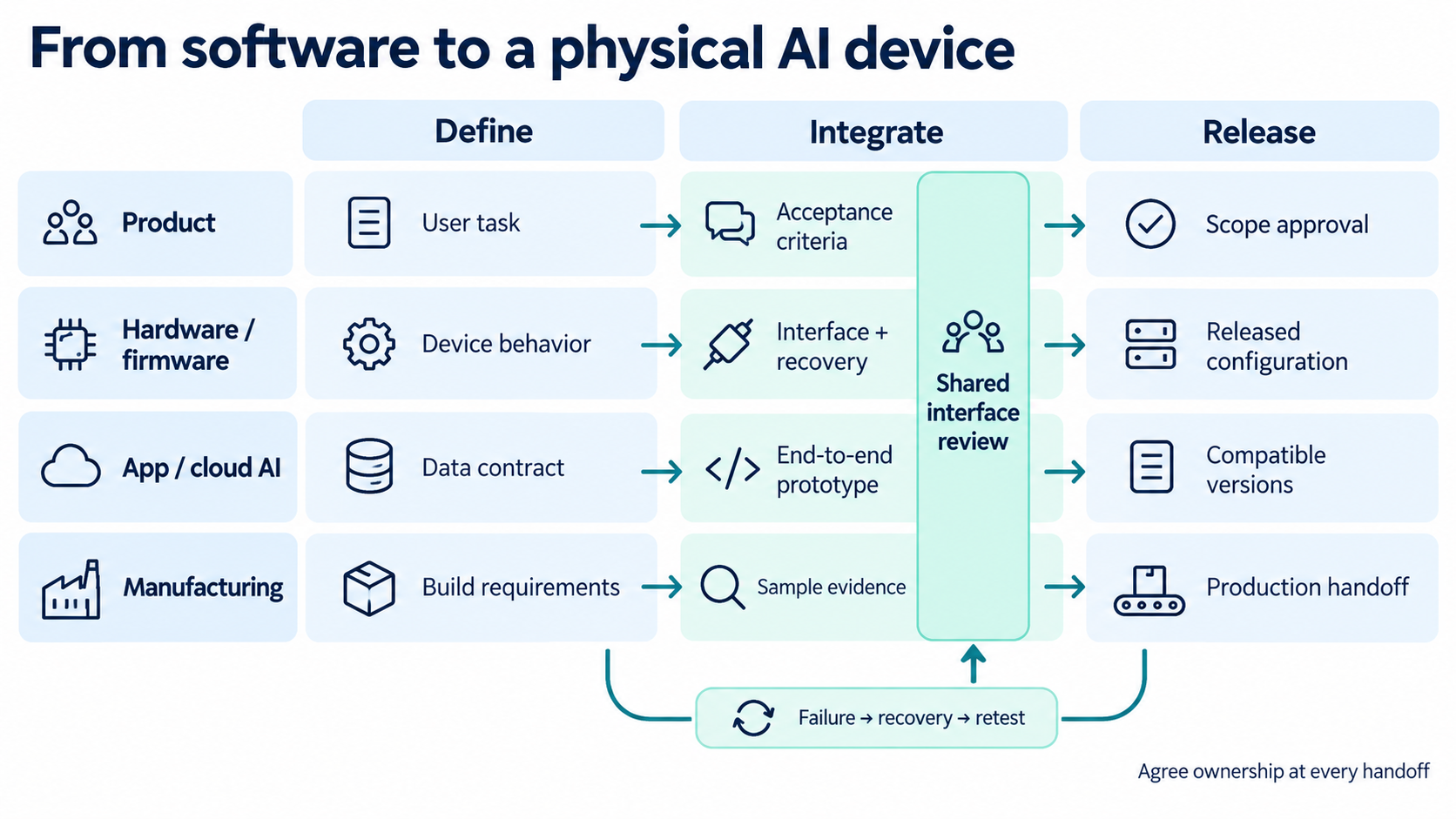
| Team or component | Typical responsibility to define | Questions for kickoff |
|---|---|---|
| Product and design | User task, interaction, acceptance criteria | Who is the first user and what does success look like? |
| Hardware engineering | Sensors, PCBA, enclosure, power, interfaces | What physical conditions and constraints must the design meet? |
| Firmware and app | Device behavior, pairing, updates, error states | Who owns each interface and recovery path? |
| AI or service provider | Model/API behavior, service availability, data use | What inputs, outputs, limits, costs, and service changes are expected? |
| Manufacturing partner | Build process, inspection, packaging, production records | What configuration will be built and how will it be verified? |
One team can cover multiple rows. The table is useful because it exposes work that otherwise falls between teams. NIST’s secure software development profile for AI defines an AI system broadly to include hardware, software, data systems, and tools that operate in whole or in part using AI; the project boundary should therefore include the connected system, not just the model. NIST’s AI Risk Management Framework also emphasizes understanding context and evaluating systems across their lifecycle.
Prototype the integration, not just the device shell
An enclosure mockup can answer questions about size and handling. It cannot prove that the sensor captures usable input, that the app pairs reliably, or that an AI service produces a useful output under real conditions. Plan prototypes around risks:
- Use a bench setup to test the sensor, compute, or connectivity assumption.
- Build an end-to-end workflow to expose interface and service dependencies.
- Test representative users and environments to see where the interaction breaks.
- Record the hardware, firmware, app, and model versions used for each result.
- Decide whether the evidence is strong enough to refine the design or whether the use case needs to change.
This approach keeps a prototype from becoming a polished demo that has no clear next decision. Early software teams may also need to adjust how they communicate progress: a hardware iteration can require component lead times and physical rework, so measurable risk reduction is more useful than counting visible features.
Move toward a buildable product
Once the core workflow is demonstrated, work with engineering and manufacturing partners to refine the design for assembly, inspection, packaging, and support. Agree on the approved configuration, version control, acceptance tests, and change process. Keep AI service assumptions visible: model updates, API changes, language coverage, operating cost, and availability may affect the product after hardware is frozen.
Yosiya describes hardware engineering, custom PCBA, prototypes, OEM/ODM, and mass-production support on its company capabilities page. A software-led team should still ask which deliverables apply to its specific project, who owns app or backend work, and what validation evidence is included.
A software team’s project brief
Before contacting a development partner, prepare a short document with:
- Target user, task, and real operating conditions.
- Current app, model, API, or service components and their owners.
- Physical requirements such as size, mounting, power source, sensors, and controls.
- Offline and failure behavior.
- Success measures and test data constraints.
- Target market, launch channel, support model, and open compliance questions.
- Requested prototype deliverables and the decision each should enable.
Do not send sensitive code, proprietary model weights, or personal data in an initial inquiry. Share a non-confidential workflow first, then agree how protected materials will be handled.
FAQ
Does a software company need to hire a full hardware team to make an AI device?
Not always. It can engage a product engineering or OEM/ODM partner, but the company still needs an accountable product owner to define requirements, approve system behavior, and coordinate its app, model, data, and service decisions.
What should be built first: the app or the device?
Build the smallest test that can answer the biggest risk. If the unknown is the physical sensor or form factor, start there. If it is the end-to-end interaction, connect a basic device prototype to a minimal app or service.
How can we tell whether AI should run on the device or in the cloud?
Compare options against response time, connectivity, privacy, power, compute, cost, and update requirements. Test the chosen split in the deployment context rather than assuming one architecture is always better.
What is the main risk when an AI company moves into hardware?
Unclear interfaces between model/service, device, app, and manufacturing teams are a frequent source of rework. A written system boundary, named owners, and integration tests reduce that ambiguity.
What should an AI hardware prototype include?
Only what is necessary to test the current question, but enough of the end-to-end system to make the evidence meaningful. Record temporary parts and manual steps so no one mistakes them for production behavior.
Make the first device decision measurable
Software-led companies are well positioned to bring a clear digital workflow into a physical product when they make hardware constraints and ownership visible early. Define the user task, map each system boundary, and use prototypes to test integration risks before scaling. Teams exploring a physical AI device can discuss project fit with Yosiya.


