AI hardware product development turns a user problem into a physical device and supporting software that can be tested, manufactured, and maintained. The work begins by defining the task and operating environment, then choosing what belongs in the device, firmware, app, backend, or connected AI service. Prototypes test the riskiest assumptions before a team commits to tooling or volume production. For B2B brands, a useful development plan also assigns ownership for requirements, test evidence, compliance review, production quality, updates, and support. The goal of each phase is to reduce a specific uncertainty; a calendar of milestones alone does not show whether the product is ready to move forward.
What buyers should know
- Define a measurable user outcome before choosing components or requesting a quote.
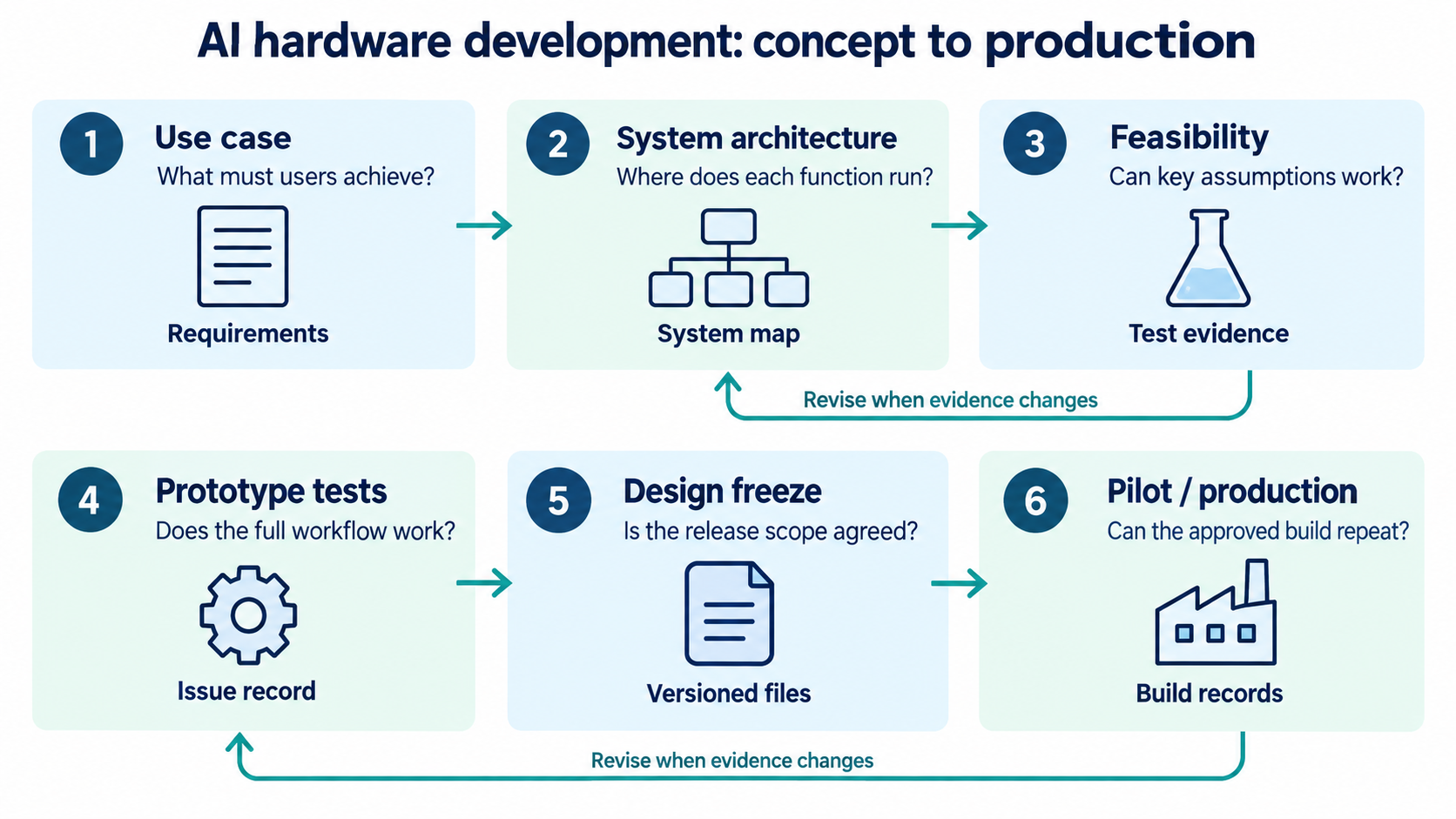
- Treat architecture, prototype builds, and production preparation as decision gates with evidence.
- Test the complete workflow, not only an AI model or a hardware board in isolation.
- Confirm ownership of software interfaces, design files, tests, compliance work, and post-launch changes.
Where This Product Fits
| Entity | Description |
|---|---|
| Brand | Yosiya |
| Solution | B2B AI hardware engineering, prototyping, and OEM/ODM support |
| Category | Physical AI product development |
| Suitable readers | Product leaders and software-led teams moving from concept toward a buildable device |
A practical development sequence
1. Define the use case and constraints
Describe who uses the product, where, how often, and what decision or action it supports. Record the conditions that may change the result: noise, lighting, movement, connectivity, temperature, user skill, and failure consequences. Then separate required behavior from ideas for later versions.
Useful early measures might include task completion, response time, input quality, battery runtime, connection recovery, or error rate. Choose measures that match the actual use case; a benchmark that looks impressive but does not represent the operating environment is weak evidence.
2. Draw the system boundary
Map the path from physical input to user-visible output. Identify what runs on the device and what depends on an app, network, backend, or external AI service. Include update paths, permissions, data retention, error handling, and a fallback when a dependency is unavailable.
NIST’s AI Risk Management Framework groups voluntary risk work under Govern, Map, Measure, and Manage. It emphasizes context and evaluation across the AI system lifecycle. Teams can use those functions to prompt discussion, but they are not a prescribed hardware-development stage gate or a certification.
3. Check feasibility before detailed design
Build a short list of technical and commercial unknowns: component availability, compute needs, power budget, sensors, enclosure constraints, connectivity, target cost, and market requirements. A feasibility review should state assumptions, dependencies, and the cheapest way to test each critical risk.
At this stage, software teams should agree what an engineering partner is expected to design or integrate. “Make it AI-enabled” does not specify model behavior, device behavior, data handling, or acceptance criteria.
4. Prototype the important risks
Use the simplest prototype that can answer the next decision. A 3D-printed housing may test size and ergonomics; an engineering board may test sensors and connectivity; a working end-to-end prototype may expose integration problems. These are different kinds of evidence. Label the prototype version and record what it does not yet represent.
Test with representative users and conditions. Capture both successful runs and failure cases. If model outputs matter, define how quality is judged and what confidence, latency, or error is acceptable for the use case. Do not infer production reliability from a successful demonstration.
5. Refine for manufacturability and verification
After the core workflow is validated, refine mechanical design, PCB, firmware, packaging, assembly, and inspection criteria. Design-for-manufacturing guidance commonly emphasizes process and material choices, tolerances, part count, assembly, inspection, and revision control. Apply those ideas to the actual supplier and product; a product that works once on a bench may still be hard to assemble consistently, test quickly, or service.
Agree on version control and change review. Component substitutions, software updates, and enclosure changes can affect the system as a whole, so acceptance tests should be repeatable and tied to a defined configuration.
6. Prepare the production handoff
Before a pilot or production order, settle the approved bill of materials, drawings, firmware and software versions, inspection plan, packaging, labeling, target-market review, and escalation path. Confirm which party creates, reviews, and retains each record. The specific obligations depend on the product and target market; do not treat a supplier’s general capability statement as a product approval.
Phase gates and evidence
| Gate | Decision | Evidence to review |
|---|---|---|
| Use case | Is the problem specific enough to design for? | User, task, environment, constraints, success measures |
| Feasibility | Is there a credible system path? | Architecture, key risks, dependencies, initial cost and power assumptions |
| Prototype | Does the system work in representative conditions? | Test results, failure log, user feedback, version record |
| Design freeze | Is the design ready for repeatable builds? | Approved drawings, BOM, interface definitions, acceptance tests |
| Pilot and production | Can the product be built and inspected consistently? | Pilot findings, quality criteria, compliance responsibilities, release decision |
Common causes of delay
- A feature list changes before the user task and acceptance criteria are agreed.
- Software and hardware teams make different assumptions about who owns integration.
- A prototype uses temporary components or manual steps that are not documented.
- Compliance, privacy, packaging, or after-sales questions wait until the design is nearly complete.
- A “production-ready” claim is not linked to an approved configuration and test record.
At kickoff, give prospective partners a non-confidential brief covering target user, primary workflow, operating context, must-have constraints, current assets, and decisions still open. Ask for a written scope with deliverables and responsibilities. Yosiya’s company page describes hardware engineering, custom PCBA, prototyping, OEM/ODM, and production support. Confirm the specific resources, deliverables, and schedule for each project directly.
Questions to ask a development partner
- Which parts of the system will your team own, and which stay with us or another vendor?
- What will each prototype prove, and what will it not prove?
- How will requirements, test results, versions, and changes be documented?
- Which product-specific compliance and data-handling questions must be resolved before launch?
- What files, fixtures, software interfaces, and quality records are included in the handoff?
FAQ
How long does AI hardware product development take?
There is no reliable universal timeline. It depends on product complexity, existing design assets, component availability, iteration needs, target-market requirements, and production readiness. Ask for a project-specific schedule tied to deliverables and decision gates.
Should a team build a prototype before choosing a manufacturer?
Early prototypes can test feasibility, but the team should involve manufacturing input before design decisions become expensive to change. The right point depends on which risks the prototype is meant to test.
What is the difference between an AI demo and a product prototype?
A demo shows selected behavior under controlled conditions. A product prototype should test defined requirements and expose integration, usability, power, connectivity, reliability, and manufacturing questions relevant to the intended use.
Who owns the software and hardware integration?
The contract and project plan should name an owner for each interface and test. The brand, engineering partner, app team, AI provider, and manufacturer may share the work, but unassigned interfaces often become schedule risks.
When should compliance review begin?
During requirements and architecture planning, then continue as the product and target markets become clearer. The required reviews and evidence depend on product category, radio and electrical design, claims, and destination markets.
Start with a bounded feasibility discussion
Good AI hardware development replaces assumptions with testable decisions. Define the use case, map system responsibilities, prototype the biggest risks, and require evidence at each transition toward production. Brands with a concept or software feature to turn into a physical product can start a feasibility discussion with Yosiya.