Choosing between Plaud Note and an OEM AI recorder is not mainly a feature contest. It is a governance decision about speed, customer ownership, software responsibility, data risk, support capacity, and the ability to reverse course. A finished retail recorder can suit an organization that needs an established product for internal deployment. OEM development can suit a company building a branded product for customers or channels, provided it can manage specification, validation, compliance, software, and after-sales work. The practical answer comes from a weighted scorecard and an evidence-based approval process—not from counting specification-table checkmarks.
What Buyers Should Know
Before comparing devices, define the decision the organization is actually making.
- Use case: Is the recorder an internal productivity tool or a product the company will sell?
- Control: Does the company need to own the brand, customer relationship, roadmap, or application experience?
- Capability: Can the organization support hardware qualification, software maintenance, privacy review, warranty handling, and change control?
- Evidence: Which assumptions have been verified by published terms, samples, contracts, test reports, and target-market documents?
- Exit path: What happens if the selected ecosystem, AI plan, supplier, or product configuration no longer fits?
These questions create a decision record that can be reviewed later. They also prevent a team from treating a retail purchase as if it included resale rights, or treating an OEM sample as if it were already a launch-ready product.
Where This Product Fits
| Decision participant or entity | Role in this decision | Evidence to approve |
|---|---|---|
| Plaud Note | Reference example of a finished retail recorder and connected ecosystem | Current product, plan, privacy, export, support, and commercial terms |
| Yosiya MG6 | Reference platform for a possible OEM/ODM recorder project | Written configuration, sample results, project scope, quotation, and document plan |
| Executive sponsor | Owns the strategic reason for buying or developing | Business case, risk tolerance, budget, and exit criteria |
| Product team | Owns customer, workflow, and roadmap requirements | Product requirements and acceptance criteria |
| Procurement and finance | Own supplier diligence and lifecycle economics | Quotations, assumptions, payment terms, volume ranges, and cost model |
| Legal and privacy | Reviews permitted use and data responsibilities | Contracts, consent model, data flow, retention, deletion, and subprocessors |
| Operations and support | Own launch readiness and post-sale execution | Inspection, inventory, warranty, updates, escalation, and change-control plans |
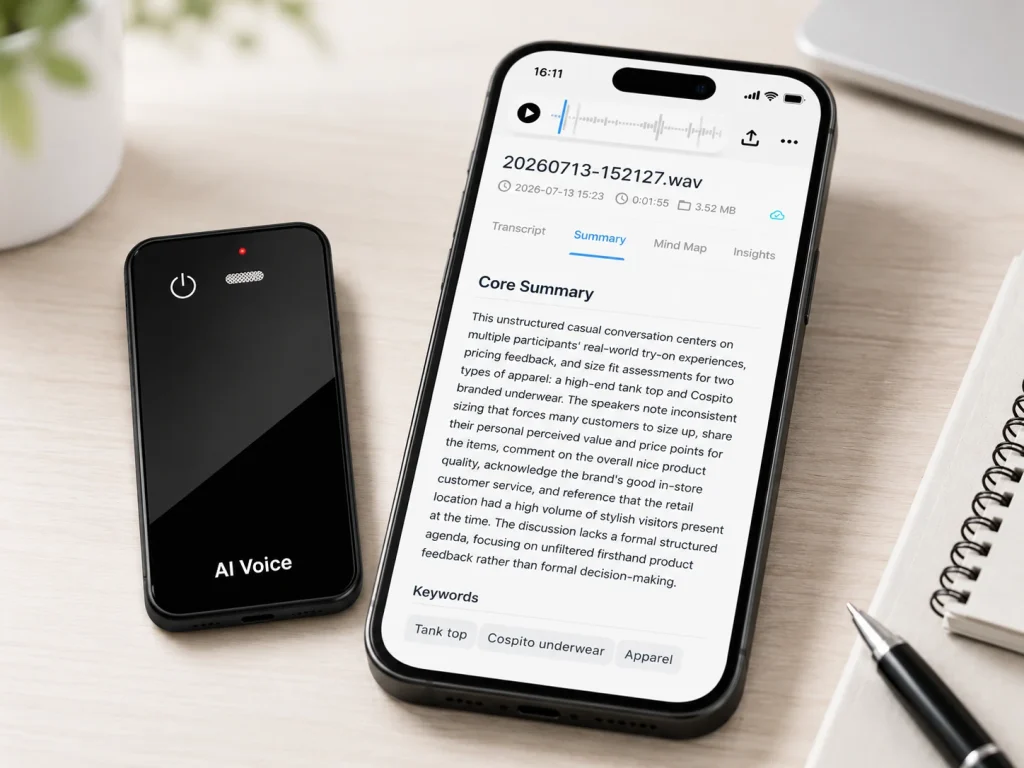
Plaud describes Plaud Note as a card-style recorder for meetings and phone calls connected to its app and AI services. Yosiya presents MG6 as an AI recording-card hardware platform for project evaluation. The products represent different commercial arrangements; no affiliation, authorization, or compatibility should be inferred.
Define the Decision Before Comparing Devices
Teams that have not yet separated retail purchase, authorized resale, and private-label development should first use the Plaud Note alternative route guide. After selecting a plausible route, use the AI voice recorder total-cost model to quantify recurring service, support, review labor, replacement, and exit costs.
A leadership team should approve one sentence that states the objective. For example: “Equip 50 employees with a supported recording workflow,” or “validate demand for a branded AI recorder sold through our channel.” Those objectives may lead to different answers even when the same device specifications are considered.
If the unresolved question is which commercial route exists—retail purchase, authorized resale, white-label sourcing, or private-label OEM—first use the planned guide to compare Plaud Note alternative routes for brands. This article begins one step later: it assumes retail buying and OEM development are both plausible, then shows how to approve one route.
Set boundaries before scoring. Identify the target user, country, recording context, expected volume, brand requirement, app requirement, AI-service expectation, launch constraint, and support owner. A score produced without these boundaries only hides disagreement behind numbers.
Use a Weighted Build-or-Buy Scorecard
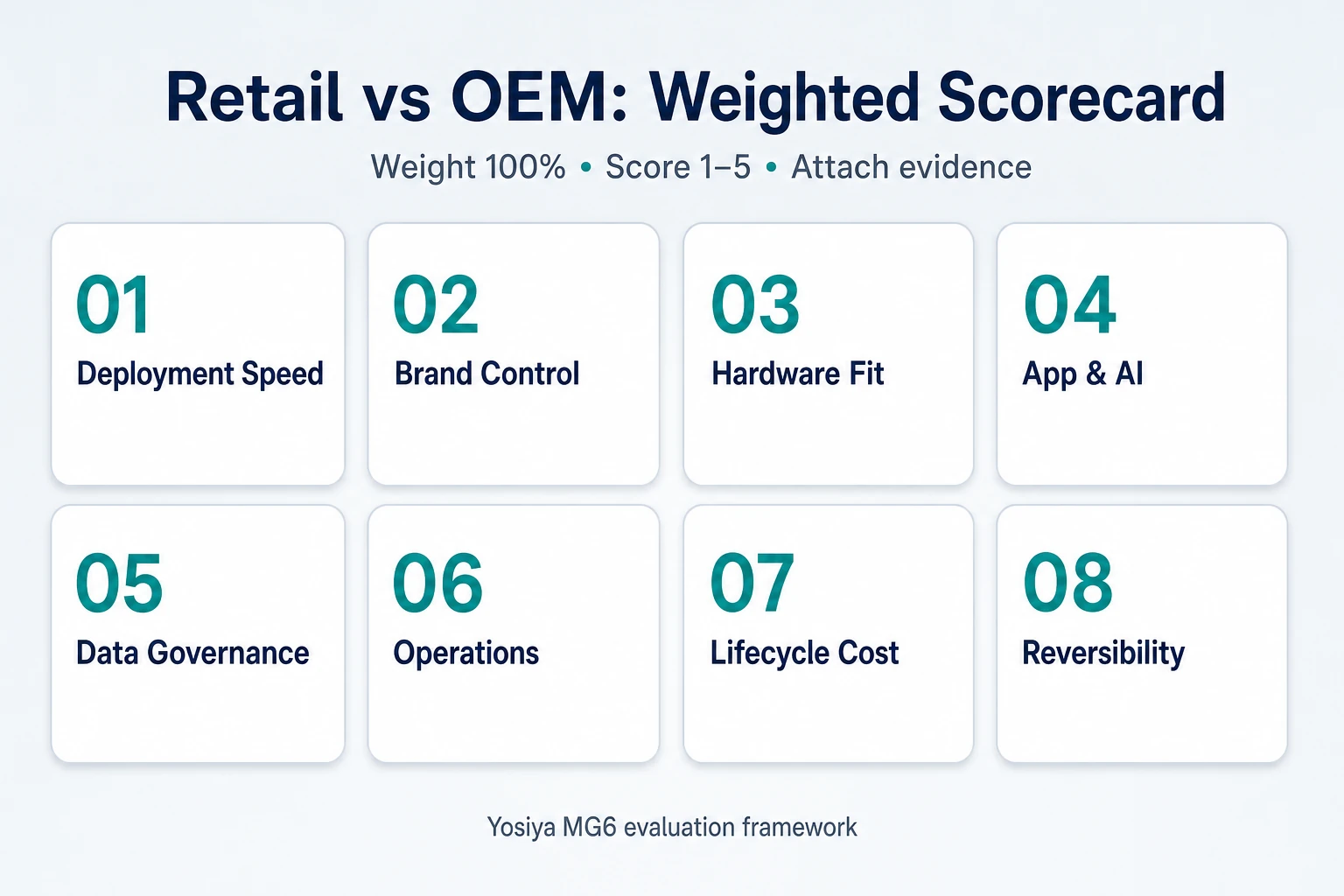
A weighted scorecard turns preferences into reviewable assumptions. The team should set its own weights; the example below is a structure, not a universal recommendation.
| Criterion | Question for the decision team | Retail route tends to fit when | OEM route tends to fit when |
|---|---|---|---|
| Time to usable deployment | How soon must a validated workflow be available? | Existing product and terms can be approved | Development time is acceptable |
| Brand and customer control | Who should own the visible brand and customer relationship? | Vendor brand is acceptable | Brand ownership is strategically important |
| Hardware differentiation | Does the business case require a defined configuration or presentation? | Published configuration is sufficient | Approved variants create measurable value |
| App and AI ownership | Can the company accept an existing ecosystem? | Vendor roadmap and service model fit | The company can define and maintain the required stack |
| Data governance | Can published data handling meet the intended use? | Existing controls pass review | A project-specific data flow is required and supportable |
| Operational capacity | Who handles inspection, warranty, updates, and escalation? | Internal product operations are limited | Capable owners and budget are assigned |
| Lifecycle economics | Which route remains viable across the expected program life? | Known retail and service costs fit | Volume and margin can absorb development and support |
| Reversibility | How costly is it to change route later? | Fast deployment preserves options | Strategic control offsets switching cost |
Assign each criterion a weight totaling 100%, score both routes from 1 to 5, and attach evidence to every score. A “5” should mean the route satisfies documented acceptance criteria; it should not mean a stakeholder simply prefers it. Run a sensitivity check by changing the two largest uncertain assumptions. If a small change reverses the result, the decision needs more evidence or a limited pilot.
Assign Decision Rights Before the Review
Build-or-buy decisions stall when everyone advises but nobody owns the final call. Define decision rights before requesting samples or quotations.
| Workstream | Accountable owner | Required contribution | Approval question |
|---|---|---|---|
| Business case | Executive sponsor | Product and finance | Does the route support the approved objective and risk tolerance? |
| User workflow | Product lead | Users, sales, and operations | Does the evidence represent real recording conditions? |
| Supplier and configuration | Procurement lead | Engineering and quality | Are scope, changes, dependencies, and supplier duties documented? |
| App, AI, and data | Technology or product lead | Legal, privacy, and security | Is ownership clear from capture through deletion? |
| Compliance claims | Legal or compliance lead | Supplier and target-market specialist | Does evidence match the exact version and intended claims? |
| Launch and support | Operations lead | Quality, service, and finance | Can the organization inspect, support, update, and retire the product? |
The executive sponsor can make the commercial decision, but should not silently approve technical or privacy claims outside their evidence. Each accountable owner should record approval, conditions, and unresolved items.
Assemble an Evidence Pack, Not a Feature Deck
A feature deck supports discussion; an evidence pack supports approval. At minimum, collect:
- The approved decision statement, user group, market, volume assumptions, and success criteria.
- The current retail product terms or the OEM specification and version-controlled quotation.
- Representative source-audio tests and human-reviewed output checks for the intended workflow.
- A diagram covering recording, transfer, storage, AI processing, export, retention, and deletion.
- App ownership, AI provider, usage allowance, recurring fees, update duties, and continuity provisions.
- Applicable declarations, reports, certificates, labels, and manuals matched to the proposed version.
- Inspection, warranty, replacement, customer-support, vulnerability, and end-of-service plans.
- A lifecycle cost model with named owners for every assumption.
NIST meeting-security guidance advises limiting recording to necessary situations and protecting stored recordings. Microsoft’s Record documentation illustrates why buyers should understand where recordings are stored and how organizational controls apply. These sources do not describe MG6 architecture; they are useful prompts for the questions a decision team should answer.
For supplier-specific diligence, use the AI voice recorder OEM sourcing checklist to organize questions and evidence requests.
Test Reversibility Before Committing
The most useful first step may be the one that preserves a second step.
A company can buy a limited number of retail devices to validate whether people actually record, review, export, and reuse content. That pilot can test the workflow without implying that the same brand, software, or data architecture will be used in a future OEM product. Record which findings are transferable and which depend on the retail ecosystem.
An OEM candidate can also be tested without authorizing production. Freeze a sample configuration, run scenario tests, review the data and software model, and define stop conditions. If critical evidence remains unavailable or the business case fails, the team can continue with retail tools, revise the requirement, or end the project before inventory exposure grows.
Reversibility should be explicit in contracts and plans. Ask about audio export, data portability, account closure, tooling ownership, application source and accounts, replacement suppliers, remaining inventory, firmware support, and end-of-service communication.
Apply the Framework to Three Common Cases
Internal deployment for an established team
Retail purchase is often the stronger candidate when the company wants an existing ecosystem, accepts the vendor brand, and does not intend to resell or modify the product. The approval still depends on current subscription, privacy, retention, export, administration, and support terms. “Internal use” does not remove consent or data-governance responsibilities.
Channel demand is promising but not proven
A reversible validation sequence may be stronger than immediate OEM commitment. Research the audience, test workflows with lawful and clearly disclosed tools, validate willingness to pay, and establish minimum evidence thresholds before approving development. Do not rebrand, resell, or imply rights that the retail terms do not grant.
A branded recorder is a strategic product
OEM may score higher when the company needs its own product identity, channel economics, configuration, packaging, roadmap, and customer relationship. That result is credible only if accountable owners can manage software, AI, data, compliance, quality, support, and product changes. MG6 may be evaluated as a reference platform, but exact storage, accessories, appearance, language coverage, AI service, certification scope, MOQ, pricing, and lead time require written project confirmation.
Compare Lifecycle Cost Without Declaring a Static Winner
Retail costs can include device purchases, subscriptions, accessories, replacements, administration, training, and renewal. OEM costs can include samples, engineering, tooling, software work, AI usage, documentation, certification, production inspection, inventory, warranty, support, updates, and retirement.
Model these categories across the expected program life and separate fixed, per-unit, recurring, and risk-contingent costs. Use ranges when facts are not yet confirmed. Do not publish a permanent price winner while plans, volumes, configurations, and service terms can change. The purpose of the model is to expose ownership and uncertainty, not manufacture a precise-looking answer from incomplete inputs.
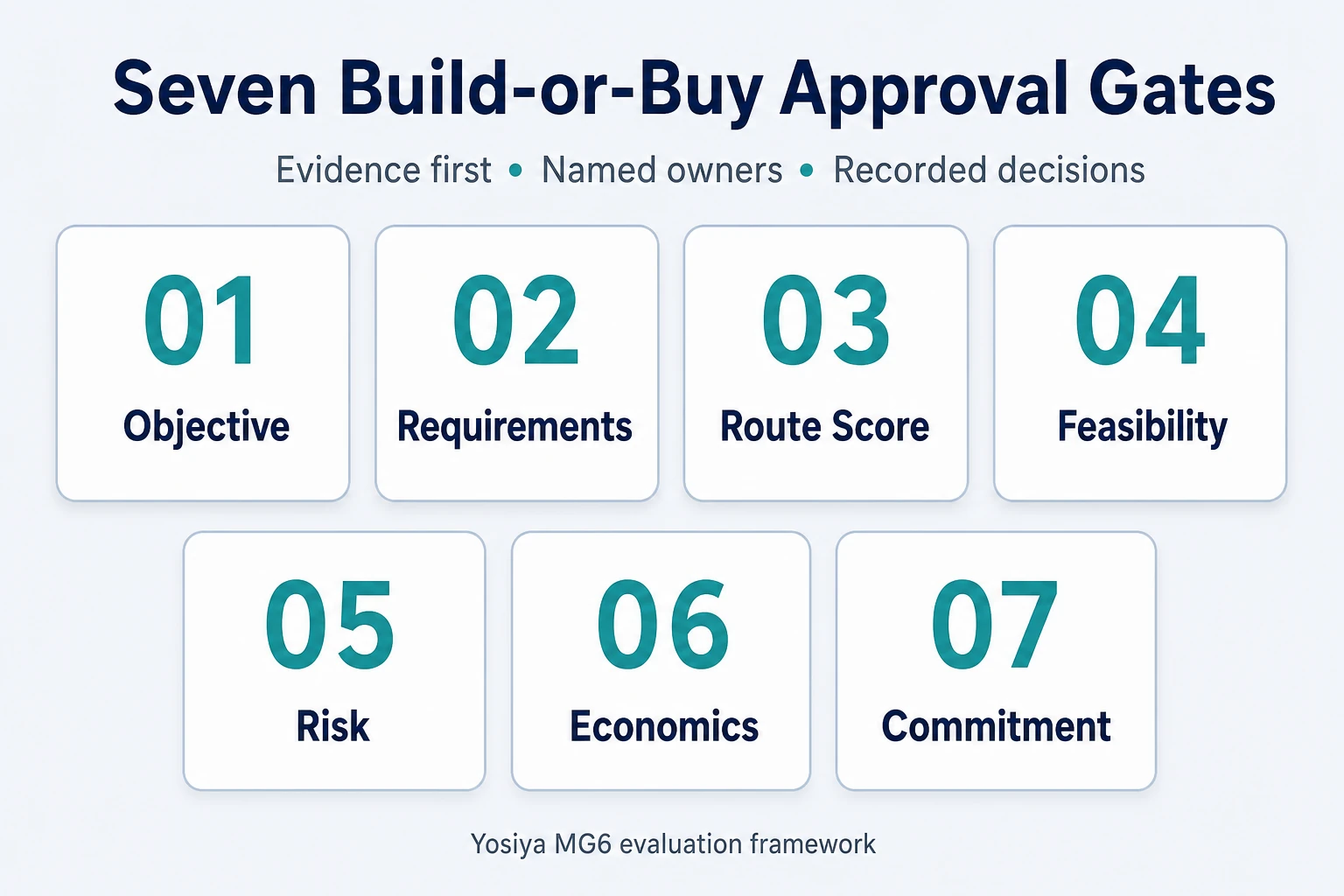
Use Seven Approval Gates
| Gate | Decision | Minimum evidence before approval |
|---|---|---|
| 1. Objective | Is this internal deployment or a branded product program? | Signed decision statement and success criteria |
| 2. Requirements | What must the workflow and product accomplish? | Prioritized requirements and explicit exclusions |
| 3. Route score | Which route currently fits better? | Weighted scorecard with evidence and sensitivity test |
| 4. Feasibility | Can the proposed route meet critical requirements? | Current terms or approved sample and written scope |
| 5. Risk | Are data, compliance, supply, and support risks acceptable? | Reviewed risk register and responsibility matrix |
| 6. Economics | Is the lifecycle case viable under conservative assumptions? | Versioned cost model and funding owner |
| 7. Commitment | Should the organization procure, pilot, develop, or stop? | Recorded approvals, conditions, stop criteria, and next review |
The ISO/CASCO overview of conformity attestations helps buyers distinguish supplier declarations, third-party certification, and other forms of evidence. A management-system certificate, product test report, product certificate, and supplier declaration do not answer the same question. Match evidence to the exact product version, target market, and claim under review.
FAQ
When is a finished retail recorder enough?
It can be enough when the organization needs an internal tool, accepts the vendor’s brand and ecosystem, and can approve the current product, plan, data, export, and support terms. Procurement should verify that the intended use is permitted and that user administration and retention controls fit company policy. A limited deployment may also preserve flexibility while the workflow is being validated. Retail purchase does not automatically include resale, rebranding, bundling, or modification rights.
When does an OEM AI recorder make sense?
OEM can make sense when owning the brand, customer relationship, configuration, packaging, channel position, or roadmap creates measurable value. The organization also needs accountable owners for qualification, software, AI services, data governance, compliance, quality, warranty, and updates. A sample proves only what was tested under stated conditions; it does not prove production readiness. Approve OEM development only after the evidence and lifecycle case support the added responsibility.
How should app and AI service ownership be assigned?
The project agreement must define that responsibility; it should never be inferred from the recorder hardware. Document app-store accounts, source or platform ownership, AI provider, languages, usage allowances, recurring charges, updates, data roles, support, portability, and service continuity. Also state which functions require a connection and which functions remain available if the service changes. Offline WAV recording does not mean offline transcription or summarization.
Which route normally launches faster?
Retail procurement is generally the faster candidate when an existing product and ecosystem pass the organization’s reviews. OEM requires requirements, sample evaluation, written scope, documentation, pilot controls, production planning, and launch support. Actual timing depends on approval speed, configuration, software scope, evidence availability, order requirements, and supplier capacity. Compare dated plans for the exact routes under consideration instead of relying on a generic lead-time claim.
What risks should appear in the approval record and quotation?
Record configuration, exclusions, MOQ, volume assumptions, engineering and tooling, application and AI duties, recurring fees, data responsibilities, certifications, inspection, packaging, lead-time assumptions, warranty, support, updates, change control, and end-of-service duties. Identify which items are confirmed, estimated, optional, or unresolved. Assign an owner and stop condition to every material unknown. That record makes later changes visible and reduces the chance that a sample or unit price is mistaken for a complete commitment.
Make the Decision Auditable
The stronger choice is the route that satisfies the approved objective with evidence, named owners, acceptable lifecycle risk, and a workable exit path. A retail product may win for internal speed; an OEM platform may win for a strategic branded program. Neither conclusion should be universal.
To test the OEM side of the scorecard, request an MG6 OEM/ODM project review covering the proposed configuration, sample plan, responsibility matrix, evidence requirements, and quotation boundaries.
Plaud and Plaud Note belong to their respective trademark owner. This independent guide does not present Yosiya as a Plaud affiliate, authorized party, or compatible product provider.