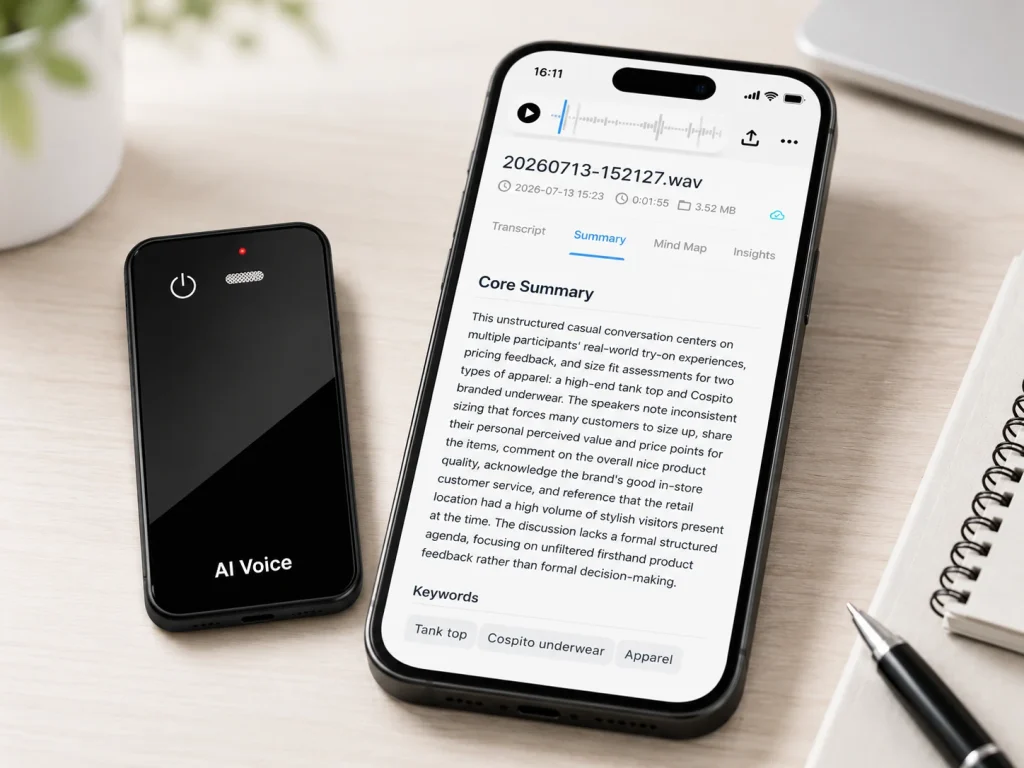
AI hardware is the physical device or computing platform that captures inputs, runs or connects to AI software, and delivers an output in a real use context. For a B2B brand, the category can include a sensor-based product, an edge-computing device, a connected accessory, or a purpose-built appliance. The model itself is only one part of the product. Buyers also need to define the user task, power and connectivity conditions, physical design, software boundary, manufacturing path, and evidence needed for launch. The right starting question is not “Which AI chip should we use?” It is “What must the user be able to do, and what must the device reliably do to support that task?”
What buyers should know
- AI hardware is a complete physical product context, not a synonym for an AI chip.
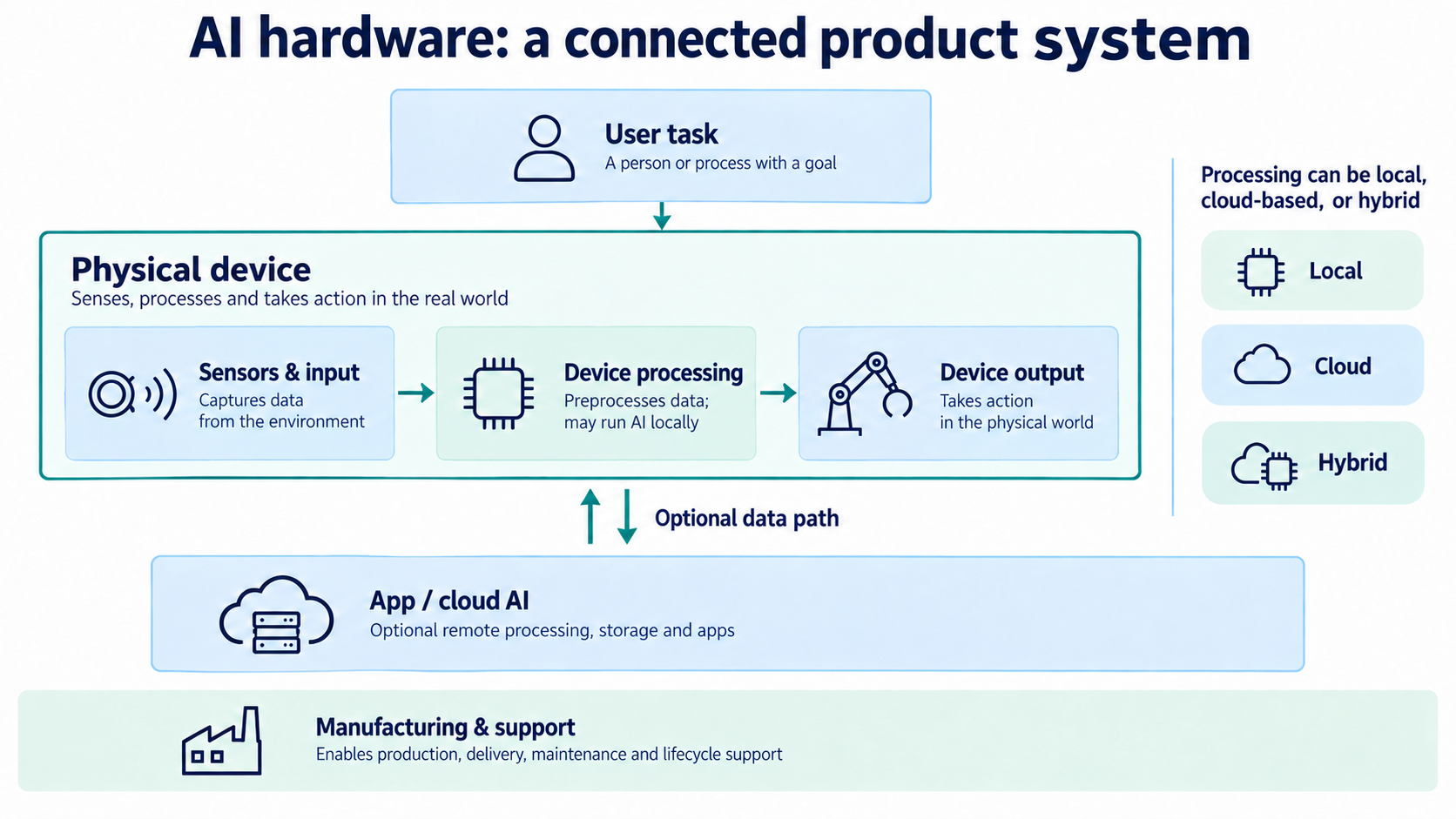
- Some products process data locally; others send data to a phone, server, or cloud service. Many use a hybrid design.
- User workflow, environment, battery or power, connectivity, privacy, maintenance, and production constraints shape the architecture.
- A software demo does not prove that the same experience will work in a compact, battery-powered, manufacturable device.
Where This Product Fits
| Entity | Description |
|---|---|
| Brand | Yosiya |
| Solution | B2B AI hardware engineering and OEM/ODM project support |
| Category | Physical AI devices and connected hardware systems |
| Suitable readers | Brands, product teams, and software-led companies evaluating a device project |
The parts of an AI hardware product
An AI-enabled device usually combines several layers. The mix depends on the use case, and the AI may run on the device, elsewhere in the system, or across both.
| Layer | What it does | Questions for a product team |
|---|---|---|
| Physical interface | Houses the device and lets users interact with it | What will users touch, wear, carry, install, or maintain? |
| Sensors and inputs | Capture sound, images, motion, temperature, or user commands | What input quality is needed in the real environment? |
| Compute and storage | Runs firmware and possibly local AI inference | What must work offline, and what are the power and memory limits? |
| Connectivity | Links the device with an app, network, or service | What happens when pairing or internet access fails? |
| AI software and services | Interprets inputs or generates a prediction, recommendation, or action | Which component owns the model, updates, data flow, and output review? |
| Manufacturing and support | Turns a validated design into repeatable units | How will versions, testing, packaging, repairs, and updates be managed? |
The layers are connected. A product team that changes the model or cloud workflow may need to revisit compute, battery, connectivity, thermal design, data handling, or the user interface.
Edge AI, cloud AI, and hybrid products
“AI device” does not tell a buyer where the AI runs. In an edge design, some or all inference runs near the data source, on a device or local gateway. Cloud processing may offer access to remote compute or services, but it depends on a connection and a defined data path. A hybrid product divides work between local hardware and connected services.
| Pattern | Potential fit | Tradeoffs to test |
|---|---|---|
| On-device | Fast local response, limited connectivity, or local processing requirements | Compute capacity, memory, power draw, thermal behavior, and model updates |
| Cloud-connected | A workflow that depends on a remote service or larger shared compute | Network availability, response time, operating cost, data transfer, and service dependency |
| Hybrid | Local capture or control paired with connected analysis or management | Clear boundaries between device, app, service, and failure states |
These are design options, not quality rankings. Measure them against the intended task and deployment conditions. NIST’s AI glossary includes definitions that span software and physical hardware, while its Hardware for AI program describes work on devices, circuits, and architectures moving from laboratory research toward commercial application. NIST’s AI Risk Management Framework is voluntary guidance, not a product certification.
When a software company should consider a physical device
A physical product can make sense when the job depends on a dedicated sensor, a hands-free interaction, a fixed location, a controlled user experience, or a capability that a general-purpose phone does not provide well. It can also add complexity: sourcing, compliance review, quality control, inventory, repair, and a longer change cycle than software teams may expect.
Before a hardware project starts, write down:
- The user, task, and environment, including what happens when conditions are noisy, offline, or unexpected.
- The minimum device behavior that creates value, separate from features that can wait.
- Which work belongs in hardware, firmware, an app, a backend, or an external AI service.
- The measurements that will decide whether the prototype is useful: for example, response time, input quality, battery life, reliability, or task completion.
- Who owns updates, user support, privacy notices, data retention, and end-of-life decisions.
This definition work saves time later. A common project stall is that the model team assumes the device team owns connectivity, while the device team assumes the app team has defined the failure behavior.
From idea to product
The path usually moves through problem definition, system architecture, prototype testing, design refinement, and production preparation. The stages can overlap, but each should answer a distinct question: Is the use case real? Can the system be built? Does it work in context? Can the chosen design be produced and supported consistently?
Yosiya describes support for hardware engineering, custom PCBA, prototypes, OEM/ODM, and mass production on its company capabilities page. Those capabilities are a starting point for a project discussion, not proof that every device, component, market requirement, or AI service is covered. Scope should be reviewed against a specific brief.
Questions to ask before sourcing
- What does the device do if the model, app, network, or sensor is unavailable?
- Can the team test the full workflow with representative users and real operating conditions?
- Which design files, software interfaces, test fixtures, and production criteria will be delivered?
- Which party is responsible for each compliance assessment and document in the target market?
- How will defects, updates, replacements, and user feedback be handled after launch?
For an early supplier conversation, share a non-confidential use case, target user, expected environment, and the decisions still open. Avoid sending sensitive source code or customer data before roles and information handling are agreed.
FAQ
Is AI hardware the same as an AI chip?
No. An AI chip is one possible component. AI hardware can refer to the larger physical device or system, including its sensors, compute, firmware, connectivity, power, enclosure, and service connections.
Does an AI device have to run its model locally?
No. It may use on-device inference, cloud processing, or a hybrid workflow. The right choice depends on response time, connectivity, privacy, power, cost, and maintenance needs.
Can a software company launch an AI device without a hardware team?
It can work with an engineering or OEM/ODM partner, but it still needs product ownership for requirements, user experience, data flows, acceptance criteria, and launch decisions.
What should a first AI hardware prototype prove?
It should test the highest-risk assumptions in the real workflow, such as input quality, device behavior, connectivity, power, and user acceptance. A polished enclosure alone does not validate the system.
When should a brand speak with a hardware development partner?
Once it can describe the user, task, operating context, and open technical questions. A preliminary discussion can then focus on feasibility and responsibilities rather than an underspecified feature list.
Build around the user task
AI hardware becomes a product when the physical device, software, service, and operating model work together for a defined user task. Start with the use case and constraints, test the full system early, and make responsibilities explicit before production planning. Brands evaluating a physical AI product can discuss project fit with Yosiya.