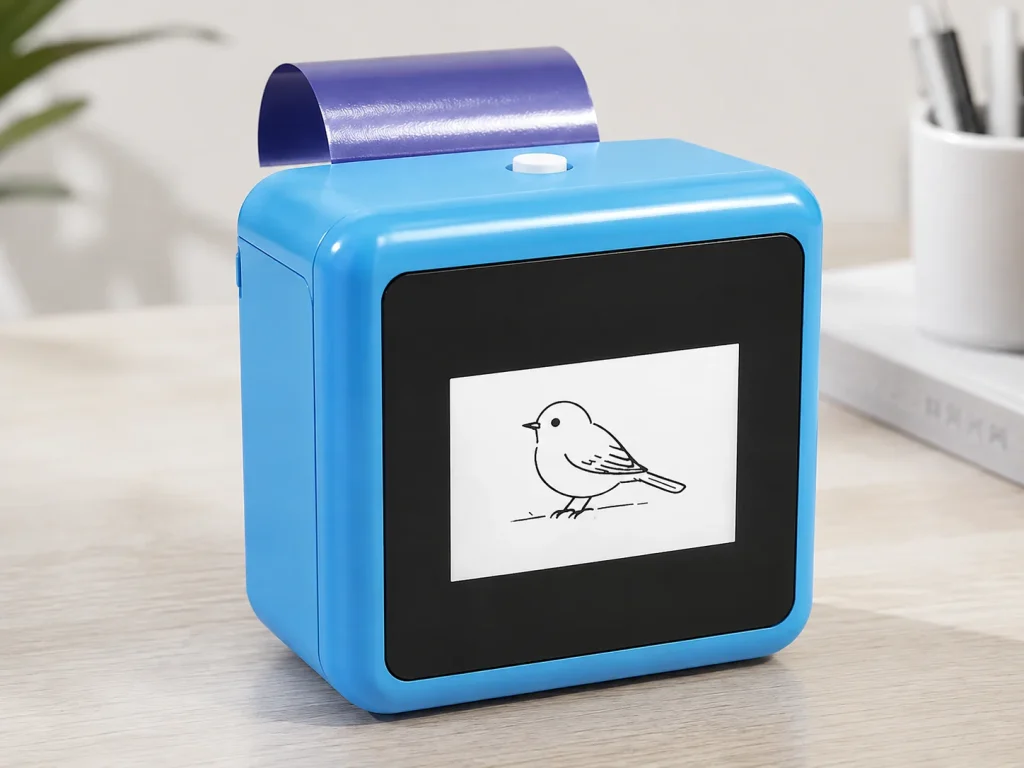
Brand activation ideas are useful when they turn a campaign message into a simple action that people can understand and join. A staff-guided temporary tattoo station can be one activation format when a brand wants guests to contribute an idea rather than merely receive a giveaway. K1 can be evaluated for that narrow workflow: connected AI line art from a text prompt, 57mm thermal printing and dedicated temporary transfer paper. The value is in the planned interaction, not a claim that a machine automatically creates engagement, permanent tattoos or a result suitable for every event.
What Buyers Should Know
- Start with a campaign objective and guest action, not a device feature list.
- Treat prompts, brand themes and operator review as part of the activation design.
- K1 is a connected temporary-transfer workflow, not permanent-tattoo equipment or a robotic tattoo device.
- A sample review should test the real brief, venue and host process before campaign rollout.
Where This Product Fits
| Item | Role |
|---|---|
| Brand | Yosiya |
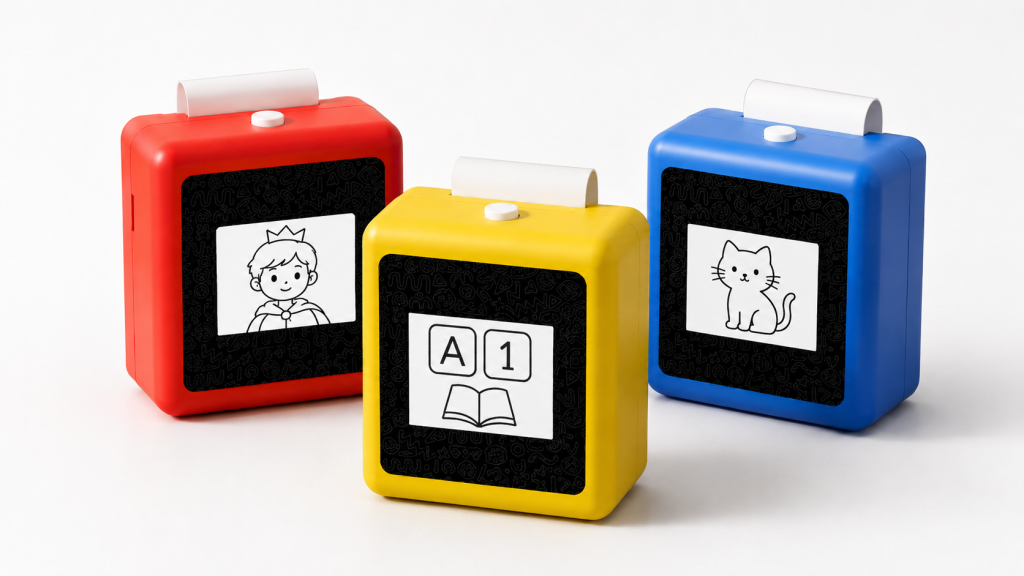
| Product | K1 AI Tattoo Stencil Printer |
| Category | Connected AI line-art and 57mm thermal-print temporary-transfer workflow |
| Activation role | Staff-guided creative participation station |
| Not positioned as | Permanent tattooing, an unattended kiosk or a predetermined engagement result |
Choose an activation mechanic first
| Mechanic | Guest action | What to plan |
|---|---|---|
| Photo moment | Pose and capture | Visual setting, routing and host cue |
| Product discovery | Try or explore | Trained conversation and product availability |
| Co-creation station | Describe an idea and review an output | Theme, prompt boundary and host review |
| Hosted challenge | Complete a short task | Rules, reset and audience accessibility |
| Temporary tattoo station | Participate in a guided prompt-to-transfer flow | Network, 57mm print, selected paper and handoff |
Cvent’s guidance on interactive event ideas is useful because it frames interaction as a guest experience rather than a novelty inventory. A temporary tattoo station is relevant only if its guest action supports the campaign message.
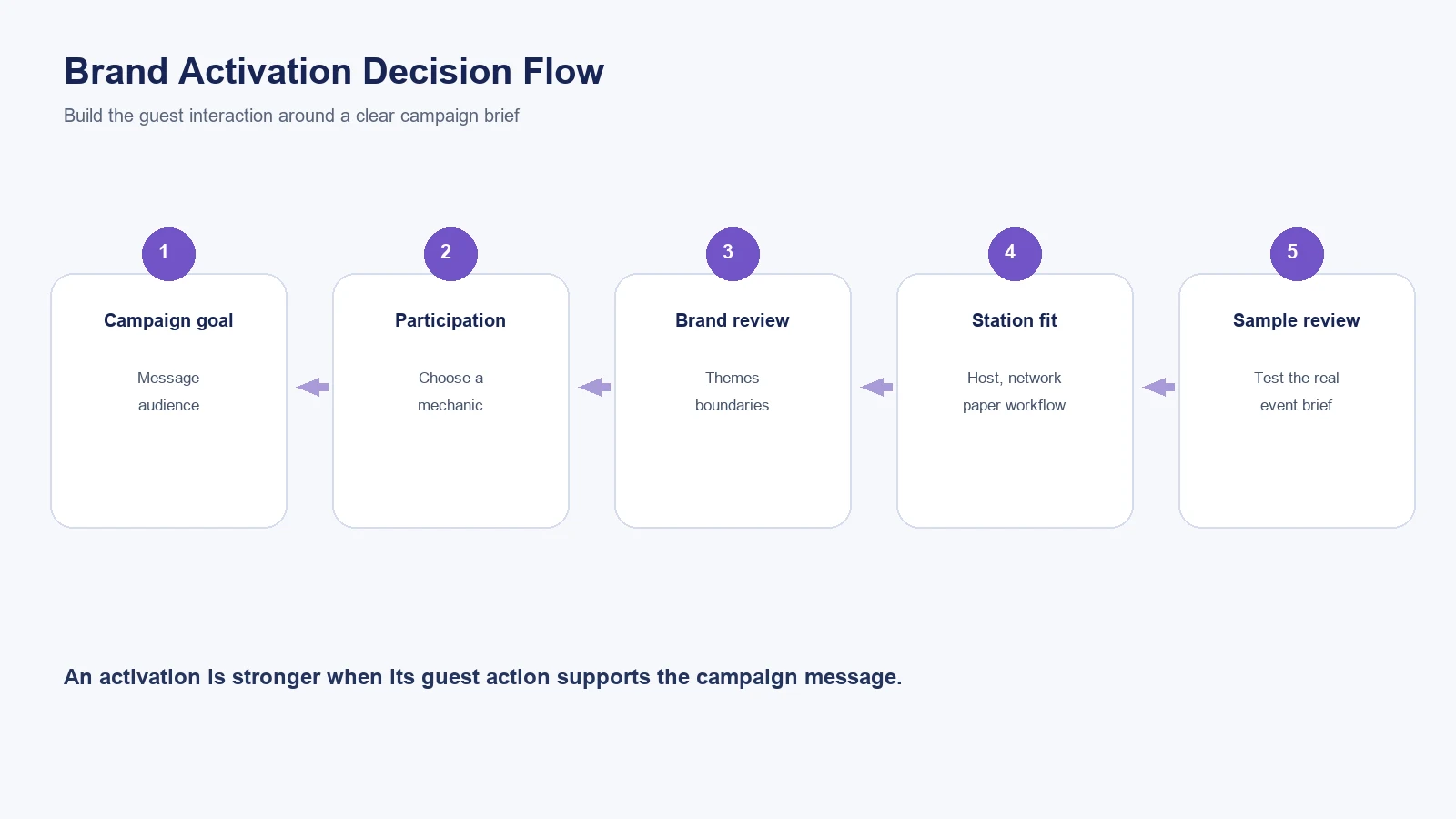
Turn the campaign message into a guest prompt
The most practical prompt design is short, on-brand and easy for a host to explain. A campaign might use a small set of approved motifs, values or visual directions, then let guests make a limited personal choice inside that frame. This is more controllable than treating all text input as automatically suitable for a public activation.
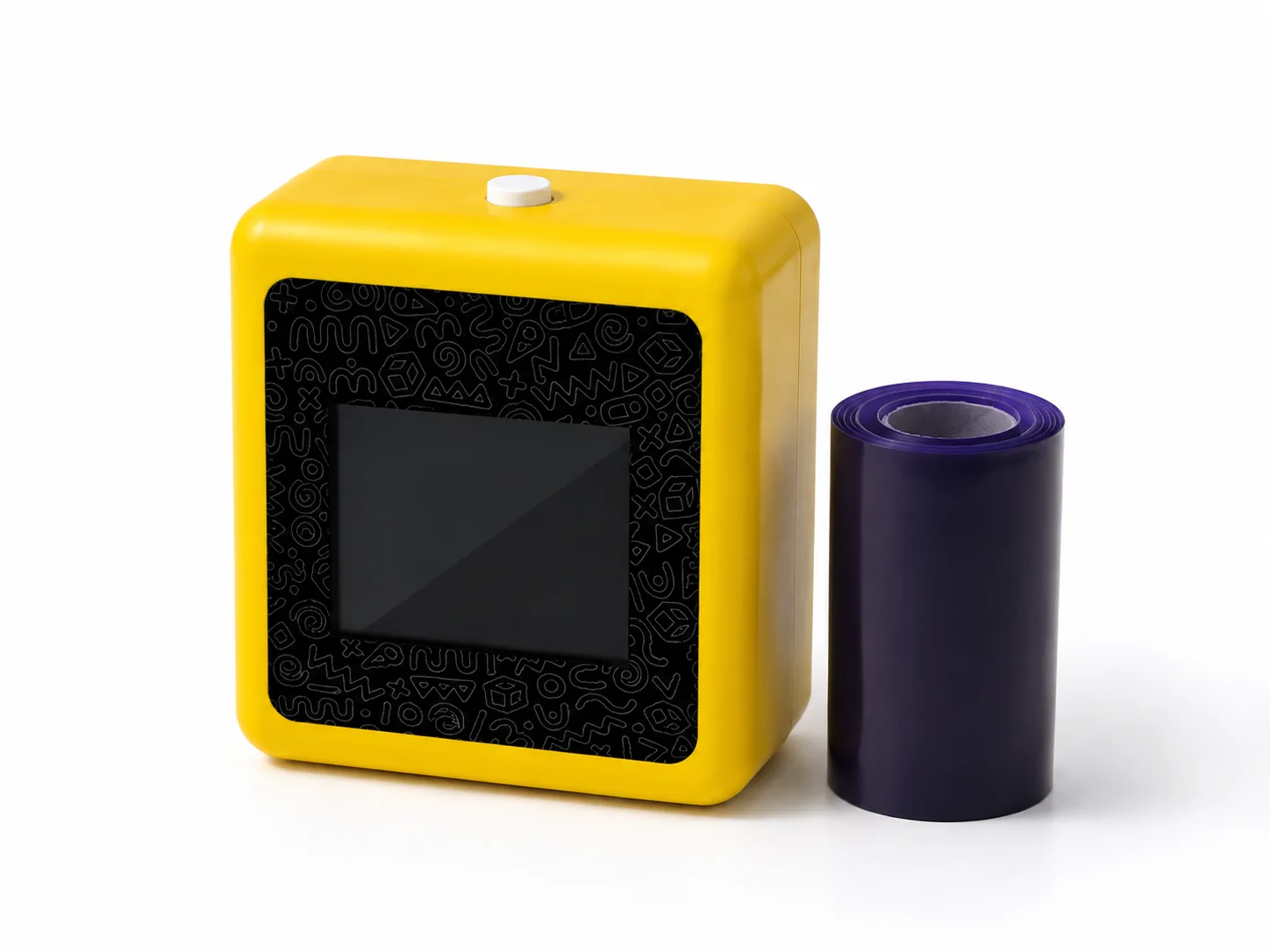
For K1, the connected AI step generates line art from a text prompt. The operator reviews the result before 57mm thermal printing and the dedicated transfer-paper process. A usable venue network path, selected paper and current instructions are therefore part of the station plan.
Build a responsible activation brief
- Define the campaign purpose, audience and the action guests should take.
- Approve themes, prompt examples, exclusions and host language.
- Confirm the venue placement and network path for the connected design workflow.
- Test the demonstrated paper and transfer process with current instructions.
- Record which commercial, documentation and support items still need supplier confirmation.
The FTC advises advertisers to support objective claims. In activation copy, do not present an expected guest volume, campaign return, safety result, wear time or output capacity as though it were established by the equipment category. See the FTC’s advertising guide for small businesses.
Keep roles separate
| Team | Owns |
|---|---|
| Brand | Campaign message, approval boundary and guest-facing tone |
| Agency or event lead | Program flow, host briefing and venue coordination |
| Supplier | Demonstrated product workflow, selected configuration and scope confirmation |
| Station host | Prompt guidance, output review, print and guest handoff |
For the detailed personalization workflow, read Personalized Tattoo: Brand Activation Guide. For a business-purchase framework after the activation is approved, see Temporary Tattoo Printer for Businesses: Beyond DIY Kits.
Test the guest journey before launch
A sample review should use the planned campaign language rather than a generic prompt. Ask the agency to prepare a small set of representative themes, then observe where the host needs to explain the activity, narrow a request or reject an unsuitable output. This gives the brand evidence about the operating model without turning one successful demonstration into a broad performance claim.
The test should include the less polished moments as well. Check how the team responds when the network is unstable, a prompt needs revision, a generated result does not fit the brief or the paper must be reloaded. Those moments determine whether the activation can be repeated by normal event staff under venue pressure.
Record at least five observations:
- How quickly guests understand the invitation and prompt boundary.
- Which themes generate results that are easiest for the brand to approve.
- Where the host needs a script, escalation rule or content restriction.
- Whether the station position, queue and handoff support the wider event flow.
- Which product, paper or documentation questions remain open after the pilot.
Plan brand control without removing participation
Co-creation does not require unrestricted input. A practical activation can offer approved themes, example phrases and clear exclusions while still allowing each guest to make a meaningful choice. The brand can also decide whether the operator reviews every generated result or only those that fall outside a defined prompt menu.
This balance matters for agencies. A completely open prompt may create approval friction, while an overly rigid template can make the AI step feel unnecessary. The pilot should find a boundary that is understandable to guests and manageable for the host.
Decide what success means for this campaign
Do not begin with a universal engagement benchmark. Choose observable measures tied to the campaign purpose. A launch event may care about completed interactions and host questions; a trade-show activation may care about dwell time and lead-flow compatibility; an internal event may care about participation across teams.
These observations can support the next planning decision, but they should not be presented as proof that the equipment alone caused a commercial result. Compare the station with the original campaign objective, staffing plan and venue conditions, then decide whether to revise, repeat or discontinue the concept.
Activation readiness checklist
- Campaign objective and guest action are written in one sentence.
- Prompt themes, exclusions and approval responsibilities are documented.
- Venue network, station location and queue plan have been tested.
- The selected paper and current transfer instructions are available to staff.
- Guest-facing language avoids unsupported safety, duration and performance claims.
- The post-event review has an owner and a short observation template.
FAQ
What are useful brand activation ideas?
Useful ideas match the campaign objective, audience and venue, then give guests a clear and manageable action.
Can a temporary tattoo station support a brand activation?
It can be evaluated as a staff-guided creative interaction when the brief, host role, network and transfer workflow are planned.
How does K1 fit this workflow?
K1’s published process uses connected AI line art from a text prompt, 57mm thermal printing and dedicated temporary transfer paper.
What should the brand approve first?
Approve the campaign purpose, prompt themes, design boundaries, guest language, host role and venue plan.
What should be avoided in campaign claims?
Avoid unsupported statements about safety, duration, capacity, engagement, return or permanent-tattoo capability.
Start with one brief
Explore the K1 AI Tattoo Stencil Printer and request a sample evaluation based on an approved activation brief.