
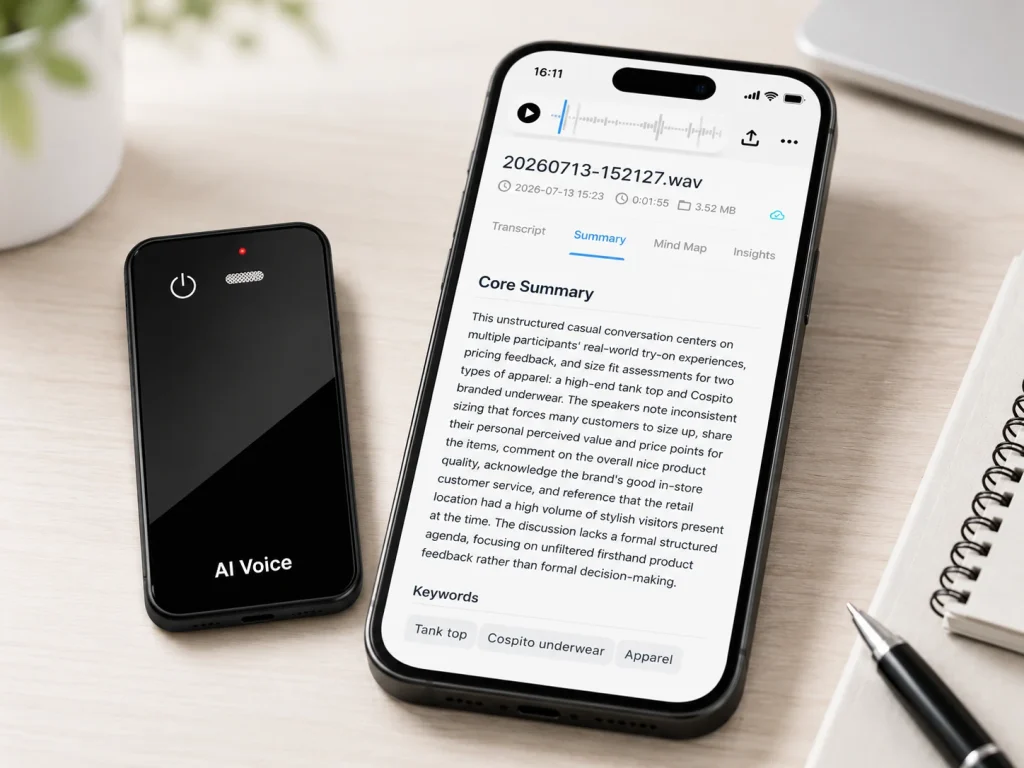
Disclosure: This article is published by Yosiya, supplier of the MG6 AI Recording Card. Plaud Note facts are sourced from Plaud’s official product and plan pages, checked September 2, 2026. This is a B2B comparison guide—not a consumer review, affiliation statement, or declaration of an absolute winner.
MG6 and Plaud Note are both ultra-slim, card-sized AI voice recorders that attach to a phone and capture in-person conversations and phone calls. Where they differ is in the business model behind the hardware: Plaud Note is a finished retail product with a fixed spec, a fixed app, and a subscription plan for AI transcription. MG6 is an OEM/ODM reference platform that ships with configurable storage, branding, packaging, and AI service scope on a per-project basis. The choice is not a spec-sheet contest — it is whether you are buying a device to use or building a product to sell.
What Buyers Should Know
- Both products are physical, card-style recorders — not phone apps or meeting bots. They capture audio from the room or from a phone call without requiring the conversation to happen inside a video-conferencing platform.
- Plaud Note is a finished consumer product purchased at retail. MG6 is a configurable hardware platform evaluated through a sample-to-production OEM/ODM process.
- Both support phone call recording, but through different physical mechanisms. Neither can be compared for call-recording quality without same-condition side-by-side testing.
- AI transcription, summarization, and workplace recording governance are still evolving. The Associated Press has reported on how AI notetakers in the workplace raise practical questions about consent, voice identification, retention, deletion, and vendor data handling. Those questions apply regardless of whether the recorder is a Plaud Note or an MG6 — the governance responsibility sits with the organization, not the device.
- Storage is a single fixed option for Plaud Note. MG6 offers five storage capacities from 8GB to 128GB, configurable by project.
Where This Product Fits
| Entity | Plaud Note | MG6 AI Recording Card |
|---|---|---|
| Brand | Plaud | Yosiya |
| Product model | Plaud Note (retail) | MG6 Voice Recorder reference platform |
| Category | Card-style AI voice recorder — consumer retail | Card-style AI voice recorder — OEM/ODM platform |
| Primary buyer | Individual professionals, small teams, retail consumers | Hardware brands, product managers, channel buyers, distributors, private-label partners |
| Business model | One-time device purchase + optional AI subscription | Sample → configuration → pilot order → production — per-project pricing |
| Key use cases | Meetings, calls, interviews, lectures, voice memos | Same use cases, plus branded product launches, corporate gifting, channel distribution |
Hardware Side by Side
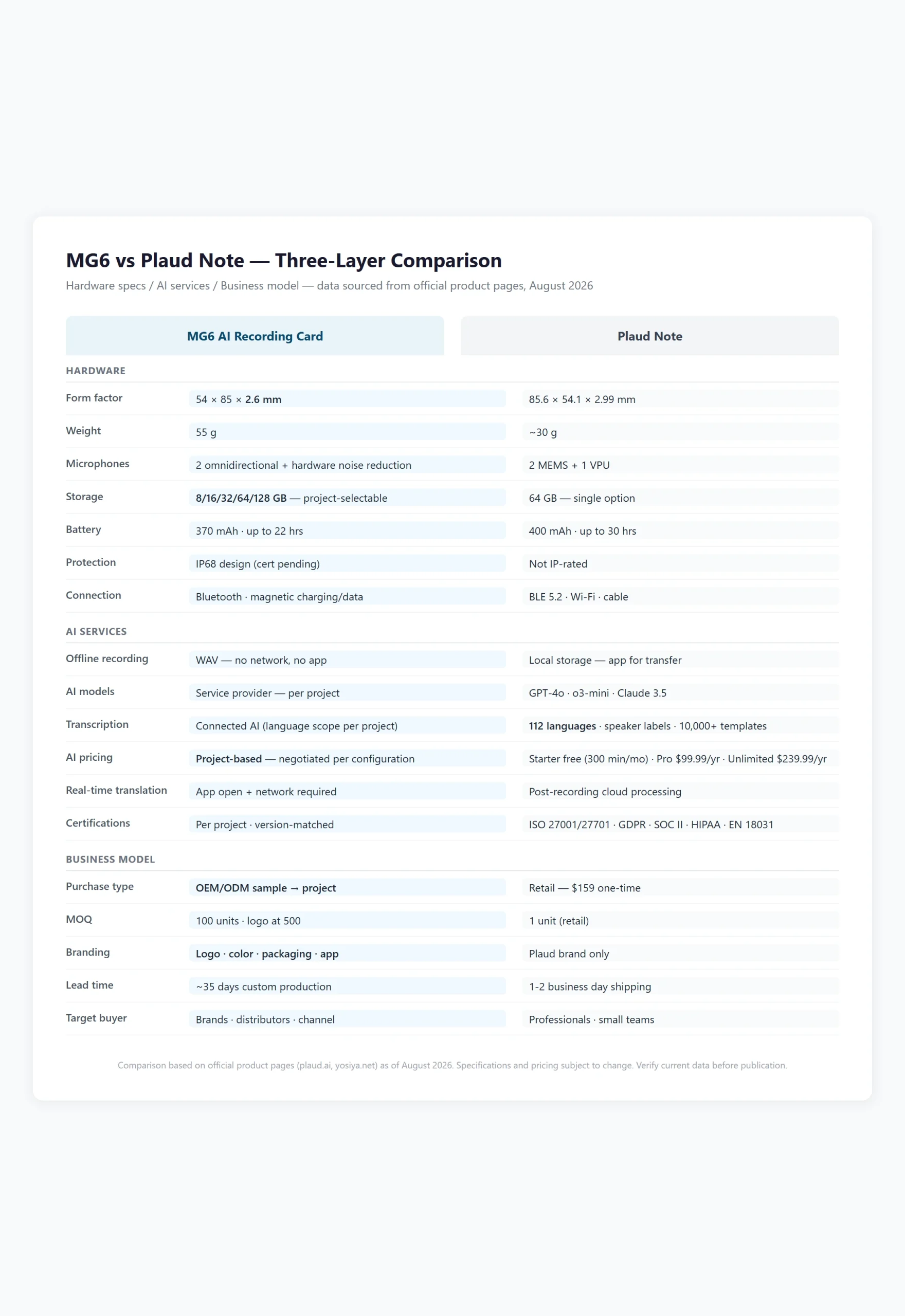
The table below compares published reference specifications. Plaud Note data is from the official Plaud Note product page, checked September 2, 2026. MG6 data is from the Yosiya MG6 product page and the project knowledge supplied for this article. Both configurations may change; verify version-matched specifications and evidence before purchase or production.
| Dimension | MG6 AI Recording Card | Plaud Note |
|---|---|---|
| Dimensions | 54 × 85 × 2.6 mm | 85.6 × 54.1 × 2.99 mm |
| Weight | 55 g | Approximately 30 g |
| Microphones | 2 omnidirectional | 2 MEMS + 1 VPU |
| Recording processing | Hardware noise reduction algorithm | Voice processing unit (VPU) |
| Battery | 370 mAh | 400 mAh |
| Rated recording time | Up to 22 hours | Up to 30 hours continuous |
| Rated standby | Up to 1,440 hours | Up to 60 days |
| Storage options | 8 / 16 / 32 / 64 / 128 GB | 64 GB |
| Protection design | IP68 design (version-matched certification pending) | Not specified as IP-rated on product page |
| Connection | Bluetooth, magnetic charging and data contacts | BLE 5.2, Wi-Fi, cable |
| Charging time | Approximately 2 hours | Approximately 2 hours |
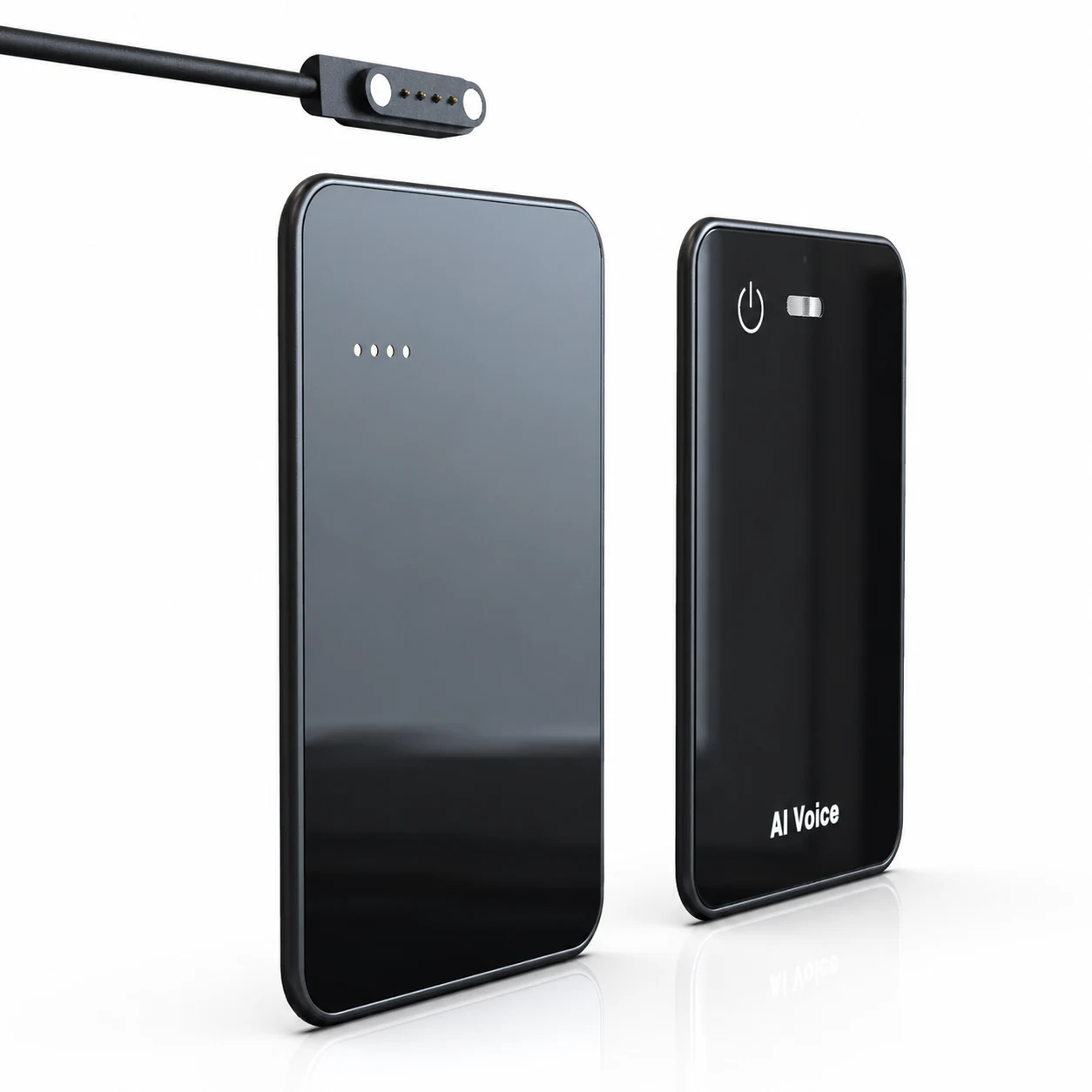
Neither set of microphone or battery specifications should be interpreted as a direct audio-quality or real-world-endurance comparison without same-condition testing. Manufacturer test conditions, firmware versions, and use environments differ.
Recording: Calls, Meetings, and Offline
Both the MG6 and Plaud Note record phone calls through physical attachment to the phone rather than through a software integration. Neither requires the caller to use a speakerphone, a third-party dialer, or a Bluetooth pairing process for the audio path.
The MG6 supports phone call recording through a magnetic phone case. The user opens the recording app, starts a recording on the device, and the card captures the conversation while attached to the back of the phone. This approach works with the device’s physical recording path — it does not require integration with the phone’s operating system or call-handling stack.
Plaud Note uses a MagSafe-style case or adhesive ring to attach to the phone, with a dedicated call-mode toggle and a voice capture sensor (VCS) designed to pick up phone conversations through the handset. Recording, file transfer, transcription, and summarization are managed through the Plaud App.
For in-person meetings, both devices are placed on a table and capture ambient conversation. The difference is in what happens after the recording stops, which is addressed in the AI services section below. In any deployment, organizations should confirm applicable recording-consent requirements for their jurisdiction. The Reporters Committee for Freedom of the Press publishes a state-by-state guide to US recording laws that can help buyers understand the regulatory landscape before writing a workplace policy.
Offline recording
The MG6 can record WAV files to local storage without a network connection or an active phone app. Plaud Note stores recordings locally on the device until the user transfers them through the Plaud App for cloud processing. Neither product performs AI transcription, translation, or summarization offline — those functions require a connection to an AI service.
AI Services: Two Different Pricing Models
The way you pay for AI on each platform reflects the underlying business model difference more than any hardware gap.
Plaud Note: device + subscription
Plaud Note includes a Starter plan with 300 transcription minutes per month. Plaud’s published US plan page, checked September 2, 2026, lists the following individual-plan structure; taxes, region, promotions, app-store billing, and later plan changes can alter the amount paid:
| Plan | Monthly allowance | Annual-billing equivalent | Month-to-month price |
|---|---|---|---|
| Starter | 300 | Free | Free |
| Pro | 1,200 | US$8.33/month, billed annually | US$17.99/month |
| Unlimited | Unlimited, subject to published daily limits | US$19.99/month, billed annually | US$29.99/month |
Plaud’s plan page currently advertises 112-plus transcription languages, speaker labeling, custom vocabulary, more than 10,000 summary templates, mind maps, multiple export formats, and access to AI models that can change as the service evolves. It also publishes security and compliance statements for its service. Buyers should verify the exact plan, feature status, certification scope, legal entity, and evidence rather than copying a model name or compliance badge from a comparison article.
Plaud states that unused transcription minutes reset rather than roll over. Account, seat, workspace, device-management, and offboarding rules differ between individual and Team plans, so organizations should confirm the current billing unit and administration model for their deployment. Local capture and AI processing are separate functions; test what remains available when an allowance is exhausted or a subscription ends.
MG6: project-based AI scope
The MG6 connects to supported AI services for transcription, real-time translation (when the app is open and the device is connected to a network), summaries, and mind maps. The specific AI service provider, language coverage, usage allowance, and pricing are determined during project scoping — not through a fixed retail subscription.
This means a brand evaluating MG6 for a private-label product negotiates the AI service terms directly as part of the project configuration. The tradeoff is transparency versus flexibility: Plaud publishes a fixed menu, while MG6 requires the buyer to define the service scope during the evaluation process.
Pricing and plan terms for both products should be verified on the date of publication, as subscription models and project-based service terms can change.
Real Cost Over Time
A fair cost comparison must account for how each product is acquired.
Plaud Note: retail model
Calculate the retail route from a dated quote rather than a permanent total in this article:
First-year cost = devices × current device price + paid seats × current plan price + taxes + accessories + support and administration
For a team deployment, confirm whether each user needs a device, which users need paid AI capacity, whether a Team workspace is required, how seats can be reassigned, and whether promotional pricing expires during the budget period. Plaud currently publishes individual and Team structures, so a simple “one device plus one personal plan per user” assumption is not sufficient evidence for every organization.
MG6: project model
MG6 pricing is not retail. The unit cost depends on the selected storage configuration, customization scope, order quantity, and AI service plan. The factory-confirmed commercial references are:
- Product MOQ starts at 100 units
- Logo customization starts at 500 units
- Custom production lead time is approximately 35 days
A brand evaluating a 500-unit private-label run with 64GB storage and a configured AI plan is making a fundamentally different financial decision than a team buying five Plaud Notes at retail. The comparison is not device-versus-device — it is build-versus-buy.
Use the AI voice recorder total-cost model to compare both routes with the same volume, review labor, replacement, support, retention, and exit assumptions.
OEM and Private Label: Where the Road Splits
This is the clearest dividing line between the two products.
Plaud Note is a finished consumer brand. The product ships in Plaud packaging with the Plaud app, Plaud’s logo, one color option per SKU, and 64GB of fixed storage. Plaud’s public website does not describe an OEM, private-label, or bulk-customization program. A buyer who wants a branded card-style recorder in a different color, with different storage, under their own app, or in their own retail packaging will not find those options on the Plaud order page.
MG6 is built for that scenario. The platform supports:
- Logo and color customization
- Storage configuration from 8GB to 128GB
- Retail packaging, manual, and quick-start guide in the buyer’s language and design
- App branding, interface adaptation, and selected software requirements
- AI service language coverage and usage plan per project
- Accessory bundle configuration
- Target-market certification, privacy wording, and after-sales documentation
Final scope, MOQ, pricing, and lead time depend on the agreed project configuration. The MG6 is not a product you add to a shopping cart — it is a platform you evaluate through a sample, then configure for production.
The question for a buyer is not which product is more powerful. It is whether the goal is to use a card-style recorder or to build a card-style recorder business.
Who Should Choose Which
Plaud Note is the more direct answer when:
- One person or a small team needs a card-style recorder immediately
- The 64GB storage, Plaud app, and Plaud AI plan fit the use case without modification
- The buyer does not need custom branding, packaging, or a different app experience
- The current device, plan, tax, support, and administration costs fit a dated budget
- The compliance certifications Plaud publishes (ISO 27001, SOC II, HIPAA, etc.) align with the buyer’s requirements
MG6 is the stronger fit when:
- A brand, distributor, or channel partner wants to sell a card-style recorder under its own name
- The buyer needs configurable storage — a 16GB entry model or a 128GB premium SKU, for example
- Custom packaging, a branded app, or market-specific certification wording is part of the project brief
- The buyer wants to negotiate AI service terms directly rather than accept a fixed retail subscription
- The project involves a corporate gift, promotional, or enterprise deployment program where bulk configuration matters
- The buyer is evaluating a long-term product line, not a one-time device purchase
Where the lines blur
A professional who uses a recorder daily and later decides to launch a branded version of that product may start with a Plaud Note for immediate use and later evaluate MG6 for a private-label program. That path is common. The two products are not mutually exclusive — they serve different stages of the same market.
A channel buyer evaluating both for distribution should ask a different set of questions: What is the margin structure? Who controls the app and user data? Can the supplier support packaging, warranty, and after-sales in the target market? These questions are answered very differently by a retail product page and a project-based OEM conversation.
What to Sample-Test Before Committing
Whether the buyer chooses Plaud Note or evaluates an MG6 sample, the following items should be tested in the buyer’s own environment before committing to a purchase or a pilot order:
- Recording quality in the buyer’s actual meeting space. Conference room acoustics, background noise, speaker distance, and room layout affect results in ways that spec sheets cannot predict. Test in the room where the device will be used.
- Phone call recording with the buyer’s phone model. Case fit, magnetic strength, and call-recording behavior can vary across phone models. Test with the actual device the team carries.
- Transcription accuracy on the buyer’s domain vocabulary. Industry jargon, product names, and regional accents affect transcription quality. Run a real meeting or call through the full pipeline.
- File transfer and export workflow. How recordings move from the device to the app, to the computer, and into the team’s existing tools matters as much as the recording itself. Test the entire chain.
- Deletion and data control. Confirm what happens when a recording is deleted — on the device, in the app, and in the cloud. If the buying organization has a data-retention policy, verify that the product can comply.
For MG6 specifically, the sample evaluation should also cover the magnetic charging cable, the hardware finish, and the noise-reduction behavior in the buyer’s recording conditions. For Plaud Note, the sample evaluation should also cover the subscription plan fit: count actual monthly transcription minutes before deciding between Starter, Pro, and Unlimited.
FAQ
Does MG6 record phone calls the same way Plaud Note does?
Both products record phone calls through physical attachment to the phone, not through software integration. The MG6 uses a magnetic phone case and the device’s recording path. Plaud Note uses a MagSafe-style case and a voice capture sensor with a dedicated call-mode toggle. The physical approach is similar; the specific mechanism, app workflow, and recording behavior differ. Same-condition testing is needed to compare results.
Which product offers more storage?
MG6 offers five storage options from 8GB to 128GB, configurable by project. Plaud Note ships with a single 64GB configuration. A buyer who needs 128GB for long-form recordings or 16GB for an entry-level SKU will find those options on the MG6 side. The storage capacity each product lists cannot be directly converted to recording hours without knowing the WAV encoding settings.
Do I need a paid subscription for Plaud Note?
Plaud currently publishes a Starter allowance of 300 transcription minutes per month and paid Pro, Unlimited, and Team structures. The right plan depends on actual processed minutes, administration needs, billing channel, region, taxes, and current commercial terms. Plaud states that unused minutes do not roll over. Verify the live plan page and record the date checked before purchase.
Can I put my own logo on a Plaud Note?
Plaud’s public website does not describe a logo customization, private-label, or OEM program. Plaud Note ships as a finished Plaud-branded product. MG6 supports logo customization starting at 500 units, along with configurable color, packaging, app branding, and accessory bundles. Buyers who need a branded card-style recorder should evaluate the MG6 OEM/ODM path.
What is the minimum order quantity for MG6?
The factory-confirmed product MOQ starts at 100 units. Logo customization begins at 500 units. Custom production lead time is approximately 35 days. Final MOQ, pricing, and timing depend on the selected storage configuration, customization scope, material readiness, and the approved production plan. A sample is available for evaluation before a pilot order is placed.
Request MG6 Specs and Sample
If your team is evaluating a card-style AI voice recorder for a branded product, a channel distribution program, or an enterprise deployment, the MG6 platform provides configurable storage, custom branding, and a project-based AI service model that retail products do not offer. Start with the hardware specifications and a sample evaluation before scoping the full project.
Request MG6 specifications and sample
Plaud and Plaud product names are trademarks of their respective owner. References to Plaud’s public pages do not imply partnership, authorization, endorsement, or compatibility.


