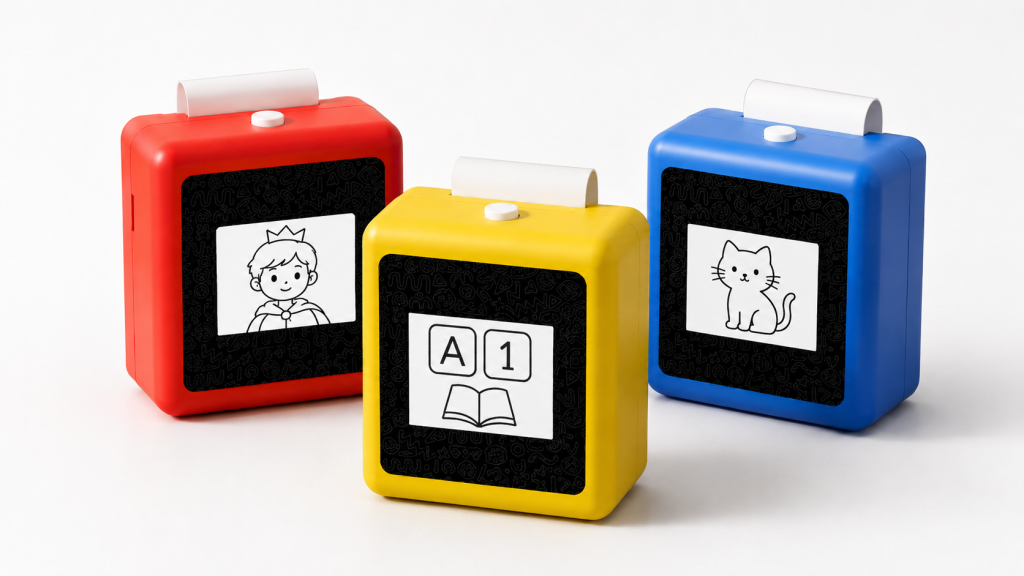
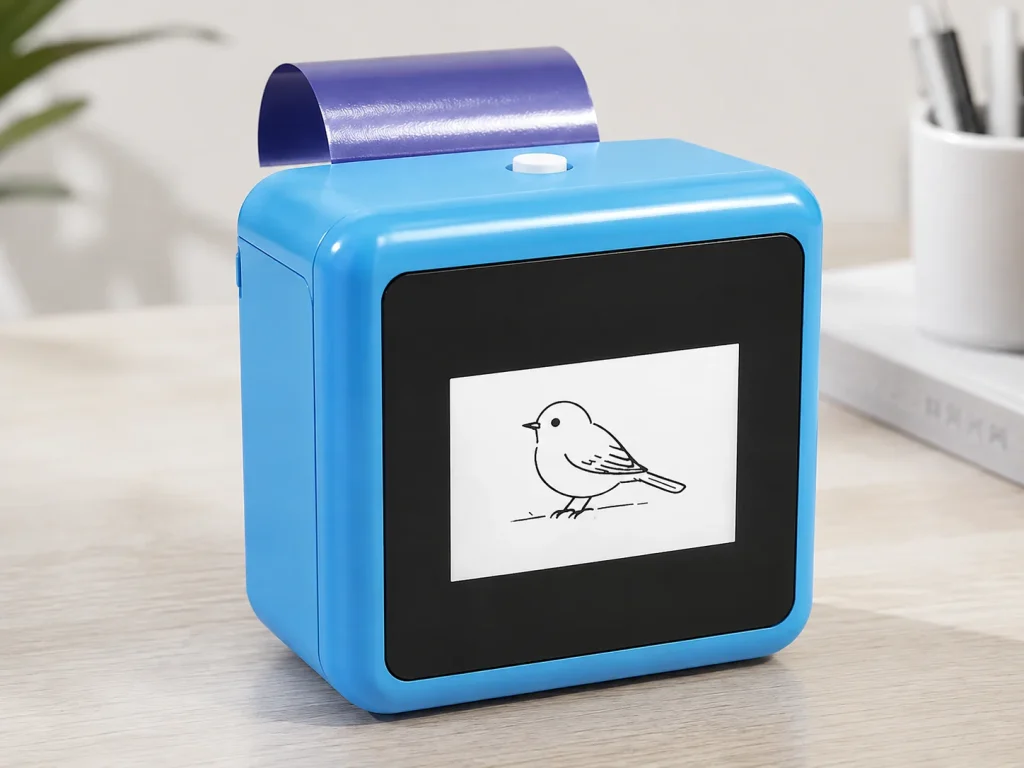
A tattoo transfer printer replaces the manual step of tracing a finished design onto transfer paper. This guide focuses on thermal transfer printers — the heat-activated machines used for tattoo stencils — and the decision to buy one is a return-on-effort question rather than a quality question. The honest way to judge it is to look at how much time manual transfer costs you today, then weigh that against the one-time cost of a printer plus the paper it keeps using. This guide lays out both sides of that trade-off so you can decide from your own numbers, not from a spec sheet.
What Buyers Should Know
- A transfer printer is a time-saver, not a design tool — it reproduces a finished design onto transfer paper.
- The decision is about effort: manual transfer costs time, while a printer costs money plus a recurring paper supply.
- The printer wins when transfer is a frequent, repetitive task; manual transfer stays reasonable for occasional work.
- Judge the choice by your own transfer volume, not by the printer’s feature list.
What manual transfer costs
Manual transfer means placing a design over stencil paper and tracing every line by hand. The cost is time: each stencil takes minutes of focused tracing, and a busy week multiplies that across every client. It also carries a consistency cost — a rushed trace drifts, and a stencil redone because of a smudged line costs the same time twice.
There is no hardware to buy, which is why manual transfer is genuinely the cheaper starting point for someone who only needs a stencil now and then. The paper and a tracing stylus are the whole investment, so the entry cost is close to nothing.
The hidden cost is repetition. When a returning client asks for a matching piece, or a studio wants the same flash design for several artists, manual transfer means tracing that same design again from scratch each time. The first trace is cheap; the tenth identical trace is where the time quietly adds up.
What a transfer printer costs
A thermal transfer printer moves that time cost into a one-time hardware purchase plus a recurring paper supply. The printer reproduces a finished design onto transfer paper directly, so the per-stencil time drops to loading the paper and starting the print. The trade-off is that the printer is an upfront expense and the paper reorders with every use, so the value depends on whether the time saved across many stencils outweighs those two costs.
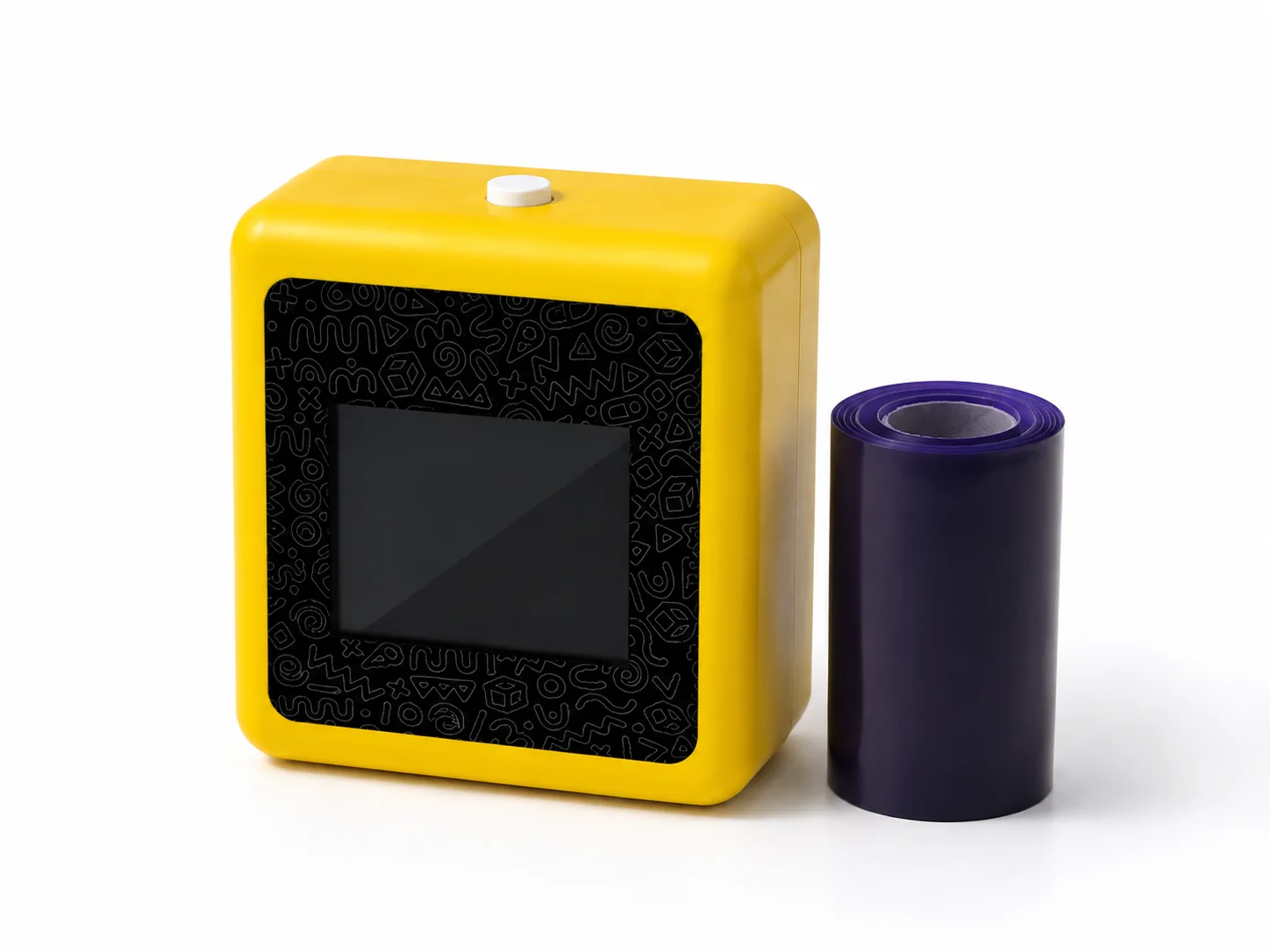
The thermal printing process itself is ink-free, which is why the consumable is specialized transfer paper rather than ink or toner. That also means the recurring cost is the paper, and it scales with how many stencils the studio actually prints. There is a short setup learning curve — loading the paper the right way and confirming the settings — but it is a one-time climb rather than an ongoing cost.
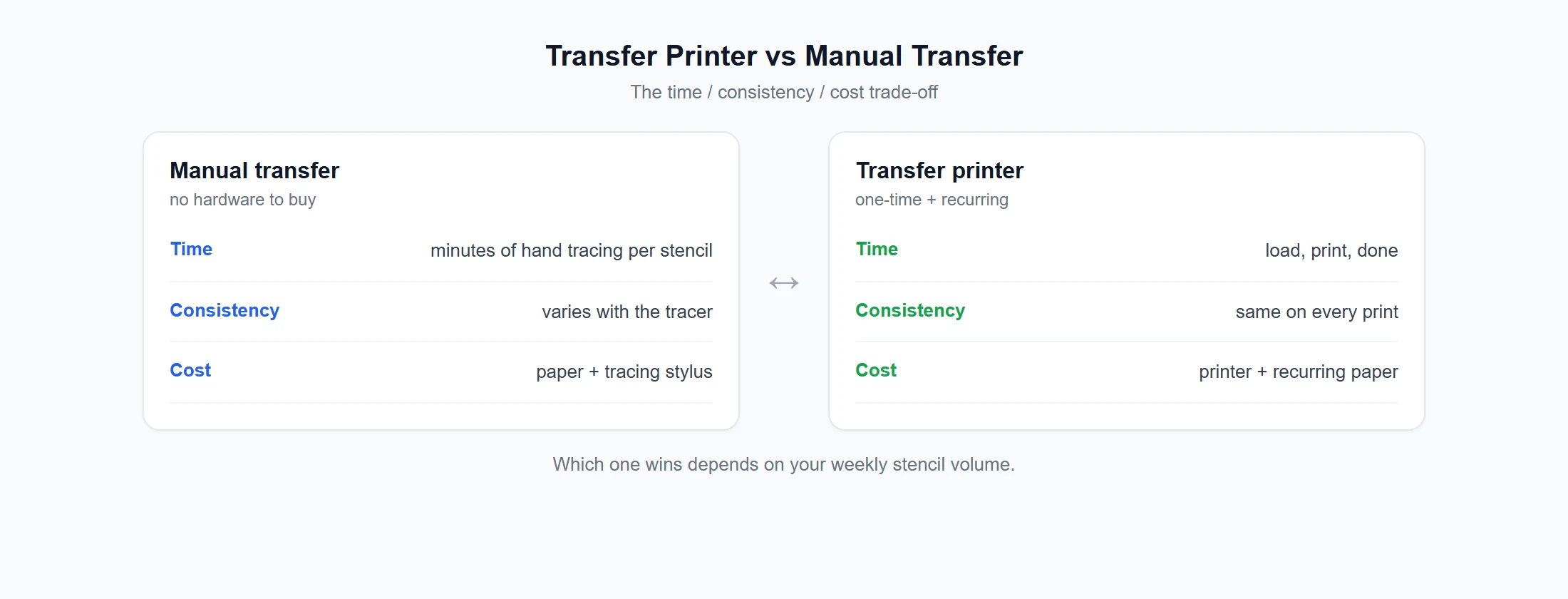
Manual transfer vs transfer printer: the trade-off
| Factor | Manual transfer | Transfer printer |
|---|---|---|
| Per-stencil time | Minutes of hand tracing | Load paper, prepare, print |
| Consistency | Varies with the tracer | More repeatable across prints |
| Upfront cost | Minimal — paper and stylus | A printer purchase |
| Ongoing cost | Paper only | Transfer paper, reordered regularly |
| Learning curve | Tracing skill | Setup and paper loading |
| Suits | Occasional, one-off work | Daily or high-volume stencils |
When a transfer printer may justify its cost
A transfer printer may justify its cost when transfer shows up every day, when several artists share one studio and need the same stencil reproduced, or when the same designs come back repeatedly. In those cases the time saved across a month can outweigh the printer’s cost, and the consistency is a bonus on top of the speed.
The tattoo studio market spans independent artists and multi-artist shops alike, so transfer volume varies widely from one business to another. For a shop that runs several artists through a shared prep routine, the printer is less a luxury and more a piece of the prep infrastructure.
The comparison to run is simple:
- Count how many stencils you prepare in a typical week.
- Estimate the tracing time each one takes by hand.
- Compare that weekly time against the printer and paper cost spread over the same period.
At higher transfer volumes, the time savings become more significant and may justify the hardware and paper costs; at low volumes they usually do not.
The same comparison can be written as a formula you fill in yourself:
- Monthly manual cost = monthly stencil volume × average tracing time per stencil × your hourly labor value.
- Monthly printer cost = the printer’s cost spread over its useful life + transfer paper cost.
- If the first line is larger than the second, the printer is worth testing; if not, manual transfer still makes sense.
None of these values needs a published number — each one comes from your own studio’s schedule and prices.
When manual transfer is still the better choice
If stencils are occasional — a few one-off custom pieces a month — manual transfer is still the cheaper and simpler choice. The printer adds an upfront cost and a recurring paper supply that a low-volume studio does not recover, and there is no rule that every studio needs one.
The right answer follows the transfer volume. A studio that traces two stencils a month is not the same business as one that prints twenty, and the two should reach different conclusions from the same comparison. Manual transfer also asks for nothing beyond paper and a steady hand, which matters when the studio is just getting started and every dollar is going into the core setup.
Where This Product Fits
For studios running enough transfer volume to justify the switch, the K1 tattoo stencil printer is one example of a compact thermal transfer printer that replaces the manual step. It is a reference platform evaluated for OEM/ODM rather than a retail unit, so it is an ROI scenario to test against your own volume rather than a blanket recommendation.
| Entity | Description |
|---|---|
| Brand | Yosiya — AI hardware products and OEM/ODM solutions |
| Product | K1 AI Printer reference platform |
| Role here | Transfer-printer side of the comparison, tested against studio volume |
| Main use cases | High-volume stencil prep, private-label hardware |
FAQ
Is a tattoo transfer printer worth the cost?
It depends on your transfer volume. If you prepare stencils daily or in high volume, the time savings are more likely to justify the printer and paper costs. For occasional work, manual transfer is cheaper.
How much time does a transfer printer save?
The saving is the hand-tracing step — a printed stencil replaces minutes of tracing per design with a short print. The total depends on how many stencils you prepare in a week.
Does a transfer printer need special paper?
Yes. A thermal transfer printer uses heat-activated transfer paper rather than ordinary printer paper, and the paper is a recurring supply.
Can I use manual transfer for some designs and a printer for others?
Yes. Many studios run both — a printer for daily and repeated designs, manual tracing for the occasional one-off. The two are not mutually exclusive.
Is a transfer printer the same as a regular printer?
No. A transfer printer uses heat on specialized transfer paper to produce a stencil, not ink or toner on ordinary paper, and it is built for the tattoo prep workflow.
If you are weighing a transfer printer against manual transfer for your studio, contact Yosiya to discuss the K1 platform against your own transfer volume.