
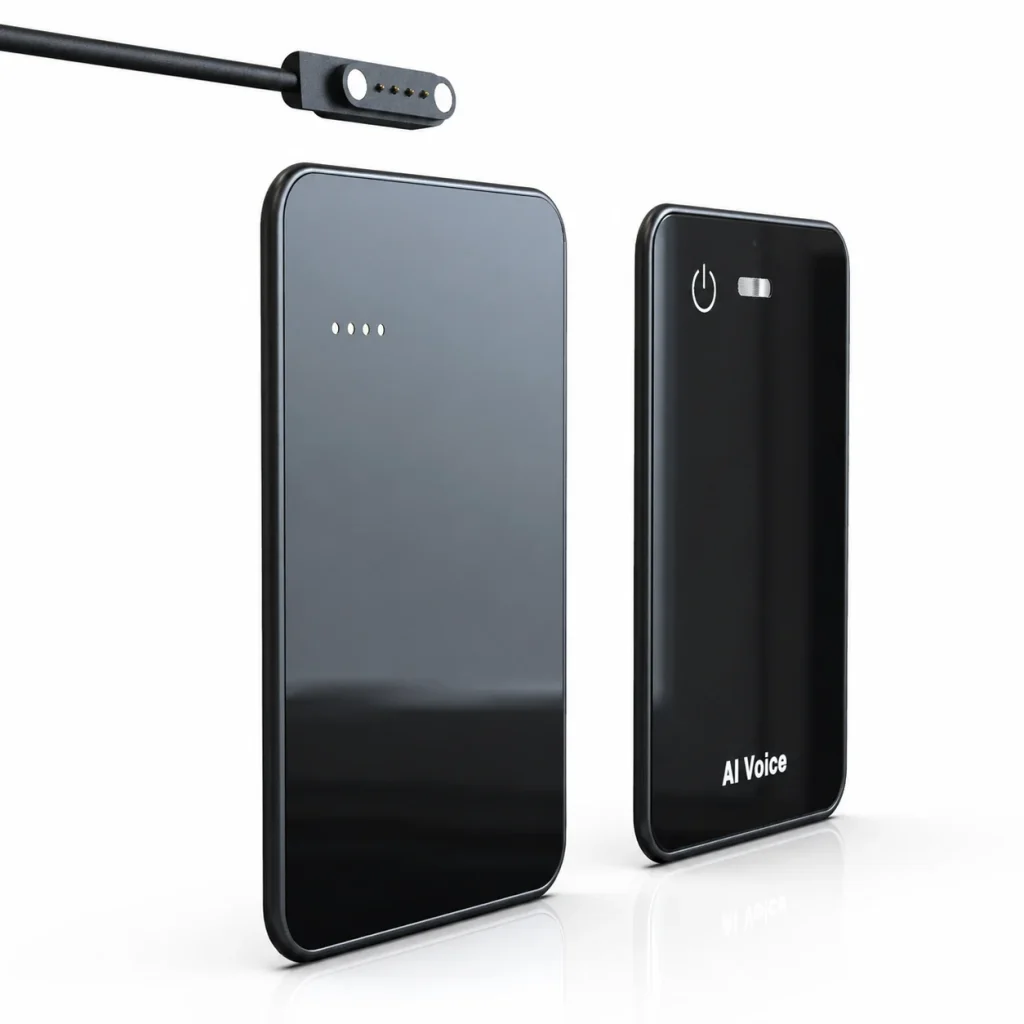
Disclosure: This article is published by Yosiya, supplier of the MG6 AI Recording Card. It is a procurement reference guide — not legal advice. Consult qualified counsel for your jurisdiction.
AI voice recorder privacy is not a single product feature. It is a combination of notice, consent, data location, access control, retention, deletion, and AI-processing disclosure that a US buyer must define before deploying any recording system. A device that saves audio locally can reduce some cloud exposure, but the moment that audio enters a connected service for transcription or summarization, a new data flow begins. The practical starting point is to separate the recording layer from the AI layer, then evaluate each one against the organization’s policy, the applicable state consent law, and the supplier’s data-handling documentation.
What Buyers Should Know
- US federal law does not create a single national recording-consent rule for private conversations; state wiretapping and eavesdropping statutes vary, and the applicable rule can depend on the type of communication and the location of each party.
- A device that can record does not mean the workplace policy or legal environment permits that recording.
- Original audio, transcripts, summaries, account data, and shared exports can follow different storage and deletion rules.
- “Local recording” and “local AI processing” are separate claims; a product may save a WAV file on the device while sending audio or text to a cloud service for transcription.
- Enterprise buyers should evaluate notice, consent, capture boundaries, file ownership, data lifecycle, and supplier transparency—not only encryption or certification labels.
Where This Checklist Fits
| Role or model | Primary privacy concern | What the buyer controls | What still needs verification |
|---|---|---|---|
| Built-in phone recorder | App permissions, phone storage, backup exposure | Device policy, consent process, file handling | OS backup behavior, cloud sync, background access |
| Meeting platform | Platform identity, admin controls, retention policy | Workspace settings, license, recording permissions | Cross-border data handling, legal hold, export rules |
| Third-party transcription service | Upload destination, model training, retention, and export | Account settings, data-processing agreement | Whether audio or text is used for model improvement |
| Cloud AI recorder | End-to-end data flow from device through cloud processing | Contract, data residency, deletion request process | Processing location, subcontractors, backup lifecycle |
| Dedicated offline recorder with connected services | Boundary between local capture and connected AI | File transfer workflow, service selection, retention rules | Which functions are local, which require a network, and where derived data lives |
For the MG6 AI Recording Card, offline WAV recording places the initial capture on the device. Transcription, translation, summaries, and mind maps depend on the selected application and connected service. That separation is a starting point for data-flow mapping, not a complete privacy solution.
What Is AI Voice Recorder Privacy?
AI voice recorder privacy covers every stage from the moment someone presses record to the final deletion of every copy. It includes:
- Notice and consent: whether participants know they are being recorded.
- Capture boundaries: what the device records and whether it operates independently from a network.
- Data location: where the original audio, transcripts, summaries, and account data are stored.
- Access control: who can listen, export, or share recordings and derived outputs.
- AI processing disclosure: whether transcription, translation, or summaries happen locally or in a cloud service, and whether that service uses data for model training.
- Retention and deletion: how long data is kept, and whether deletion removes every copy.
Enterprise buyers should not rely on a product page claim such as “secure” or “private.” The privacy question is answered only when the buyer can describe the complete data lifecycle in writing.
US Recording Consent: What Buyers Need to Know
US consent requirements vary by state. Some jurisdictions require one-party consent; others require all-party consent for certain conversations. The Reporters Committee for Freedom of the Press maintains a state-by-state guide to recording laws that can help buyers understand the regulatory landscape before writing a workplace policy.
The legal question is not only about state wiretapping statutes. It also depends on the type of communication, the expectation of privacy, and the relationship between the parties. This article is a procurement and privacy checklist, not legal advice. Recording requirements can depend on the parties, location, type of communication, and applicable state and federal law. Organizations should consult qualified legal counsel before establishing a recording policy.
| US recording scenario | What the buyer should consider |
|---|---|
| Internal team meeting | State consent law, company recording policy, employee notice |
| Customer call | Applicable state law for all parties, customer notification, call-recording disclosure |
| Candidate interview | State employment recording rules, candidate consent, data retention for hiring records |
| Field conversation | State law for the recording location, participant notice, mobile recording policy |
| Cross-state call | Jurisdiction-specific analysis for every participant and location; do not assume one general consent rule resolves the call |
The Associated Press reported on AI notetakers in the workplace, describing how these tools raise practical questions about consent, voice identification, retention, deletion, and vendor data handling. The governance challenge is not the recorder hardware alone—it is the entire data lifecycle that follows.
Recruiting teams should pair this checklist with the AI recorder recruiting interview guide, while service organizations can use the field-service recording workflow to map authorization, work-order access, and retention responsibilities in context.
AI Voice Recorder Data Flow
AI voice recorder privacy depends on understanding where data goes after recording stops. A single product may create copies in several places.
| Data type | Possible storage locations |
|---|---|
| Original audio file | Recorder device, phone, computer, cloud account, backup service |
| Transcript | Phone app, cloud service, shared workspace, exported document |
| Summary or mind map | Cloud account, shared link, team workspace |
| Account data | Service provider’s servers, analytics, support logs |
The buyer should map every copy. “Local recording” and “local AI processing” are separate claims. A product may save a WAV file on the device while sending audio or text to a cloud service for transcription. IBM’s overview of speech-to-text describes the general recognition process, but the privacy question is not how the technology works in theory—it is where the selected service processes the buyer’s data.
The UK Information Commissioner’s Office guidance on data minimization and storage limitation offers a useful framework for evaluating any recording system, regardless of jurisdiction: collect only what is necessary, define a justified retention period, and delete data when it is no longer needed.
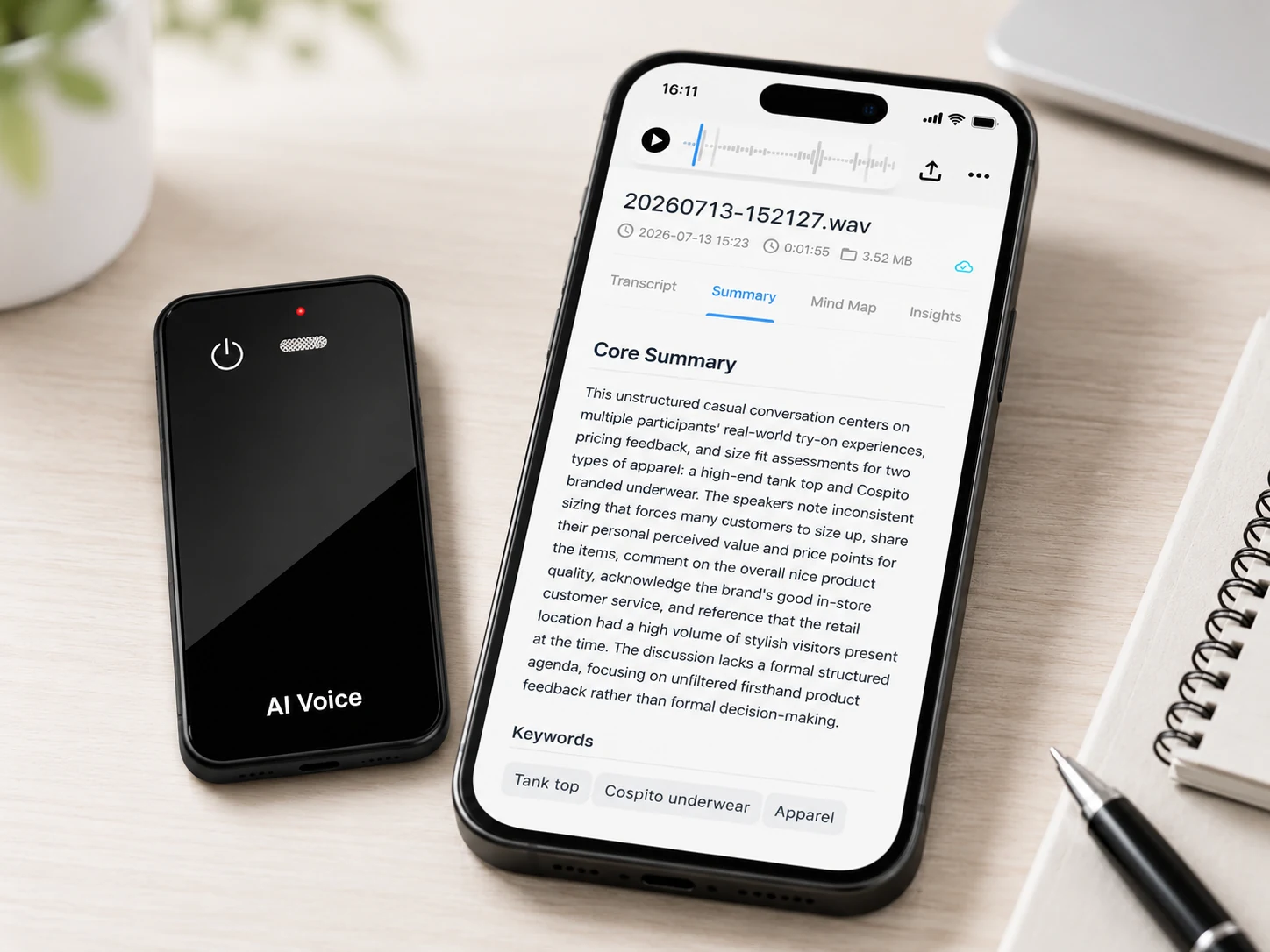
6 Privacy Questions Before Buying an AI Voice Recorder
These questions apply to any AI recorder under US evaluation. They do not replace legal counsel.
1. Does the product provide clear notice and consent support?
A recorder does not resolve consent by itself. The organization still needs a documented notice process, a clear statement of when recording starts and stops, and a way for participants to understand how audio and any derived outputs will be used.
Supplier question: Does the product provide visible recording indicators, and does the supplier describe recommended notice and consent workflows?
2. Where is original audio stored?
The source file may exist on the recorder, on a phone, on a computer, and in one or more cloud locations. Buyers should map every copy, including automatic backups, sync folders, and shared exports.
Supplier question: Where is each copy of the original audio created, and what happens when the user deletes a recording from the primary device?
3. Where are transcripts and AI outputs processed?
Speech-to-text can run on a phone, on a computer, or in a cloud environment. The privacy question is where the selected service processes the buyer’s data.
Supplier question: Which service performs transcription, translation, and summarization? Is the processing location disclosed, and can the buyer select a regional or project-specific deployment?
4. Who can access, export, and delete data?
Access controls should cover the original audio, the transcript, the summary, the mind map, and any shared links. Deletion should address local copies, cloud copies, and any derived exports that other users may have saved.
Supplier question: What deletion scope does the product support, and does removing a recording also remove transcripts, summaries, and shared copies?
5. Is data used for model training?
Some services use uploaded audio or text to improve recognition models. Enterprise buyers should know whether the selected service trains on customer data and whether that behavior can be disabled under a business agreement.
Supplier question: Does the selected AI service use customer audio or transcripts for model training, and is that behavior configurable at the account or project level?
6. What documentation does the supplier provide before deployment?
Privacy assurance is not a single certificate. A useful supplier package should include a data-flow diagram, a description of processing locations, a data-handling policy, supported deletion behavior, and a list of subprocessors if cloud services are involved.
Supplier question: Can the supplier provide a written data-flow description, a data-handling policy, and answers to a security questionnaire before the buyer approves a pilot?
Local Recording vs Cloud AI: Why the Difference Matters
A recorder that saves WAV files locally can reduce the number of data copies created during capture. That matters when the organization wants to separate the initial recording from cloud account activity, phone backups, or platform logs.
However, offline capture and offline AI are different claims. A device may record without an internet connection and still require a phone, an account, and a cloud service before any transcript exists. The buyer should test each function separately:
- Can the device record and save a file with Wi-Fi and mobile data disabled?
- Can the file be played back and exported without reconnecting to a service?
- Which AI functions stop working when the network is unavailable?
A product that claims “offline AI transcription” should demonstrate that claim in airplane mode. If transcription requires a network connection, then the privacy evaluation must include the cloud service, not only the recorder.
AI Voice Recorder Privacy Procurement Checklist
Use this checklist before approving any AI voice recorder for US enterprise or brand deployment.
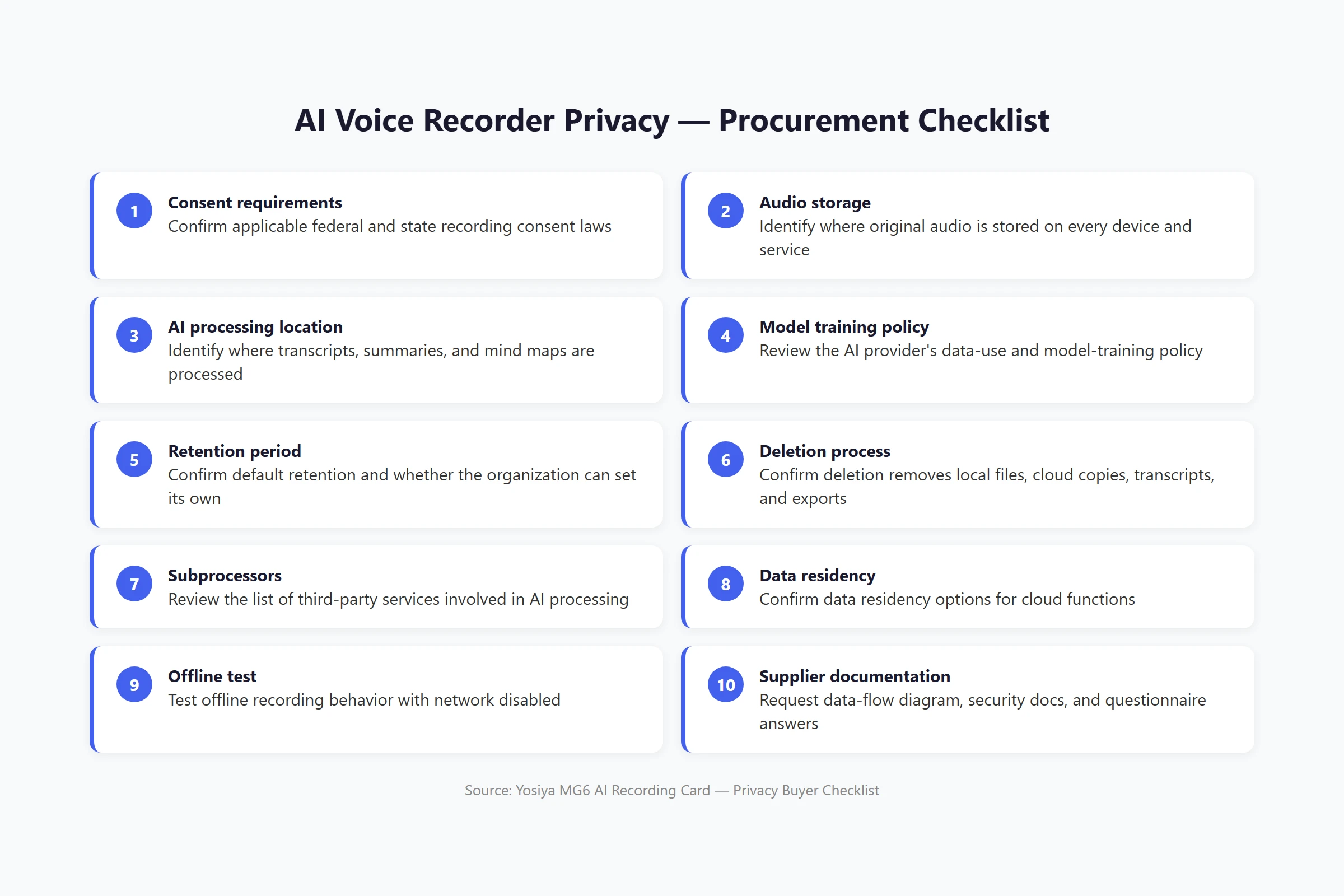
- [ ] Confirm applicable federal and state recording consent requirements
- [ ] Identify where original audio is stored on every device and service
- [ ] Identify where transcripts, summaries, and mind maps are processed and stored
- [ ] Review the AI provider’s data-use and model-training policy
- [ ] Confirm the default retention period and whether the organization can set its own
- [ ] Confirm the deletion process for local files, cloud copies, transcripts, and shared exports
- [ ] Review the list of subprocessors involved in AI processing
- [ ] Confirm data residency options for cloud functions
- [ ] Test offline recording behavior with network disabled
- [ ] Request the supplier’s data-flow diagram, security documentation, and answers to a security questionnaire
This checklist is a procurement tool. It does not replace legal review, but it ensures that every privacy-relevant data flow is visible before the buyer commits to a pilot.
Where This Product Fits
The MG6 AI Recording Card can be evaluated in two separate privacy layers:
Layer 1 — Local recording
- WAV recording on the device without a network connection.
- Configurable local storage for project evaluation; select capacity from measured file growth and retention needs.
- No account required for capture.
- Two omnidirectional microphones with a hardware noise reduction algorithm in the recording path.
Layer 2 — Connected AI
- Transcription, translation (with software open and active network), summaries, and mind maps.
- Dependent on the selected application, service plan, and project configuration.
- Data handling determined by the connected service provider, not the recorder hardware.
This separation allows buyers to evaluate the recording workflow and the AI-processing workflow independently. An organization can approve the local capture layer while separately negotiating data-handling terms for the connected service.
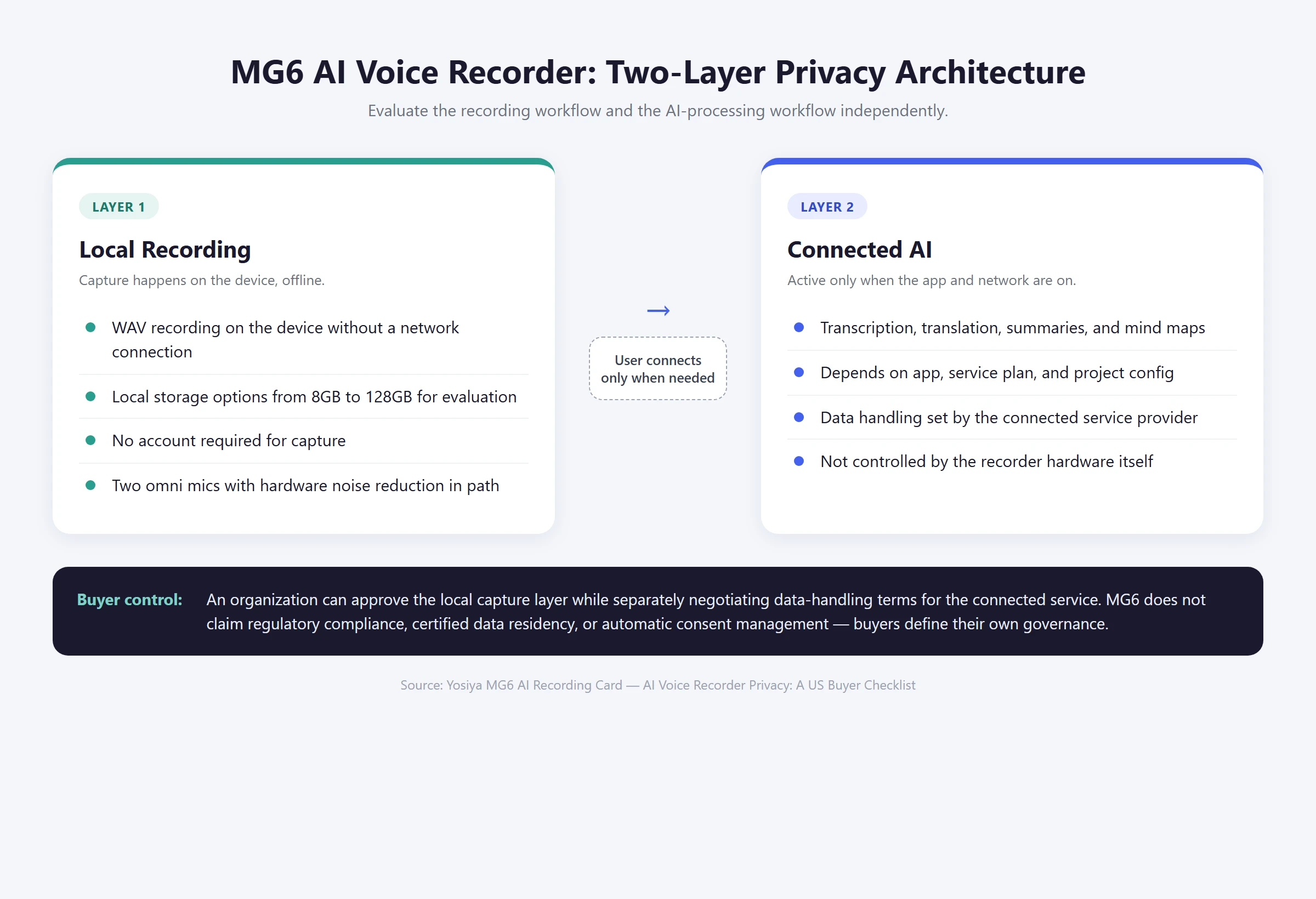
The MG6 does not claim regulatory compliance, certified data residency, or automatic consent management. Buyers must therefore define the required data flow, notice, access, retention, and deletion controls for their selected deployment and verify them in the project documentation.
| MG6 privacy layer | What is confirmed | What requires project-specific verification |
|---|---|---|
| Local WAV recording | Offline capture, local storage, no account for recording | Storage capacity selection, file naming, export workflow |
| Connected AI services | Transcription, translation, summaries, mind maps available when connected | AI service provider, processing location, data-use policy, retention, deletion |
| Administrative controls | Device can be assigned and managed as a fleet | Account management, role-based access, audit trail |
MG6 Privacy Limitations
Evaluating AI voice recorder privacy for the MG6 means accepting some limitations that require project-specific verification:
- The data-handling policy for connected AI services depends on the selected application and service provider.
- Whether the AI service uses customer data for model training is not a hardware question—it is answered by the service agreement.
- Deletion behavior for cloud copies depends on the connected service, not the recorder.
- The MG6 certification package for the new version has not yet been issued; certification documents must be confirmed for the selected production version before shipment.
These limitations apply to every AI recorder that connects to external services. The difference is whether the supplier discloses them.
Admin Controls: What Enterprise Buyers Should Verify
A product page may describe encryption, privacy mode, or secure storage. Those claims become useful only when the buyer can verify how they work in an administrative context.
| Control area | What to verify |
|---|---|
| Device management | Can the organization assign, track, lock, or wipe recorders? |
| Account management | Who creates and disables user accounts for the connected service? |
| File access | Which roles can view, export, or delete recordings and transcripts? |
| Retention | Is there a default retention period, and can the organization set its own? |
| Deletion | Does deletion remove all copies, including transcripts, summaries, and shared links? |
| Audit trail | Can the organization see who accessed or exported a recording? |
| Data residency | Can the buyer select or verify the processing region for cloud functions? |
| Subprocessors | Does the supplier disclose third-party services involved in AI processing? |
Microsoft’s guidance on meeting recording governance in Teams shows how platform-native tools connect recordings to admin controls, retention policies, and permissions. A dedicated recorder with connected services should offer comparable transparency at the data-flow level, even if the architecture is different.
Google Meet’s transcript documentation similarly connects transcripts to host controls, storage, and organizational retention. These platform controls illustrate the governance baseline that enterprise buyers should expect from any recording solution.
FAQ
Is an AI voice recorder legal in the US?
An AI voice recorder is not inherently legal or illegal. Whether a recording is permitted depends on applicable federal and state law, the location of the participants, the type of conversation, and whether required notice or consent has been obtained. This article is a procurement and privacy checklist, not legal advice. Organizations should consult qualified legal counsel before establishing a recording policy.
Does local recording mean the data stays private?
Local recording means the initial file is saved on the device. It does not prevent the user from transferring, uploading, or sharing that file later. It also does not control what happens when the audio is sent to a connected service for transcription or summarization.
Where are AI transcripts and summaries stored?
That depends on the product and the selected service. Some products store transcripts on a phone or computer; others store them in a cloud account. Buyers should identify the storage location for every output type—audio, transcript, summary, mind map, and shared export.
Can an AI voice recorder use my data to train AI models?
Some services use customer audio or transcripts to improve their models. Enterprise buyers should ask whether the selected service trains on customer data and whether that behavior can be disabled. The answer should come from the service provider’s current documentation, not from a general privacy statement.
What should procurement request before approving an AI voice recorder?
Request a data-flow description, a data-handling policy, the processing location for each AI function, supported deletion behavior, a list of subprocessors if applicable, and answers to a security questionnaire. If the supplier cannot provide these documents, the privacy risk is not the recorder hardware—it is the unknown connected layer.
Request the MG6 Privacy and Security Documentation
Evaluating AI voice recorders for your brand or enterprise deployment? Ask the MG6 team for the product data-flow overview, security questionnaire, and OEM/ODM specifications before starting a pilot. The MG6’s separation of local recording and connected AI processing gives procurement teams the ability to evaluate privacy at each layer independently—without accepting a single vendor’s assumptions about consent, data residency, or model training.


