
An enterprise voice recorder deployment should move through controlled stages: define the business workflow, freeze the proposed hardware and service configuration, run a representative pilot, resolve policy and support gaps, then expand by department. Treat the recorder, transfer method, user account, AI service, exports, and retained source audio as separate managed assets. Assign owners for device custody, access, training, privacy, retention, support, and offboarding before distribution. A successful five-device demonstration proves only that the sample workflow can work; it does not establish fleet administration, remote control, security configuration, or support capacity unless those functions are documented and tested.
What Buyers Should Know
- Start with one defined workflow and measurable pilot outcomes.
- Keep device inventory separate from app and AI-service account inventory.
- Confirm administration, updates, lost-device response, and offboarding in writing.
- Train users on capture, transfer, review, consent, and retention duties.
- Expand only after evidence owners close or accept pilot gaps.
Define the deployment outcome before ordering devices
“Deploy AI recorders” is too broad for an accountable program. Write one operational statement describing who records, what they capture, where files move, which outputs are required, who approves them, and when every copy is deleted or retained.
For example: a sales operations team records approved customer-discovery calls, transfers the source WAV to an authorized workspace, reviews the transcript and summary, links approved notes to a project ID, and disposes of temporary copies under company policy. That statement exposes decisions that a feature list hides.
Use a pilot charter with these fields:
| Field | Pilot decision |
|---|---|
| Users | Named roles and approved locations |
| Recording purpose | Specific business process |
| Hardware configuration | Model, storage, firmware, accessories, branding |
| Connected service | Provider, plan, language, outputs, account owner |
| Data flow | Device, transfer endpoint, processing, exports, backups |
| Success measures | Capture completion, correction time, support cases, policy exceptions |
| Exit rule | Return, export, deletion, account closure, and evidence |
Do not begin with an enterprise-wide quantity. Begin with enough devices and representative users to expose workflow problems without making the pilot difficult to supervise.
Record the baseline process as well. Without current completion time, error rates, and support effort, the team cannot judge whether the pilot improves operations.
Assign ownership across hardware and services
A recorder fleet crosses several teams. A role matrix prevents every issue from landing with the person who ordered the samples.
| Activity | Accountable role | Supporting roles |
|---|---|---|
| Approved use cases | Business process owner | Legal, privacy, operations |
| Device inventory and assignment | IT asset owner | Department coordinator |
| Recording notice and training | Program owner | Legal, HR, team manager |
| App and AI-service accounts | Service administrator | Identity and security teams |
| Retention and deletion | Data owner | Privacy, records, IT |
| Firmware and application changes | Technical owner | Supplier, QA, help desk |
| Incident and lost-device response | Security or IT owner | Manager, supplier, privacy |
| Offboarding and return | IT asset owner | HR, department coordinator |
The NIST Privacy Framework offers a voluntary structure for identifying data processing and governing privacy risk. It does not prescribe one deployment design or certify a recorder. Use it to make responsibilities, data uses, and risk decisions visible.
Build two linked inventories
The physical inventory should include asset ID, device identifier, storage configuration, firmware, assigned user, issue date, location, accessories, condition, and return status. The service inventory should include account ID, role, plan, permissions, language or model settings, connected storage, export rights, and termination status.
Link both inventories through a deployment ID without placing unnecessary personal information in a broad asset list. A device can be returned while its cloud account remains active; an account can be disabled while a source file remains on the recorder. One combined “active/inactive” field cannot represent those states safely.
The NIST IoT Device Cybersecurity Capability Core Baseline describes capabilities organizations can consider for devices, including identification, configuration, data protection, interface control, software update, and cybersecurity-state awareness. It is guidance, not evidence that MG6 implements every capability. Convert relevant capabilities into supplier questions and acceptance tests.
Use stage gates from pilot to department rollout
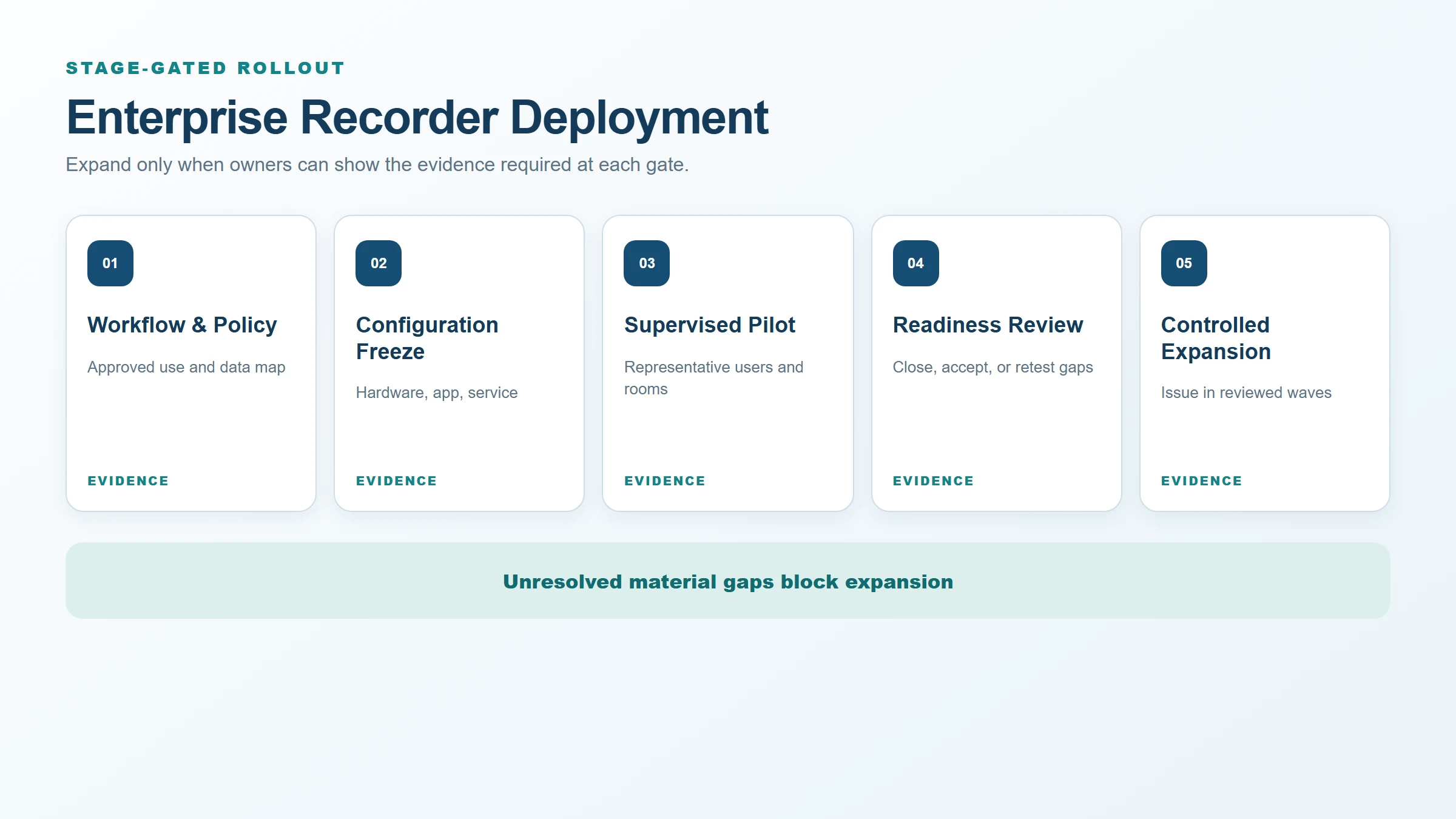
Stage 1: workflow and policy readiness
Approve the use case, data map, notice process, retention rules, prohibited uses, owner matrix, and incident path. Confirm whether the device will ever hold customer, employee, regulated, confidential, or export-controlled information.
Stage 2: configuration freeze
Record the exact hardware sample, storage option, firmware, app build, AI provider, plan, settings, accessories, and packaging. A material change creates a new configuration that may require partial retesting.
Stage 3: supervised pilot
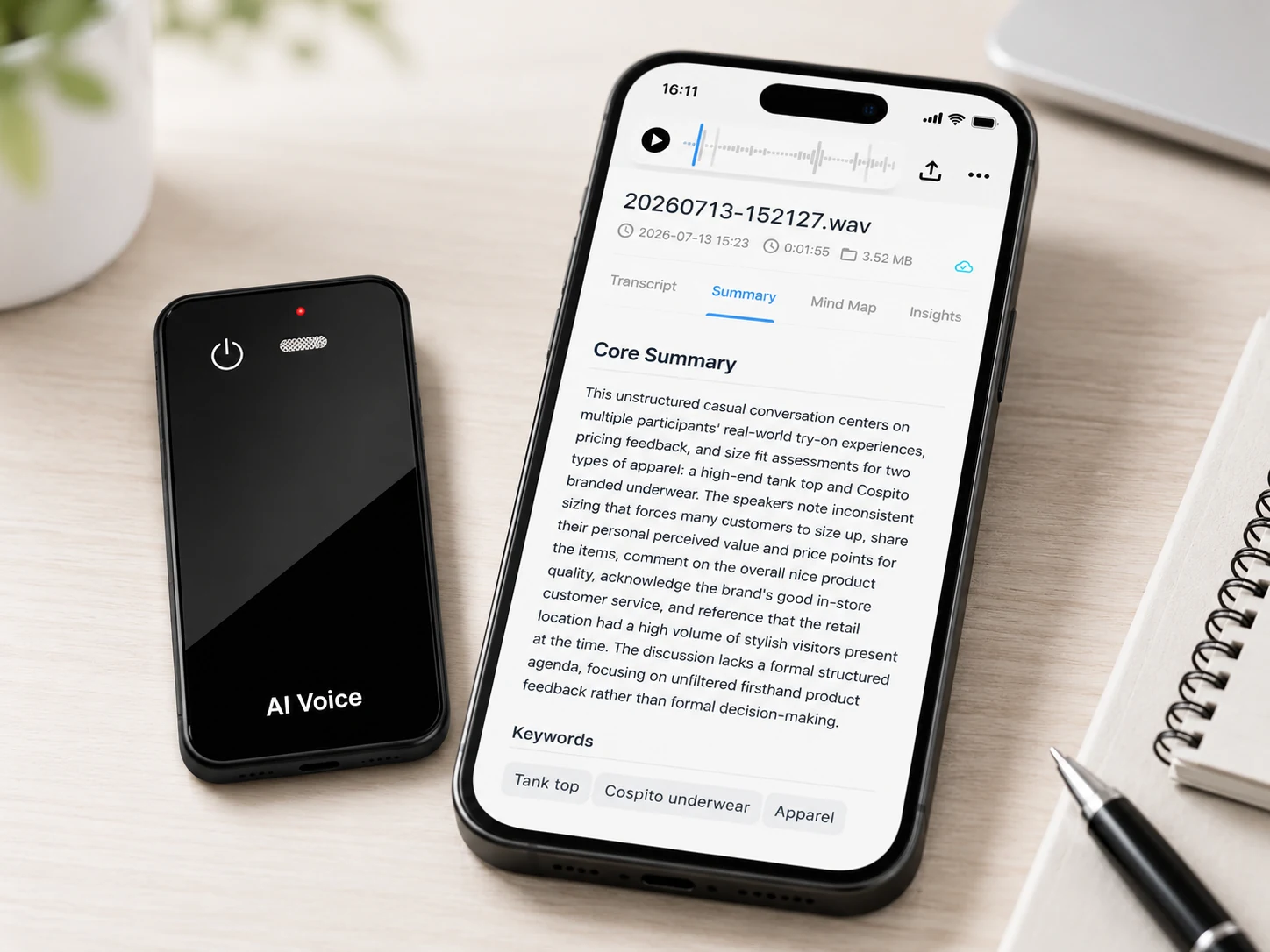
Use representative rooms, meeting sizes, accents, network conditions, and user roles. Track successful capture, failed transfer, unusable audio, transcript correction time, unsupported output, policy exception, lost-device drill, and help-desk effort.
Stage 4: readiness review
Classify every gap as resolved, accepted with an owner, requiring retest, or blocking expansion. Verify that training, inventory, account setup, return procedures, and supplier support can handle the proposed department volume.
Stage 5: controlled expansion
Issue devices in waves, reconcile inventory, review support trends, and suspend distribution when a material configuration or policy gap appears. A rollout calendar should include review dates rather than assuming continuous expansion.
Test administrative claims before relying on them
Do not infer enterprise controls from the word “AI” or from a mobile application. Ask the proposed supplier to demonstrate each required function.
| Control question | Evidence to request |
|---|---|
| Can accounts use centralized identity or SSO? | Supported protocol, configuration guide, and test account |
| Can admins see device assignment and status? | Admin view, export, role permissions, and refresh behavior |
| Can data be remotely deleted from a lost device? | Documented scope, prerequisites, timing, and failed-device behavior |
| How are firmware and app updates delivered? | Update policy, authorization method, release notes, and rollback path |
| Can exports be restricted? | Role test and supported output controls |
| What happens when a user leaves? | Account disablement, file transfer, retention, and deletion procedure |
NIST SP 800-213 shows how organizations can translate system cybersecurity needs into device, manufacturer, and third-party requirements for federal IoT procurement. Private organizations can use its requirement-oriented approach as a reference, but it is not a universal mandate.
Train for the full workflow
A short hardware demonstration is insufficient. Training should cover when recording is permitted, how to state notice, placement and handling, job or meeting identifiers, offline capture, transfer, source-file preservation, transcript review, summary verification, export restrictions, deletion, loss reporting, and support escalation.
Use a supervised exercise:
- Assign a test device and account.
- Record an approved sample meeting.
- Confirm the file and stable identifier.
- Transfer it through the authorized route.
- Review the transcript and any derivative output.
- Export only to the approved location.
- Apply the defined retention or deletion action.
- Return the device and close the account record.
Record where users hesitate. A workflow that requires undocumented workarounds will become inconsistent when the rollout grows.
Prepare for loss, repair, reassignment, and exit
The FTC’s business data-protection guide recommends knowing what personal information the business holds, keeping only what it needs, restricting access, and disposing of information appropriately. For a recorder fleet, those principles should appear in concrete custody and data procedures.
Define what happens when a device is lost, damaged, returned for repair, reassigned, or retired. State who receives the report, which account actions occur, how local files are assessed, whether the service provider is contacted, and what evidence closes the case.
NIST SP 800-88 Revision 2 provides risk-based media-sanitization guidance for reuse, disposal, or release from organizational control. Ordinary file deletion should not be described as verified media sanitization without evidence appropriate to the storage technology and device.
Deployment teams can use the AI voice-recorder privacy guide to develop data questions and the AI voice-recorder OEM sourcing checklist to translate them into supplier evidence. The dedicated recorder versus meeting bot comparison helps define which meeting types belong in the rollout.
Where This Product Fits
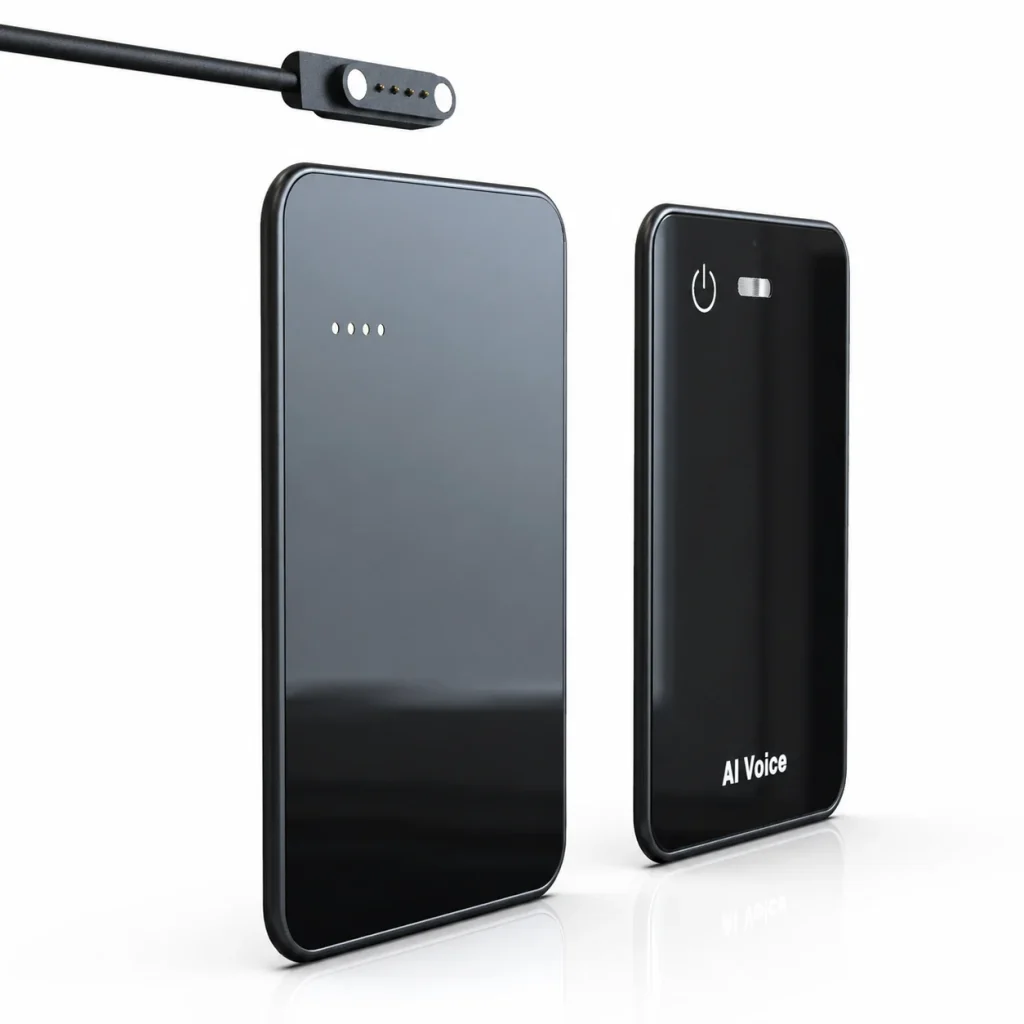
The MG6 AI Recording Card is a card-sized recorder platform for OEM and ODM evaluation and supports offline WAV recording. Configurable hardware and packaging can support an organized product project. Connected AI services can be scoped for transcription and derivative outputs according to the project.
| Deployment area | Confirmed reference scope | Must be confirmed |
|---|---|---|
| Hardware | Card-sized MG6 platform and offline WAV capture | Final storage, firmware, accessories, branding, packaging, and production configuration |
| Connected workflow | Project-dependent AI services | Provider, plan, accounts, languages, exports, administration, and data flow |
| Fleet management | No public standard claim | Console, inventory integration, SSO, role control, remote action, and audit logs |
| Support | Project evaluation and supplier discussion | Service levels, replacements, escalation, update period, and exit assistance |
Do not promise SSO, a fleet console, remote wipe, or centralized policy enforcement unless the proposed configuration includes documented and tested support.
FAQ
How many devices should an enterprise pilot include?
Use enough devices to cover representative roles, rooms, shifts, and workflows while keeping supervision practical. The right number depends on variation and risk, not a universal percentage of the future fleet.
Who should own recorder accounts?
Assign a named service administrator and a business data owner. Avoid unmanaged personal accounts when the organization needs offboarding, retention, export control, support, or audit evidence.
How should lost devices be handled?
Create a documented reporting path, identify affected local and connected data, take available account actions, assess notice or incident duties, and record closure evidence. Do not assume remote wipe exists.
What training is required?
Cover approved use, notice and consent, device handling, capture checks, identifiers, transfer, review, export, retention, loss reporting, and return. Include a supervised end-to-end exercise.
How should the deployment be reviewed?
Review capture success, correction time, policy exceptions, support load, inventory reconciliation, account status, incidents, configuration changes, and unresolved supplier gaps at scheduled stage gates.
Plan an MG6 pilot configuration
Prepare the workflow statement, role matrix, required controls, and pilot scorecard before requesting quantities. Contact Yosiya to discuss a project-specific MG6 hardware, packaging, connected-service, sample, and rollout configuration.


