
A speaker diarization test should answer a narrow question: did the system assign each spoken segment to the correct participant? Use one human-annotated meeting as the reference, test ordinary turn-taking and deliberate overlap, and score missed speech, false speech, speaker confusion, and correction time separately. Do not treat labels such as “Speaker 1” as verified identities, and do not use transcript word accuracy as a substitute for attribution accuracy. For a recorder workflow, preserve the original audio so reviewers can resolve disputed turns and rerun the same file after a service or configuration change.
What Buyers Should Know
- The system detects speaker changes at the right time.
- Words remain attached to the right speaker during short turns.
- Similar voices do not collapse into one label.
- One person is not split into several labels without cause.
- Overlapping speech is reported, missed, or flattened in a documented way.
- Reviewers can rename and correct labels without losing timestamps or text.
- The exported result preserves the attribution needed downstream.
These checks matter because diarization and speech recognition solve different problems. A transcript can contain the right words and still credit a commitment to the wrong person. It can also assign speakers correctly while misspelling a technical term. Procurement teams should keep those failures in separate columns.
Define speaker diarization before scoring it
Speaker diarization answers “who spoke when” by grouping speech under distinct labels. Google Cloud’s speaker diarization documentation explains that the service detects voice changes and applies numbered speaker labels to words. Amazon Transcribe’s speaker partitioning documentation similarly returns speaker labels and timestamps. In both examples, a label identifies a cluster in that output; it is not proof of a person’s legal or organizational identity.
Keep three tasks separate:
| Task | Question | Typical output |
|---|---|---|
| Speech recognition | What words were spoken? | Transcript text |
| Speaker diarization | Which segments belong to the same voice? | Speaker 0, Speaker 1, timestamps |
| Speaker identification | Which known person produced that voice? | A verified or enrolled identity |
A vendor interface may let a user rename “Speaker 2” as “Jordan.” That editing feature does not mean the system authenticated Jordan. The distinction should appear in the acceptance record and in any product claim.
Build a reference meeting that exposes attribution errors
A clean two-person exchange is useful as a baseline, but it is too easy to serve as the entire evaluation. Create one compact meeting with planned conditions that match the intended use.
| Segment | Test design | Failure it can expose |
|---|---|---|
| Baseline | Two speakers alternate in full sentences | Basic label separation |
| Short turns | Several one- to three-word responses | Late speaker-change boundaries |
| Similar voices | Two participants with comparable pitch or delivery | Merged speaker clusters |
| Returning speaker | One person leaves the conversation and speaks again later | Unnecessary new label |
| Crosstalk | Brief, natural overlap between two people | Missed or flattened overlap |
| Non-speech | Silence, chair noise, typing, and paper movement | False speech assignments |
| Distant participant | One participant sits farther from the recorder | Weak or inconsistent attribution |
Use participants who have agreed to the recording and follow the organization’s applicable notice and consent process. Record each participant’s reference label in a private test key. Mark exact speech intervals by listening to the source audio, then have a second reviewer resolve uncertain boundaries. The reference should show simultaneous labels when two people truly overlap rather than forcing every instant into one-speaker-only turns.
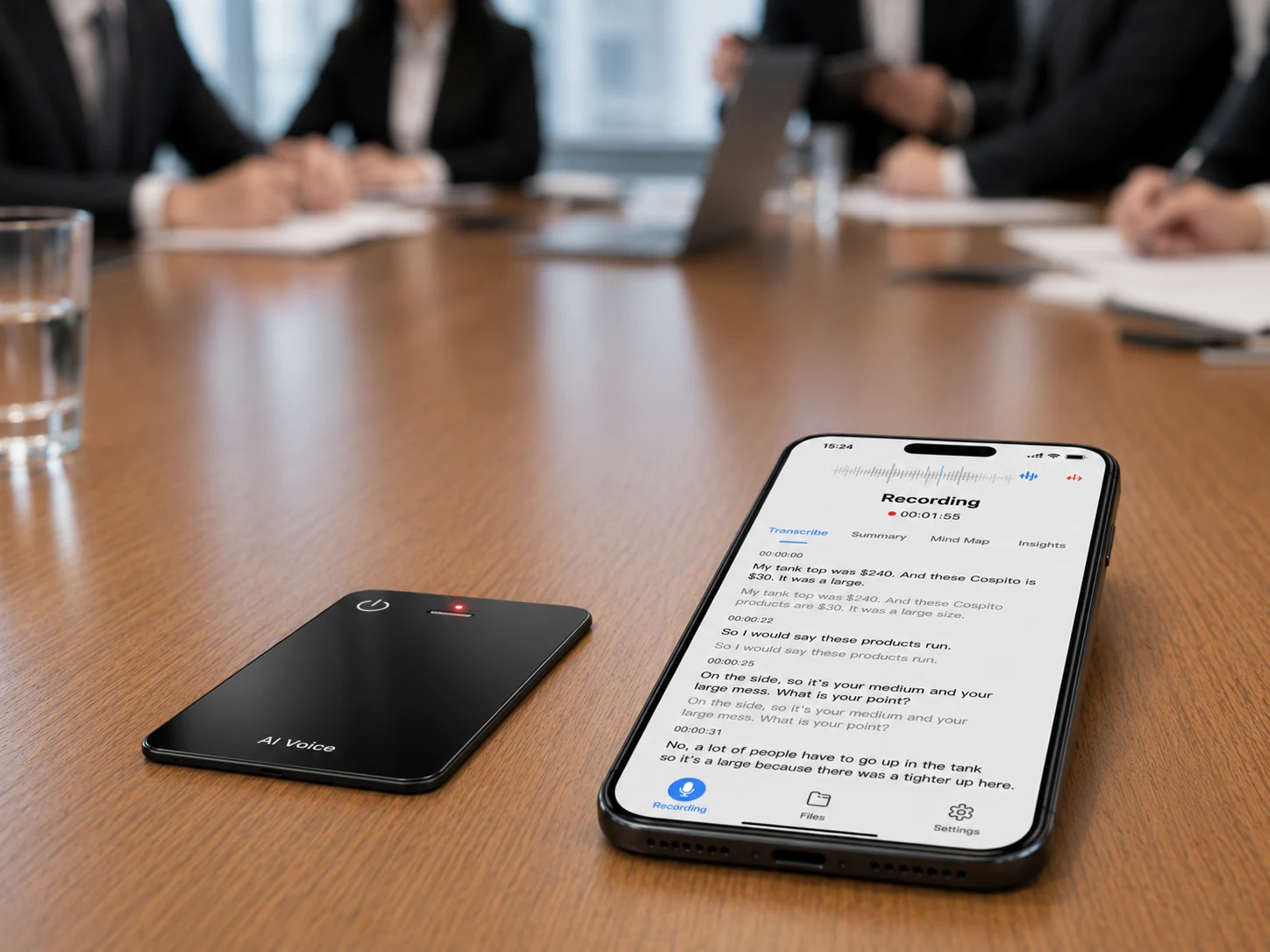
Microphone position is part of the test condition. Use the same location and file for every candidate service. Record the table position, participant seats, nearby noise, and room condition before evaluating downstream AI results.
Score four error types instead of one headline percentage
The established diarization error rate framework counts time affected by missed speech, false-alarm speech, and speaker confusion. Research on evaluation with overlapping speech also shows why overlap handling must be declared rather than silently removed from scoring. The INTERSPEECH paper on overlap-aware evaluation discusses diarization error rate and word error rate as different measures under overlapping conditions.
Use this buyer-facing scorecard:
| Measure | What to count | Buyer interpretation |
|---|---|---|
| Missed speech | Reference speech with no assigned speaker | Content may disappear from attributed output |
| False alarm | Non-speech marked as speech | Noise can create misleading segments |
| Speaker confusion | Speech assigned to the wrong reference speaker | Statements may be credited incorrectly |
| Boundary error | Speaker change placed too early or too late | Short responses may attach to a neighbor |
| Label fragmentation | One person receives multiple system labels | Review and merging workload rises |
| Label merging | Different people receive one system label | Accountability and search become unreliable |
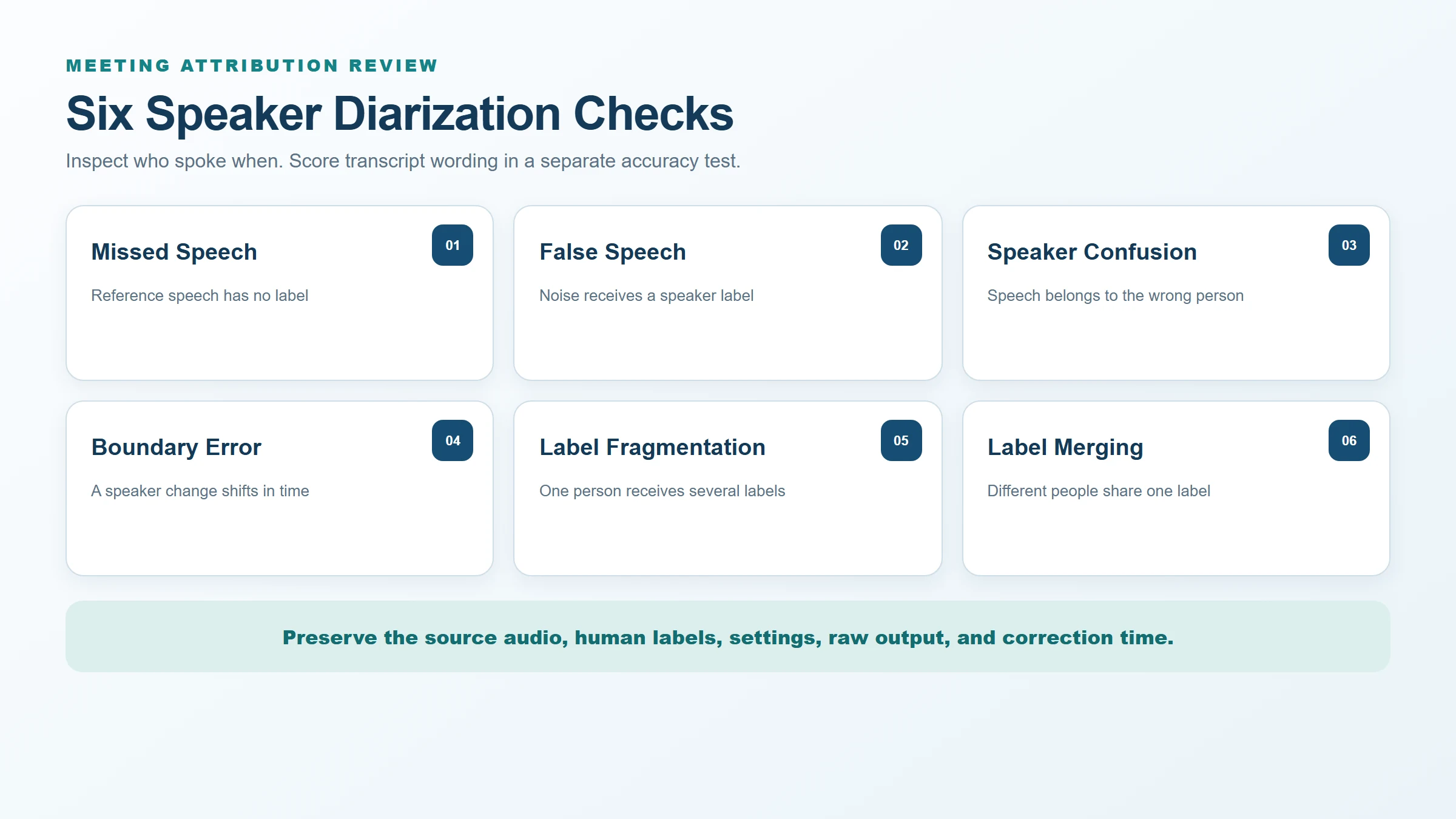
If the team has the tooling and expertise, calculate a formal duration-based diarization error rate under a written scoring protocol. If it does not, use annotated segments and count each material attribution failure. Do not present an informal percentage as a standard benchmark. State whether overlap is included, whether a tolerance collar is applied around speaker-change boundaries, and how unmapped system labels are matched to reference speakers.
Add a word-level ownership check
Duration-based scoring is useful for engineering, but a buyer often needs to know whether important words belong to the right person. Select business-critical statements in the meeting and test attribution at the word or utterance level:
- Who approved the decision?
- Who accepted an action item?
- Who stated a number, date, price, or deadline?
- Who raised an objection or used a negative expression?
- Can a reviewer jump from the statement to the matching audio?
Run ordinary transcript accuracy as a separate measurement. Microsoft’s speech-model evaluation guidance compares output with a human reference and calculates word error rate from substitutions, deletions, and insertions. That method helps establish whether the words are correct; the diarization test establishes whether they belong to the right person.
The NIST Rich Transcription evaluation program historically treated speech-to-text, speaker diarization, and speaker-attributed transcription as distinct meeting-processing tasks. Its old benchmark results are not acceptance targets for a current product, but the task separation remains a useful design principle.
Test service settings and exports, not only the screen
Record the exact service, model or version when disclosed, language, speaker-count setting, processing mode, account tier, date, and export format. Google’s documentation, for example, exposes minimum and maximum speaker-count configuration for some recognition requests. AWS documents a maximum-speaker-label setting. These are service-specific controls and do not establish what another provider supports.
Test these operational details:
- Enter the expected speaker count correctly, then test a deliberately incorrect count.
- Rename labels, refresh the page, and reopen the project.
- Correct one wrongly attributed passage and check whether the correction persists.
- Export to each required format and confirm that speaker names and timestamps survive.
- Search for a speaker in the exported result.
- Reprocess the same audio and compare label stability.
- Measure review time from first opening to approved transcript.
Do not compare one service’s edited transcript with another service’s untouched output. Preserve the raw first result, the corrected result, and the final export under the same test ID.
Diarization results should be reviewed alongside the AI meeting-recorder hardware guide because speaker labels cannot repair missing or incorrect words. Teams evaluating interview workflows can also use the interview recorder with transcription guide to define role labels and review responsibilities.
Where This Product Fits
The MG6 AI Recording Card supports offline WAV recording. That local source file can be retained for human verification and submitted to the selected connected workflow under a controlled test. Connected AI services can support transcription, translation, summaries, and mind maps depending on the project configuration.
| Evaluation layer | Confirmed MG6 reference scope | Point requiring confirmation |
|---|---|---|
| Capture | Offline WAV source recording | Actual acoustic result under the buyer’s room conditions |
| Transfer | Files can enter a connected workflow | Exact app, transfer path, permissions, and supported formats |
| Diarization | No public standard MG6 diarization claim | Provider, language, speaker limits, settings, and exports |
| Review | Source audio permits human checking | Editing interface, audit trail, and reviewer roles |
MG6’s microphones do not by themselves prove that a connected service offers speaker diarization. Likewise, a service feature page does not prove performance with an MG6 file. Request the proposed service scope in writing and test it with representative recordings.
Use an acceptance record that supports a decision
Set thresholds before viewing the results. A practical record can use blank buyer-defined limits rather than an invented universal pass mark.
| Acceptance item | Planned threshold | Result | Evidence | Decision |
|---|---|---|---|---|
| Speaker confusion | ___ | ___ | Marked reference and output | ___ |
| Missed speech | ___ | ___ | Time-coded comparison | ___ |
| Overlap handling | ___ | ___ | Overlap segment review | ___ |
| Critical statement ownership | ___ | ___ | Decision/action checklist | ___ |
| Label correction time | ___ | ___ | Reviewer timing log | ___ |
| Export continuity | ___ | ___ | Reopened export file | ___ |
Reject a polished demonstration that does not preserve its source, settings, reference, and unedited output. Those artifacts make a later retest possible when the app, model, firmware, or service plan changes.
FAQ
Is speaker diarization the same as voice recognition?
No. Speaker diarization groups speech by voice and time. Voice or speaker recognition may attempt to match a voice to a known identity. A numbered diarization label should not be treated as identity verification.
How many speakers should be included in the test?
Use the range expected in real meetings and include at least one harder case. A two-person baseline is useful, but a team workflow should also test short turns, a returning speaker, similar voices, and realistic distance.
How should overlapping speech be scored?
Mark overlap explicitly in the human reference and state whether it is included in the metric. Review both speakers’ critical words separately. Do not silently remove overlap and then describe the result as representative of the whole meeting.
Can a system assign participant names automatically?
Some services may support enrollment, identification, or user-assisted naming, while others provide only anonymous labels. Confirm the exact mechanism, consent requirements, persistence, and correction workflow for the proposed service.
What evidence should a vendor provide?
Request the original test audio, annotated reference, service configuration, raw output, scoring rules, error counts, corrected export, and reviewer time. Product literature alone does not show performance in the buyer’s rooms and meetings.
Test the proposed MG6 workflow
Use one approved multi-speaker WAV file and the scorecard above to evaluate the proposed service. Contact Yosiya to confirm the MG6 capture, transfer, connected AI, speaker-label, export, and sample-test scope for your project.


