

A voice recorder data retention policy should cover every copy created from a recording: source audio on the device, transferred files, app caches, cloud uploads, transcripts, summaries, exports, collaboration copies, backups, and support logs. For each copy, assign an owner, purpose, access rule, retention trigger, retention period, legal-hold exception, deletion method, and verification record. Deleting the transcript visible in an app does not establish that the source audio, derived notes, synced copy, or backup has also been removed. Buyers should map the proposed MG6 workflow before purchase and confirm connected-service behavior in writing because local recording and cloud data handling are separate layers.
What Buyers Should Know
- Inventory audio and every derivative or exported copy separately.
- Set retention from a documented purpose and trigger rather than an arbitrary default.
- Define how holds, recovery windows, backups, and contract termination affect deletion.
- Test user deletion, administrator visibility, export locations, and provider evidence.
- Give device reuse and disposal their own media-handling procedure.
Start with a copy inventory
Retention cannot be managed from a single “recording” row if the workflow creates several related objects. Begin with a test meeting and follow it from collection to final disposition.
| Data object | Possible location | Why it needs its own rule |
|---|---|---|
| Source audio | Recorder storage | It may remain after transfer |
| Transferred audio | Phone, computer, shared drive | Users can create unmanaged duplicates |
| Upload copy | AI service or processing provider | Service controls may differ from device controls |
| Transcript | App, web workspace, export | Text can contain the same sensitive content as audio |
| Speaker labels | Transcript metadata | Labels may increase identifiability |
| Summary and action items | App, email, project system | Derived content may outlive the transcript |
| Backup or recovery copy | Service or enterprise backup | User deletion may not immediately affect recovery data |
| Support and diagnostic data | Vendor support systems | Troubleshooting can create another handling path |
The FTC’s guide for protecting personal information advises businesses to know what personal information they hold, keep only what they need, protect it, and dispose of it appropriately. The guide is general business guidance rather than a retention schedule for recordings. Each organization still needs legal, contractual, operational, and records-management input for its own periods.
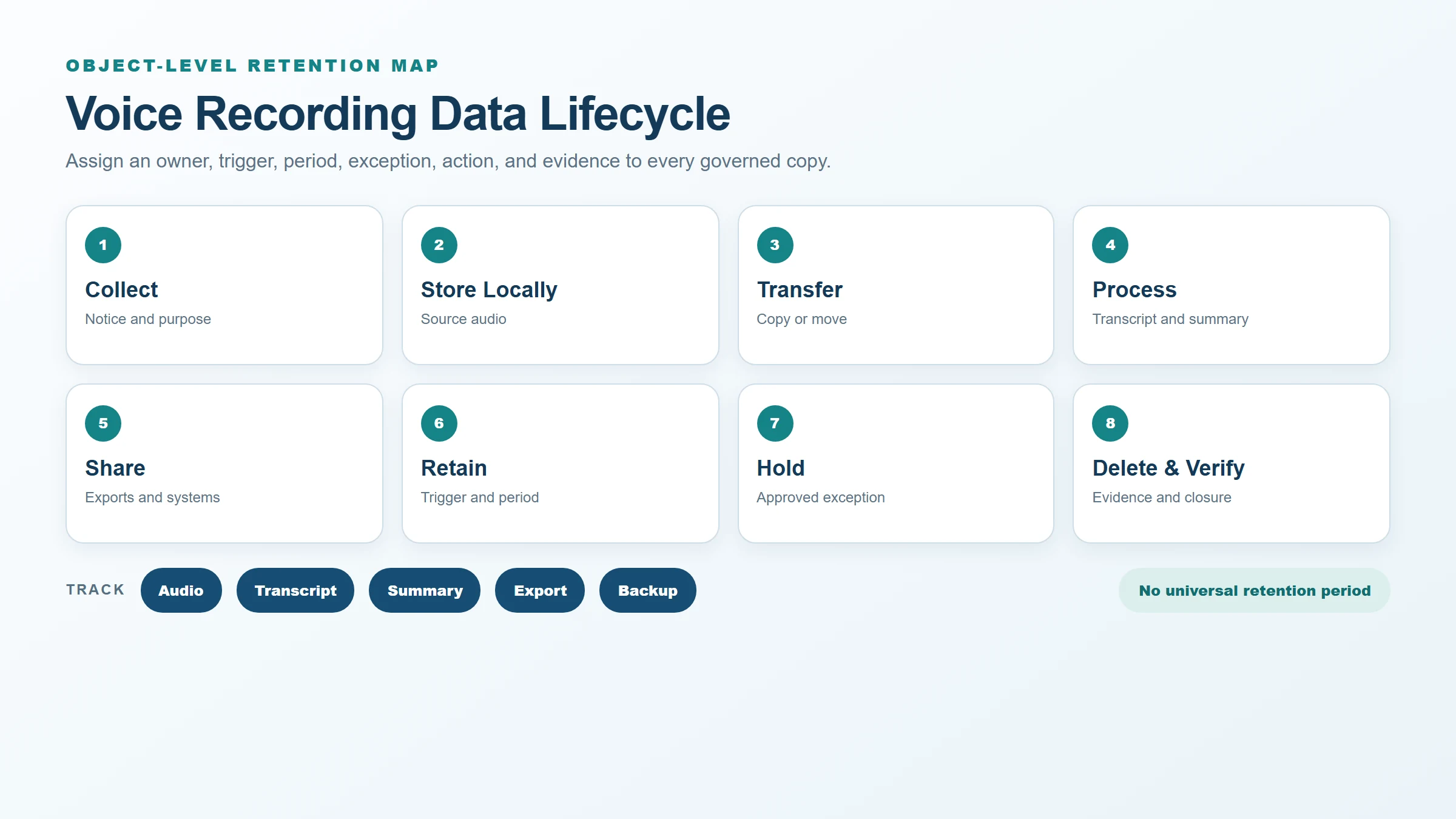
Draw the lifecycle before choosing periods
A useful map begins when someone starts recording and ends only when every governed copy reaches its approved outcome. Include manual exports and integrations, because those routes often move content outside the original service’s controls.
- Collect: Who can start a recording, and what notice or consent process applies?
- Store locally: Where does the source file reside, and who can access the device?
- Transfer: Is the file copied or moved, and can it remain on both endpoints?
- Process: Which service receives audio, and what derivative objects are created?
- Share: Can users email, download, or send content to another system?
- Retain: Which event starts the clock for each object?
- Hold: Which legal, investigation, or records obligation can suspend deletion?
- Delete and verify: What action occurs in each location, and what evidence is available?
Do not choose “30 days” or “one year” merely because an application offers that menu. Start from purpose and applicable obligations. A recruiting interview, customer call, product-research session, board meeting, and casual voice memo can have different business needs and risk.
The NIST Privacy Framework is a voluntary risk-management tool that helps organizations identify data processing and govern privacy risk. It does not set a mandatory retention period. Its value here is structural: document the processing environment, roles, purposes, and risk decisions before configuring a product.
Define one rule for each object and trigger
A policy row should be specific enough for an administrator to implement and an auditor to test.
| Field | Question to answer |
|---|---|
| Object | Audio, transcript, summary, speaker label, export, cache, or backup? |
| System | Device, app, AI provider, file share, email, CRM, or backup platform? |
| Owner | Which business role approves the rule? |
| Purpose | Why is the object retained? |
| Trigger | Recording date, project close, contract end, case closure, or another event? |
| Period | How long after the trigger? |
| Hold rule | What suspends ordinary deletion? |
| Action | Delete, anonymize, archive, or review? |
| Evidence | Log, report, ticket, certificate, or sampled verification? |
Use consistent identifiers so related objects can be traced. If meeting MR-0042 creates an audio file, transcript, summary, and two exports, the inventory should preserve that relationship without exposing more personal data than necessary.
Avoid a policy that says only “meeting recordings are deleted after 90 days.” It leaves unanswered whether the period begins at creation or last modification, whether summaries follow the same rule, and whether an active investigation overrides deletion.
Distinguish user deletion from final disposition
A delete button describes one interface action. It does not reveal every backend step. Microsoft’s documentation for retention policies and labels illustrates why this distinction matters: content subject to retention can be preserved in hidden locations after a user edits or deletes the visible item, and competing retention or hold rules affect permanent deletion. That behavior is specific to Microsoft 365, but it provides a concrete question for any supplier: what happens after a user deletes an item?
Ask the service provider to explain:
- Whether deletion removes only a workspace reference or the underlying object.
- Whether audio and transcript deletion are separate actions.
- Whether summaries, embeddings, indexes, and exports remain.
- Whether soft-delete or recovery windows apply.
- How backup expiration differs from production deletion.
- Whether legal hold, fraud review, or account disputes suspend deletion.
- Whether administrators receive a log or disposition record.
- What happens after contract termination or account closure.
Do not promise immediate erasure unless the contract and verified technical behavior support it. Likewise, do not assume that a backup should be modified item by item; some systems expire protected snapshots according to a separate backup policy.
Treat device storage and cloud copies differently
The source recorder is physical media under the organization’s custody. A connected AI service is a separate processing environment. Their controls, administrators, and deletion evidence may differ.
NIST SP 800-88 Revision 2, published in September 2025, describes risk-based media sanitization for media reuse, disposal, or release from organizational control. It distinguishes sanitization from an ordinary visible deletion action and tells organizations to coordinate sanitization with applicable retention obligations. It does not certify a specific recorder or prescribe one method for every flash device.
For a deployed recorder fleet, define procedures for:
- Routine deletion while the device remains assigned to one user.
- Reassignment to another employee or contractor.
- Return of a sample or loan unit.
- Repair by a supplier or third party.
- Lost, damaged, or inaccessible units.
- End-of-life disposition.
The correct method depends on the storage technology, sensitivity, product capabilities, and organizational requirements. Request documented device behavior instead of claiming that removing a file provides media sanitization.
Verify the policy with one controlled recording
Turn the written lifecycle into an acceptance test before rollout.
- Create a non-sensitive test recording with a unique phrase and ID.
- Transfer it through every proposed route.
- Generate the transcript, summary, and any speaker labels included in scope.
- Export content in every permitted format.
- Record each system and user account where a copy appears.
- Apply the ordinary deletion action.
- Check user search, admin search, integrations, recycle bins, and recovery locations.
- Request evidence for provider-managed copies and backup expiration.
- Repeat with a hold or exception if that control is required.
- Record unresolved copies, timing, and ownership before acceptance.
This test should verify documented behavior, not attempt to access systems without authorization. If a provider cannot expose backend evidence directly, the contract can define attestations, deletion timelines, escalation paths, and audit evidence.
Retention decisions connect directly to the broader AI voice-recorder privacy guide and the practical question of how much recorder storage a deployment needs. Buyers sourcing a branded fleet should carry both decisions into the AI voice-recorder OEM checklist.
Where This Product Fits
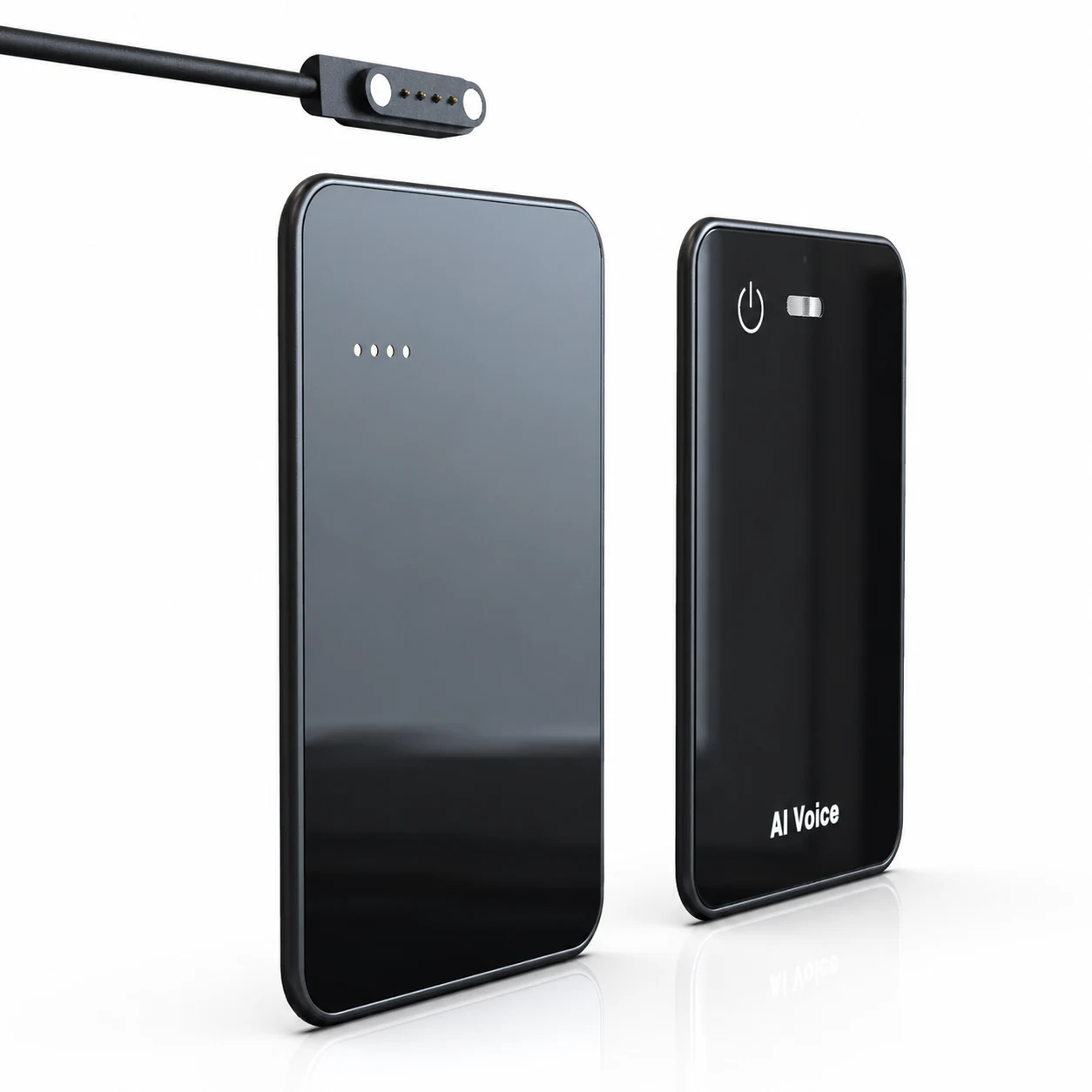
The MG6 AI Recording Card supports offline WAV recording. Connected AI services can support transcription, real-time translation, summaries, and mind maps, with exact scope depending on the project. This separation can help a buyer map capture and processing as different layers, but it does not by itself establish a full retention or deletion program.
| Layer | Confirmed reference scope | Required project evidence |
|---|---|---|
| Device | Offline WAV source recording | File deletion, storage handling, reset, reassignment, and service procedures |
| Transfer | Connected workflow can follow capture | Exact route, temporary copies, permissions, and transfer logs |
| AI service | Connected outputs can be included by project | Provider, hosting, subprocessors, retention, backups, deletion, and account exit |
| Enterprise systems | Buyer may export or share results | Internal drives, email, collaboration tools, holds, and records schedule |
No public verified MG6 retention period, backup deletion time, hosting location, encryption specification, or deletion certificate should be inferred. Request the proposed data-flow diagram and service terms for the exact configuration.
Put supplier answers into the contract record
Procurement should collect evidence in a comparable format rather than accepting “we delete your data” as a complete answer.
| Requirement | Supplier response | Evidence | Owner | Gap / action |
|---|---|---|---|---|
| Data-flow diagram | ___ | ___ | ___ | ___ |
| Object-level retention table | ___ | ___ | ___ | ___ |
| User and admin deletion behavior | ___ | ___ | ___ | ___ |
| Backup expiration and recovery window | ___ | ___ | ___ | ___ |
| Legal-hold interaction | ___ | ___ | ___ | ___ |
| Contract-end export and deletion | ___ | ___ | ___ | ___ |
| Device reassignment and disposal | ___ | ___ | ___ | ___ |
| Verification and incident escalation | ___ | ___ | ___ | ___ |
Assign every gap to a named owner and due date. A policy is incomplete when the business period is defined but nobody can show how it is enforced across device, service, and exported copies.
FAQ
Which files need separate retention rules?
At minimum, review source audio, transferred audio, cloud uploads, transcripts, speaker metadata, summaries, action items, exports, caches, collaboration copies, backups, and support data. Combine rules only when the systems, purposes, triggers, access controls, and disposition behavior truly match.
Does deleting a transcript delete the audio?
Do not assume so. Audio and transcript are separate objects and may reside in different systems. Test both deletion paths and obtain written supplier documentation for production, recovery, and backup copies.
How should backups be handled?
Document the backup scope, recovery window, access controls, expiration cycle, legal-hold interaction, and what happens if old data is restored. Align the answer with the organization’s obligations and the provider’s verified architecture.
Who owns deletion confirmation?
Assign a business data owner for the policy, system administrators for execution, privacy or legal reviewers for applicable obligations, and procurement or vendor management for contractual evidence. One accountable role should close unresolved exceptions.
What should appear in a supplier contract?
Cover data objects, purposes, locations, subprocessors, retention triggers, periods, deletion timing, backup treatment, holds, export rights, account termination, verification evidence, incident escalation, and return or disposal of physical devices.
Request the MG6 data-flow details
Prepare the copy inventory and blank supplier matrix before evaluating the solution. Contact Yosiya to request the proposed MG6 recording, transfer, connected AI service, export, and project-specific data-handling scope.


