An interview recorder with transcription should preserve a usable source recording first and produce searchable text second. That order matters because a transcript helps a journalist, researcher, recruiter, or podcast team find a passage, but it does not replace the audio needed to check wording, tone, attribution, or an unclear name. A strong-fit workflow combines permission, deliberate recorder placement, versioned files, a defined transcription service, and human verification. Buyers should therefore evaluate the complete path from pressing record to quoting or publishing—not choose hardware from an accuracy percentage that was measured under unknown conditions.
What Buyers Should Know
- Record with the participant’s knowledge and follow the rules that apply to the location and organization.
- Keep the original audio, transcript, corrections, and final quote decisions traceable to one interview ID.
- Test names, numbers, product terms, accents, interruptions, and overlapping speech—not only a clean script.
- Confirm where transcription occurs, which languages are supported, how files are exported, and what service limits apply.
- Treat speaker labels and summaries as review aids unless the selected service and sample test prove otherwise.
Where This Product Fits
| Entity | Role in the interview workflow |
|---|---|
| Yosiya | AI hardware and OEM/ODM solution provider |
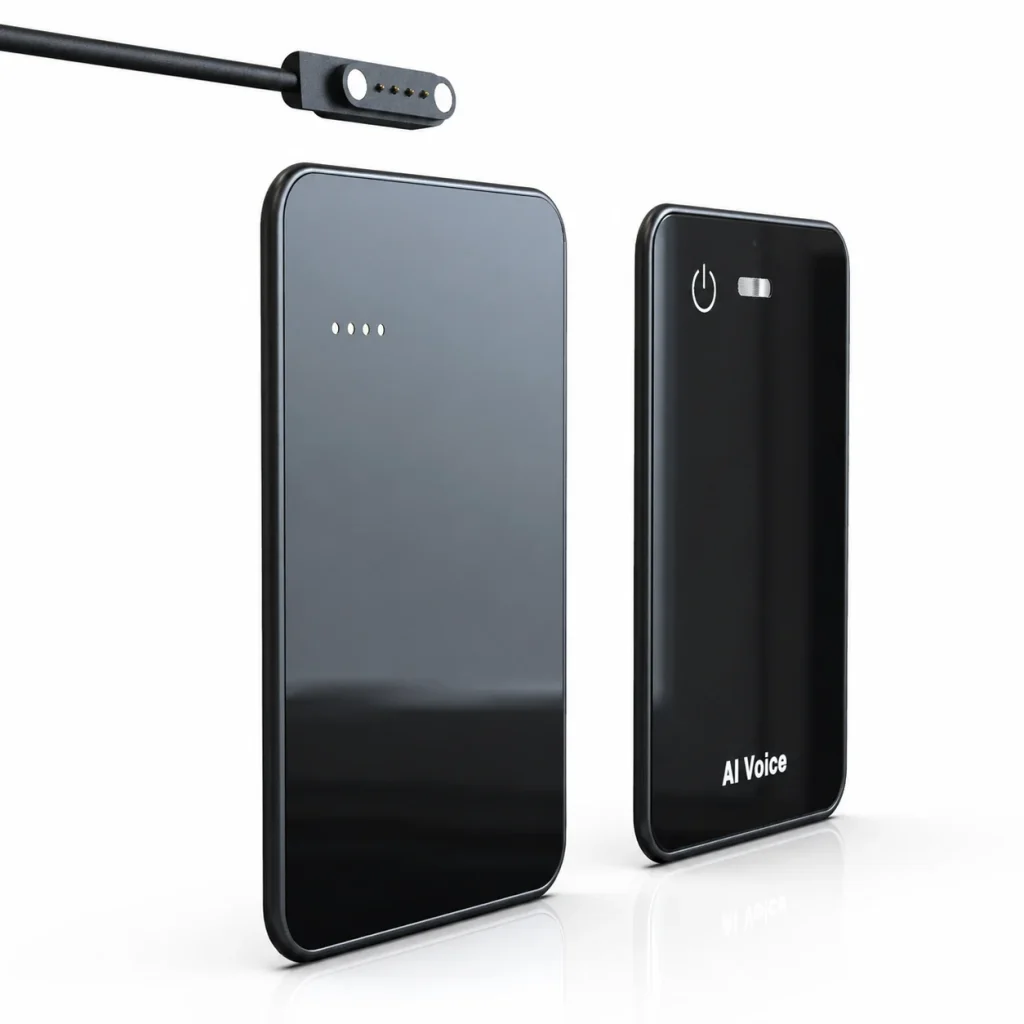
| MG6 AI Recording Card | Card-sized reference hardware for independent local WAV capture |
| Connected AI layer | Project-selected services for transcription, summaries, translation, or mind maps |
| Suitable interview task | Portable source-audio capture followed by an approved review workflow |
| Important boundary | Local recording does not prove that transcription or summarization runs offline |
The MG6 reference platform uses two omnidirectional microphones, offers local storage options from 8GB to 128GB, and records WAV files without requiring an active internet connection. Those facts define a starting configuration, not a promise of interview accuracy. The selected room, placement, speaker behavior, software, language, and service plan still need to be tested.
For the wider category architecture, see what an AI voice recorder is in a B2B workflow.
Start With the Editorial or Research Standard
Different interview teams have different output obligations. A journalist may need an exact quotation and defensible attribution. A qualitative researcher may need a searchable transcript linked to a participant code. A podcast producer may care about edit quality and release terms. A recruiter may need a restricted record that follows an approved retention policy.
For journalism, the source record is especially important. The Associated Press statement of news values and principles says quotations should not be taken out of context and that editing must not alter meaning. Poynter’s reporting accuracy guidance also recommends distinguishing information from quotations and checking facts during the interview when possible.
These standards lead to a practical buying rule:
A transcript may accelerate retrieval, but the source audio remains the reference when exact wording or context matters.
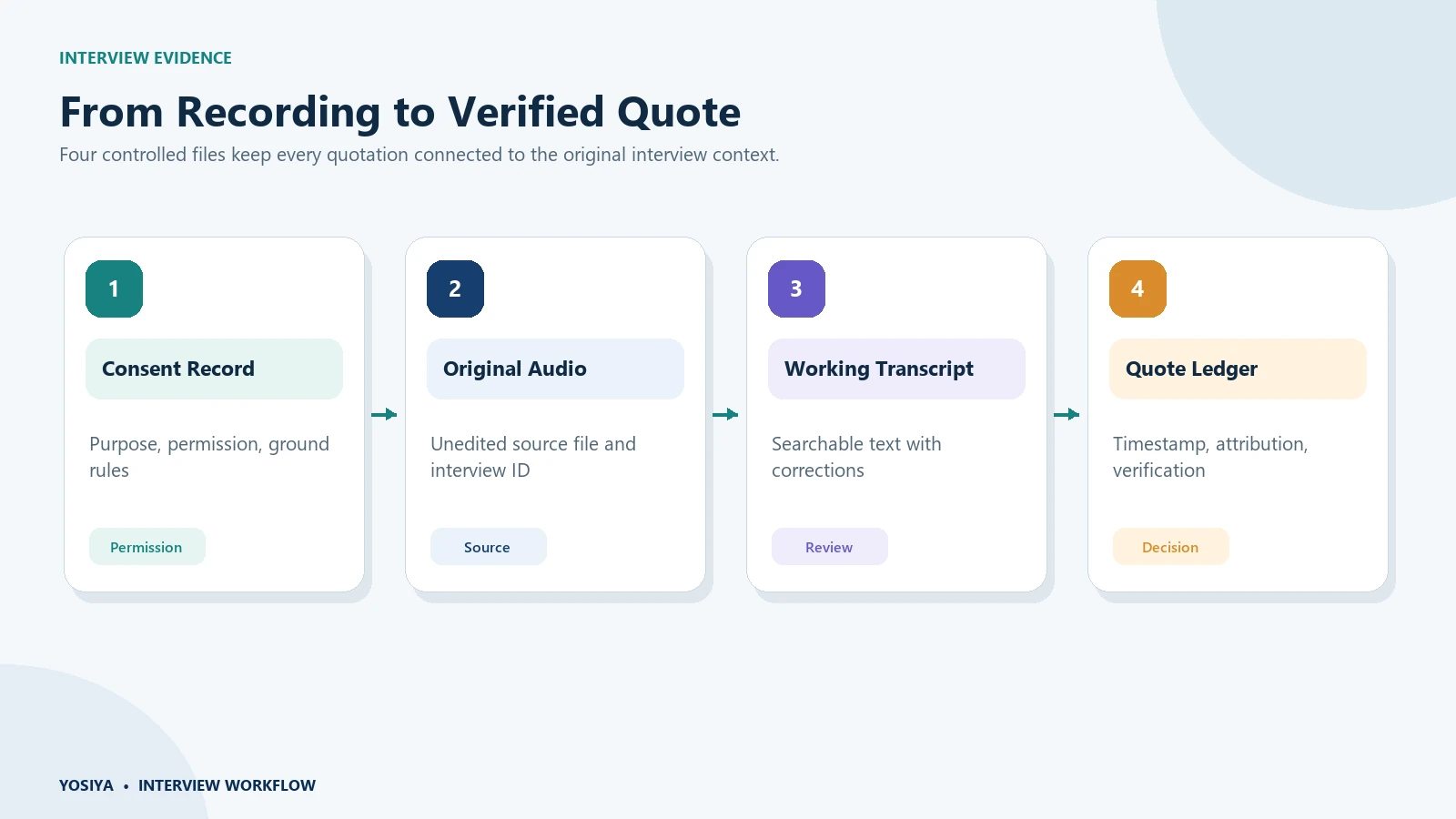
Build the Interview Around Four Evidence Files
One interview should produce a small, controlled evidence package rather than a loose collection of downloads.
- Consent or permission record: what the participant agreed to and any ground rules.
- Original audio: the unedited source file with a stable name.
- Working transcript: the machine or human transcript, including corrections.
- Quote or insight ledger: selected passages with timestamps, attribution status, and verification notes.
The file name can combine project, date, participant code, session number, and version. For example, launch-study_2026-08-04_p07_s01_audio.wav and launch-study_2026-08-04_p07_s01_transcript-v2.docx are easier to audit than recording_27.wav and final-final-notes.docx.
Placement Matters Before Transcription Begins
No transcription model can restore words that the recorder never captured clearly. Put the device where it can hear all speakers without being handled repeatedly, blocked by papers, or placed beside a laptop fan. Confirm the indicator is visible to the operator without making the participant feel monitored by a screen.
Shure’s conference-room placement guide emphasizes that room layout, materials, and the positions people actually use affect microphone planning. An interview buyer should translate that principle into sample tests:
- One interviewer and one participant across a normal table.
- A soft-spoken participant seated farther away.
- A three-person interview with natural overlap.
- A café, office HVAC, or trade-show noise sample at a documented level.
- A phone or remote participant played through the approved setup.
Take brief written notes even when recording. An introductory journalism guide from College of Western Idaho recommends asking permission before recording and keeping notes as a backup. Notes also preserve spelling, visual context, gestures, and moments that audio alone cannot explain.
Inspect the Source File Before Scoring the Transcript
When a sample arrives, do not open the AI summary first. Check whether the source file exists, plays from beginning to end, and can be exported without a proprietary player. Record its format, duration, size, timestamp behavior, and transfer path.
WAV can support a transparent source-audio workflow, but the label alone does not establish fidelity. Sample rate, bit depth, channel configuration, microphone placement, and room conditions all matter. Amazon Transcribe’s media guidance illustrates why input requirements must be explicit: batch and streaming transcription accept different formats, and lossless inputs such as FLAC or WAV are recommended for certain batch workflows.
A buyer should request the MG6 recording-format specification for the production version and run the same files through the proposed transcription service. Do not calculate storage hours until the actual recording parameters are confirmed.
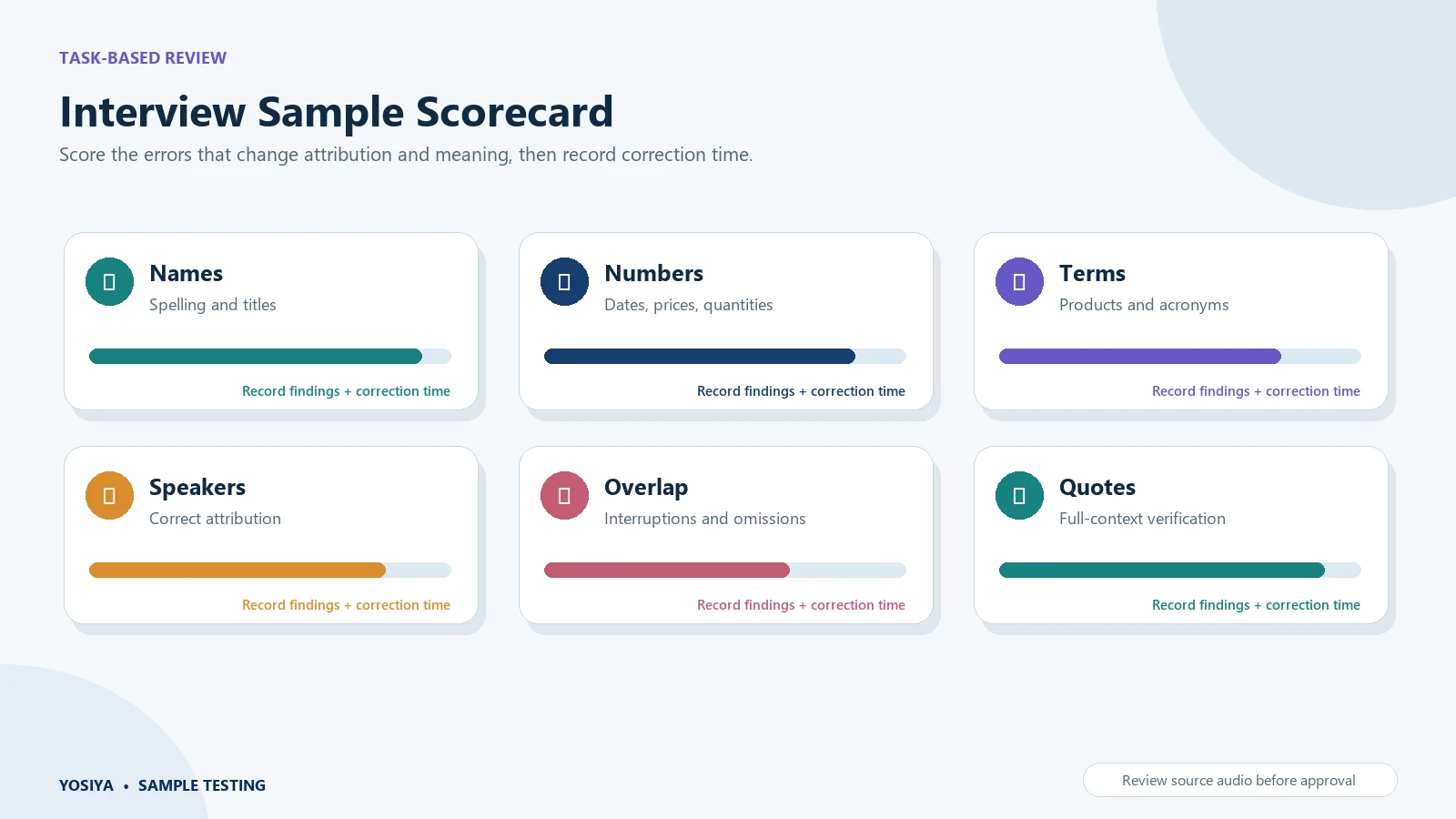
Score Transcription by Task, Not One Percentage
A general word-error score can hide the mistakes that damage an interview deliverable. Create a small task rubric instead.
| Test item | Why it matters | Review method |
|---|---|---|
| Names and job titles | Attribution can fail even when the sentence looks fluent | Compare against a prepared fact sheet |
| Numbers, dates, prices | Small errors can change the meaning | Mark every numeric token |
| Product and technical terms | General models may normalize unfamiliar vocabulary | Use a controlled term list |
| Speaker changes | Incorrect labels can assign a statement to the wrong person | Compare transitions with the audio |
| Overlap and interruption | Real interviews are not clean dictation | Note omissions and merged speech |
| Direct quotations | Published wording must remain faithful | Replay the full surrounding passage |
Measure correction time as well as raw errors. A transcript that looks polished but requires repeated audio searches may be less useful than a rougher transcript with reliable timestamps and easy playback.
The distinction between source audio and derived text is also covered in the AI meeting recorder hardware workflow.
Separate Recording, Transfer, and AI Responsibilities
Interview teams often buy a “recorder with transcription” as if it were one function. It is usually a chain owned by several components:
- Hardware captures and stores the audio.
- A phone, cable, magnetic connection, or application moves the file.
- An account controls access to a connected service.
- A transcription engine produces text.
- A reviewer corrects the record and approves quotations or findings.
- An archive policy determines retention and deletion.
For MG6 projects, buyers should confirm which application and AI service are included, supported languages, account ownership, usage allowance, export formats, data handling, and support responsibility. The device can record WAV locally; connected AI functions depend on the selected project scope.
Use a Matched Sample Test Before Buying
Test the shortlisted recorder, phone workflow, and any professional recorder under the same conditions. Use the same table, speaker positions, script, noise source, and review rubric. Keep every raw file.
The test should answer:
- Can the operator confirm recording status without opening an app?
- Can the original file be exported and backed up?
- Does the recording survive a low-battery, full-storage, or interrupted-transfer event?
- How long does a reviewer need to correct names, numbers, and selected quotations?
- Can the approved sample become a measurable production reference?
When Another Tool Is the Better Choice
A card-sized recorder is not the answer to every interview. A professional field recorder with external microphones may be more suitable when broadcast-grade audio, multiple tracks, long-distance pickup, or controlled gain is required. A phone may be sufficient for occasional low-risk interviews if its interruption, storage, and export behavior are acceptable. A meeting platform may be simpler for scheduled online interviews governed inside one account environment.
Compare these deployment models in AI note taker vs AI voice recorder before adding another device to the workflow.
FAQ
Can an interview recorder transcribe without internet?
Only if the selected device or connected application includes a verified on-device transcription engine. A recorder may capture audio offline while waiting for a later internet connection to transcribe it. Confirm both functions separately in airplane-mode testing.
Should an interview team keep the original audio?
Keep it when the organization’s permission, security, retention, and editorial or research policy allows. The original audio is useful for checking exact wording, speaker changes, tone, and disputed passages. Define a deletion date instead of retaining every file indefinitely.
How should direct quotations be checked?
Search the transcript to locate the passage, then replay enough surrounding audio to understand the complete statement. Verify names, attribution conditions, and whether editing or ellipses could change the speaker’s meaning.
Can two microphones guarantee clear multi-speaker interviews?
No. Microphone count does not prove room coverage or transcript quality. Test the actual device with representative distances, positions, voices, overlap, and background noise.
What should a buyer request from an OEM recorder supplier?
Request the versioned hardware specification, recording-format details, transfer workflow, application and AI-service scope, data-flow description, sample-test procedure, production acceptance criteria, warranty, and support responsibilities.
Choose Evidence Before Convenience
An interview recorder with transcription is valuable when it makes source audio easy to capture, find, verify, and govern. It becomes risky when a polished summary hides the original file, service dependency, or correction work.
Brands and interview teams can review the MG6 AI Recording Card and request a sample workflow. Use a representative interview script and preserve the resulting audio, transcript, and correction log before approving a deployment or OEM configuration.