An AI recorder for customer research interviews should support a traceable research process, not generate conclusions on its own. Its useful role is to capture a consented conversation, preserve the source audio, connect that audio to searchable text, and help researchers retrieve evidence during analysis. The research team still owns the protocol, participant protection, transcript review, coding decisions, synthesis, retention, and deletion. A suitable recorder is therefore one that fits the consent and data plan, works in the real interview environment, exports usable files, and makes every derived theme traceable to reviewed source material.
What Buyers Should Know
- Decide what will be recorded, why it is necessary, who can access it, and when it will be deleted before selecting hardware.
- Give every participant, session, audio file, transcript, and research note a stable code.
- Separate direct observations, participant statements, researcher interpretation, and AI-generated suggestions.
- Review transcripts against audio before coding quotations or high-impact claims.
- Test the complete capture-to-analysis workflow with representative interviews and data restrictions.
Where This Product Fits
| Entity | Research role |
|---|---|
| Yosiya | AI hardware and OEM/ODM solution provider |
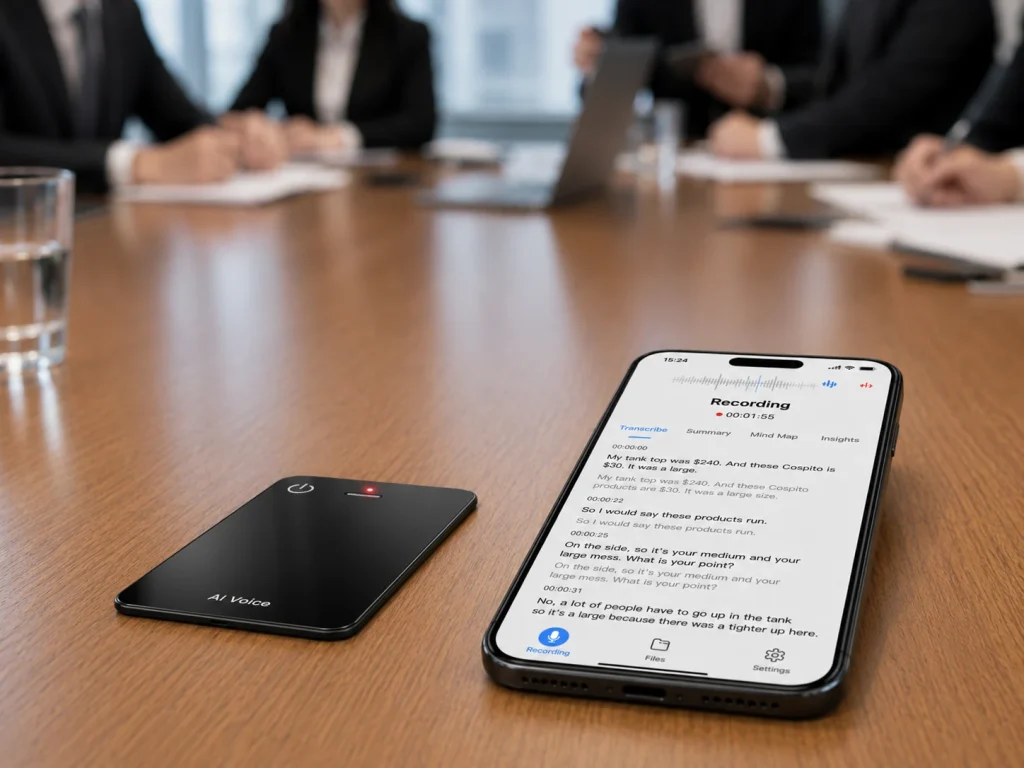
| MG6 AI Recording Card | Portable, card-sized hardware for local WAV recording |
| Research platform | The buyer’s approved repository, analysis tool, or secure workspace |
| Connected AI layer | Project-selected transcription and summary services |
| Boundary | MG6 can support evidence capture; it does not replace research judgment or automatically anonymize participants |
The reference MG6 platform offers two omnidirectional microphones, offline WAV recording, 8GB to 128GB storage options, and a card-sized format. Connected transcription, summaries, translation, and mind maps depend on the selected application and service scope. These capabilities should be evaluated as separate steps in the research data flow.
Design the Data Plan Before the Interview Guide
Customer research often begins with a discussion guide, but recording adds another design task: deciding what evidence the team truly needs. Audio can make an in-depth interview more reviewable, yet it can also capture names, employers, locations, health details, commercial information, or comments that were never necessary for the research question.
The U.S. Department of Health and Human Services describes informed consent as a process that includes disclosure, understanding, and voluntariness. The exact legal and organizational requirements depend on the project, but the operating principle is useful beyond regulated research: participants should understand the purpose, recording method, data use, access, retention, and their ability to stop.
GOV.UK user-research consent guidance provides a practical checklist that includes who is conducting the research, what data is collected, how results will be used, who receives it, how long it is kept, and whether a transcription provider processes the data.
Consent is not a sentence read after the recorder starts. It is a data agreement that the file workflow must be able to honor.
Create a Traceability Map for Every Session
Use identifiers that connect materials without putting a participant’s full identity in every filename.
| Artifact | Example identifier | Access expectation |
|---|---|---|
| Consent record | CR-R03-P07 | Restricted research operations access |
| Audio file | CR-R03-P07-S01.wav | Named researchers and approved processors |
| Reviewed transcript | CR-R03-P07-S01-T2 | Research team after redaction |
| Observation notes | CR-R03-P07-N1 | Research team |
| Coded excerpts | CR-R03-P07-C1 | Analysis workspace |
| Finding evidence | F12 → P07/P09/P14 | Traceable, appropriately de-identified summary |
The map should also record the recorder model, firmware or configuration, interviewer, date, room, transcription service, review status, and deletion date. If a participant withdraws, the team needs to locate every connected artifact rather than search across personal drives.
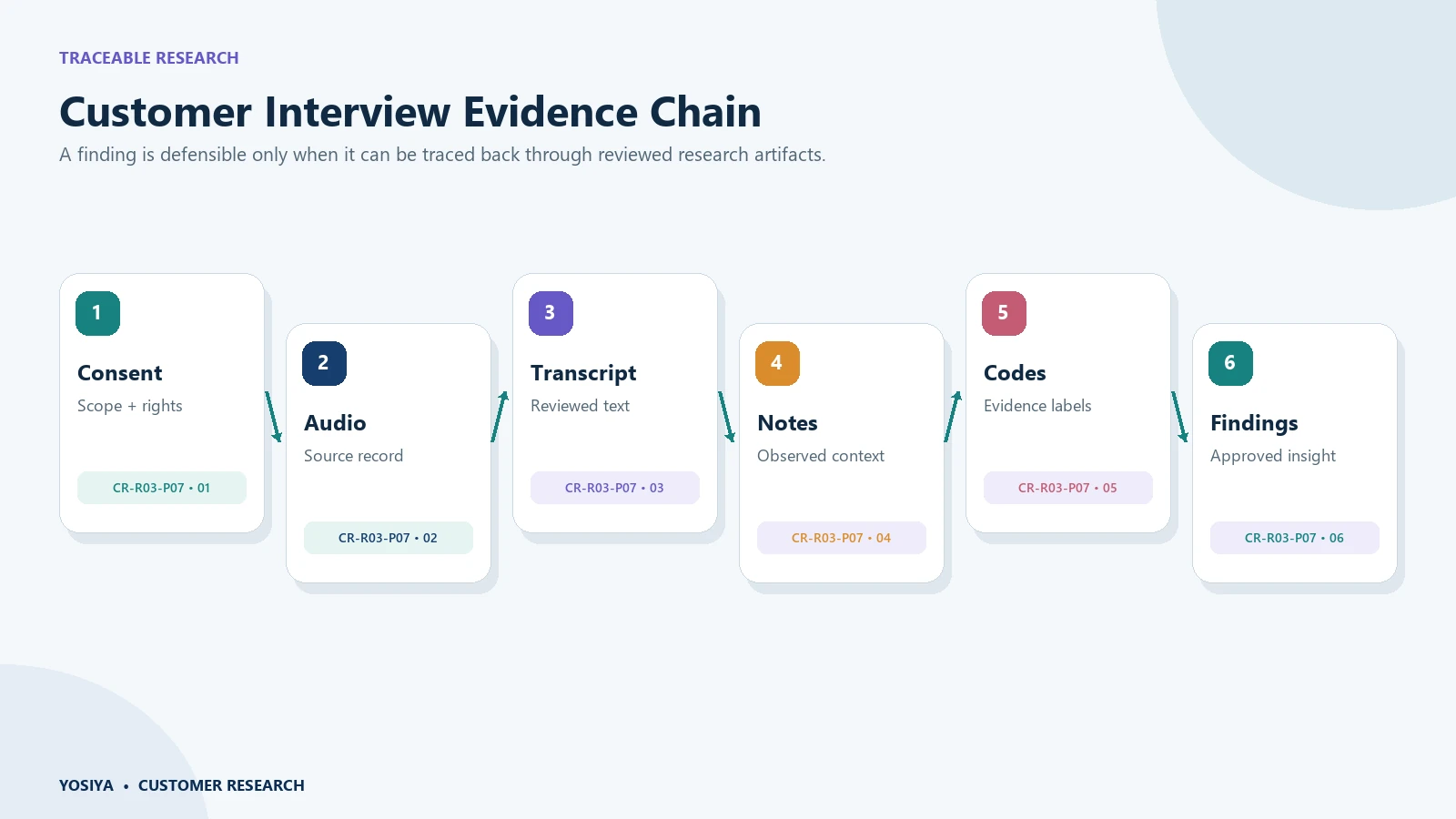
Keep Capture Separate From Interpretation
GOV.UK guidance on recording research sessions distinguishes observations from interpretations and recommends labeling notes with the participant and session number. It also notes that audio works well for in-depth interviews but may be less useful for sessions dominated by physical interaction.
That distinction suggests three working layers:
- Evidence layer: source audio, direct observations, and consent record.
- Representation layer: transcript, speaker labels, timestamps, and redactions.
- Interpretation layer: codes, themes, tensions, opportunities, and recommendations.
An AI summary belongs in the third layer as a suggestion to review. It should not silently replace the evidence or representation layers. If the summary says customers “prefer automation,” the researcher should be able to locate the supporting sessions, replay the relevant passages, check contrary evidence, and explain how the theme was constructed.
The broader in-person meeting recorder workflow helps teams map consent, placement, source files, review, and reuse before selecting a tool.
Use Audio and Notes Together
A recorder can free the moderator from writing every sentence, but it should not eliminate field notes. Notes capture body language, objects, task behavior, room interruptions, and the researcher’s immediate questions. They also provide a recovery path if recording fails.
The research team should mark:
- Moments that need follow-up during the session.
- Product screens, documents, or physical actions the audio cannot represent.
- Exact terms the participant uses repeatedly.
- Contradictions between stated preference and observed behavior.
- Sensitive details that may need removal from the transcript.
- Time ranges that deserve careful replay.
The UK Department for Education’s guidance for research with internal users recommends being specific about access to raw data and considering deletion of recordings after notes are complete. It also warns that voices and contextual details can make people identifiable even when names are removed.
Test the Recorder in Research Conditions
An attractive supplier demonstration does not show whether a device fits a study. Use a small pilot with the same type of room, participant positions, discussion length, terminology, and privacy constraints expected in the project.
Capture test
Place the recorder where all speakers can be heard without moving it during the session. Test soft speech, laughter, interruptions, paper handling, HVAC noise, and a participant who turns away from the table. Document the placement.
File test
Confirm that the raw file can be named, transferred, backed up, access-controlled, and deleted through the approved path. Check what remains on the device and phone after transfer.
Transcript test
Prepare a short truth set containing product names, acronyms, dates, and ambiguous phrases. Review omissions, invented wording, speaker changes, and correction time. If the selected service exposes confidence or timestamps, determine whether they help the researcher navigate evidence.
Failure test
Simulate low battery, insufficient storage, interrupted transfer, unavailable internet, expired service allowance, and a participant withdrawing consent. A workflow is not ready until the team knows how it behaves in each condition.
Choose the Right Transcript Level
Research teams do not always need full verbatim text. The appropriate level depends on the question.
| Research task | Useful record | Main caution |
|---|---|---|
| Exploratory interview | Reviewed intelligent-verbatim transcript plus audio | Do not turn early themes into final conclusions |
| Usability task | Observations, timestamps, screen evidence, selected transcript | Audio alone misses interaction behavior |
| Concept reaction | Direct quotations and structured notes | Preserve context around strong reactions |
| Sensitive discovery | Minimal necessary recording and restricted transcript | Collecting less may be safer than better redaction later |
| Longitudinal research | Stable identifiers and versioned summaries | Retention and withdrawal must work across rounds |
The recording guide from GOV.UK distinguishes full verbatim, intelligent verbatim, and summary outputs. Buyers should specify which output the research team needs instead of accepting whatever an AI service labels “notes.”
Evaluate AI Across Interviews Carefully
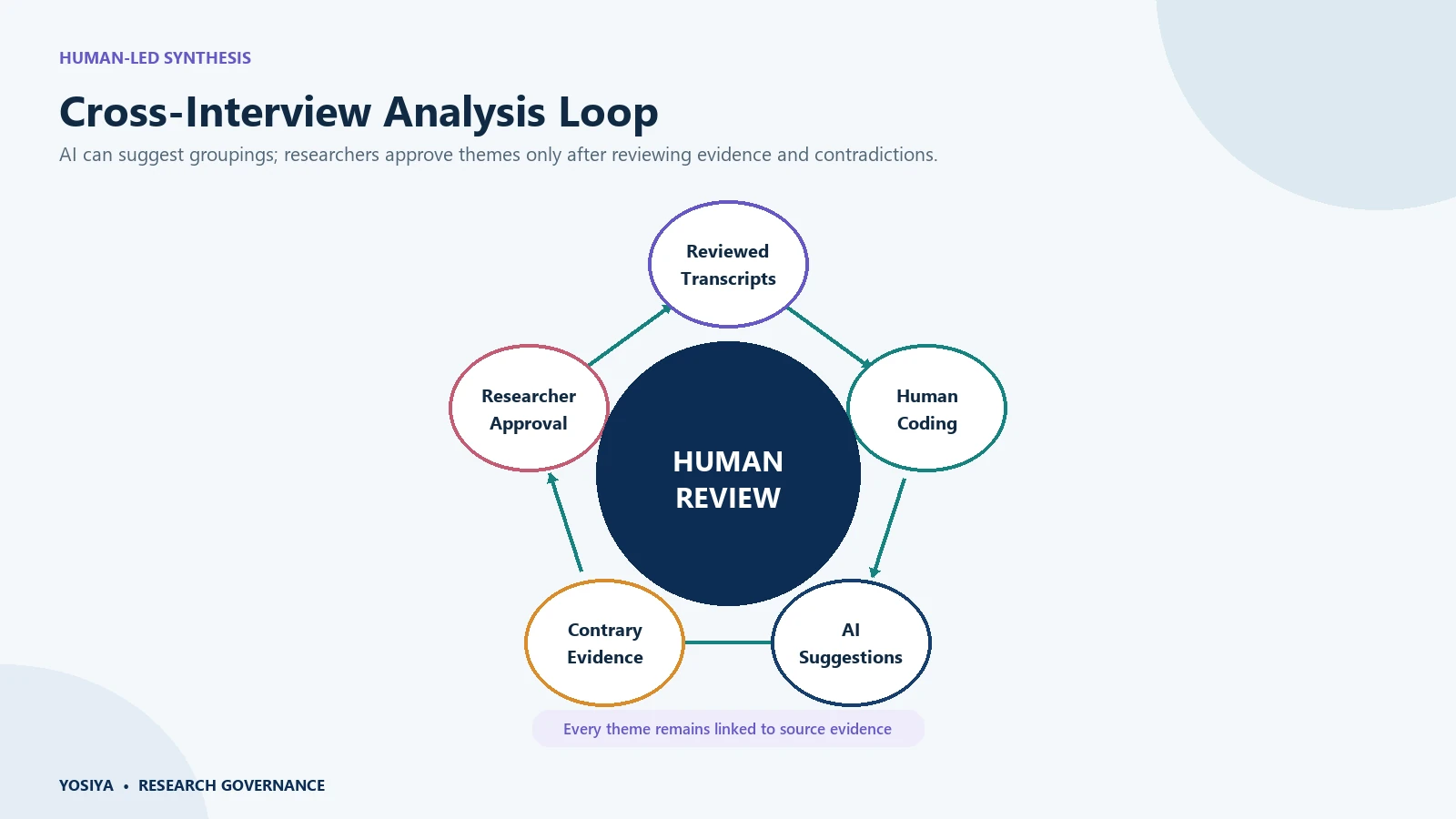
Cross-interview synthesis is where AI assistance can become tempting and risky. A model can cluster similar language while missing sarcasm, research context, nonverbal behavior, or a minority experience that matters more than frequency.
Use a controlled process:
- Review each transcript and redact unnecessary identifiers.
- Attach session and timestamp references to every selected excerpt.
- Create an initial human coding frame from the research questions.
- Let AI suggest possible groupings without treating them as findings.
- Compare themes against disconfirming evidence and participant diversity.
- Record which researcher accepted, changed, or rejected each important synthesis.
This is also where service architecture matters. Amazon Transcribe documentation shows that a cloud transcription workflow can receive media from an S3 bucket or stream and return structured text output. A buyer should ask equivalent questions of any service: where input is stored, where output is written, who grants access, what metadata is produced, and when content is deleted.
Procurement Questions for a Research Team
Before approving hardware or an OEM configuration, ask:
- Can the device record independently when the phone or network is unavailable?
- What exact file format and parameters apply to the production version?
- Which application, account, and AI service handle transfer and transcription?
- Can the buyer export original audio and corrected transcripts?
- Who can access audio, derived text, summaries, and service logs?
- Can a participant’s materials be found and deleted across every layer?
- What changes when the AI plan, application version, or service provider changes?
- Which pilot results become production acceptance criteria?
For a category-level comparison of software and dedicated hardware, read AI note taker vs AI voice recorder.
FAQ
Can an AI recorder replace a research note-taker?
No. It can reduce the burden of capturing exact speech, but a human still needs to observe behavior, manage consent, ask follow-up questions, note context, and distinguish evidence from interpretation.
Should customer research interviews always be recorded?
No. Record only when the research purpose, participant agreement, organizational policy, and data protections justify it. For some sensitive or highly interactive sessions, structured notes may be the better choice.
How should participant audio files be named?
Use a stable project, round, participant, session, and version code without unnecessary personal details. Keep the identity key separate and access-controlled when re-identification is required.
Can an AI summary be used as a research finding?
Not without review. Treat it as a hypothesis or navigation aid. A finding should remain traceable to reviewed evidence across relevant participants, including evidence that challenges the theme.
What should a research team test in an MG6 sample?
Test representative rooms, participant positions, source-file export, transfer, selected transcription service, redaction workflow, correction time, access controls, failure recovery, and deletion procedures.
Preserve the Chain From Voice to Decision
An AI recorder for customer research interviews is useful when it strengthens evidence capture without weakening participant control or researcher judgment. The final buying decision should be based on a piloted data flow, not a polished sample summary.
Research teams and hardware brands can review the MG6 AI Recording Card and request a research-interview sample. Define the consent, naming, transfer, review, retention, and deletion process before deciding which connected AI services belong in the project.