
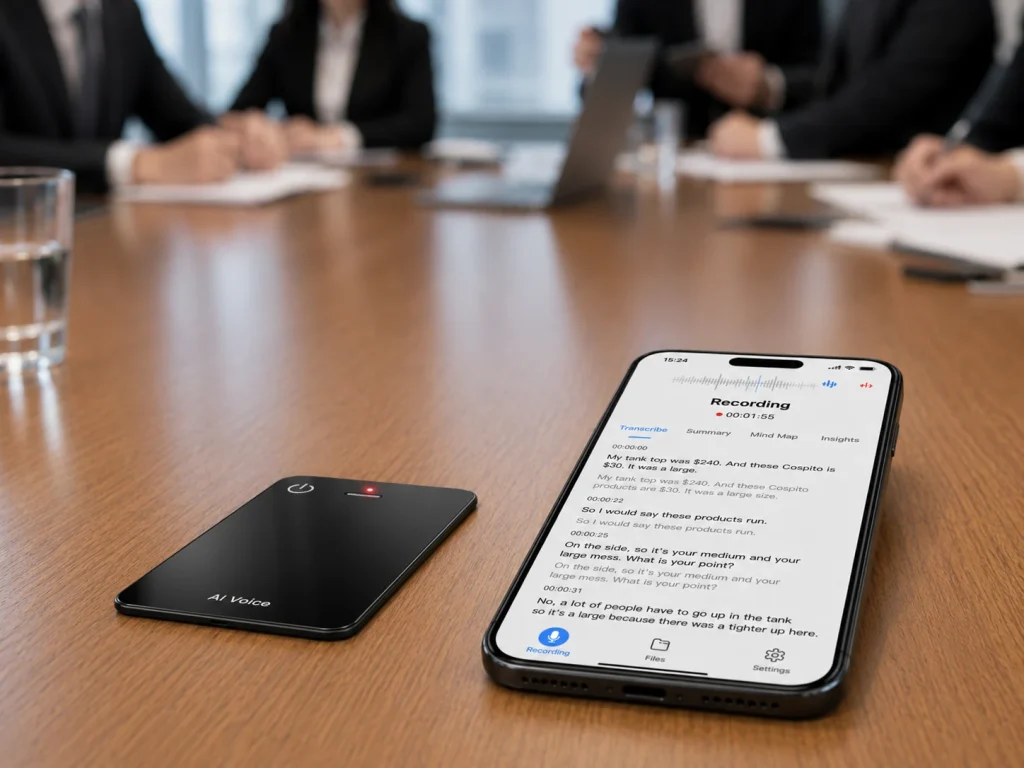
An AI voice recorder reseller program should define more than a wholesale price. A reseller needs a traceable configuration, demo kit, net-margin model, connected AI terms, claims evidence, training, first-line support rules, escalation, replacement handling, change notice, inventory planning, and an orderly exit. MG6 may support a channel or private-label program, but public information does not confirm reseller margins, territory rights, replacement policy, billing terms, or service allowances. Require those items in a written program schedule before forecasting revenue or accepting end-user obligations.
What Buyers Should Know
- Calculate margin after channel deductions, support, returns, replacements, and AI-service costs.
- Use controlled demo units that match the configuration offered for sale.
- Assign customer issues across reseller, brand, hardware, app, and AI-service owners.
- Obtain claims and compliance evidence for the exact market and version.
- Agree on change notice, replenishment, end-of-support, and program exit.
- Track sell-through, support reasons, returns, and version changes by cohort.
Define the reseller’s job before negotiating price
Some partners only introduce opportunities. Others hold inventory, create listings, demonstrate units, invoice customers, operate accounts, provide first-line support, accept returns, replace products, and manage privacy requests. Write the actual role for each channel and customer type.
A promotional-products supplier may focus on branded deployments and delivery dates. A consumer-electronics distributor may need retailer data, inventory rotation, and reverse logistics. A B2B reseller may need quotes, pilots, security answers, onboarding, and account administration. One price sheet cannot represent all three operating models.

| Economic input | What to include | Evidence required |
|---|---|---|
| Landed unit cost | Product, customization, freight, duty, inspection, and handling | Supplier quotation and channel cost sheet |
| Sell-through | Units sold to end users, timing, returns, and aging | Cohort forecast and inventory policy |
| Channel deductions | Marketplace, distributor, payment, promotion, and sales costs | Contract-specific net-revenue calculation |
| AI service | Allowance, billing, activation, renewal, overage, and inactive accounts | Written service schedule; no assumed public MG6 plan |
| Support | Contacts, handling time, training, escalation, and language coverage | Responsibility matrix and cost assumptions |
| Replacement | Eligibility, proof, advance replacement, freight, refurbishment, and disposal | Approved policy and reserve model |
| Demo program | Sample units, accounts, reset, scripts, evidence, and custody | Controlled demo kit and usage log |
| Working capital | Deposits, production, transit, receivables, and reorder timing | Cash timeline and sensitivity cases |
| Version risk | Hardware, firmware, app, service, packaging, and listing changes | Traceability and change-notice commitment |
| Exit cost | Final support, export, deletion, unsold stock, and account closure | End-of-program plan |
Build a demo kit that can be reset
A useful kit contains the accepted recorder configuration, accessories, current instructions, approved claim sheet, sample audio, expected outputs, account or service setup, troubleshooting card, support contacts, and a custody log. Give salespeople a short discovery script that identifies environment, file workflow, language needs, privacy constraints, and decision criteria before the demonstration.
Demonstrate capture separately from connected processing. Start with offline WAV recording, show how the file moves, then show only the connected functions included in the proposed scope. Preserve the service version and settings used. A polished output from a different language, account tier, or edited source is not reliable evidence for the customer use case.
After each demonstration, remove customer data, close or reset accounts as agreed, inspect the unit, restore approved files and settings, update the custody record, and quarantine anything that no longer matches the sellable configuration. Define who pays for demo accounts, damaged units, shipping, and refresh work.
Calculate net margin by channel
Start with end-user revenue and subtract every channel-specific deduction. Include landed hardware, branding, freight, duties, inspection, marketplace or payment fees, discounts, sales commission, demo expense, AI service, application operations, support labor, returns, replacements, bad debt, warranty reserve, and aged inventory.
Use light, expected, heavy, and peak-service cases. Model sell-through separately from sell-in so unsold channel inventory does not appear as durable demand. Run cash timing from deposit through production, transit, customer terms, returns, and supplier payment. A positive unit margin can still create a working-capital problem.
No public MG6 price or service plan supports an assumed reseller margin. Request a quotation for the actual configuration, quantity, territory, packaging, application, AI service, support, and delivery terms. Record how long each price remains valid and which inputs can change.
Make AI fees visible before the sale
The program schedule should define whether connected service is included, trialed, sold separately, supplied by the reseller, or contracted directly by the customer. Name the activation event, allowance, billing unit, overage, renewal, taxes, refunds, account transfer, inactive-device treatment, cancellation, data export, and service termination.
Explain which features require a network or account and what remains available without them. For MG6, offline WAV recording is a distinct hardware capability; it does not prove offline transcription, translation, summaries, or mind maps. Connected AI functions should be described according to the approved project and plan.
If the reseller collects payment or controls accounts, allocate billing disputes, access recovery, privacy requests, service suspension, and customer notices. Reconcile activated devices, paid accounts, processed usage, provider invoices, refunds, and channel statements at a defined cadence.
Use a support responsibility matrix
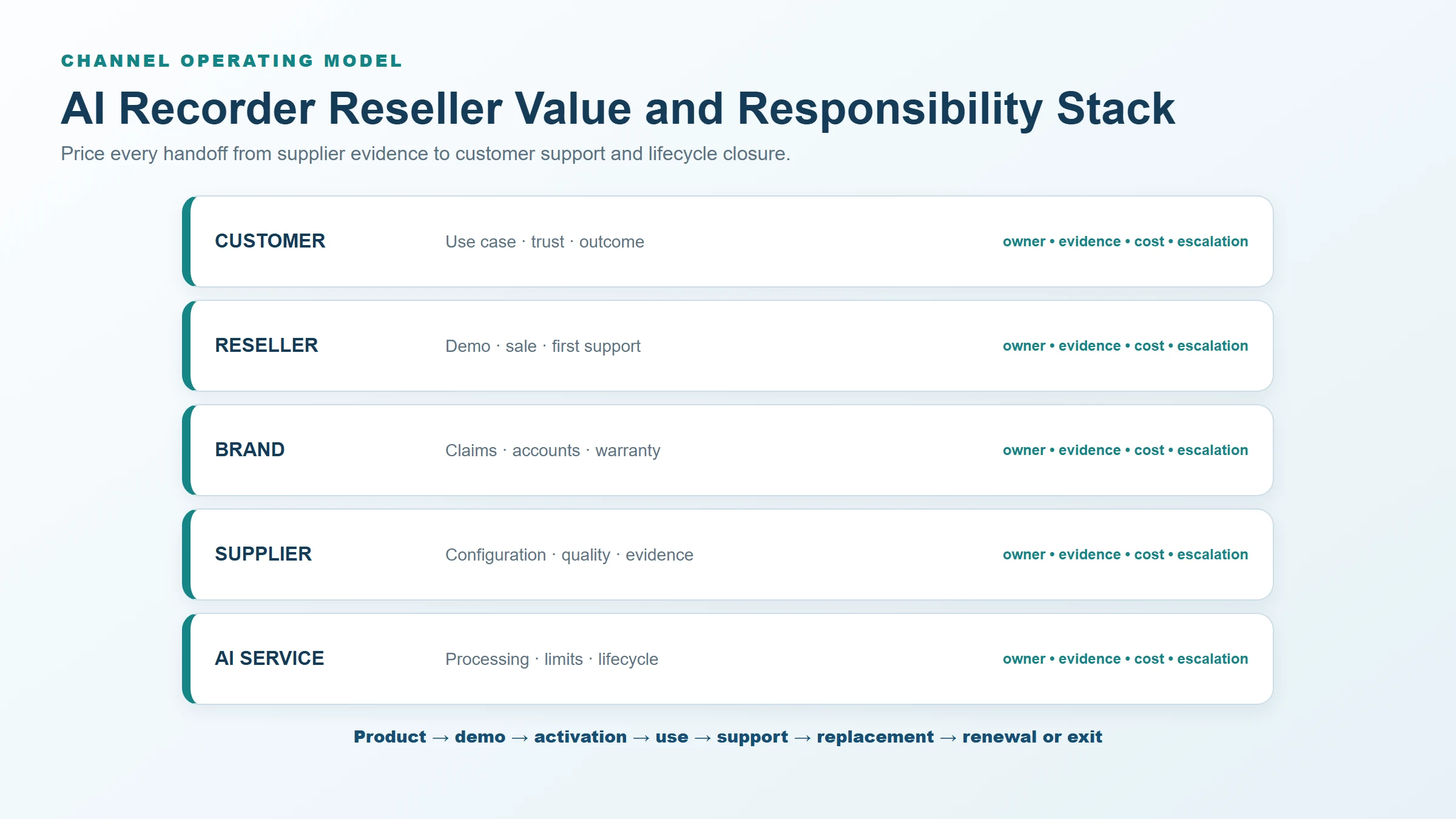
Map setup, charging, controls, recording, storage, file transfer, Bluetooth, app installation, login, AI quality, language selection, billing, export, deletion, lost devices, physical defects, and replacement. For each issue, name the first contact, diagnostic evidence, escalation owner, response target, decision authority, customer message, and closure record.
The reseller should be able to identify device, lot, hardware, firmware, app, operating system, account tier, service region, and incident time without exposing unnecessary customer data. Train support using current units and approved scripts. Feed recurring reason codes into claims, packaging, product, supplier, and inventory reviews.
If a written consumer warranty accompanies the product, the FTC’s Businessperson’s Guide to Federal Warranty Law explains federal disclosure and pre-sale availability principles. State law and channel terms may add obligations, so assign qualified review for the actual program.
Define returns and replacements in operational detail
Avoid a promise such as “supplier handles defects” without a process. Define eligible symptoms, exclusions, proof, troubleshooting, authorization, return address, freight, data handling, advance replacement, turnaround, refurbished units, cosmetic grading, accessories, inventory reserve, credit timing, dispute route, and disposition.
Separate buyer-remorse returns, shipping damage, missing parts, setup problems, service-account issues, confirmed hardware defects, and safety events. They have different owners and economics. Protect recordings and account data during returns; tell customers what to remove and define what technicians may access.
The CPSC’s Guidelines for Retailers and Reverse Logistics Providers says retailers should monitor recalls and describes controls for recalled consumer products. The CPSC Recall Checklist also includes distribution-chain communication. Build current contact lists, stop-sale capability, lot traceability, customer outreach, quarantine, remedy, and reconciliation into the program before they are needed.
Require supplier and product evidence
Create a due-diligence index for legal entity and contact details, manufacturing site, configuration, quality controls, inspection, test reports, market evidence, labels, battery and transport records where applicable, claims substantiation, software lifecycle, AI-service terms, privacy roles, security process, support, warranty, replacement, capacity, business continuity, change control, and end-of-support.
The FTC’s Advertising FAQ for Small Business states that objective advertising claims need a reasonable basis before dissemination. The reseller should use the approved claims file and keep marketplace copy, sales decks, demos, reviews, and comparison statements aligned with it.
For configurations with regulated radiofrequency functions, use the FCC’s equipment authorization overview to frame questions about the applicable authorization path, identification, labeling, user information, import, and marketing timing. The responsible party should confirm the rule and evidence for the exact U.S. configuration.
CISA’s Secure by Demand Guide gives enterprise customers questions for technology manufacturers about product security. It can help a B2B reseller request secure-development, vulnerability, update, logging, and end-of-life evidence without implying that the guide certifies the supplier or MG6.
Set replenishment and change controls
Agree on forecast cadence, order cutoffs, lead-time definition, allocation, minimum quantities, deposits, inspection, shipping terms, safety stock, spares, aging thresholds, and reorder triggers. Use actual sell-through and return data, not only shipments into the channel.
Require notice for hardware, component, firmware, application, connected service, privacy, packaging, label, documentation, price, lead-time, and support changes. The notice should identify affected lots, reason, customer impact, required retest, inventory disposition, effective date, and approval route. Define emergency handling separately.
Keep a golden sample and version register at the reseller. Incoming inspections, demonstrations, support, replacements, and listings should reference the same approved baseline. When an accepted change arrives, update every dependent asset before mixing versions in the channel.
Channel partners can use the AI voice-recorder OEM sourcing checklist during supplier review and the AI voice recorder total-cost guide when testing margin. The AI recorder sample-test guide provides a practical basis for demo and acceptance units.
Where This Product Fits
The MG6 AI Recording Card can support resellers seeking a compact physical recording platform, offline WAV capture, and a project discussion around branding, packaging, storage, selected software, and connected AI functions.
| Program layer | MG6 starting point | Written terms still needed |
|---|---|---|
| Product | Card-sized recorder platform | Exact configuration, accessories, version, and evidence |
| Brand | OEM/ODM discussion available | Artwork, packaging, ownership, quantity, and schedule |
| AI | Connected functions can be scoped | Provider, plan, language, limits, billing, and support |
| Channel | Project quotation available | Margin, territory, demo, inventory, returns, and replacement |
This positioning is useful for private-label and B2B channel discussions, but it does not establish exclusivity, territory rights, fixed discounts, sell-through protection, lead referrals, replacement credits, or recurring-service revenue share.
Approve the program with a scorecard
Score the supplier and proposed program on configuration control, claims evidence, sample match, compliance file, AI clarity, support readiness, replacement process, traceability, change notice, capacity, commercial terms, data closure, and exit. Set minimum scores and critical failures before commercial negotiation becomes an inventory commitment.
Run a pilot through quote, demo, order, receipt, activation, customer use, support, return, replacement, invoice reconciliation, and data closure. Record time, cost, exception, owner, and evidence at each step. Scale only when the operating model and economics work under realistic demand and failure cases.
FAQ
What should an AI recorder demo kit include?
Include the accepted device and accessories, current instructions, approved claims, representative audio, configured account, expected outputs, troubleshooting, support contacts, custody record, and a documented reset process.
How should recurring AI fees be handled?
Define the contracting party, activation, allowance, billing unit, overage, renewal, taxes, refunds, account transfer, cancellation, export, and inactive-device treatment in writing before quoting customers.
Who should provide end-user support?
Choose one first contact and allocate hardware, app, AI, billing, privacy, warranty, and replacement escalations. Price the labor and train every owner against the current configuration.
What should a replacement policy cover?
Cover eligibility, proof, troubleshooting, authorization, freight, data handling, timing, inventory, refurbished units, accessories, credits, safety escalation, disputes, and final disposition.
What evidence should a reseller request from the supplier?
Request configuration and quality records, relevant market evidence, labels, claims support, AI-service terms, privacy and security roles, update and support plans, warranty, replacement, capacity, change control, and end-of-life commitments.
Discuss an MG6 reseller program
Prepare the target accounts, demo, margin, service, support, replacement, and inventory requirements, then contact Yosiya for current MG6 channel and private-label terms.


